English is a melting pot of indo-european
languages
Celtic Latin German
French
History of English Language
 400 A.D. to 1066 - Old English (OE)
dates
 1066-1485 - Middle English (ME)
Distinction:
 Old English is nearly impossible to
read or understand without studying it
much
They are different to the eye and ear.
 Middle English speaker would study
Old English
 Old English is also known as SAXON
 The principle invading Germanic Tribes
were the ANGLES, SAXONS, JUTES,
and FRISIANS
 Anglo- Saxon dialects developed into
Old English
 The most commonly used words today
derive from those early Anglo- Saxon
roots
 Later the language was influenced by
the French speaking NORMAN
ANGLO-SAXON ALPHABET
pronunciations
Old English Modern English
Scip ship
Fisc fish
Cild child
Cyning king
Overview of Periods of Early
English History
Pre-History—1066 A. D.
1. Pre-Roman/Pre-Historical  55
BC
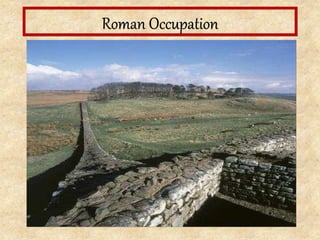
2. Roman Occupation  55 BC –
410 AD
3. Anglo-Saxon Period  410 –
Pre-Historical / Pre-Roman
Roman Occupation
The Conquest of Briton
 Between 800 – 600
B.C.: Celts
 55 B.C.: Romans
 About 407 A. D.:
Anglo-Saxons/
Jutes
Celts
Nature-Lover , Peace loving, Skilled
craftsmen of iron, Animism
"spirit” in rivers & rocks, War-like
Druids - Priests
Demanded total dedication
Mistletoe (sacred) and oak
Voluntary human sacrifice
Use of stones in worship
CELTIC LEGENDS
 King Arthur- celtic warrior
 Filled with strong women
 Tall, fierce, beautiful
 Bloody
 Magical
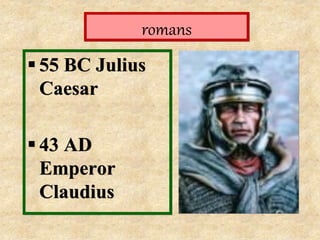
romans
 55 BC Julius
Caesar
 43 AD
Emperor
Claudius
Romans
 Conquered
celts
 Established
cities
 Organized law
 Roadways
 Roman baths
romans
 61 ad queen Boadecia
 Queen of a briton Tribe
 Killed 70,000 Romans
 409 Romans withdrew from
Britain leaving no central
gov’t.
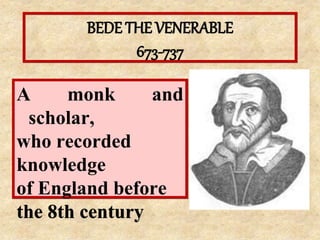
BEDE THE VENERABLE
673-737
A monk and
scholar,
who recorded
knowledge
of England before
the 8th century
ANGLO-SAXON
449-1066AD
Angles
Angles
 Germanic
 Migrated from
Germany 5th
Century
That land was
later called as
“Anglo-land”
now England
saxons  Large and powerful
Germanic people
from Northwestern
German and the
Eastern Netherlands
 invaded Britain in
the early Middle
Ages, giving their
names to the
kingdoms of Essex,
Sussex and Wessex
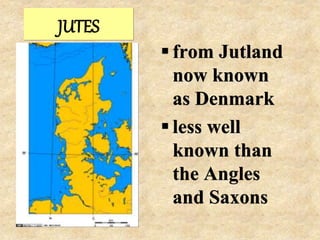
JUTES
 from Jutland
now known
as Denmark
 less well
known than
the Angles
and Saxons
Anglo-saxons
7 KINGDOMS
OF THE
ANGLO
SAXONS
Anglo-Saxons
 Blond-haired, blue-eyed
 Fair, sturdy
 Loved nature and the sea
 Sense of honor
 Generous: Love to eat and
drink
 Loved glory of battle
 Braggarts
Anglo-Saxon Society
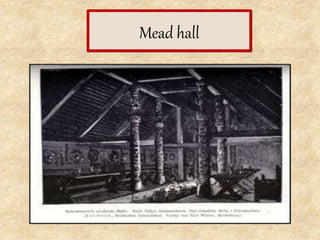
 Mead hall (communal hall)
 Mead - potent drink made from honey
 Women as decorative element of the
society
 Scops told stories/riddles in the halls
 King received power from gods (Woden)
 Government system is democratic
 Justice System: “Eye for eye a Tooth for a
Tooth”
 Pagan religion / mixed with Christianity
later
Mead hall
Pagan gods
 Woden - Wednesday
 Fria - Friday; goddess of love
 Tui - Tuesday; god of war
 Thor - Thursday; god of thunder
 Eostre - goddess of dawn and new
life
 Wyrd - god of fate
Hierarchal system
KING
Power from Gods
EARL
ATHELING
Young Males
NOBLES
THANES
FREEMAN
CHURL
THANES
 LIKE MEDIEVAL
KNIGHTS
 SWORN TO
PROTECT KING
 FOUGHT FOR
GLORY, FAME, &
HONOR
WERGILD (WIERGILD)
“MANPRICE”
VICTIM’S RELATIVES
WOULD SEEK REVENGE
IN FORM OF WERGILD.
FAILURE TO DO SO
WOULD KEEP FAMILY
FROM EVER BEING ABLE
TO SATISFY THEIR GRIEF
wiergild
Wiergild system
The value of the life of every Anglo-
Saxon (Germanic and Scandinavian)
was based on his rank.
e.g. The life of a churl was worth two
hundred shillings; that of a thane ... six
times as much, and the price to be paid
for injury, like the loss of a hand or a leg,
was calculated in proportion."
treasures
scops
Old English poetry was
meant to be read/sung
aloud before an
audience.
The Scop, would
entertain with tales of
past deeds, battles of
old and history was
kept alive for the Anglo-
Saxons
The scop was a master
of his art, can recite
thousands of lines from
memory (the epic
Beowulf has 3182 lines)
Some more experienced
scops would add to the
stories as they were told
Christianity
 Arrived in Britain in the 6th Century -
St. Augustine
 Converted population in the 9th
Century when most Britons were
Christian
 Latin introduced to Anglo Saxons who
integrated Old English with Latin
Vocabulary
 Centers for learning
 Preservation of manuscripts
 871 alfred the Great unified
tribes
 1066 norman french invasion
 King Harold vs William, the
conqueror
The site of sutton hoo
1930’S the site of the grave was on the
land of Edith. She was convinced the
site contained treasure. She had a
dream in which she saw an ancient
funeral procession
The graves of a warrior and his
horse were found in one of the
smaller mounds
Anglo-saxon literature
 Oral
Tradition
 Beowulf
 Epic
 Latin
Characteristics of anglo-saxon poetry
 Love of freedom
 Responsiveness
to nature
 Devotion to glory
as ruling motive
in warriors’ lives
 Brooding
melancholy
The epic
 Narrative poem
 Gives“biography”
of great hero
 Based on myth
and tradition
 Sung by the
minstrels
epic
 Long, majestic
narrative poem
 Legendary or
historical events
 Ideals of an entire
nation at a critical
point of its history;
gratifies national
pride
CHARACTERISTICS OF EPIC
 Supernatural forces
 Conflict in form of
combat
 Stylistic
conventions
 Characters experience
universal emotions
 Hero is demigod
 Begins in media res
 Contains good vs evil battle
 Exaggeration and superlatives
CHARACTERISTICS OF EPIC
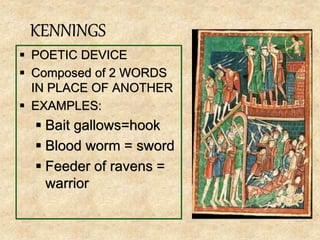
KENNINGS
 POETIC DEVICE
 Composed of 2 WORDS
IN PLACE OF ANOTHER
 EXAMPLES:
 Bait gallows=hook
 Blood worm = sword
 Feeder of ravens =
warrior
Epic hero
 Represents a whole culture
 Universal aspects of human condition
 Embodies qualities of human greatness
 Exists for the sake of community and
protect community from evil
 Larger than life
 Shows proof of victory
 Boasts of prowess
 Acclaimed after death
End of anglo-saxon period
 Norman French
Invasion 1066
Beowulf
beowulf
 Anglo-Saxon epic
poem
 Dates from late 10th
century
 Considered work of
anonymous 8th-
century poet
(English monk)
 Fuses Scandinavian
history and pagan
mythology
 It is neither about Englishmen nor
Christians
It is about several Scandinavian people
(tribes), mainly the Geats and the Danes,
but also the Swedes.
It was written down, in the kingdom of
Mercia (East Central England today) at
around 700 AD
 The plot is in Geatland and Denmark (the
island of Zealand and in Southern Sweden) .
. . Or more generally, in the Baltic region of
beowulf
The scary pLOT
Beowulf takes place in a “once upon a time
world” and that it taps into “three archetypal
sites of fear”:
 The barricaded night house (Grendel)
 The infested underwater current
(Grendel’s mother)
 Reptile-haunted rocks of a wilderness
(dragon)
 A murky lake
 The dark recesses of the earth
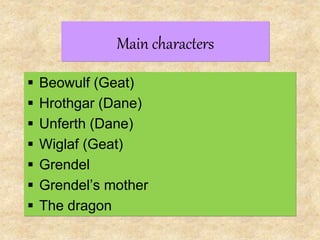
Main characters
 Beowulf (Geat)
 Hrothgar (Dane)
 Unferth (Dane)
 Wiglaf (Geat)
 Grendel
 Grendel’s mother
 The dragon

ANGLO-SAXON.ppt

  • 1.
    English is amelting pot of indo-european languages Celtic Latin German French
  • 2.
    History of EnglishLanguage  400 A.D. to 1066 - Old English (OE) dates  1066-1485 - Middle English (ME) Distinction:  Old English is nearly impossible to read or understand without studying it much They are different to the eye and ear.  Middle English speaker would study
  • 3.
    Old English  OldEnglish is also known as SAXON  The principle invading Germanic Tribes were the ANGLES, SAXONS, JUTES, and FRISIANS  Anglo- Saxon dialects developed into Old English  The most commonly used words today derive from those early Anglo- Saxon roots  Later the language was influenced by the French speaking NORMAN
  • 4.
  • 5.
    pronunciations Old English ModernEnglish Scip ship Fisc fish Cild child Cyning king
  • 6.
    Overview of Periodsof Early English History Pre-History—1066 A. D. 1. Pre-Roman/Pre-Historical  55 BC 2. Roman Occupation  55 BC – 410 AD 3. Anglo-Saxon Period  410 –
  • 7.
  • 8.
  • 9.
    The Conquest ofBriton  Between 800 – 600 B.C.: Celts  55 B.C.: Romans  About 407 A. D.: Anglo-Saxons/ Jutes
  • 10.
    Celts Nature-Lover , Peaceloving, Skilled craftsmen of iron, Animism "spirit” in rivers & rocks, War-like Druids - Priests Demanded total dedication Mistletoe (sacred) and oak Voluntary human sacrifice Use of stones in worship
  • 11.
    CELTIC LEGENDS  KingArthur- celtic warrior  Filled with strong women  Tall, fierce, beautiful  Bloody  Magical
  • 12.
    romans  55 BCJulius Caesar  43 AD Emperor Claudius
  • 13.
    Romans  Conquered celts  Established cities Organized law  Roadways  Roman baths romans
  • 14.
     61 adqueen Boadecia  Queen of a briton Tribe  Killed 70,000 Romans  409 Romans withdrew from Britain leaving no central gov’t.
  • 15.
    BEDE THE VENERABLE 673-737 Amonk and scholar, who recorded knowledge of England before the 8th century
  • 16.
  • 18.
    Angles Angles  Germanic  Migratedfrom Germany 5th Century That land was later called as “Anglo-land” now England
  • 19.
    saxons  Largeand powerful Germanic people from Northwestern German and the Eastern Netherlands  invaded Britain in the early Middle Ages, giving their names to the kingdoms of Essex, Sussex and Wessex
  • 20.
    JUTES  from Jutland nowknown as Denmark  less well known than the Angles and Saxons
  • 21.
  • 22.
  • 23.
    Anglo-Saxons  Blond-haired, blue-eyed Fair, sturdy  Loved nature and the sea  Sense of honor  Generous: Love to eat and drink  Loved glory of battle  Braggarts
  • 24.
    Anglo-Saxon Society  Meadhall (communal hall)  Mead - potent drink made from honey  Women as decorative element of the society  Scops told stories/riddles in the halls  King received power from gods (Woden)  Government system is democratic  Justice System: “Eye for eye a Tooth for a Tooth”  Pagan religion / mixed with Christianity later
  • 25.
  • 26.
    Pagan gods  Woden- Wednesday  Fria - Friday; goddess of love  Tui - Tuesday; god of war  Thor - Thursday; god of thunder  Eostre - goddess of dawn and new life  Wyrd - god of fate
  • 27.
    Hierarchal system KING Power fromGods EARL ATHELING Young Males NOBLES THANES FREEMAN CHURL
  • 28.
    THANES  LIKE MEDIEVAL KNIGHTS SWORN TO PROTECT KING  FOUGHT FOR GLORY, FAME, & HONOR
  • 29.
    WERGILD (WIERGILD) “MANPRICE” VICTIM’S RELATIVES WOULDSEEK REVENGE IN FORM OF WERGILD. FAILURE TO DO SO WOULD KEEP FAMILY FROM EVER BEING ABLE TO SATISFY THEIR GRIEF
  • 30.
    wiergild Wiergild system The valueof the life of every Anglo- Saxon (Germanic and Scandinavian) was based on his rank. e.g. The life of a churl was worth two hundred shillings; that of a thane ... six times as much, and the price to be paid for injury, like the loss of a hand or a leg, was calculated in proportion."
  • 31.
  • 32.
    scops Old English poetrywas meant to be read/sung aloud before an audience. The Scop, would entertain with tales of past deeds, battles of old and history was kept alive for the Anglo- Saxons The scop was a master of his art, can recite thousands of lines from memory (the epic Beowulf has 3182 lines) Some more experienced scops would add to the stories as they were told
  • 33.
    Christianity  Arrived inBritain in the 6th Century - St. Augustine  Converted population in the 9th Century when most Britons were Christian  Latin introduced to Anglo Saxons who integrated Old English with Latin Vocabulary  Centers for learning  Preservation of manuscripts
  • 34.
     871 alfredthe Great unified tribes  1066 norman french invasion  King Harold vs William, the conqueror
  • 35.
    The site ofsutton hoo 1930’S the site of the grave was on the land of Edith. She was convinced the site contained treasure. She had a dream in which she saw an ancient funeral procession
  • 36.
    The graves ofa warrior and his horse were found in one of the smaller mounds
  • 37.
  • 38.
    Characteristics of anglo-saxonpoetry  Love of freedom  Responsiveness to nature  Devotion to glory as ruling motive in warriors’ lives  Brooding melancholy
  • 39.
    The epic  Narrativepoem  Gives“biography” of great hero  Based on myth and tradition  Sung by the minstrels
  • 40.
    epic  Long, majestic narrativepoem  Legendary or historical events  Ideals of an entire nation at a critical point of its history; gratifies national pride
  • 41.
    CHARACTERISTICS OF EPIC Supernatural forces  Conflict in form of combat  Stylistic conventions
  • 42.
     Characters experience universalemotions  Hero is demigod  Begins in media res  Contains good vs evil battle  Exaggeration and superlatives CHARACTERISTICS OF EPIC
  • 43.
    KENNINGS  POETIC DEVICE Composed of 2 WORDS IN PLACE OF ANOTHER  EXAMPLES:  Bait gallows=hook  Blood worm = sword  Feeder of ravens = warrior
  • 44.
    Epic hero  Representsa whole culture  Universal aspects of human condition  Embodies qualities of human greatness  Exists for the sake of community and protect community from evil  Larger than life  Shows proof of victory  Boasts of prowess  Acclaimed after death
  • 45.
    End of anglo-saxonperiod  Norman French Invasion 1066
  • 46.
  • 47.
    beowulf  Anglo-Saxon epic poem Dates from late 10th century  Considered work of anonymous 8th- century poet (English monk)  Fuses Scandinavian history and pagan mythology
  • 48.
     It isneither about Englishmen nor Christians It is about several Scandinavian people (tribes), mainly the Geats and the Danes, but also the Swedes. It was written down, in the kingdom of Mercia (East Central England today) at around 700 AD  The plot is in Geatland and Denmark (the island of Zealand and in Southern Sweden) . . . Or more generally, in the Baltic region of beowulf
  • 50.
    The scary pLOT Beowulftakes place in a “once upon a time world” and that it taps into “three archetypal sites of fear”:  The barricaded night house (Grendel)  The infested underwater current (Grendel’s mother)  Reptile-haunted rocks of a wilderness (dragon)  A murky lake  The dark recesses of the earth
  • 51.
    Main characters  Beowulf(Geat)  Hrothgar (Dane)  Unferth (Dane)  Wiglaf (Geat)  Grendel  Grendel’s mother  The dragon