English Literature
Literature is characterized by beauty of expression and form and by
university of intellectual and emotional appeal. Literature shows us
not only what a society is like in a certain age, but also what
individual feel about it, what they hope from it, and how they can
change it or escape from it.
Literature gives readers an insight into the tradition, custom, beliefs,
attitudes, folklore, values of the age in which it is written.

Prof. MSc. Maura Xavier Garcia
How to study Literature?
a. analytical approach
 The elements of fiction include plot, character, setting, point of view,
theme, symbol, allegory, style, and tone.
b.thematic approach
 What is the story, the poem, the play, or the essay about?
c. historical approach
 It aims at illustrating the historical development of literature. All the
Literature exists in time and as such bears the unmistakable imprint of
the period and culture in which it is written.
 Other approaches








Marxist/sociological criticism
psychoanalytical criticism
feminist/gender criticism
mythic and archetypal criticism
reader-response criticism
formalist /new criticism structuralism
deconstructuralism
literature
1): pagan: oral sagas: the Song of Beowulf
2): Christian: copied by the monk. The
influence of the Christianity upon language
and culture. Two ecclesiastic poets:
Caedmon and Cynewulf
3. the Song of Beowulf----England’s
national epic
creation time: written in 10-th century
 plot and theme: fight with Grendel fight with
Grendel’s mother fight with firedrake death
and funeral
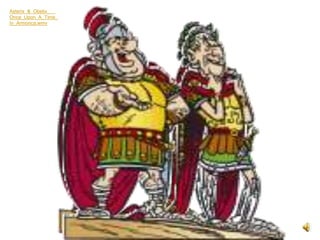
Asterix
Obelix
Asterix_&_Obelix___
Once_Upon_A_Time_
In_Armorica.wmv
55BC
55 BC
The Roman Baths in Bath England Feature Video From
BathTV.wmv
Roman Baths in Bath.wmv
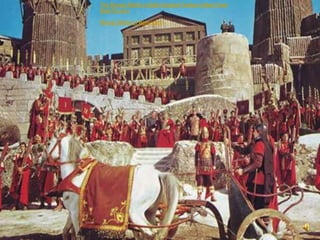
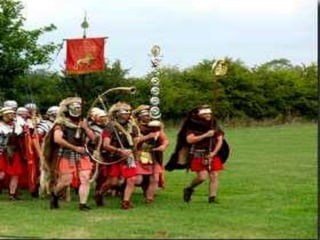
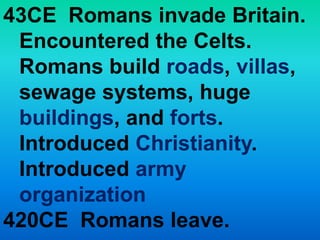
43CE Romans invade Britain.
Encountered the Celts.
Romans build roads, villas,
sewage systems, huge
buildings, and forts.
Introduced Christianity.
Introduced army
organization
420CE Romans leave.
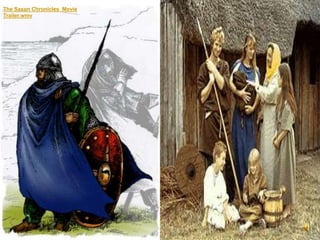
The Saxon Chronicles Movie
Trailer.wmv
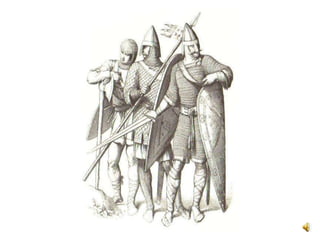
•Anglo-Saxon society.

–Lived in tribal groups with a high class of
warriors.

–Kings emerged as society developed.
•Spoke Old English.
•This was the language that Beowulf was written in.
•Became Christian but still valued heroic ideals
and traditional heroes.
•Their culture valued human contact, family,
virtue, and a good story.
•They feared humiliation and loneliness in their
lives. In addition, the Anglo-Saxons desired

richness, power, and appreciated heroic
actions of warriors.
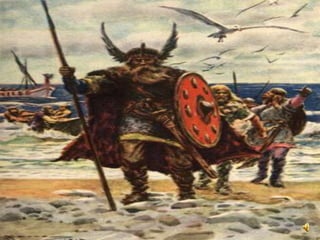
•787CE Viking raids begin
•871-899CE saxon King Alfred the Great becomes
King of England.

–Established education systems, rebuilt
monasteries.
–Contributed with artfacts
–Fought Danes and forced them from Wessex.
–Unified Anglo-Saxons under one king to resist
the Viking invasions.
–Danes ruled in the North, Anglo-Saxons in the
South.
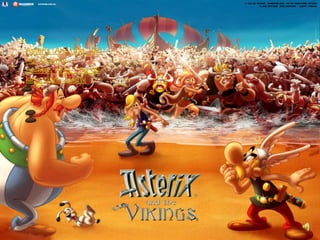
Asterix_And_the_Viki
ng_19.wmv
Asterix_ANd_The_Vi
king_part_2.wmv
the Anglo-Saxon period (4491066)
historical background
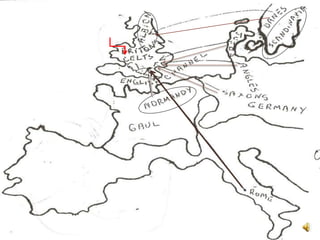
Three conquests: Roman conquest in 43 AD;
Anglo-Saxon conquest in 449;
Norman conquest in 1066 43 AD,
Roman conquered Britain ,making the latter a
province of
Roman Empire; the withdrawal of Roman troops
,the Teutonic (Germanic people)
tribes, esp., the Anglos conquered the island and
called it
Angle-land, then England, their language is
Anglo-Saxon
old English.
1.
Beowulf towers above all other

Anglo-Saxon literature, not only
because it is a powerful poem
about people’s hero written in
true epic style, but also because
it tells in artistic form the tale in a
leisurely way, full of elaborations
in legendary details, and the
verse rises at places to heights of
poetic grandeur.
The significance of Beowulf:
 This glorious epic presents us a vivid

picture of the life of Anglo-Saxon
people and highly praises the brave
and courageous spirit of the fighting
against the elemental forces.
 The epic reflects the situations the
epoch of pagan tribalism and of the
era of the Christianized feudal
society.
 The epic gives the vivid portrayal of a
characters
• Beowulf: main character, a hero featuring all the qualities
of an epic hero. He has superhuman strength and is
fearless and brave in battle. (Geats)

• Hrothgar: the king of the village that Beowulf saves
from Grendel. (Danes)

• Grendel: a monster terrorizing Hrothgar’s village.
• Grendel’s mother: a monster set out to avenge her
son’s death.
Plot (movie here)
 Beowulf travels to Hrothgar’s village to save them from







Grendel, a terrifying monster eating their warriors.
An epic battle ensures Beowulf is the winner.
Of course, Grendel’s mother comes seeking
vengeance for her son’s death. Again, Beowulf is
called upon to save them all, and he fights heroically
and defeats the evil monster.
After being vastly rewarded and refusing an offer from
Hrothgar to be his heir, Beowulf makes the long trek
back to his homeland where he becomes a mighty and
generous king for many years.
He fights a massive dragon who is threatening his
 Anglo-Saxon literature began as an oral tradition.

Stories, poems, and songs were all told aloud and
passed from generation to generation orally through
minstrels (also called scops).
 Poems traditionally had a strong beat, alliteration,
and no rhyme.
 Caesura: “a cutting.” A break in a line of poetry,
used in Old English to depict a half line. We use a
comma for a modern effect.
 i.e. Da com of moreunder mistheleopum
―Out from the marsh, from the foot of the hills.‖
 Kenning: derived from the Norse word ―kenna‖
which means ―to know, to recognize.‖ It is a
compact metaphor that functions as a name.


i.e. helmberend: ―Helm bearer‖ or ―warrior‖
Characteristics of ―Beowulf‖
a. the mixture of pagan elements
with Christian coloring. The most
outstanding example is the frequent
reference in the epic to ―Wyrd‖
(fate) as the decisive factor in
human affaires, while on other
occasions “God” or “Lord” is also
mentioned as the omniscient and
Pagan vs. Christianity in Beowulf

pagan
 Strong nature

presence
 Strength of the
warrior

 God is mentioned by

two of the main
characters in the
poem: Beowulf and
Hrothgar.
 Grendel as Lucifer
 Both are outcasts
 Perform a task for

God
 Grendel is described
as a son or
descendant of Cain,
a clear Biblical
Characteristics of ―Beowulf‖
b. the frequent use of metaphors and understatements.

“Ring giver” is used for king,
“Swan road”, “whale-path” or
“seal bath” for the sea,
“wave-traveler” or “sea-wood”
for ship,
“shield-bearer”, “battle-hero”
or “spear-fighter” for soldier.
kenning
 KENNING
 Light-of-battle
 Fighting-gear, battle-

 MEANING

Sword
 Body armor

gear
 Blood
 Battle-sweat

other words:
 Life would have ended
[...] under wide earth

 Would have died
 Handle

 Hilt
 Lake, pond, swamp
 Mere
Characteristics of ―Beowulf‖
c. Beowulf

is written in alliterative verse. Its
rhythm depends upon accent and
alliteration. That is, the beginning of two or
more words in the same line with the same
sound or letter.
The lines are made up of two short halves,
separated by a pause. No rhyme is used;
but a musical effect is produced by giving
each half line two strongly accented
syllables. Each full line, therefore, has four
accents, three of which usually begin with
• Most famous of early Germanic poems
• Written anywhere between 400-1000, but most

likely after the 500s. Period of the barbarian
invasions.
• The

author is unknown, but likely to be

Christian. It is likely that a few different authors
elaborated on the tale.
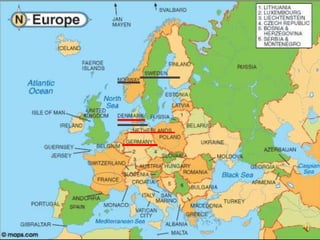
• Takes place in Sweden, Denmark, and

Frisia.
– The Norse were at this time attacking
Beowulf
 The events described in the poem

take place in the late 5th century, after
the Anglo-Saxons had begun migration
and settlement in England, and before

the beginning of the 7th century, a time
when the Saxons were either newly arrived or
in close contact with their fellow Germanic
kinsmen in Scandinavia and Northern
Germany.
Beowulf anonymous
useless to men as of yore it was.
Then about that barrow the battle-keen rode,
atheling-born, a band of twelve,
lament to make, to mourn their king,
chant their dirge, and their chieftain honor.
They praised his earlship, his acts of prowess
worthily witnessed: and well it is
that men their master-friend mightily laud,
heartily love, when hence he goes
from life in the body forlorn away.
/ˈ
beɪəˈw
ʊlf/
http://www.webenglishteacher.com/beowulf.html
Funeral pyre lit and Beowulf burned.
 [Question: why is this old woman placed here in
the book? Is this a woman's comment on all the
men's actions and male dominated society that
creates such continual misery with their warrior
ways'?]
 OLD WOMAN predicts that the Geats will be
overrun. She seems to know 'what goes round
comes around' and 'they'll get theirs.' They build
the tower and twelve Geats ride around the tower
praising Beowulf, best of kings.
 http://tehttp://www.webenglishteacher.com/chauc
er.htmlacher2b.com/literature/beowlspl.htm

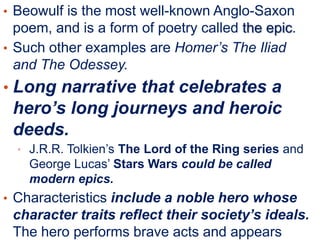
• Beowulf is the most well-known Anglo-Saxon

poem, and is a form of poetry called the epic.
• Such other examples are Homer’s The Iliad
and The Odessey.

• Long narrative that celebrates a

hero’s long journeys and heroic
deeds.
• J.R.R. Tolkien’s The Lord of the Ring series and

George Lucas’ Stars Wars could be called
modern epics.
• Characteristics include a noble hero whose

character traits reflect their society’s ideals.
The hero performs brave acts and appears
 The epic poem Beowulf strengthens the Heroic Code.

This code was derived from the Anglo-Saxons’
Germanic roots, and called for strength, courage, and
loyalty in warriors. It also required kings to be
hospitable, generous, and have great political skills.
This code was a basis for Anglo-Saxon honor.
• Universal themes of epic poetry
• Good vs. evil
• Beowulf vs. Grendel

• Isolation
• Courage and honor
• Beowulf is fearless and brave while fighting the monsters.

• Gods or semi-divine creatures
• Grendel, Grendel’s mother, the dragon

• Tale involves the fate of an entire race
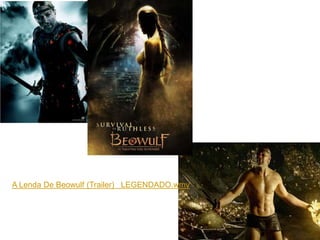
A Lenda De Beowulf (Trailer) LEGENDADO.wmv
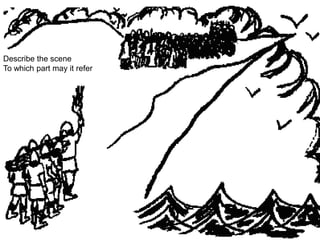
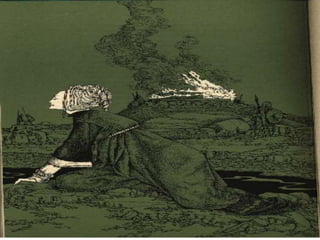
Describe the scene
To which part may it refer
 Beowulf is an example of Medieval Anglo-Saxon poetry which was

written by monks c1100. Beowulf describes the adventures of a great
Scandinavian warrior of the sixth century. The poem of Beowulf is
distinguished by its heavy use of alliteration which was used instead of
the modern rhyme. There are therefore many examples of alliteration in
Beowulf, often three examples in every line. Like a rhyme, alliteration
makes a poem easy to remember. Examples from Beowulf are

as follows:

Cunningly creeping, a spectral

stalker
Hot-hearted Beowulf was bent
upon battle
He had often haunted Hrothgar's
house
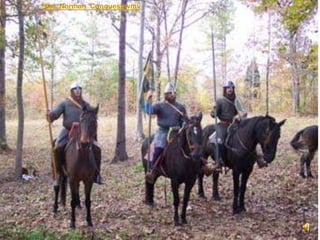
the_Norman_Conquest.wmv
•1066CE Norman Conquest by
William the Conqueror.
–From Norman French.
–Defeated Danes and Anglo-Saxons.
–Officially ended Anglo-Saxon era and
brought about the beginning of the
Medieval Period.
cru·sade (kr-sd) n. 1. often Crusade Any of the military expeditions undertaken by
European Christians in the 11th, 12th, and 13th centuries to recover the Holy Land from
the Muslims.
2. A holy war undertaken with papal sanction.
3. A vigorous concerted movement for a cause or against an abuse. See Synonyms at
campaign.
intr.v. cru·sad·ed, cru·sad·ing, cru·sades To engage in a crusade.
the Anglo-Norman period (1066—
1350)

historical background Norman
Conquest of Anglo-Saxon
England, under William, Duke of
Normandy after the battle of
Hastings in 1066, accelerated
the development of feudalism in
England. The middle ages: the
dark age (449-16-th century)

1.
Literature - romance
 a. Geoffrey’s history: a source book
of literature
 b. the work of the French Writers:
Arthurian legends
 c. Riming/rhythmic chronicles:
history in doggerel verse (cordel)
 d. metrical romances, or tales in
verse.
Geoffrey Chaucer (1340—1400)

1.his life born in a wine
merchant family, page to
ElizabethCountess of Ulster,
wife of Edward III's third son
he had broad and intimate
acquaintance with persons
high and low in all walks of life
and knew well the whole
His literary career
French period (1360-1372) in
French ― Romance of the
rose‖
b. Italian period
in Latin
―the legend of Good
Women‖
a.

(1372-1385)
Chaucer’s contributions to
English Literature and Language
 a. a master of realism

 b.founder of English literary

language
 c.Chaucer’s English: London dialect
 d.Father of English poetry : heroic
couplet (The heroic couplet is an iambic
pentameter heaving the lines rhyming in
pairs).
The Canterbury
Tales
 It is one of the most famous works

in all literature. It begins with a
general prologue that explains the
occasion for the narration of the
tales and gives a description of
the pilgrims who narrate the
tales, and then follow the twentyfour tales that make up the bulk of
the book, plus the separate
prologues and the ―links that
accompany some of‖ the tales.
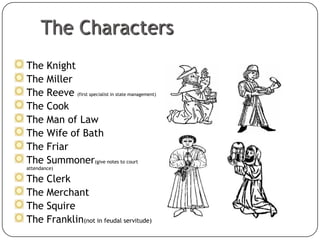
The Characters
The Knight
The Miller
The Reeve (first specialist in state management)
The Cook
The Man of Law
The Wife of Bath
The Friar
The Summoner(give notes to court
attendance)

The Clerk
The Merchant
The Squire
The Franklin(not in feudal servitude)
49
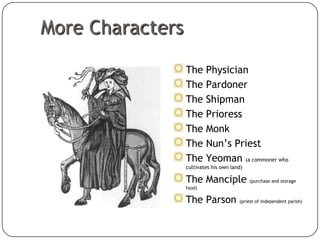
More Characters
The Physician
The Pardoner
The Shipman
The Prioress
The Monk
The Nun’s Priest
The Yeoman (a commoner who
cultivates his own land)

The Manciple (purchase and storage
food)

The Parson (priest of independent parish)
50
understand that Chaucer the Poet
actually wrote The Canterbury
Tales,
but Chaucer the Pilgrim tells
them.
Making himself a character in
the Tales enables Chaucer to
inject opinions without claiming
they are his own,
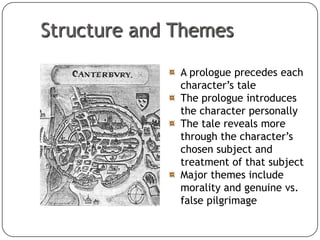
Structure and Themes
A prologue precedes each
character’s tale
The prologue introduces
the character personally
The tale reveals more
through the character’s
chosen subject and
treatment of that subject
Major themes include
morality and genuine vs.
false pilgrimage
52
The Wife of Bath by Geoffrey
Chaucer in The Canterbury
AndTales
she obeyed him in every thing

That mighte do him pleasance or liking.
And thus they live unto their lives' end
In perfect joy; and Jesus Christ us send
Husbandes meek and young, and fresh in bed,
And grace to overlive them that we wed.
And eke I pray Jesus to short their lives,
That will not be governed by their wives.
And old and angry niggards of dispence,*
(*expense)
God send them soon a very pestilence!
The_Mirror_Has_Two_Faces_(1996)___2__13.wmv
The_Wife_Of_Bath.wmv
The_Nun's_Priest_Tale_(The_Canterbury_Tales).wmv

medieval marriage was a largely financial arrangement, involving a transfer
of wealth from the bride's family to the groom. Does this fact make the Wife's
account of her own marriages seem improbable?
there is evidence that medieval law held wives in subordination to their
husband. Should we view her not as a freethinker but as an outlaw?
Finally, what of love? In medieval times, love seems to have had little
place in marriage. How should this fact influence our response to the Wife's
frequent emphasis on sexual appeal as a driving force in her relationships?
The moral of the story seems to confirm her argument in the "Prologue," that
wives should have authority over their husbands, but the proof of the moral
seems to come through magic. Are we to take the story at face value, or is it,
in the truest sense, a "fairy tale"?
Does Chaucer in this way represent the Wife as seeing herself as the
"loathly lady" waiting for some loving husband to unlock the beauty inside
her?

Beginnings and beowulf (2)

  • 1.
    English Literature Literature ischaracterized by beauty of expression and form and by university of intellectual and emotional appeal. Literature shows us not only what a society is like in a certain age, but also what individual feel about it, what they hope from it, and how they can change it or escape from it. Literature gives readers an insight into the tradition, custom, beliefs, attitudes, folklore, values of the age in which it is written. Prof. MSc. Maura Xavier Garcia
  • 2.
    How to studyLiterature? a. analytical approach  The elements of fiction include plot, character, setting, point of view, theme, symbol, allegory, style, and tone. b.thematic approach  What is the story, the poem, the play, or the essay about? c. historical approach  It aims at illustrating the historical development of literature. All the Literature exists in time and as such bears the unmistakable imprint of the period and culture in which it is written.  Other approaches        Marxist/sociological criticism psychoanalytical criticism feminist/gender criticism mythic and archetypal criticism reader-response criticism formalist /new criticism structuralism deconstructuralism
  • 3.
    literature 1): pagan: oralsagas: the Song of Beowulf 2): Christian: copied by the monk. The influence of the Christianity upon language and culture. Two ecclesiastic poets: Caedmon and Cynewulf 3. the Song of Beowulf----England’s national epic creation time: written in 10-th century  plot and theme: fight with Grendel fight with Grendel’s mother fight with firedrake death and funeral
  • 4.
  • 5.
  • 7.
  • 8.
  • 10.
    The Roman Bathsin Bath England Feature Video From BathTV.wmv Roman Baths in Bath.wmv
  • 12.
    43CE Romans invadeBritain. Encountered the Celts. Romans build roads, villas, sewage systems, huge buildings, and forts. Introduced Christianity. Introduced army organization 420CE Romans leave.
  • 13.
    The Saxon ChroniclesMovie Trailer.wmv
  • 14.
    •Anglo-Saxon society. –Lived intribal groups with a high class of warriors. –Kings emerged as society developed. •Spoke Old English. •This was the language that Beowulf was written in. •Became Christian but still valued heroic ideals and traditional heroes. •Their culture valued human contact, family, virtue, and a good story. •They feared humiliation and loneliness in their lives. In addition, the Anglo-Saxons desired richness, power, and appreciated heroic actions of warriors.
  • 16.
    •787CE Viking raidsbegin •871-899CE saxon King Alfred the Great becomes King of England. –Established education systems, rebuilt monasteries. –Contributed with artfacts –Fought Danes and forced them from Wessex. –Unified Anglo-Saxons under one king to resist the Viking invasions. –Danes ruled in the North, Anglo-Saxons in the South.
  • 17.
  • 18.
    the Anglo-Saxon period(4491066) historical background Three conquests: Roman conquest in 43 AD; Anglo-Saxon conquest in 449; Norman conquest in 1066 43 AD, Roman conquered Britain ,making the latter a province of Roman Empire; the withdrawal of Roman troops ,the Teutonic (Germanic people) tribes, esp., the Anglos conquered the island and called it Angle-land, then England, their language is Anglo-Saxon old English. 1.
  • 19.
    Beowulf towers aboveall other Anglo-Saxon literature, not only because it is a powerful poem about people’s hero written in true epic style, but also because it tells in artistic form the tale in a leisurely way, full of elaborations in legendary details, and the verse rises at places to heights of poetic grandeur.
  • 20.
    The significance ofBeowulf:  This glorious epic presents us a vivid picture of the life of Anglo-Saxon people and highly praises the brave and courageous spirit of the fighting against the elemental forces.  The epic reflects the situations the epoch of pagan tribalism and of the era of the Christianized feudal society.  The epic gives the vivid portrayal of a
  • 21.
    characters • Beowulf: maincharacter, a hero featuring all the qualities of an epic hero. He has superhuman strength and is fearless and brave in battle. (Geats) • Hrothgar: the king of the village that Beowulf saves from Grendel. (Danes) • Grendel: a monster terrorizing Hrothgar’s village. • Grendel’s mother: a monster set out to avenge her son’s death.
  • 22.
    Plot (movie here) Beowulf travels to Hrothgar’s village to save them from     Grendel, a terrifying monster eating their warriors. An epic battle ensures Beowulf is the winner. Of course, Grendel’s mother comes seeking vengeance for her son’s death. Again, Beowulf is called upon to save them all, and he fights heroically and defeats the evil monster. After being vastly rewarded and refusing an offer from Hrothgar to be his heir, Beowulf makes the long trek back to his homeland where he becomes a mighty and generous king for many years. He fights a massive dragon who is threatening his
  • 23.
     Anglo-Saxon literaturebegan as an oral tradition. Stories, poems, and songs were all told aloud and passed from generation to generation orally through minstrels (also called scops).  Poems traditionally had a strong beat, alliteration, and no rhyme.  Caesura: “a cutting.” A break in a line of poetry, used in Old English to depict a half line. We use a comma for a modern effect.  i.e. Da com of moreunder mistheleopum ―Out from the marsh, from the foot of the hills.‖  Kenning: derived from the Norse word ―kenna‖ which means ―to know, to recognize.‖ It is a compact metaphor that functions as a name.  i.e. helmberend: ―Helm bearer‖ or ―warrior‖
  • 24.
    Characteristics of ―Beowulf‖ a.the mixture of pagan elements with Christian coloring. The most outstanding example is the frequent reference in the epic to ―Wyrd‖ (fate) as the decisive factor in human affaires, while on other occasions “God” or “Lord” is also mentioned as the omniscient and
  • 25.
    Pagan vs. Christianityin Beowulf pagan  Strong nature presence  Strength of the warrior  God is mentioned by two of the main characters in the poem: Beowulf and Hrothgar.  Grendel as Lucifer  Both are outcasts  Perform a task for God  Grendel is described as a son or descendant of Cain, a clear Biblical
  • 26.
    Characteristics of ―Beowulf‖ b.the frequent use of metaphors and understatements. “Ring giver” is used for king, “Swan road”, “whale-path” or “seal bath” for the sea, “wave-traveler” or “sea-wood” for ship, “shield-bearer”, “battle-hero” or “spear-fighter” for soldier.
  • 27.
    kenning  KENNING  Light-of-battle Fighting-gear, battle-  MEANING Sword  Body armor gear  Blood  Battle-sweat other words:  Life would have ended [...] under wide earth  Would have died  Handle  Hilt  Lake, pond, swamp  Mere
  • 28.
    Characteristics of ―Beowulf‖ c.Beowulf is written in alliterative verse. Its rhythm depends upon accent and alliteration. That is, the beginning of two or more words in the same line with the same sound or letter. The lines are made up of two short halves, separated by a pause. No rhyme is used; but a musical effect is produced by giving each half line two strongly accented syllables. Each full line, therefore, has four accents, three of which usually begin with
  • 29.
    • Most famousof early Germanic poems • Written anywhere between 400-1000, but most likely after the 500s. Period of the barbarian invasions. • The author is unknown, but likely to be Christian. It is likely that a few different authors elaborated on the tale. • Takes place in Sweden, Denmark, and Frisia. – The Norse were at this time attacking
  • 30.
    Beowulf  The eventsdescribed in the poem take place in the late 5th century, after the Anglo-Saxons had begun migration and settlement in England, and before the beginning of the 7th century, a time when the Saxons were either newly arrived or in close contact with their fellow Germanic kinsmen in Scandinavia and Northern Germany.
  • 31.
    Beowulf anonymous useless tomen as of yore it was. Then about that barrow the battle-keen rode, atheling-born, a band of twelve, lament to make, to mourn their king, chant their dirge, and their chieftain honor. They praised his earlship, his acts of prowess worthily witnessed: and well it is that men their master-friend mightily laud, heartily love, when hence he goes from life in the body forlorn away.
  • 32.
    /ˈ beɪəˈw ʊlf/ http://www.webenglishteacher.com/beowulf.html Funeral pyre litand Beowulf burned.  [Question: why is this old woman placed here in the book? Is this a woman's comment on all the men's actions and male dominated society that creates such continual misery with their warrior ways'?]  OLD WOMAN predicts that the Geats will be overrun. She seems to know 'what goes round comes around' and 'they'll get theirs.' They build the tower and twelve Geats ride around the tower praising Beowulf, best of kings.  http://tehttp://www.webenglishteacher.com/chauc er.htmlacher2b.com/literature/beowlspl.htm 
  • 33.
    • Beowulf isthe most well-known Anglo-Saxon poem, and is a form of poetry called the epic. • Such other examples are Homer’s The Iliad and The Odessey. • Long narrative that celebrates a hero’s long journeys and heroic deeds. • J.R.R. Tolkien’s The Lord of the Ring series and George Lucas’ Stars Wars could be called modern epics. • Characteristics include a noble hero whose character traits reflect their society’s ideals. The hero performs brave acts and appears
  • 34.
     The epicpoem Beowulf strengthens the Heroic Code. This code was derived from the Anglo-Saxons’ Germanic roots, and called for strength, courage, and loyalty in warriors. It also required kings to be hospitable, generous, and have great political skills. This code was a basis for Anglo-Saxon honor. • Universal themes of epic poetry • Good vs. evil • Beowulf vs. Grendel • Isolation • Courage and honor • Beowulf is fearless and brave while fighting the monsters. • Gods or semi-divine creatures • Grendel, Grendel’s mother, the dragon • Tale involves the fate of an entire race
  • 35.
    A Lenda DeBeowulf (Trailer) LEGENDADO.wmv
  • 36.
    Describe the scene Towhich part may it refer
  • 38.
     Beowulf isan example of Medieval Anglo-Saxon poetry which was written by monks c1100. Beowulf describes the adventures of a great Scandinavian warrior of the sixth century. The poem of Beowulf is distinguished by its heavy use of alliteration which was used instead of the modern rhyme. There are therefore many examples of alliteration in Beowulf, often three examples in every line. Like a rhyme, alliteration makes a poem easy to remember. Examples from Beowulf are as follows: Cunningly creeping, a spectral stalker Hot-hearted Beowulf was bent upon battle He had often haunted Hrothgar's house
  • 41.
  • 42.
    •1066CE Norman Conquestby William the Conqueror. –From Norman French. –Defeated Danes and Anglo-Saxons. –Officially ended Anglo-Saxon era and brought about the beginning of the Medieval Period. cru·sade (kr-sd) n. 1. often Crusade Any of the military expeditions undertaken by European Christians in the 11th, 12th, and 13th centuries to recover the Holy Land from the Muslims. 2. A holy war undertaken with papal sanction. 3. A vigorous concerted movement for a cause or against an abuse. See Synonyms at campaign. intr.v. cru·sad·ed, cru·sad·ing, cru·sades To engage in a crusade.
  • 43.
    the Anglo-Norman period(1066— 1350) historical background Norman Conquest of Anglo-Saxon England, under William, Duke of Normandy after the battle of Hastings in 1066, accelerated the development of feudalism in England. The middle ages: the dark age (449-16-th century) 1.
  • 44.
    Literature - romance a. Geoffrey’s history: a source book of literature  b. the work of the French Writers: Arthurian legends  c. Riming/rhythmic chronicles: history in doggerel verse (cordel)  d. metrical romances, or tales in verse.
  • 45.
    Geoffrey Chaucer (1340—1400) 1.hislife born in a wine merchant family, page to ElizabethCountess of Ulster, wife of Edward III's third son he had broad and intimate acquaintance with persons high and low in all walks of life and knew well the whole
  • 46.
    His literary career Frenchperiod (1360-1372) in French ― Romance of the rose‖ b. Italian period in Latin ―the legend of Good Women‖ a. (1372-1385)
  • 47.
    Chaucer’s contributions to EnglishLiterature and Language  a. a master of realism  b.founder of English literary language  c.Chaucer’s English: London dialect  d.Father of English poetry : heroic couplet (The heroic couplet is an iambic pentameter heaving the lines rhyming in pairs).
  • 48.
    The Canterbury Tales  Itis one of the most famous works in all literature. It begins with a general prologue that explains the occasion for the narration of the tales and gives a description of the pilgrims who narrate the tales, and then follow the twentyfour tales that make up the bulk of the book, plus the separate prologues and the ―links that accompany some of‖ the tales.
  • 49.
    The Characters The Knight TheMiller The Reeve (first specialist in state management) The Cook The Man of Law The Wife of Bath The Friar The Summoner(give notes to court attendance) The Clerk The Merchant The Squire The Franklin(not in feudal servitude) 49
  • 50.
    More Characters The Physician ThePardoner The Shipman The Prioress The Monk The Nun’s Priest The Yeoman (a commoner who cultivates his own land) The Manciple (purchase and storage food) The Parson (priest of independent parish) 50
  • 51.
    understand that Chaucerthe Poet actually wrote The Canterbury Tales, but Chaucer the Pilgrim tells them. Making himself a character in the Tales enables Chaucer to inject opinions without claiming they are his own,
  • 52.
    Structure and Themes Aprologue precedes each character’s tale The prologue introduces the character personally The tale reveals more through the character’s chosen subject and treatment of that subject Major themes include morality and genuine vs. false pilgrimage 52
  • 53.
    The Wife ofBath by Geoffrey Chaucer in The Canterbury AndTales she obeyed him in every thing That mighte do him pleasance or liking. And thus they live unto their lives' end In perfect joy; and Jesus Christ us send Husbandes meek and young, and fresh in bed, And grace to overlive them that we wed. And eke I pray Jesus to short their lives, That will not be governed by their wives. And old and angry niggards of dispence,* (*expense) God send them soon a very pestilence!
  • 54.
    The_Mirror_Has_Two_Faces_(1996)___2__13.wmv The_Wife_Of_Bath.wmv The_Nun's_Priest_Tale_(The_Canterbury_Tales).wmv medieval marriage wasa largely financial arrangement, involving a transfer of wealth from the bride's family to the groom. Does this fact make the Wife's account of her own marriages seem improbable? there is evidence that medieval law held wives in subordination to their husband. Should we view her not as a freethinker but as an outlaw? Finally, what of love? In medieval times, love seems to have had little place in marriage. How should this fact influence our response to the Wife's frequent emphasis on sexual appeal as a driving force in her relationships? The moral of the story seems to confirm her argument in the "Prologue," that wives should have authority over their husbands, but the proof of the moral seems to come through magic. Are we to take the story at face value, or is it, in the truest sense, a "fairy tale"? Does Chaucer in this way represent the Wife as seeing herself as the "loathly lady" waiting for some loving husband to unlock the beauty inside her?