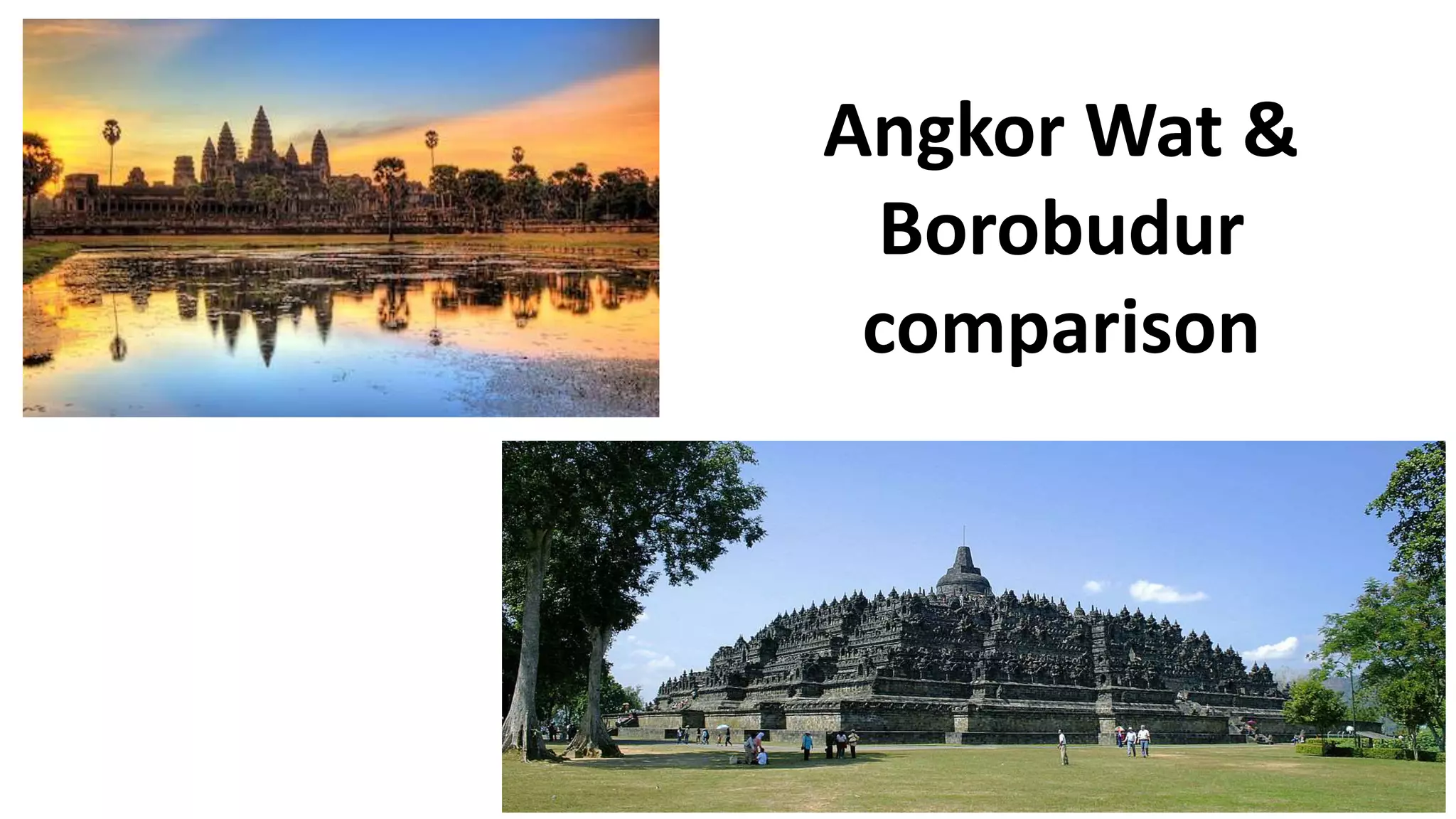
Angkor Wat &
Borobudur
comparison
Angkor Wat
• Angkor ‘Holy City’
• Located in Khmer empire
• Decorated with images of regional deities and the Hindu god
Vishnu
• Largest Religious Monument in the world
• Believed that the temple was also served as the king’s
mausoleum death
• Construction took over 30 years, it was never fully completed
• Took 300,000 workers
• Built entirely from stone
• 1,200 sq m of carved bas reliefs
Angkor Wat
• Represented 8 different stories of Hindu
• Buddhist use the temple today
• 504 statues of Buddha
• Symbolize moving from darkness to light
• About people achieving enlightenment
• More geometrical things in its layout
• Originally Hindu
• Located in Cambodia
• Built in 12th century
• Dedicated to Vishnu
Angkor Wat
• Khmer kings built to gain social support
• 5 stone towers represent the five mountain ranges significant
to Buddhism
• In Cambodia
• We don’t know what it used to be called
• Covered a whole city
• The king built the temple to prove his worth
• Largest religious monument in the world
• Angkor Wat is also on the Cambodian flag
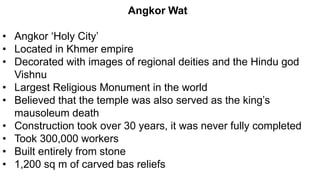
Borobudur
• Monument to Buddha
• Went unused after 100 years when the gov center was moved
• Designed by Gunadharma
• Resembles a pyramid
• Referred to as chaitya (prayer hall)
• Plan - 3D mandala
• Set Upon the Hill
• Carved Relief sculptures
• 1212 decorated reliefs
• 1460 stone reliefs on the wall
• 72 stupas containing 3D sculptures of Buddha
Borobudur
• Philosophical and spiritual
• Idea of moving darkness into light
• World's largest Buddhist monument
• Aligned with nature
• Made kings role prominent
• Miles of carvings on all the walls
• Didn't have a name at first
• Dedicated to Hindu God Vishnu
• Battle between good + evil
Borobudur
• Built in 800 CE
• Largest Buddhist site in the world
• Located in Indonesia
• Dedicated to Buddha
• Built around central axis
• In Java, Indonesia
• Built in the 8th century
• Used to be referred to as chaitya (shrine), stupa (reliquary), and
sacred mountain
• Focus on the path of Enlightenment and impermanence
• Buddhist
Borobudur
• Built by the Sailendra Dynasty
• Temple not a city
• Abandoned when the capital changed
• Relief sculptures mediate a physical and spiritual journey higher
states of consciousness
Angkor Wat & Borobudur commonalities
• Religious monuments
• Used by Buddhist today
• Detailed carvings and reliefs that told stories of their religion
• Both went unused for a while
• Both very important to their religion
• Symbolized whoever they were worshipping
• Shape of mandala
• Constructed to praise gods
• Both temples are centralized around axis mundi
• In Southeast Asia

Angkor wat and borobudur comparison

  • 1.
  • 2.
    Angkor Wat • Angkor‘Holy City’ • Located in Khmer empire • Decorated with images of regional deities and the Hindu god Vishnu • Largest Religious Monument in the world • Believed that the temple was also served as the king’s mausoleum death • Construction took over 30 years, it was never fully completed • Took 300,000 workers • Built entirely from stone • 1,200 sq m of carved bas reliefs
  • 3.
    Angkor Wat • Represented8 different stories of Hindu • Buddhist use the temple today • 504 statues of Buddha • Symbolize moving from darkness to light • About people achieving enlightenment • More geometrical things in its layout • Originally Hindu • Located in Cambodia • Built in 12th century • Dedicated to Vishnu
  • 4.
    Angkor Wat • Khmerkings built to gain social support • 5 stone towers represent the five mountain ranges significant to Buddhism • In Cambodia • We don’t know what it used to be called • Covered a whole city • The king built the temple to prove his worth • Largest religious monument in the world • Angkor Wat is also on the Cambodian flag
  • 5.
    Borobudur • Monument toBuddha • Went unused after 100 years when the gov center was moved • Designed by Gunadharma • Resembles a pyramid • Referred to as chaitya (prayer hall) • Plan - 3D mandala • Set Upon the Hill • Carved Relief sculptures • 1212 decorated reliefs • 1460 stone reliefs on the wall • 72 stupas containing 3D sculptures of Buddha
  • 6.
    Borobudur • Philosophical andspiritual • Idea of moving darkness into light • World's largest Buddhist monument • Aligned with nature • Made kings role prominent • Miles of carvings on all the walls • Didn't have a name at first • Dedicated to Hindu God Vishnu • Battle between good + evil
  • 7.
    Borobudur • Built in800 CE • Largest Buddhist site in the world • Located in Indonesia • Dedicated to Buddha • Built around central axis • In Java, Indonesia • Built in the 8th century • Used to be referred to as chaitya (shrine), stupa (reliquary), and sacred mountain • Focus on the path of Enlightenment and impermanence • Buddhist
  • 8.
    Borobudur • Built bythe Sailendra Dynasty • Temple not a city • Abandoned when the capital changed • Relief sculptures mediate a physical and spiritual journey higher states of consciousness
  • 9.
    Angkor Wat &Borobudur commonalities • Religious monuments • Used by Buddhist today • Detailed carvings and reliefs that told stories of their religion • Both went unused for a while • Both very important to their religion • Symbolized whoever they were worshipping • Shape of mandala • Constructed to praise gods • Both temples are centralized around axis mundi • In Southeast Asia