BA V sem
BHU
Borobudur
By
Prachi Virag Sontakke
Introduction
• Borobudur is a Buddhist shrine situated in Central Java in Indonesia.
• It sits on a plateau between two twin volcanoes and two rivers.
• Mahayana Buddhist temple.
• UNESCO World Heritage site.
• Borobudur ranks with Bagan in Myanmar and Angkor Wat in Cambodia as
one of the great archeological sites of Southeast Asia
History of Borobudur
• Hidden for centuries under layers of volcanic ash and jungle growth.
• Not known when active use of the monument and Buddhist pilgrimage to it ceased.
• Sometime between 928 and 1006 CE, King Mpu Sindok moved the capital of the Medang
Kingdom to the region of East Java after a series of volcanic eruptions.
• Not certain whether this influenced the abandonment, but several sources mention this as
the most likely period of abandonment.
• Popular belief that the temples were disbanded when the population converted to Islam in
the 15th century following the decline of Hindu kingdoms in Java
• Folk stories gradually shifted from its past glory into more superstitious beliefs associated
with bad luck and misery.
Discovery of Borubodur
• Sir Thomas Stamford Raffles: A British
governor who led Indonesia in
transition from Dutch to British
colonial in 1811 -1816 CE.
• Considered as the first to uncover the
origin of the Borobudur Temple in
1814.
Construction history
• Constructed in the 9th century during the reign of Samartungga of
Shailendra dynasty
• Construction estimated to have taken 75 years.
• Completed in 825 CE
• Folk lore attributes the construction to an architect named
Gunadharma.
Technique of construction
• Made from andesite stone known for its durability compared to bricks,
against tropical weathers and torrential rains.
• Was probably once coated with varjalepa white yellowish plaster.
• Vajralepa: made from the mixture of ground limestone + tuff or white earth +
plant binder such as gum or resin.
• It was then painted with bright colors.
• The same vajralepa plaster can also be found other temples in Cambodia.
• It is likely that the bas-reliefs of Borobudur were originally quite colorful,
before centuries of torrential tropical rainfalls peeled-off the color pigments.
Architectural style
• Blend of Indonesian indigenous architecture and the Buddhist
architecture
• Some scholars believe that the temple demonstrates the influences
of Gupta art which in turn reflects India’s influence on the region.
Layout
• Original foundation: a square, 118X118sq m
• 9 stacked platforms,6 square & 3 circular, topped by a central
dome.
• Decorated with 2,672 relief panels and 504 Buddha statues.
• The upper platform: 72 small stupas surrounding one large central
stupa.
• Each stupa is bell-shaped and pierced by numerous decorative
openings. Statues of the Buddha sit inside the pierced enclosures
• The central dome is surrounded by 72 Buddha statues, each
seated inside a perforated stupa
• Kala makar entrance.
Symbolism of Borobudur plan
• Borobudur is built as a single large stupa and when viewed from above, takes the
form of a giant tantric Buddhist mandal.
• Plan resonates the three fold Buddhist cosmology and the nature of mind.
• Three levels symbolic of Buddhist cosmogeny: Kamadhatu (the world of
desire), Rupadhatu(the world of forms) & Arupadhatu (the world of formlessness).
• Kāmadhātu is represented by the base, Rupadhatu by the five square platforms
(the body), and Arupadhatu by the three circular platforms and the large topmost
stupa.
• The architectural features between the three stages have metaphorical differences.
• For instance, square and detailed decorations in the Rupadhatu disappear into
plain circular platforms in the Arupadhatu to represent how the world of forms—
where men are still attached with forms and names—changes into the world of the
formless
Thematic depictions
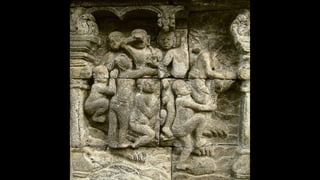
• Heavily ornamented with bas-reliefs.
• Exquisite, considered to be the most elegant and
graceful in the ancient Buddhist world
• Royalty + courtly life + Daily life.
• Flora-fauna
• Events from life of Buddha.
• Jataka stories.
• Celestial nymphs, Gandharvas, Kinnaras.
• Architecture, weaponry, economy, fashion, mode
of transportation of 8th-century south east Asia
Threats faced by
Borobudur
• Volcanic eruption.
• Soft foundation, heavy rains.
• Floral-fungal infestation
• Drainage problem.
• Wrongful conservation.
• Terrorist attacks
• Excessive visitor intake: load
bearing capacity.
• Vandalism & theft.
Restoration of Borobudur
• 1965: Indonesia asked UNESCO for help to conserve monuments
• 1968: Save Borobudur Campaign by Professor Soekmono, of the
Archeological Service of Indonesia.
• 1970s: 27 countries joined. A bold plan developed: to dismantle &
rebuild the 5 square terraces from the base up; to clean each of the
stones; to reinforce the foundation, at the same time installing an
efficient drainage system behind the walls & under the floors.
• 1975: Restoration began. Borobudur became a testing ground for
new conservation techniques, new procedures to battle the
microorganisms eating away at the stone. Using state of the art
techniques, experts in engineering, chemistry, biology and
archeology all shared their skills to solve the multitude of problems.
The restoration cost 25 million dollars.
• The monument was closed to public for ten years.
The combination of spirituality, intellect, design
and architecture have been welded together so
harmoniously and so flawlessly that there is no
other monument that is as beautiful as
Borobudur

Borubodur pdf

  • 1.
  • 2.
    Introduction • Borobudur isa Buddhist shrine situated in Central Java in Indonesia. • It sits on a plateau between two twin volcanoes and two rivers. • Mahayana Buddhist temple. • UNESCO World Heritage site. • Borobudur ranks with Bagan in Myanmar and Angkor Wat in Cambodia as one of the great archeological sites of Southeast Asia
  • 4.
    History of Borobudur •Hidden for centuries under layers of volcanic ash and jungle growth. • Not known when active use of the monument and Buddhist pilgrimage to it ceased. • Sometime between 928 and 1006 CE, King Mpu Sindok moved the capital of the Medang Kingdom to the region of East Java after a series of volcanic eruptions. • Not certain whether this influenced the abandonment, but several sources mention this as the most likely period of abandonment. • Popular belief that the temples were disbanded when the population converted to Islam in the 15th century following the decline of Hindu kingdoms in Java • Folk stories gradually shifted from its past glory into more superstitious beliefs associated with bad luck and misery.
  • 5.
    Discovery of Borubodur •Sir Thomas Stamford Raffles: A British governor who led Indonesia in transition from Dutch to British colonial in 1811 -1816 CE. • Considered as the first to uncover the origin of the Borobudur Temple in 1814.
  • 6.
    Construction history • Constructedin the 9th century during the reign of Samartungga of Shailendra dynasty • Construction estimated to have taken 75 years. • Completed in 825 CE • Folk lore attributes the construction to an architect named Gunadharma.
  • 7.
    Technique of construction •Made from andesite stone known for its durability compared to bricks, against tropical weathers and torrential rains. • Was probably once coated with varjalepa white yellowish plaster. • Vajralepa: made from the mixture of ground limestone + tuff or white earth + plant binder such as gum or resin. • It was then painted with bright colors. • The same vajralepa plaster can also be found other temples in Cambodia. • It is likely that the bas-reliefs of Borobudur were originally quite colorful, before centuries of torrential tropical rainfalls peeled-off the color pigments.
  • 8.
    Architectural style • Blendof Indonesian indigenous architecture and the Buddhist architecture • Some scholars believe that the temple demonstrates the influences of Gupta art which in turn reflects India’s influence on the region.
  • 9.
    Layout • Original foundation:a square, 118X118sq m • 9 stacked platforms,6 square & 3 circular, topped by a central dome. • Decorated with 2,672 relief panels and 504 Buddha statues. • The upper platform: 72 small stupas surrounding one large central stupa. • Each stupa is bell-shaped and pierced by numerous decorative openings. Statues of the Buddha sit inside the pierced enclosures • The central dome is surrounded by 72 Buddha statues, each seated inside a perforated stupa • Kala makar entrance.
  • 13.
    Symbolism of Borobudurplan • Borobudur is built as a single large stupa and when viewed from above, takes the form of a giant tantric Buddhist mandal. • Plan resonates the three fold Buddhist cosmology and the nature of mind. • Three levels symbolic of Buddhist cosmogeny: Kamadhatu (the world of desire), Rupadhatu(the world of forms) & Arupadhatu (the world of formlessness). • Kāmadhātu is represented by the base, Rupadhatu by the five square platforms (the body), and Arupadhatu by the three circular platforms and the large topmost stupa. • The architectural features between the three stages have metaphorical differences. • For instance, square and detailed decorations in the Rupadhatu disappear into plain circular platforms in the Arupadhatu to represent how the world of forms— where men are still attached with forms and names—changes into the world of the formless
  • 15.
    Thematic depictions • Heavilyornamented with bas-reliefs. • Exquisite, considered to be the most elegant and graceful in the ancient Buddhist world • Royalty + courtly life + Daily life. • Flora-fauna • Events from life of Buddha. • Jataka stories. • Celestial nymphs, Gandharvas, Kinnaras. • Architecture, weaponry, economy, fashion, mode of transportation of 8th-century south east Asia
  • 28.
    Threats faced by Borobudur •Volcanic eruption. • Soft foundation, heavy rains. • Floral-fungal infestation • Drainage problem. • Wrongful conservation. • Terrorist attacks • Excessive visitor intake: load bearing capacity. • Vandalism & theft.
  • 29.
    Restoration of Borobudur •1965: Indonesia asked UNESCO for help to conserve monuments • 1968: Save Borobudur Campaign by Professor Soekmono, of the Archeological Service of Indonesia. • 1970s: 27 countries joined. A bold plan developed: to dismantle & rebuild the 5 square terraces from the base up; to clean each of the stones; to reinforce the foundation, at the same time installing an efficient drainage system behind the walls & under the floors. • 1975: Restoration began. Borobudur became a testing ground for new conservation techniques, new procedures to battle the microorganisms eating away at the stone. Using state of the art techniques, experts in engineering, chemistry, biology and archeology all shared their skills to solve the multitude of problems. The restoration cost 25 million dollars. • The monument was closed to public for ten years.
  • 36.
    The combination ofspirituality, intellect, design and architecture have been welded together so harmoniously and so flawlessly that there is no other monument that is as beautiful as Borobudur