Seminar in Tangible Cultural Resource Studies II
Wednesday, October 23rd 2013
Maharani Dian Permanasari
Graduate School of Cultural Resource Management Program

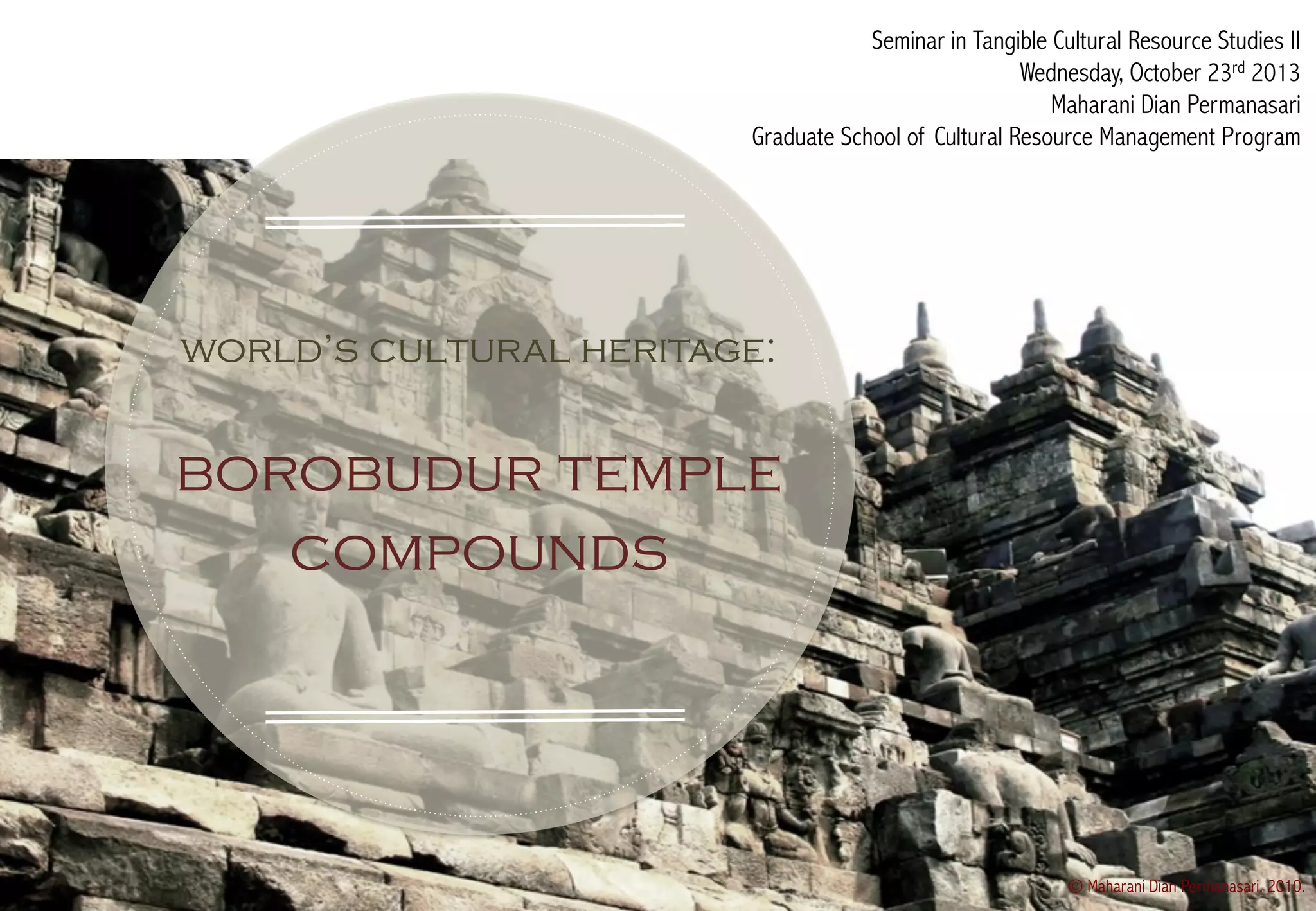
world’s cultural heritage:

borobudur temple
compounds

© Maharani Dian Permanasari. 2010.
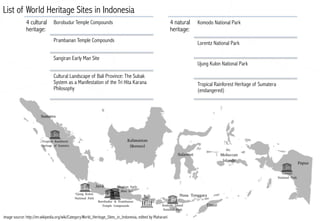
List of World Heritage Sites in Indonesia
4 cultural
heritage:

Borobudur Temple Compounds
Prambanan Temple Compounds
Sangiran Early Man Site
Cultural Landscape of Bali Province: The Subak
System as a Manifestation of the Tri Hita Karana
Philosophy

image source: http://en.wikipedia.org/wiki/Category:World_Heritage_Sites_in_Indonesia, edited by Maharani

4 natural
heritage:

Komodo National Park
Lorentz National Park
Ujung Kulon National Park
Tropical Rainforest Heritage of Sumatera
(endangered)
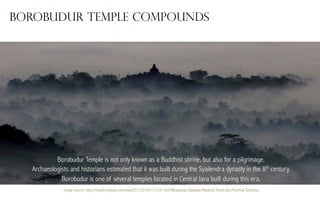
Borobudur temple compounds

Borobudur Temple is not only known as a Buddhist shrine, but also for a pilgrimage.
Archaeologists and historians estimated that it was built during the Syailendra dynasty in the 8th century.
Borobudur is one of several temples located in Central Java built during this era.
image source: http://travel.kompas.com/read/2013/01/01/12241365/Wisatawan.Saksikan.Matahari.Terbit.dari.Punthuk.Setumbu
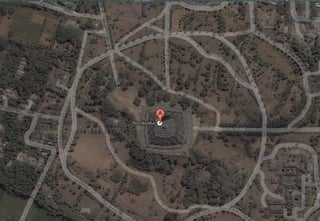
Borobudur location
750-­‐850	
  (8th	
  century)	
  
• 
Borobudur	
  built	
  by	
  Syailendra	
  Dynasty	
  
• 
Possibility:	
  three	
  phases	
  in	
  its	
  construc>on	
  process	
  
1006	
  (11th	
  century)	
  
• 
Mahapralaya	
  (huge	
  volcanic	
  erup>on)	
  
	
  15th	
  century	
  (abandonment)	
  
• 
Conflict	
   between	
   Syailendra	
   and	
   Sanjaya	
   Dynasty,	
  
shiUing	
  the	
  central	
  ruling	
  to	
  East	
  Java	
  
	
  16th	
  century	
  
• 
Incoming	
  of	
  Islam	
  
1814	
  (18th	
  century)	
  
• 
Raffles	
   sent	
   Cornellius	
   to	
   inves>gate	
   “the	
   temple	
  
ruins”	
  
1817	
  
• 
Raffles	
   introduce	
   “Borobudur”	
   in	
   his	
   book,	
   “The	
  
History	
  of	
  Java”	
  
1873	
  
• 
The	
  1st	
  monograph	
  of	
  Borobodur	
  was	
  published	
  

• 
• 

• 

meant	
   to	
   be	
   built	
   as	
   a	
   structured	
  
pyramid,	
   but	
   finally	
   changed	
   to	
   be	
  
CONSTRUCTION	
  
structure	
  on	
  soil/hill	
  
founda>on	
   widened,	
   added	
   with	
   two	
  
square	
   levels	
   and	
   one	
   circle	
   level	
   with	
  
main	
  stupa	
  
top	
   circle	
   steps	
   were	
   demolished,	
  
replaced	
  by	
  three	
  circle	
  levels.	
  Stupas	
  
were	
   built	
  ABANDONMENT	
   one	
   big	
  
in	
   this	
   area,	
   with	
  
stupa	
  in	
  the	
  center	
  

Historical Timeline of Borobudur

REDISCOVERY	
  
“Borobudur”	
   by	
   Van	
   Kinsbergen,	
   1873.	
   Retrieved	
   from	
  
hbp://en.wikipedia.org/wiki/Borobudur	


1900	
  
• 
VOC	
   conducted	
   the	
   commibee	
   for	
   Borobudur	
  
excava>on	
  and	
  restora>on	
  	
  
1907-­‐1911	
  
• 
The	
   1st	
   excava>on	
   &	
   restora>on	
   led	
   by	
   Theodoor	
  
van	
  Erp	
  
1926-­‐1940	
  
• 
The	
   2nd	
   excava>on	
   &	
   restora>on,	
   stopped	
   because	
  
of	
  the	
  World	
  War	
  2	
  

EARLY	
  RESTORATION	
  

1956	
  
• 
Indonesian	
   government	
   consulted	
   the	
   UNESCO	
  
about	
  deteriora>on	
  in	
  Borobudur	
  
1963	
  
• 
Indonesian	
  government	
  issued	
  the	
  Restora>on	
  Act	
  
of	
  Borobudur,	
  got	
  cancelled	
  by	
  G-­‐30-­‐S	
  
1968	
  
• 
UNESCO	
  decided	
  to	
  give	
  aid	
  to	
  save	
  Borobudur	
  in	
  
the	
  15th	
  Conference	
  in	
  France	
  
1971	
  
• 
Indonesian	
   Government	
   made	
   a	
   team	
   for	
  
restora>on	
  of	
  Borobudur	
  

PREPARATION	
  FOR	
  	
  
2ND	
  PHASE	
  OF	
  RESTORATION	
  

Early	
  restora>on.	
  Retrieved	
  from	
  
hbp://www.borobudurpark.com/temple/aboutBorobudur	
  
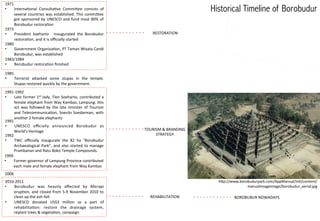
1971	
  
• 
Interna>onal	
   Consulta>ve	
   Commibee	
   consists	
   of	
  
several	
  countries	
  was	
  established.	
  This	
  commibee	
  
got	
   sponsored	
   by	
   UNESCO	
   and	
   fund	
   most	
   80%	
   of	
  
Borobudur	
  restora>on	
  
1973	
  
• 
President	
   Soeharto	
   	
   inaugurated	
   the	
   Borobudur	
  
restora>on,	
  and	
  it	
  is	
  officially	
  started	
  
1980	
  
• 
Government	
   Organiza>on,	
   PT	
   Taman	
   Wisata	
   Candi	
  
Borobudur,	
  was	
  established	
  
1983/1984	
  
• 
Borobudur	
  restora>on	
  finished	
  

Historical Timeline of Borobudur
RESTORATION	
  

1985	
  
• 
Terrorist	
   abacked	
   some	
   stupas	
   in	
   the	
   temple.	
  
Stupas	
  restored	
  quickly	
  by	
  the	
  government.	
  
1991-­‐1992	
  
• 
Late	
   former	
   1st	
   lady,	
   Tien	
   Soeharto,	
   contributed	
   a	
  
female	
  elephant	
  from	
  Way	
  Kambas,	
  Lampung.	
  this	
  
act	
   was	
   followed	
   by	
   the	
   late	
   minister	
   of	
   Tourism	
  
and	
   Telecommunica>on,	
   Soesilo	
   Soedarman,	
   with	
  
another	
  2	
  female	
  elephants	
  
1991	
  
• 
UNESCO	
   officially	
   announced	
   Borobudur	
   as	
  
World’s	
  Heritage	
  
1992	
  
• 
TWC	
   officially	
   inaugurate	
   the	
   82	
   ha	
   “Borobudur	
  
Archaeological	
   Park”,	
   and	
   also	
   started	
   to	
   manage	
  
Prambanan	
  and	
  Ratu	
  Boko	
  Temple	
  Compounds.	
  
1999	
  
• 
Former	
  governor	
  of	
  Lampung	
  Province	
  contributed	
  
each	
  male	
  and	
  female	
  elephant	
  from	
  Way	
  Kambas	
  	
  
2006	
  
• 
Earthquake	
   in	
   Yogyakarta,	
   badly	
   damaged	
   nearby	
  
2010-­‐2011	
  
Prambanan	
  Temple,	
  leU	
  Borobudur	
  unscathed	
  
• 
Borobudur	
   was	
   heavily	
   affected	
   by	
   Merapi	
  
erup>on,	
   and	
   closed	
   from	
   5-­‐9	
   November	
   2010	
   to	
  
clean	
  up	
  the	
  ash-­‐fall.	
  
• 
UNESCO	
   donated	
   US$3	
   million	
   as	
   a	
   part	
   of	
  
rehabilita>on:	
   restore	
   the	
   drainage	
   system,	
  
replant	
  trees	
  &	
  vegeta>on,	
  campaign	
  

TOURISM	
  &	
  BRANDING	
  	
  
STRATEGY	
  

hbp://www.borobudurpark.com/AppManual/in>/content/
manualimageimage/borobudur_aerial.jpg	
  

REHABILITATION	
  

BOROBUBUR	
  NOWADAYS	
  
Overview: Borobudur
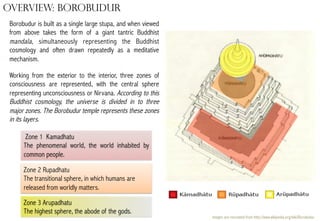
Borobudur is built as a single large stupa, and when viewed
from above takes the form of a giant tantric Buddhist
mandala, simultaneously representing the Buddhist
cosmology and often drawn repeatedly as a meditative
mechanism.
Working from the exterior to the interior, three zones of
consciousness are represented, with the central sphere
representing unconsciousness or Nirvana. According to this
Buddhist cosmology, the universe is divided in to three
major zones. The Borobudur temple represents these zones
in its layers.
Zone 1 Kamadhatu
The phenomenal world, the world inhabited by
common people.
Zone 2 Rupadhatu
The transitional sphere, in which humans are
released from worldly matters.
Zone 3 Arupadhatu
The highest sphere, the abode of the gods.

images are recreated from http://www.wikipedia.org/wiki/Borobudur
Borobudur
Building
Structure

• 
• 
• 
• 
• 

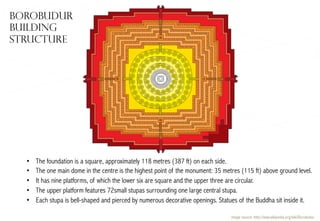
The foundation is a square, approximately 118 metres (387 ft) on each side.
The one main dome in the centre is the highest point of the monument: 35 metres (115 ft) above ground level.
It has nine platforms, of which the lower six are square and the upper three are circular.
The upper platform features 72small stupas surrounding one large central stupa.
Each stupa is bell-shaped and pierced by numerous decorative openings. Statues of the Buddha sit inside it.
image source: http://www.wikipedia.org/wiki/Borobudur
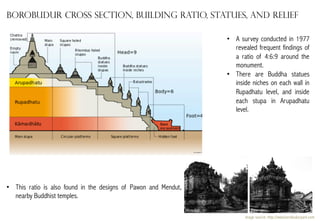
Borobudur cross section, building ratio, statues, and relief
•  A survey conducted in 1977
revealed frequent findings of
a ratio of 4:6:9 around the
monument.
•  There are Buddha statues
inside niches on each wall in
Rupadhatu level, and inside
each stupa in Arupadhatu
level.

•  This ratio is also found in the designs of Pawon and Mendut,
nearby Buddhist temples.
image source: http://www.borobudurpark.com
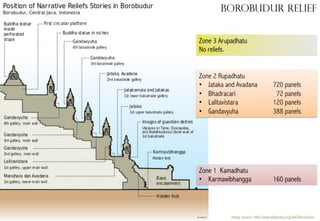
Borobudur Relief
Zone 3 Arupadhatu
No reliefs.
Zone 2 Rupadhatu
•  Jataka and Avadana
•  Bhadracari
•  Lalitavistara
•  Gandavyuha

720 panels
72 panels
120 panels
388 panels

Zone 1 Kamadhatu
•  Karmawibhangga

160 panels

image source: http://www.wikipedia.org/wiki/Borobudur
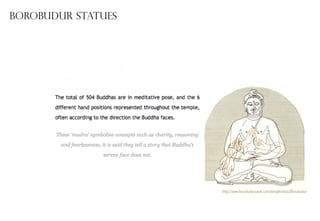
Borobudur Statues

http://www.borobudurpark.com/temple/aboutBorobudur
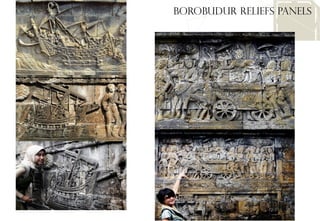
Zone 2: Rupadhatu
•  Jataka and Avadana
720 panels
•  Bhadracari
72 panels
•  Lalitavistara
120 panels
•  Gandavyuha
388 panels

Borobudur Reliefs Panels

Zone 1: Kamadhatu
•  K a r m a w i b h a n g g a
160 panels
ICOMOS evaluations of
borobudur temple
Criterion (i): “to represent a masterpiece of human its
(i): Borobudur Temple Compounds with
creative genius”
stepped, unroofed pyramid consisting of ten
compounds

superimposing terraces, crowned by a large bell-shaped
Criterion harmonious marriage of stupas, temple and
dome is a(i): “to represent a masterpiece of human creative
genius”
mountain that is a masterpiece of Buddhist architecture
•  a harmonious marriage of stupas, temple and mountain
and monumental arts.
that is a masterpiece of Buddhist architecture and
monumental arts.
Criterion (vi): Laid out in the form of a lotus, the sacred
Criterion (vi): “to be directly or tangibly associated
flower of Buddha, Borobudur Temple Compounds is an
Criterion (ii): “to exhibit blending important interchange
with events or living aexhibit with the very with
exceptional reflection oftraditions,an of ideas, or central of
human indigenous a span time or within a cultural
beliefs, with artistic and literary works of the Buddhist
idea of values, over ancestorofworship and outstanding area of
the world, attaining Nirvana. The ten mounting or technology,
universal on developments in architecture terraces
concept ofsignificance”
monumental structure correspond to the design”
of the entirearts, town-planning or landscapesuccessive
•  an outstanding example of achieve before
stages that the Bodhisattva has toIndonesia’s art and
architecture from between the early 8th and late 9th
attaining to Buddhahood.
centuries that exerted considerable influence on an
architectural revival between the mid-13th and early 16th
centuries.

Criterion (ii): “to exhibit Temple Compounds is of
Criterion (ii): Borobudur an important interchange an
human values, over a span of time or within a cultural
outstanding example of Indonesia’s art and architecture
area of the the early 8th and late in centuries that
from between world, on developments9tharchitecture or
technology, monumental arts, tangiblyarchitectural
exerted considerable influence orontown-planning or
an associated
Criterion (vi): “to be directly
landscape design”mid-13th and early ideas, or with
revival events or living traditions, with16th centuries.
with between the
beliefs, with artistic and literary works of outstanding
universal significance”
•  an exceptional reflection of a blending of the very
central idea of indigenous ancestor worship
(lotus) and the Buddhist concept of attaining
Nirvana (ten mounting terraces).
UNESCO Statements
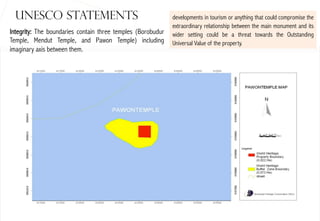
Integrity: The boundaries contain three temples (Borobudur
Temple, Mendut Temple, and Pawon Temple) including
imaginary axis between them.	
  

developments in tourism or anything that could compromise the
extraordinary relationship between the main monument and its
wider setting could be a threat towards the Outstanding
Universal Value of the property.

The map of Borobudur Archaeological Park and its surrounding, showing that Mendut, Pawon, and Borobudur forming a straight line. Self made, redrawed by Gunawan Kartapranata, 2011.
r
Protection and Policy Law
concerning with the site
•  Indonesian Law No. 11/2010 concerning Cultural
Heritage and its surrounding cultural landscape.
•  The legal and institutional framework for the effective
management of the property is regulated by a
Presidential Decree Number 1 Year 1992.
•  a New Presidential Regulation is still being
formulated by a Coordinating Board (14 Ministries
and local authorities as well as representatives of
local communities)
•  Monitoring programs has been effectively executed
to monitor the growing rate of deterioration of
building stone and also damage by unsupervised
visitors.
•  The Borobudur Heritage Conservation Office has
conducted community development programs
targeting especially at the youth to raise their
awareness.

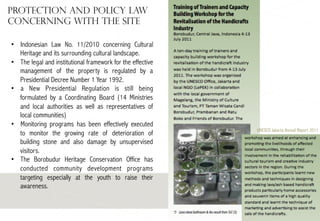
UNESCO Jakarta Annual Report 2011
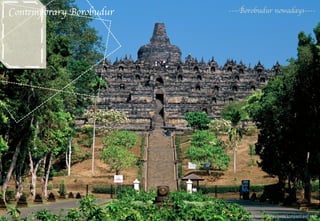
Contemporary Borobudur	


----Borobudur nowadays----	


images source: http://www.kompastravel.com
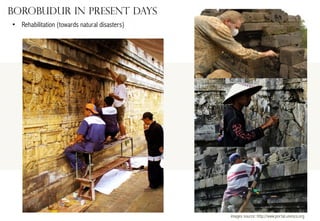
Borobudur in present days
•  Rehabilitation (towards natural disasters)

images source: http://www.portal.unesco.org
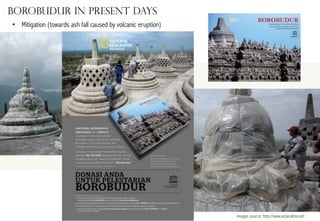
Borobudur in present days
•  Mitigation (towards ash fall caused by volcanic eruption)

images source: http://www.antarafoto.net
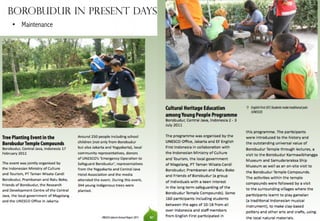
Borobudur in present days
•  Maintenance

images source: http://www.antarafoto.net
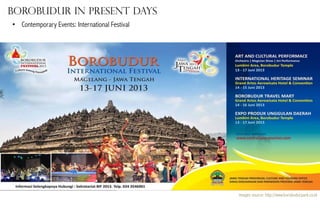
Borobudur in present days
•  Contemporary Events: International Festival

images source: http://www.borobudurpark.co.id
borobudur in present days
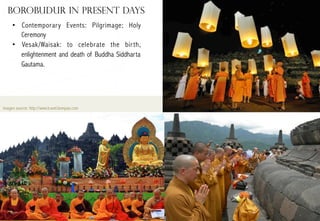
•  Contemporary Events: Pilgrimage; Holy
Ceremony
•  Vesak/Waisak: to celebrate the bir th,
enlightenment and death of Buddha Siddharta
Gautama.

images source: http://www.travel.kompas.com
Borobudur in present days
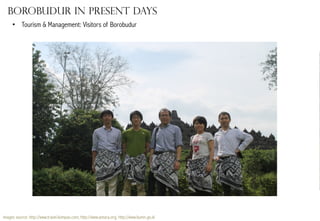
•  Tourism & Management: Visitors of Borobudur

images source: http://www.travel.kompas.com; http://www.antara.org; http://www.bumn.go.id
Borobudur in present days
Tourism & Management: Museums (Karmawibhangga & Samudraraksa)
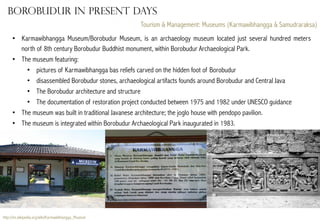
•  Karmawibhangga Museum/Borobudur Museum, is an archaeology museum located just several hundred meters
north of 8th century Borobudur Buddhist monument, within Borobudur Archaeological Park.
•  The museum featuring:
•  pictures of Karmawibhangga bas reliefs carved on the hidden foot of Borobudur
•  disassembled Borobudur stones, archaeological artifacts founds around Borobudur and Central Java
•  The Borobudur architecture and structure
•  The documentation of restoration project conducted between 1975 and 1982 under UNESCO guidance
•  The museum was built in traditional Javanese architecture; the joglo house with pendopo pavilion.
•  The museum is integrated within Borobudur Archaeological Park inaugurated in 1983.

http://en.wikipedia.org/wiki/Karmawibhangga_Museum
Borobudur in present days
Tourism & Management: Museums (Karmawibhangga & Samudraraksa)
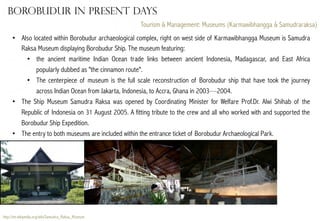
•  Also located within Borobudur archaeological complex, right on west side of Karmawibhangga Museum is Samudra
Raksa Museum displaying Borobudur Ship. The museum featuring:
•  the ancient maritime Indian Ocean trade links between ancient Indonesia, Madagascar, and East Africa
popularly dubbed as "the cinnamon route".
•  The centerpiece of museum is the full scale reconstruction of Borobudur ship that have took the journey
across Indian Ocean from Jakarta, Indonesia, to Accra, Ghana in 2003—2004.
•  The Ship Museum Samudra Raksa was opened by Coordinating Minister for Welfare Prof.Dr. Alwi Shihab of the
Republic of Indonesia on 31 August 2005. A fitting tribute to the crew and all who worked with and supported the
Borobudur Ship Expedition.
•  The entry to both museums are included within the entrance ticket of Borobudur Archaeological Park.

http://en.wikipedia.org/wiki/Samudra_Raksa_Museum
Borobudur in present days
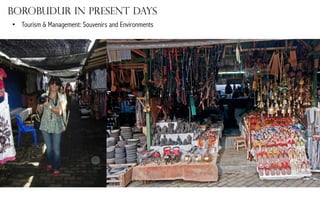
•  Tourism & Management: Souvenirs and Environments
Borobudur in present days
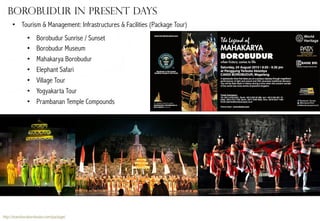
•  Tourism & Management: Infrastructures & Facilities (Package Tour)
• 
• 
• 
• 
• 
• 
• 

Borobudur Sunrise / Sunset
Borobudur Museum
Mahakarya Borobudur
Elephant Safari
Village Tour
Yogyakarta Tour
Prambanan Temple Compounds

http://manoharaborobudur.com/package/
Borobudur in present days
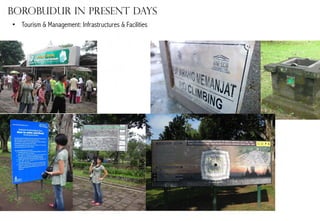
•  Tourism & Management: Infrastructures & Facilities
Borobudur in present days
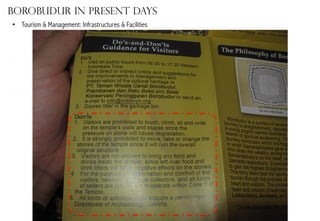
•  Tourism & Management: Infrastructures & Facilities
Borobudur in present days
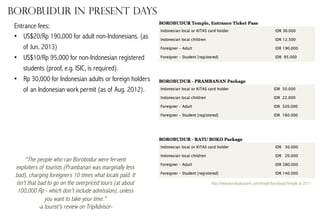
Entrance fees:
•  US$20/Rp 190,000 for adult non-Indonesians. (as
of Jun. 2013)
•  US$10/Rp 95,000 for non-Indonesian registered
students (proof, e.g. ISIC, is required).
•  Rp 30,000 for Indonesian adults or foreign holders
of an Indonesian work permit (as of Aug. 2012).

“The people who ran Borobodur were fervent
exploiters of tourists (Prambanan was marginally less
bad), charging foreigners 10 times what locals paid. It
isn't that bad to go on the overpriced tours (at about
100,000 Rp - which don't include admission), unless
you want to take your time.”
-a tourist’s review on TripAdvisor-

http://www.borobudurpark.com/temple/borobudurTemple at 2011
Borobudur in present days
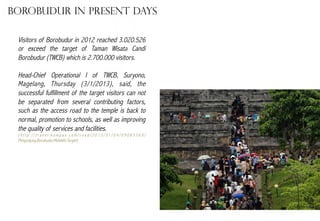
Visitors of Borobudur in 2012 reached 3.020.526
or exceed the target of Taman Wisata Candi
Borobudur (TWCB) which is 2.700.000 visitors.
Head-Chief Operational I of TWCB, Suryono,
Magelang, Thursday (3/1/2013), said, the
successful fulfillment of the target visitors can not
be separated from several contributing factors,
such as the access road to the temple is back to
normal, promotion to schools, as well as improving
the quality of services and facilities.
(http://travel.kompas.com/read/2013/01/04/09083369/
Pengunjung.Borobudur.Melebihi.Target)
problems in the maintenance
and utilization of borobudur
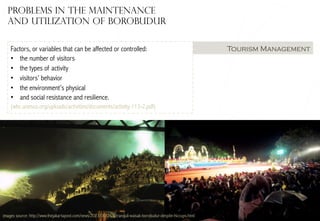
Factors, or variables that can be affected or controlled:
• •  natural disasters (earthquake, volcanic eruption, etc.)
the number of visitors
• •  vandalism on reliefs and statues.
the types of activity
• •  there is no system to limit the number of visitors per day.
visitors’ behavior
• •  thereenvironment’sto introduce mandatory guided tours only.
the is no system physical
• •  uncivilized behaviour ofand resilience. holy ceremony.
and social resistance visitors during
(whc.unesco.org/uploads/activities/documents/activity-113-2.pdf‎)

images source: http://www.thejakartapost.com/news/2013/06/04/a-tranquil-waisak-borobudur-despite-hiccups.html

Tourism Management
strategies to tourism management problems
in borobudur temple compounds
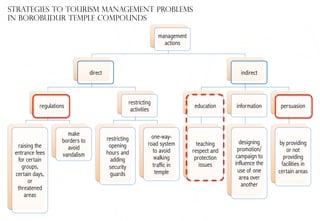
management
actions

direct

regulations

raising the
entrance fees
for certain
groups,
certain days,
or
threatened
areas

make
borders to
avoid
vandalism

indirect

restricting
activities

restricting
opening
hours and
adding
security
guards

one-wayroad system
to avoid
walking
traffic in
temple

education

information

persuasion

teaching
respect and
protection
issues

designing
promotion/
campaign to
influence the
use of one
area over
another

by providing
or not
providing
facilities in
certain areas
thank you for
your attention

© Maharani Dian Permanasari.

World Heritage: Borobudur

  • 1.
    Seminar in TangibleCultural Resource Studies II Wednesday, October 23rd 2013 Maharani Dian Permanasari Graduate School of Cultural Resource Management Program world’s cultural heritage: borobudur temple compounds © Maharani Dian Permanasari. 2010.
  • 2.
    List of WorldHeritage Sites in Indonesia 4 cultural heritage: Borobudur Temple Compounds Prambanan Temple Compounds Sangiran Early Man Site Cultural Landscape of Bali Province: The Subak System as a Manifestation of the Tri Hita Karana Philosophy image source: http://en.wikipedia.org/wiki/Category:World_Heritage_Sites_in_Indonesia, edited by Maharani 4 natural heritage: Komodo National Park Lorentz National Park Ujung Kulon National Park Tropical Rainforest Heritage of Sumatera (endangered)
  • 3.
    Borobudur temple compounds BorobudurTemple is not only known as a Buddhist shrine, but also for a pilgrimage. Archaeologists and historians estimated that it was built during the Syailendra dynasty in the 8th century. Borobudur is one of several temples located in Central Java built during this era. image source: http://travel.kompas.com/read/2013/01/01/12241365/Wisatawan.Saksikan.Matahari.Terbit.dari.Punthuk.Setumbu
  • 4.
  • 5.
    750-­‐850  (8th  century)   •  Borobudur  built  by  Syailendra  Dynasty   •  Possibility:  three  phases  in  its  construc>on  process   1006  (11th  century)   •  Mahapralaya  (huge  volcanic  erup>on)    15th  century  (abandonment)   •  Conflict   between   Syailendra   and   Sanjaya   Dynasty,   shiUing  the  central  ruling  to  East  Java    16th  century   •  Incoming  of  Islam   1814  (18th  century)   •  Raffles   sent   Cornellius   to   inves>gate   “the   temple   ruins”   1817   •  Raffles   introduce   “Borobudur”   in   his   book,   “The   History  of  Java”   1873   •  The  1st  monograph  of  Borobodur  was  published   •  •  •  meant   to   be   built   as   a   structured   pyramid,   but   finally   changed   to   be   CONSTRUCTION   structure  on  soil/hill   founda>on   widened,   added   with   two   square   levels   and   one   circle   level   with   main  stupa   top   circle   steps   were   demolished,   replaced  by  three  circle  levels.  Stupas   were   built  ABANDONMENT   one   big   in   this   area,   with   stupa  in  the  center   Historical Timeline of Borobudur REDISCOVERY   “Borobudur”   by   Van   Kinsbergen,   1873.   Retrieved   from   hbp://en.wikipedia.org/wiki/Borobudur     1900   •  VOC   conducted   the   commibee   for   Borobudur   excava>on  and  restora>on     1907-­‐1911   •  The   1st   excava>on   &   restora>on   led   by   Theodoor   van  Erp   1926-­‐1940   •  The   2nd   excava>on   &   restora>on,   stopped   because   of  the  World  War  2   EARLY  RESTORATION   1956   •  Indonesian   government   consulted   the   UNESCO   about  deteriora>on  in  Borobudur   1963   •  Indonesian  government  issued  the  Restora>on  Act   of  Borobudur,  got  cancelled  by  G-­‐30-­‐S   1968   •  UNESCO  decided  to  give  aid  to  save  Borobudur  in   the  15th  Conference  in  France   1971   •  Indonesian   Government   made   a   team   for   restora>on  of  Borobudur   PREPARATION  FOR     2ND  PHASE  OF  RESTORATION   Early  restora>on.  Retrieved  from   hbp://www.borobudurpark.com/temple/aboutBorobudur  
  • 6.
    1971   •  Interna>onal  Consulta>ve   Commibee   consists   of   several  countries  was  established.  This  commibee   got   sponsored   by   UNESCO   and   fund   most   80%   of   Borobudur  restora>on   1973   •  President   Soeharto     inaugurated   the   Borobudur   restora>on,  and  it  is  officially  started   1980   •  Government   Organiza>on,   PT   Taman   Wisata   Candi   Borobudur,  was  established   1983/1984   •  Borobudur  restora>on  finished   Historical Timeline of Borobudur RESTORATION   1985   •  Terrorist   abacked   some   stupas   in   the   temple.   Stupas  restored  quickly  by  the  government.   1991-­‐1992   •  Late   former   1st   lady,   Tien   Soeharto,   contributed   a   female  elephant  from  Way  Kambas,  Lampung.  this   act   was   followed   by   the   late   minister   of   Tourism   and   Telecommunica>on,   Soesilo   Soedarman,   with   another  2  female  elephants   1991   •  UNESCO   officially   announced   Borobudur   as   World’s  Heritage   1992   •  TWC   officially   inaugurate   the   82   ha   “Borobudur   Archaeological   Park”,   and   also   started   to   manage   Prambanan  and  Ratu  Boko  Temple  Compounds.   1999   •  Former  governor  of  Lampung  Province  contributed   each  male  and  female  elephant  from  Way  Kambas     2006   •  Earthquake   in   Yogyakarta,   badly   damaged   nearby   2010-­‐2011   Prambanan  Temple,  leU  Borobudur  unscathed   •  Borobudur   was   heavily   affected   by   Merapi   erup>on,   and   closed   from   5-­‐9   November   2010   to   clean  up  the  ash-­‐fall.   •  UNESCO   donated   US$3   million   as   a   part   of   rehabilita>on:   restore   the   drainage   system,   replant  trees  &  vegeta>on,  campaign   TOURISM  &  BRANDING     STRATEGY   hbp://www.borobudurpark.com/AppManual/in>/content/ manualimageimage/borobudur_aerial.jpg   REHABILITATION   BOROBUBUR  NOWADAYS  
  • 7.
    Overview: Borobudur Borobudur isbuilt as a single large stupa, and when viewed from above takes the form of a giant tantric Buddhist mandala, simultaneously representing the Buddhist cosmology and often drawn repeatedly as a meditative mechanism. Working from the exterior to the interior, three zones of consciousness are represented, with the central sphere representing unconsciousness or Nirvana. According to this Buddhist cosmology, the universe is divided in to three major zones. The Borobudur temple represents these zones in its layers. Zone 1 Kamadhatu The phenomenal world, the world inhabited by common people. Zone 2 Rupadhatu The transitional sphere, in which humans are released from worldly matters. Zone 3 Arupadhatu The highest sphere, the abode of the gods. images are recreated from http://www.wikipedia.org/wiki/Borobudur
  • 8.
    Borobudur Building Structure •  •  •  •  •  The foundation isa square, approximately 118 metres (387 ft) on each side. The one main dome in the centre is the highest point of the monument: 35 metres (115 ft) above ground level. It has nine platforms, of which the lower six are square and the upper three are circular. The upper platform features 72small stupas surrounding one large central stupa. Each stupa is bell-shaped and pierced by numerous decorative openings. Statues of the Buddha sit inside it. image source: http://www.wikipedia.org/wiki/Borobudur
  • 9.
    Borobudur cross section,building ratio, statues, and relief •  A survey conducted in 1977 revealed frequent findings of a ratio of 4:6:9 around the monument. •  There are Buddha statues inside niches on each wall in Rupadhatu level, and inside each stupa in Arupadhatu level. •  This ratio is also found in the designs of Pawon and Mendut, nearby Buddhist temples. image source: http://www.borobudurpark.com
  • 10.
    Borobudur Relief Zone 3Arupadhatu No reliefs. Zone 2 Rupadhatu •  Jataka and Avadana •  Bhadracari •  Lalitavistara •  Gandavyuha 720 panels 72 panels 120 panels 388 panels Zone 1 Kamadhatu •  Karmawibhangga 160 panels image source: http://www.wikipedia.org/wiki/Borobudur
  • 11.
  • 12.
    Zone 2: Rupadhatu • Jataka and Avadana 720 panels •  Bhadracari 72 panels •  Lalitavistara 120 panels •  Gandavyuha 388 panels Borobudur Reliefs Panels Zone 1: Kamadhatu •  K a r m a w i b h a n g g a 160 panels
  • 13.
    ICOMOS evaluations of borobudurtemple Criterion (i): “to represent a masterpiece of human its (i): Borobudur Temple Compounds with creative genius” stepped, unroofed pyramid consisting of ten compounds superimposing terraces, crowned by a large bell-shaped Criterion harmonious marriage of stupas, temple and dome is a(i): “to represent a masterpiece of human creative genius” mountain that is a masterpiece of Buddhist architecture •  a harmonious marriage of stupas, temple and mountain and monumental arts. that is a masterpiece of Buddhist architecture and monumental arts. Criterion (vi): Laid out in the form of a lotus, the sacred Criterion (vi): “to be directly or tangibly associated flower of Buddha, Borobudur Temple Compounds is an Criterion (ii): “to exhibit blending important interchange with events or living aexhibit with the very with exceptional reflection oftraditions,an of ideas, or central of human indigenous a span time or within a cultural beliefs, with artistic and literary works of the Buddhist idea of values, over ancestorofworship and outstanding area of the world, attaining Nirvana. The ten mounting or technology, universal on developments in architecture terraces concept ofsignificance” monumental structure correspond to the design” of the entirearts, town-planning or landscapesuccessive •  an outstanding example of achieve before stages that the Bodhisattva has toIndonesia’s art and architecture from between the early 8th and late 9th attaining to Buddhahood. centuries that exerted considerable influence on an architectural revival between the mid-13th and early 16th centuries. Criterion (ii): “to exhibit Temple Compounds is of Criterion (ii): Borobudur an important interchange an human values, over a span of time or within a cultural outstanding example of Indonesia’s art and architecture area of the the early 8th and late in centuries that from between world, on developments9tharchitecture or technology, monumental arts, tangiblyarchitectural exerted considerable influence orontown-planning or an associated Criterion (vi): “to be directly landscape design”mid-13th and early ideas, or with revival events or living traditions, with16th centuries. with between the beliefs, with artistic and literary works of outstanding universal significance” •  an exceptional reflection of a blending of the very central idea of indigenous ancestor worship (lotus) and the Buddhist concept of attaining Nirvana (ten mounting terraces).
  • 14.
    UNESCO Statements Integrity: Theboundaries contain three temples (Borobudur Temple, Mendut Temple, and Pawon Temple) including imaginary axis between them.   developments in tourism or anything that could compromise the extraordinary relationship between the main monument and its wider setting could be a threat towards the Outstanding Universal Value of the property. The map of Borobudur Archaeological Park and its surrounding, showing that Mendut, Pawon, and Borobudur forming a straight line. Self made, redrawed by Gunawan Kartapranata, 2011. r
  • 15.
    Protection and PolicyLaw concerning with the site •  Indonesian Law No. 11/2010 concerning Cultural Heritage and its surrounding cultural landscape. •  The legal and institutional framework for the effective management of the property is regulated by a Presidential Decree Number 1 Year 1992. •  a New Presidential Regulation is still being formulated by a Coordinating Board (14 Ministries and local authorities as well as representatives of local communities) •  Monitoring programs has been effectively executed to monitor the growing rate of deterioration of building stone and also damage by unsupervised visitors. •  The Borobudur Heritage Conservation Office has conducted community development programs targeting especially at the youth to raise their awareness. UNESCO Jakarta Annual Report 2011
  • 16.
  • 17.
    Borobudur in presentdays •  Rehabilitation (towards natural disasters) images source: http://www.portal.unesco.org
  • 18.
    Borobudur in presentdays •  Mitigation (towards ash fall caused by volcanic eruption) images source: http://www.antarafoto.net
  • 19.
    Borobudur in presentdays •  Maintenance images source: http://www.antarafoto.net
  • 20.
    Borobudur in presentdays •  Contemporary Events: International Festival images source: http://www.borobudurpark.co.id
  • 21.
    borobudur in presentdays •  Contemporary Events: Pilgrimage; Holy Ceremony •  Vesak/Waisak: to celebrate the bir th, enlightenment and death of Buddha Siddharta Gautama. images source: http://www.travel.kompas.com
  • 22.
    Borobudur in presentdays •  Tourism & Management: Visitors of Borobudur images source: http://www.travel.kompas.com; http://www.antara.org; http://www.bumn.go.id
  • 23.
    Borobudur in presentdays Tourism & Management: Museums (Karmawibhangga & Samudraraksa) •  Karmawibhangga Museum/Borobudur Museum, is an archaeology museum located just several hundred meters north of 8th century Borobudur Buddhist monument, within Borobudur Archaeological Park. •  The museum featuring: •  pictures of Karmawibhangga bas reliefs carved on the hidden foot of Borobudur •  disassembled Borobudur stones, archaeological artifacts founds around Borobudur and Central Java •  The Borobudur architecture and structure •  The documentation of restoration project conducted between 1975 and 1982 under UNESCO guidance •  The museum was built in traditional Javanese architecture; the joglo house with pendopo pavilion. •  The museum is integrated within Borobudur Archaeological Park inaugurated in 1983. http://en.wikipedia.org/wiki/Karmawibhangga_Museum
  • 24.
    Borobudur in presentdays Tourism & Management: Museums (Karmawibhangga & Samudraraksa) •  Also located within Borobudur archaeological complex, right on west side of Karmawibhangga Museum is Samudra Raksa Museum displaying Borobudur Ship. The museum featuring: •  the ancient maritime Indian Ocean trade links between ancient Indonesia, Madagascar, and East Africa popularly dubbed as "the cinnamon route". •  The centerpiece of museum is the full scale reconstruction of Borobudur ship that have took the journey across Indian Ocean from Jakarta, Indonesia, to Accra, Ghana in 2003—2004. •  The Ship Museum Samudra Raksa was opened by Coordinating Minister for Welfare Prof.Dr. Alwi Shihab of the Republic of Indonesia on 31 August 2005. A fitting tribute to the crew and all who worked with and supported the Borobudur Ship Expedition. •  The entry to both museums are included within the entrance ticket of Borobudur Archaeological Park. http://en.wikipedia.org/wiki/Samudra_Raksa_Museum
  • 25.
    Borobudur in presentdays •  Tourism & Management: Souvenirs and Environments
  • 26.
    Borobudur in presentdays •  Tourism & Management: Infrastructures & Facilities (Package Tour) •  •  •  •  •  •  •  Borobudur Sunrise / Sunset Borobudur Museum Mahakarya Borobudur Elephant Safari Village Tour Yogyakarta Tour Prambanan Temple Compounds http://manoharaborobudur.com/package/
  • 27.
    Borobudur in presentdays •  Tourism & Management: Infrastructures & Facilities
  • 28.
    Borobudur in presentdays •  Tourism & Management: Infrastructures & Facilities
  • 29.
    Borobudur in presentdays Entrance fees: •  US$20/Rp 190,000 for adult non-Indonesians. (as of Jun. 2013) •  US$10/Rp 95,000 for non-Indonesian registered students (proof, e.g. ISIC, is required). •  Rp 30,000 for Indonesian adults or foreign holders of an Indonesian work permit (as of Aug. 2012). “The people who ran Borobodur were fervent exploiters of tourists (Prambanan was marginally less bad), charging foreigners 10 times what locals paid. It isn't that bad to go on the overpriced tours (at about 100,000 Rp - which don't include admission), unless you want to take your time.” -a tourist’s review on TripAdvisor- http://www.borobudurpark.com/temple/borobudurTemple at 2011
  • 30.
    Borobudur in presentdays Visitors of Borobudur in 2012 reached 3.020.526 or exceed the target of Taman Wisata Candi Borobudur (TWCB) which is 2.700.000 visitors. Head-Chief Operational I of TWCB, Suryono, Magelang, Thursday (3/1/2013), said, the successful fulfillment of the target visitors can not be separated from several contributing factors, such as the access road to the temple is back to normal, promotion to schools, as well as improving the quality of services and facilities. (http://travel.kompas.com/read/2013/01/04/09083369/ Pengunjung.Borobudur.Melebihi.Target)
  • 31.
    problems in themaintenance and utilization of borobudur Factors, or variables that can be affected or controlled: • •  natural disasters (earthquake, volcanic eruption, etc.) the number of visitors • •  vandalism on reliefs and statues. the types of activity • •  there is no system to limit the number of visitors per day. visitors’ behavior • •  thereenvironment’sto introduce mandatory guided tours only. the is no system physical • •  uncivilized behaviour ofand resilience. holy ceremony. and social resistance visitors during (whc.unesco.org/uploads/activities/documents/activity-113-2.pdf‎) images source: http://www.thejakartapost.com/news/2013/06/04/a-tranquil-waisak-borobudur-despite-hiccups.html Tourism Management
  • 32.
    strategies to tourismmanagement problems in borobudur temple compounds management actions direct regulations raising the entrance fees for certain groups, certain days, or threatened areas make borders to avoid vandalism indirect restricting activities restricting opening hours and adding security guards one-wayroad system to avoid walking traffic in temple education information persuasion teaching respect and protection issues designing promotion/ campaign to influence the use of one area over another by providing or not providing facilities in certain areas
  • 33.
    thank you for yourattention © Maharani Dian Permanasari.