1
CONTENT
Overview of angiogenesis The angiogenic process Regulation of angiogenesis
Therapeutic angiogenesis Antiangiogenic therapies
2
Overview of angiogenesis
Angiogenesis is the growth of blood vessels from the existing vasculature. It occurs
throughout life in both health and disease, beginning in utero and continuing on through
old age.
Angiogenesis
3
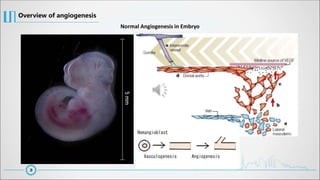
Overview of angiogenesis
Normal Angiogenesis in Embryo
4
Overview of angiogenesis
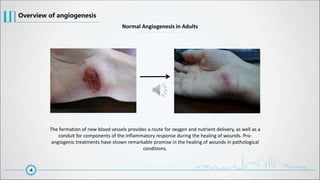
Normal Angiogenesis in Adults
The formation of new blood vessels provides a route for oxygen and nutrient delivery, as well as a
conduit for components of the inflammatory response during the healing of wounds. Pro-
angiogenic treatments have shown remarkable promise in the healing of wounds in pathological
conditions.
5
The angiogenic process
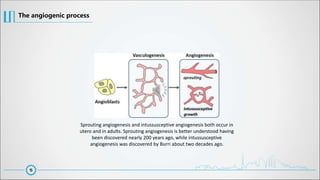
Sprouting angiogenesis and intussusceptive angiogenesis both occur in
utero and in adults. Sprouting angiogenesis is better understood having
been discovered nearly 200 years ago, while intussusceptive
angiogenesis was discovered by Burri about two decades ago.
6
The angiogenic process
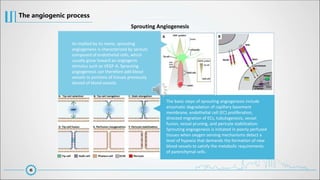
Sprouting Angiogenesis
As implied by its name, sprouting
angiogenesis is characterized by sprouts
composed of endothelial cells, which
usually grow toward an angiogenic
stimulus such as VEGF-A. Sprouting
angiogenesis can therefore add blood
vessels to portions of tissues previously
devoid of blood vessels.
The basic steps of sprouting angiogenesis include
enzymatic degradation of capillary basement
membrane, endothelial cell (EC) proliferation,
directed migration of ECs, tubulogenesis, vessel
fusion, vessel pruning, and pericyte stabilization.
Sprouting angiogenesis is initiated in poorly perfused
tissues when oxygen sensing mechanisms detect a
level of hypoxia that demands the formation of new
blood vessels to satisfy the metabolic requirements
of parenchymal cells.
7
Intussusceptive Angiogenesis
The angiogenic process
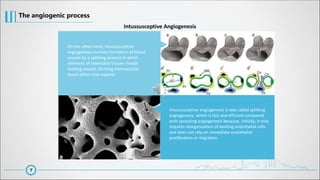
On the other hand, intussusceptive
angiogenesis involves formation of blood
vessels by a splitting process in which
elements of interstitial tissues invade
existing vessels, forming transvascular
tissue pillars that expand.
Intussusceptive angiogenesis is also called splitting
angiogenesis, which is fast and efficient compared
with sprouting angiogenesis because, initially, it only
requires reorganization of existing endothelial cells
and does not rely on immediate endothelial
proliferation or migration.
8
Angiogenesis is regulated by a balance between activators and inhibitors.
Regulation of angiogenesis
9
Anti-
angiogenic
factor
Pro-
angiogenic
factor
Activators and Inhibitors of Angiogenesis
Negative regulators
or inhibitors of
vessel growth need
to also be down-
regulated
Up-regulation of the
activity of
angiogenic factors is
itself not sufficient
for angiogenesis
10
Table 1 Positive and negative regulation of angiogenesis
Activators Inhibitors
Angiognin Angiostatin (plasminogen fragment)
Angiopoietin-1 Anti-angiogenic anti-thrombin III
AC133 Canstatin
VEGF Vasculostatin
Integrins, αVβ3, αVβ5, α5β1 Interferon inducible protein (IP-10)
IL-8 IL-4, IL-12, IL-18
MMPs Kringle-5(plasminogen fragment)
Pleiotrophin (PTN) PEDF (pigment epithelium derived growth factor)
TNF-α Tissue inhibitor of metalloproteinases (TIMPs)
VE cadherin TSP-1
VEGF Vasculostatin
Regulation of angiogenesis
11
Although a vast variety of growth factors and cytokines act as
inducers of angiogenesis, vascular endothelial growth factor
(VEGF) is the most specific growth factor for vascular
endothelium.
VEGF receptors are type III receptor tyrosine kinases, VEGFR1
(Flt-1; fms-like tyrosine kinase) and VEGFR2 (Flk-1/KDR; kinase
insert domain containing receptor), are expressed primarily on
endothelial cells.Gene targeting studies show that both VEGFR1
and VEGFR2 are essential for the development of the
embryonic vasculature in mice. Flk-1 is considered the most
potent mitogenic receptor and neuropilin aids in the binding of
VEGF to Flk-1, thus increasing its mitogenic capability.
VEGF and their receptors have been the most “wanted” target
for angiogenic/anti-angiogenic therapy in angiogenesis-
dependent pathological conditions.
Regulation of angiogenesis
Angiogenesis Activators
12
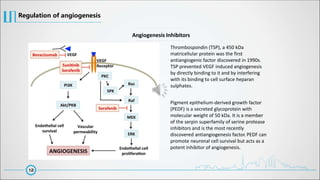
Pigment epithelium-derived growth factor
(PEDF) is a secreted glycoprotein with
molecular weight of 50 kDa. It is a member
of the serpin superfamily of serine protease
inhibitors and is the most recently
discovered antiangiogenesis factor. PEDF can
promote neuronal cell survival but acts as a
potent inhibitor of angiogenesis.
Regulation of angiogenesis
Angiogenesis Inhibitors
Thrombospondin (TSP), a 450 kDa
matricellular protein was the first
antiangiogenic factor discovered in 1990s.
TSP prevented VEGF induced angiogenesis
by directly binding to it and by interfering
with its binding to cell surface heparan
sulphates.
13
Therapeutic angiogenesis
The pathological disruption of angiogenesis can be caused by either vascular insufficiency
(myocardial or critical limb ischemia) or vascular overgrowth (hemangiomas, tumors, and
retinopathies) (Table 2). Thus, therapeutic benefits may be realized by manipulating
angiogenesis.
14
Stimulation of angiogenesis
Induction of collateral vessel
formation: Myocardial ischemia,
Peripheral ischemia, Cerebral ischemia
After blood vessels blockage (occulsion),
collateral vessels can be developed to improve
blood supply to the area.
Wound Healing Intricate process in which the skin (or another
organ-tissue) repairs itself after injury.
Angiogenesis occurs concurrently with fibroblast
proliferation when endothelial cells migrate to
the area of the wound
Reconstructive surgery Surgery to restore the form and function of the
body
Therapeutic angiogenesis
Therapeutic angiogenic drugs that accelerate the angiogenesis process are
useful for treating diseases of deficient angiogenesis.
15
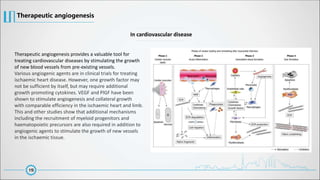
Therapeutic angiogenesis provides a valuable tool for
treating cardiovascular diseases by stimulating the growth
of new blood vessels from pre-existing vessels.
Various angiogenic agents are in clinical trials for treating
ischaemic heart disease. However, one growth factor may
not be sufficient by itself, but may require additional
growth promoting cytokines. VEGF and PlGF have been
shown to stimulate angiogenesis and collateral growth
with comparable efficiency in the ischaemic heart and limb.
This and other studies show that additional mechanisms
including the recruitment of myeloid progenitors and
haematopoietic precursors are also required in addition to
angiogenic agents to stimulate the growth of new vessels
in the ischaemic tissue.
In cardiovascular disease
Therapeutic angiogenesis
16
The formation of new blood vessels provides a route for oxygen
and nutrient delivery, as well as a conduit for components of the
inflammatory response during the healing of wounds. Pro-
angiogenic treatments have shown remarkable promise in the
healing of wounds in pathological conditions. Kirchner et al
reported that topical use of VEGF had 50% improvement in time
for wound healing in diabetic mice. Galeano et al also suggested
VEGF gene transfer might be a new approach to treat wound
healing disorders associated with diabetes. It is encouraging that
recombinant platelet derived growth factor-BB (rhPDGF-BB) has
been approved to treat diabetic neuropathic foot ulcers.
In wound healing
Therapeutic angiogenesis
17
Recently stem cell derived vascular cells or endothelial
progenitor cells (EPCs) have attracted significant attention
because of their capability for (re)vascularisation called
vasculogenesis. Vasculogenesis resembles the embryological
process where the haematopoietic/endothelial progenitors,
“haemangioblasts” differentiate into blood cells as well as
blood vessels.
The therapeutic potential of stem cells can be further
enhanced by combining with gene therapy. In this approach,
stem cells can be genetically modified prior to transplantation
in such a way that particular cellular processes are
strategically exploited. Gene delivery can be used to over-
express desired therapeutic factors to induce a biological
response. In contrast to growth factor delivery, gene delivery
may also be utilized to up-regulate expression of intracellular
transcription factors or cell surface receptors. These
strategies offer the advantage of controlling cell behavior at
the intracellular signaling level.
In tissue remodeling
Therapeutic angiogenesis
18
Antiangiogenic Therapies
Hemangiomas Ophthalmopathy Arthritis Cancer
Interferon alpha-2a Macugen
Visudyne
Bevacizumab
Nexavar
Minocycline
TNP-470
19
Antiangiogenic therapies
Hemangiomas occur in 1 out of 100 neonates
and in 1 out of 5 premature infants.
About 10% of them may have serious tissue
damage that includes interfering with a vital
organ, obstructive airway, heart failure, or
Kasabach-Merritt syndrome. Kasabach-Merritt
syndrome, a platelet-trapping
thrombocytopenic coagulopathy, and hepatic
hemangiomas have a mortality rate of 30%-
50%.
Interferon alpha-2a (IFNα-2a) is an angiogenic
agent that could be useful for treating these
hemangiomas. It was also found that therapy
with IFNα-2a accelerated the tumor
regression in 18 of 20 hemangioma patients.
IFNα-2a suppresses the production of FGFs in
human tumor cells, which could work for
hemangiomas because bFGF is an angiogenic
factor that is overexpressed in hemangiomas.
Interferon Alpha-2a to Treat Hemangiomas
20
Ocular Neovascularization
Antiangiogenic therapies
Inhibiting VEGF is presently an antiangiogenic therapy that is approved for
ophthalmic conditions. Two currently approved antiangiogenic therapies for
ophthalmic diseases are an anti-VEGF aptamer (pegaptanib, Macugen) and a
Fab fragment of a monoclonal antibody directed against VEGF (ranibizumab,
Lucentis). A photodynamic therapy called Visudyne (QLT Therapeutics/CIBA
Vision) has shown effectiveness for treating macular degeneration and was
the first FDA-approved blood vessel therapy for eye disease in 2004.
21
Rheumatoid Arthritis
Antiangiogenic therapies
Clinical trials of angiogenic inhibitors have
not been performed yet in patients with
arthritis; however, minocycline and TNP-
470 (also known as AGM-470) have shown
efficacy as potent inhibitors of the
vascular pannus in experimental arthritis.
Angiogenesis plays a critical role
in the growth and spread of
cancer because a blood supply is
necessary for tumor growth and
metastases. Many natural or
synthetic angiogenesis inhibitors,
also called antiangiogenic agents,
have been studied to prevent or
slow the growth of cancer.
Bevacizumab (Avastin) is a
monoclonal antibody that
specifically recognizes and binds
to VEGF, which prevents VEGF
from activating VEGFR.
22
Cancer
Antiangiogenic therapies
The other FDA-approved
antiangiogenic drugs are
sorafenib (Nexavar) for
hepatocellular carcinoma and
kidney cancer, sunitinib (sutent)
for kidney cancer and
neuroendocrine tumors,
pazopanib (votrient) for kidney
cancer and neuroendocrine
tumors, and everolimus
(Afinitor) for kidney cancer.
Researchers are exploring the
use of angiogenesis inhibitors in
some clinical trials.
Angiogenesis

Angiogenesis

  • 2.
    1 CONTENT Overview of angiogenesisThe angiogenic process Regulation of angiogenesis Therapeutic angiogenesis Antiangiogenic therapies
  • 3.
    2 Overview of angiogenesis Angiogenesisis the growth of blood vessels from the existing vasculature. It occurs throughout life in both health and disease, beginning in utero and continuing on through old age. Angiogenesis
  • 4.
    3 Overview of angiogenesis NormalAngiogenesis in Embryo
  • 5.
    4 Overview of angiogenesis NormalAngiogenesis in Adults The formation of new blood vessels provides a route for oxygen and nutrient delivery, as well as a conduit for components of the inflammatory response during the healing of wounds. Pro- angiogenic treatments have shown remarkable promise in the healing of wounds in pathological conditions.
  • 6.
    5 The angiogenic process Sproutingangiogenesis and intussusceptive angiogenesis both occur in utero and in adults. Sprouting angiogenesis is better understood having been discovered nearly 200 years ago, while intussusceptive angiogenesis was discovered by Burri about two decades ago.
  • 7.
    6 The angiogenic process SproutingAngiogenesis As implied by its name, sprouting angiogenesis is characterized by sprouts composed of endothelial cells, which usually grow toward an angiogenic stimulus such as VEGF-A. Sprouting angiogenesis can therefore add blood vessels to portions of tissues previously devoid of blood vessels. The basic steps of sprouting angiogenesis include enzymatic degradation of capillary basement membrane, endothelial cell (EC) proliferation, directed migration of ECs, tubulogenesis, vessel fusion, vessel pruning, and pericyte stabilization. Sprouting angiogenesis is initiated in poorly perfused tissues when oxygen sensing mechanisms detect a level of hypoxia that demands the formation of new blood vessels to satisfy the metabolic requirements of parenchymal cells.
  • 8.
    7 Intussusceptive Angiogenesis The angiogenicprocess On the other hand, intussusceptive angiogenesis involves formation of blood vessels by a splitting process in which elements of interstitial tissues invade existing vessels, forming transvascular tissue pillars that expand. Intussusceptive angiogenesis is also called splitting angiogenesis, which is fast and efficient compared with sprouting angiogenesis because, initially, it only requires reorganization of existing endothelial cells and does not rely on immediate endothelial proliferation or migration.
  • 9.
    8 Angiogenesis is regulatedby a balance between activators and inhibitors. Regulation of angiogenesis
  • 10.
    9 Anti- angiogenic factor Pro- angiogenic factor Activators and Inhibitorsof Angiogenesis Negative regulators or inhibitors of vessel growth need to also be down- regulated Up-regulation of the activity of angiogenic factors is itself not sufficient for angiogenesis
  • 11.
    10 Table 1 Positiveand negative regulation of angiogenesis Activators Inhibitors Angiognin Angiostatin (plasminogen fragment) Angiopoietin-1 Anti-angiogenic anti-thrombin III AC133 Canstatin VEGF Vasculostatin Integrins, αVβ3, αVβ5, α5β1 Interferon inducible protein (IP-10) IL-8 IL-4, IL-12, IL-18 MMPs Kringle-5(plasminogen fragment) Pleiotrophin (PTN) PEDF (pigment epithelium derived growth factor) TNF-α Tissue inhibitor of metalloproteinases (TIMPs) VE cadherin TSP-1 VEGF Vasculostatin Regulation of angiogenesis
  • 12.
    11 Although a vastvariety of growth factors and cytokines act as inducers of angiogenesis, vascular endothelial growth factor (VEGF) is the most specific growth factor for vascular endothelium. VEGF receptors are type III receptor tyrosine kinases, VEGFR1 (Flt-1; fms-like tyrosine kinase) and VEGFR2 (Flk-1/KDR; kinase insert domain containing receptor), are expressed primarily on endothelial cells.Gene targeting studies show that both VEGFR1 and VEGFR2 are essential for the development of the embryonic vasculature in mice. Flk-1 is considered the most potent mitogenic receptor and neuropilin aids in the binding of VEGF to Flk-1, thus increasing its mitogenic capability. VEGF and their receptors have been the most “wanted” target for angiogenic/anti-angiogenic therapy in angiogenesis- dependent pathological conditions. Regulation of angiogenesis Angiogenesis Activators
  • 13.
    12 Pigment epithelium-derived growthfactor (PEDF) is a secreted glycoprotein with molecular weight of 50 kDa. It is a member of the serpin superfamily of serine protease inhibitors and is the most recently discovered antiangiogenesis factor. PEDF can promote neuronal cell survival but acts as a potent inhibitor of angiogenesis. Regulation of angiogenesis Angiogenesis Inhibitors Thrombospondin (TSP), a 450 kDa matricellular protein was the first antiangiogenic factor discovered in 1990s. TSP prevented VEGF induced angiogenesis by directly binding to it and by interfering with its binding to cell surface heparan sulphates.
  • 14.
    13 Therapeutic angiogenesis The pathologicaldisruption of angiogenesis can be caused by either vascular insufficiency (myocardial or critical limb ischemia) or vascular overgrowth (hemangiomas, tumors, and retinopathies) (Table 2). Thus, therapeutic benefits may be realized by manipulating angiogenesis.
  • 15.
    14 Stimulation of angiogenesis Inductionof collateral vessel formation: Myocardial ischemia, Peripheral ischemia, Cerebral ischemia After blood vessels blockage (occulsion), collateral vessels can be developed to improve blood supply to the area. Wound Healing Intricate process in which the skin (or another organ-tissue) repairs itself after injury. Angiogenesis occurs concurrently with fibroblast proliferation when endothelial cells migrate to the area of the wound Reconstructive surgery Surgery to restore the form and function of the body Therapeutic angiogenesis Therapeutic angiogenic drugs that accelerate the angiogenesis process are useful for treating diseases of deficient angiogenesis.
  • 16.
    15 Therapeutic angiogenesis providesa valuable tool for treating cardiovascular diseases by stimulating the growth of new blood vessels from pre-existing vessels. Various angiogenic agents are in clinical trials for treating ischaemic heart disease. However, one growth factor may not be sufficient by itself, but may require additional growth promoting cytokines. VEGF and PlGF have been shown to stimulate angiogenesis and collateral growth with comparable efficiency in the ischaemic heart and limb. This and other studies show that additional mechanisms including the recruitment of myeloid progenitors and haematopoietic precursors are also required in addition to angiogenic agents to stimulate the growth of new vessels in the ischaemic tissue. In cardiovascular disease Therapeutic angiogenesis
  • 17.
    16 The formation ofnew blood vessels provides a route for oxygen and nutrient delivery, as well as a conduit for components of the inflammatory response during the healing of wounds. Pro- angiogenic treatments have shown remarkable promise in the healing of wounds in pathological conditions. Kirchner et al reported that topical use of VEGF had 50% improvement in time for wound healing in diabetic mice. Galeano et al also suggested VEGF gene transfer might be a new approach to treat wound healing disorders associated with diabetes. It is encouraging that recombinant platelet derived growth factor-BB (rhPDGF-BB) has been approved to treat diabetic neuropathic foot ulcers. In wound healing Therapeutic angiogenesis
  • 18.
    17 Recently stem cellderived vascular cells or endothelial progenitor cells (EPCs) have attracted significant attention because of their capability for (re)vascularisation called vasculogenesis. Vasculogenesis resembles the embryological process where the haematopoietic/endothelial progenitors, “haemangioblasts” differentiate into blood cells as well as blood vessels. The therapeutic potential of stem cells can be further enhanced by combining with gene therapy. In this approach, stem cells can be genetically modified prior to transplantation in such a way that particular cellular processes are strategically exploited. Gene delivery can be used to over- express desired therapeutic factors to induce a biological response. In contrast to growth factor delivery, gene delivery may also be utilized to up-regulate expression of intracellular transcription factors or cell surface receptors. These strategies offer the advantage of controlling cell behavior at the intracellular signaling level. In tissue remodeling Therapeutic angiogenesis
  • 19.
    18 Antiangiogenic Therapies Hemangiomas OphthalmopathyArthritis Cancer Interferon alpha-2a Macugen Visudyne Bevacizumab Nexavar Minocycline TNP-470
  • 20.
    19 Antiangiogenic therapies Hemangiomas occurin 1 out of 100 neonates and in 1 out of 5 premature infants. About 10% of them may have serious tissue damage that includes interfering with a vital organ, obstructive airway, heart failure, or Kasabach-Merritt syndrome. Kasabach-Merritt syndrome, a platelet-trapping thrombocytopenic coagulopathy, and hepatic hemangiomas have a mortality rate of 30%- 50%. Interferon alpha-2a (IFNα-2a) is an angiogenic agent that could be useful for treating these hemangiomas. It was also found that therapy with IFNα-2a accelerated the tumor regression in 18 of 20 hemangioma patients. IFNα-2a suppresses the production of FGFs in human tumor cells, which could work for hemangiomas because bFGF is an angiogenic factor that is overexpressed in hemangiomas. Interferon Alpha-2a to Treat Hemangiomas
  • 21.
    20 Ocular Neovascularization Antiangiogenic therapies InhibitingVEGF is presently an antiangiogenic therapy that is approved for ophthalmic conditions. Two currently approved antiangiogenic therapies for ophthalmic diseases are an anti-VEGF aptamer (pegaptanib, Macugen) and a Fab fragment of a monoclonal antibody directed against VEGF (ranibizumab, Lucentis). A photodynamic therapy called Visudyne (QLT Therapeutics/CIBA Vision) has shown effectiveness for treating macular degeneration and was the first FDA-approved blood vessel therapy for eye disease in 2004.
  • 22.
    21 Rheumatoid Arthritis Antiangiogenic therapies Clinicaltrials of angiogenic inhibitors have not been performed yet in patients with arthritis; however, minocycline and TNP- 470 (also known as AGM-470) have shown efficacy as potent inhibitors of the vascular pannus in experimental arthritis.
  • 23.
    Angiogenesis plays acritical role in the growth and spread of cancer because a blood supply is necessary for tumor growth and metastases. Many natural or synthetic angiogenesis inhibitors, also called antiangiogenic agents, have been studied to prevent or slow the growth of cancer. Bevacizumab (Avastin) is a monoclonal antibody that specifically recognizes and binds to VEGF, which prevents VEGF from activating VEGFR. 22 Cancer Antiangiogenic therapies The other FDA-approved antiangiogenic drugs are sorafenib (Nexavar) for hepatocellular carcinoma and kidney cancer, sunitinib (sutent) for kidney cancer and neuroendocrine tumors, pazopanib (votrient) for kidney cancer and neuroendocrine tumors, and everolimus (Afinitor) for kidney cancer. Researchers are exploring the use of angiogenesis inhibitors in some clinical trials.