DEALING WITH
ANGER
HOW DO I DO IT?
OBJECTIVES:
• 1. Define Anger
• 2. What Causes Anger
• 3. Anger vs. Aggression
• 4. Physical symptoms of anger.
5. Anger Trigggers and Anger style
• 6. Dealing with Anger effectively
WHAT IS ANGER?
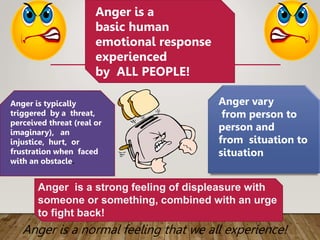
Anger is a normal feeling that we all experience!
Anger is a
basic human
emotional response
experienced
by ALL PEOPLE!
Anger is typically
triggered by a threat,
perceived threat (real or
imaginary), an
injustice, hurt, or
frustration when faced
with an obstacle.
Anger vary
from person to
person and
from situation to
situation
Anger is a strong feeling of displeasure with
someone or something, combined with an urge
to fight back!
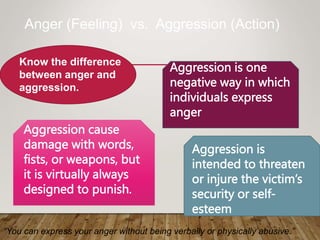
Aggression is one
negative way in which
individuals express
anger
Aggression is
intended to threaten
or injure the victim’s
security or self-
esteem
Aggression cause
damage with words,
fists, or weapons, but
it is virtually always
designed to punish.
Know the difference
between anger and
aggression.
“You can express your anger without being verbally or physically abusive.”
Anger (Feeling) vs. Aggression (Action)
WHAT ARE
SOMETHING OF
THE THINGS
WHICH MAKE YOU
ANGRY?
TRIGGERS
WHAT BUGS YOU?
• Different things can make
different people angry, but
everyone feels angry sometimes.
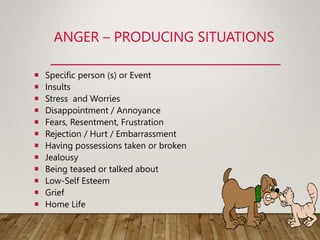
ANGER – PRODUCING SITUATIONS
 Specific person (s) or Event
 Insults
 Stress and Worries
 Disappointment / Annoyance
 Fears, Resentment, Frustration
 Rejection / Hurt / Embarrassment
 Having possessions taken or broken
 Jealousy
 Being teased or talked about
 Low-Self Esteem
 Grief
 Home Life
DEALING WITH ANGER
• If you know your anger triggers, then you can either:
• 1. Try to avoid them
• 2. Learn how to deal with them.
• 3. Learn how to put your feelings
into words, explore and name the
emotions (hurt, confused, shame,
etc.
POOR HANDLED ANGER CAN CAUSE MANY PROBLEMS
There are two issues:
Controlling Anger
Reacting to Anger
CONTROLLING YOUR ANGER
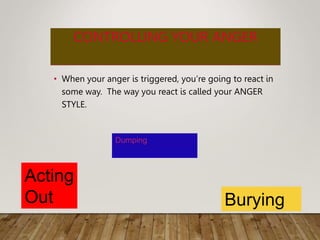
• When your anger is triggered, you’re going to react in
some way. The way you react is called your ANGER
STYLE.
Acting
Out
Dumping
Burying
UNCONTROLLED ANGER
(OUT -OF CONTROL)
• Can trigger a large number of antisocial
behaviors
• Can trigger Negative consequences
• Can hurt Physical Health
You can’t always control the situation
you’re in or how it makes you feel, but you
can control how you express your anger.
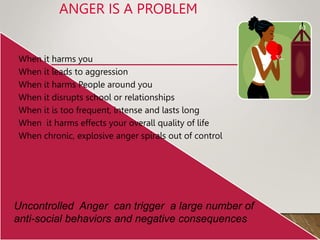
ANGER IS A PROBLEM
 When it harms you
 When it leads to aggression
 When it harms People around you
 When it disrupts school or relationships
 When it is too frequent, intense and lasts long
 When it harms effects your overall quality of life
 When chronic, explosive anger spirals out of control
Uncontrolled Anger can trigger a large number of
anti-social behaviors and negative consequences
CONSEQUENCES OF
ACTING OUT
• Can lead to legal troubles
• Can lead to problems at school / home /
community
• Relationships Problems
• Substance Abuse
• Physical Problems
• Emotional Problems
• Low Self Esteem
• Others
HOW DOES ANGER
MAKE YOU
FEEL PHYSICALLY?
Feeling angry has a physical reaction that is usually unpleasant
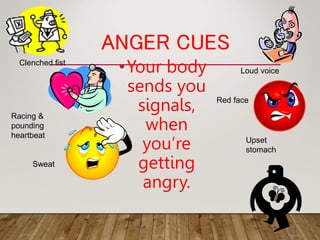
ANGER CUES
•Your body
sends you
signals,
when
you’re
getting
angry.
Clenched fist
Loud voice
Sweat
Red face
Racing &
pounding
heartbeat
Upset
stomach
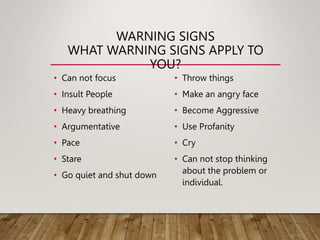
WARNING SIGNS
WHAT WARNING SIGNS APPLY TO
YOU?
• Can not focus
• Insult People
• Heavy breathing
• Argumentative
• Pace
• Stare
• Go quiet and shut down
• Throw things
• Make an angry face
• Become Aggressive
• Use Profanity
• Cry
• Can not stop thinking
about the problem or
individual.
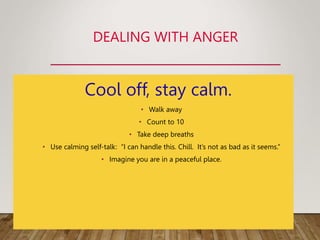
DEALING WITH ANGER
Cool off, stay calm.
• Walk away
• Count to 10
• Take deep breaths
• Use calming self-talk: “I can handle this. Chill. It’s not as bad as it seems.”
• Imagine you are in a peaceful place.
 2. Give yourself some time to sort things out.
 Write the problem down on paper.
 Think it through. Ask yourself: what really
happened? How was I triggered? What were my
cues?
 Talk it over with a friend or adult you trust.
 Look at the situation from a different viewpoint.
Turn your angry energy into a change for the better
 Channel your angry energy into a physical activity.
 Try to solve the problem.
 Try to accept situations you can’t change.
 Changing our view of a situation can change our
reaction to it.
“Don’t let anger control you,
take control over it”
EXERCISE SELF-CONTROL
Self-Control is the ability to resist
inappropriate behavior, dealing effectively
with emotions, such as anger and developing patience.
Maintaining Self-Control is key to Managing Anger
EVERYBODY GETS
ANGRY
•That’s just how it is.
•The difference comes in what you do
about it.
SO:
GET A GRIP!!!
DEALING WITH ANGER
 When you find yourself angry,
REMEMBER the only behavior
you can manage is YOUR own!!!
 So, pay attention to your anger
cues.
 And, if you feel like you’re going
to lose it…

Anger Management.ppt

  • 2.
  • 3.
    OBJECTIVES: • 1. DefineAnger • 2. What Causes Anger • 3. Anger vs. Aggression • 4. Physical symptoms of anger. 5. Anger Trigggers and Anger style • 6. Dealing with Anger effectively
  • 4.
  • 5.
    Anger is anormal feeling that we all experience! Anger is a basic human emotional response experienced by ALL PEOPLE! Anger is typically triggered by a threat, perceived threat (real or imaginary), an injustice, hurt, or frustration when faced with an obstacle. Anger vary from person to person and from situation to situation Anger is a strong feeling of displeasure with someone or something, combined with an urge to fight back!
  • 7.
    Aggression is one negativeway in which individuals express anger Aggression is intended to threaten or injure the victim’s security or self- esteem Aggression cause damage with words, fists, or weapons, but it is virtually always designed to punish. Know the difference between anger and aggression. “You can express your anger without being verbally or physically abusive.” Anger (Feeling) vs. Aggression (Action)
  • 8.
    WHAT ARE SOMETHING OF THETHINGS WHICH MAKE YOU ANGRY?
  • 9.
    TRIGGERS WHAT BUGS YOU? •Different things can make different people angry, but everyone feels angry sometimes.
  • 10.
    ANGER – PRODUCINGSITUATIONS  Specific person (s) or Event  Insults  Stress and Worries  Disappointment / Annoyance  Fears, Resentment, Frustration  Rejection / Hurt / Embarrassment  Having possessions taken or broken  Jealousy  Being teased or talked about  Low-Self Esteem  Grief  Home Life
  • 11.
    DEALING WITH ANGER •If you know your anger triggers, then you can either: • 1. Try to avoid them • 2. Learn how to deal with them. • 3. Learn how to put your feelings into words, explore and name the emotions (hurt, confused, shame, etc.
  • 12.
    POOR HANDLED ANGERCAN CAUSE MANY PROBLEMS There are two issues: Controlling Anger Reacting to Anger
  • 13.
    CONTROLLING YOUR ANGER •When your anger is triggered, you’re going to react in some way. The way you react is called your ANGER STYLE. Acting Out Dumping Burying
  • 14.
    UNCONTROLLED ANGER (OUT -OFCONTROL) • Can trigger a large number of antisocial behaviors • Can trigger Negative consequences • Can hurt Physical Health You can’t always control the situation you’re in or how it makes you feel, but you can control how you express your anger.
  • 15.
    ANGER IS APROBLEM  When it harms you  When it leads to aggression  When it harms People around you  When it disrupts school or relationships  When it is too frequent, intense and lasts long  When it harms effects your overall quality of life  When chronic, explosive anger spirals out of control Uncontrolled Anger can trigger a large number of anti-social behaviors and negative consequences
  • 16.
    CONSEQUENCES OF ACTING OUT •Can lead to legal troubles • Can lead to problems at school / home / community • Relationships Problems • Substance Abuse • Physical Problems • Emotional Problems • Low Self Esteem • Others
  • 17.
    HOW DOES ANGER MAKEYOU FEEL PHYSICALLY? Feeling angry has a physical reaction that is usually unpleasant
  • 18.
    ANGER CUES •Your body sendsyou signals, when you’re getting angry. Clenched fist Loud voice Sweat Red face Racing & pounding heartbeat Upset stomach
  • 19.
    WARNING SIGNS WHAT WARNINGSIGNS APPLY TO YOU? • Can not focus • Insult People • Heavy breathing • Argumentative • Pace • Stare • Go quiet and shut down • Throw things • Make an angry face • Become Aggressive • Use Profanity • Cry • Can not stop thinking about the problem or individual.
  • 20.
    DEALING WITH ANGER Cooloff, stay calm. • Walk away • Count to 10 • Take deep breaths • Use calming self-talk: “I can handle this. Chill. It’s not as bad as it seems.” • Imagine you are in a peaceful place.
  • 21.
     2. Giveyourself some time to sort things out.  Write the problem down on paper.  Think it through. Ask yourself: what really happened? How was I triggered? What were my cues?  Talk it over with a friend or adult you trust.  Look at the situation from a different viewpoint.
  • 22.
    Turn your angryenergy into a change for the better  Channel your angry energy into a physical activity.  Try to solve the problem.  Try to accept situations you can’t change.  Changing our view of a situation can change our reaction to it. “Don’t let anger control you, take control over it”
  • 23.
    EXERCISE SELF-CONTROL Self-Control isthe ability to resist inappropriate behavior, dealing effectively with emotions, such as anger and developing patience. Maintaining Self-Control is key to Managing Anger
  • 24.
    EVERYBODY GETS ANGRY •That’s justhow it is. •The difference comes in what you do about it. SO: GET A GRIP!!!
  • 25.
    DEALING WITH ANGER When you find yourself angry, REMEMBER the only behavior you can manage is YOUR own!!!  So, pay attention to your anger cues.  And, if you feel like you’re going to lose it…

Editor's Notes

  • #6 Anger is a normal human emotion. Everyone feels annoyed, frustrated, irritated, or even very angry from time to time. Anger is a feeling in response to frustration, or injury expressing yourself in an impulsive manner without thought a mixture of emotional, physiological, and cognitive elements heart rate and blood pressure go up levels of energy hormones, adrenaline and nonadrenaline go up an emotional state that varies in intensity from mild irritation to intense fury and rage
  • #7 Anger is an emotion and it is important that we identify our feelings including anger- At times we
  • #8 Natural ways to express anger is to respond Aggressively. Anger often inspires powerful, often aggressive feelings and behaviors – that allow us to fight and defend ourselves when we are attacked. It is extremely important to recognize the difference between anger and aggression. Although the two are similar and may occur together, anger is an emotion that may result from frustration, fear, stress, annoyance, low-self-esteem disappointment and resentment; aggression is a negative act intended to hurt someone or something. Anger can sometimes feel intense and overwhelming but it does not necessarily lead to violent or aggressive behavior.
  • #9 Review the worksheet and have young people share some information Asks students how anger makes them feel physically.
  • #10 Different things can make dif
  • #13 Some people try to pretend they aren’t angry. Other People feel they anger is out of Control and they can not handle it.
  • #16 Anger may do more harm than any other emotion. It upsets at least two people – the aggressor and the aggressed against. The overall effects of anger are enormous: anger is related to violence, crime, spouse and child abuse, divorce, stormy relationships, poor working conditions, poor physical health – headaches, hypertension, GI disturbances, heart attacks, emotional disorders and so on.
  • #19 What are your anger cues?