Android
                  Security


   Jesus Cox                  Richard Rand
Jonathan Heide               Luis Rodriguez
Overview
•   Built on the Linux kernel.
•   Android is open source, meaning that developers can
    customize the operating system to suit each device.
•   As a result, Android has been adapted to a wide array
    of mobile devices, with varying hardware, price
    points, and market segments.
•   Manufacturers have also been able to experiment
    with many styles of Graphical User Interfaces.
•   This diversity has been a security challenge, because
    it takes longer to update the OS to fix security flaws.
Permissions
                              ACCESS_CHECKIN_PROPERTIES      Allows read/write access to the "properties" table in the
Traditionally UNIX security                                  checkin database, to change values that get uploaded.

is about protecting users     ACCESS_COARSE_LOCATION
                              location
                                                             Allows an application to access coarse (e.g., Cell-ID, WiFi)


from each other and the       ACCESS_FINE_LOCATION      Allows an application to access fine (e.g., GPS) location
                              ACCESS_LOCATION_EXTRA_COMMANDS Allows an application to access extra location
operating system from                                   provider commands
                              ACCESS_MOCK_LOCATION      Allows an application to create mock location providers for
users, by limiting the                                  testing
                              ACCESS_NETWORK_STATE      Allows applications to access information about networks
permissions of certain        ACCESS_SURFACE_FLINGER    Allows an application to use SurfaceFlinger's low level
users.                        ACCESS_WIFI_STATE
                                                        features
                                                        Allows applications to access information about Wi-Fi
                                                        networks
                              ACCOUNT_MANAGER           Allows applications to call into AccountAuthenticators.
                              ADD_VOICEMAIL             Allows an application to add voicemails into the system.
Android extends this          AUTHENTICATE_ACCOUNTS     Allows an application to act as an AccountAuthenticator for
concept to protect the        BATTERY_STATS
                                                        the AccountManager
                                                        Allows an application to collect battery statistics
user from apps they           BIND_APPWIDGET            Allows an application to tell the AppWidget service which
                                                        application can access AppWidget's data.
install.                      BIND_DEVICE_ADMIN         Must be required by device administration receiver, to
                                                        ensure that only the system can interact with it.
                              BIND_INPUT_METHOD         Must be required by an InputMethodService, to ensure that
                                                        only the system can bind to it.
                              BIND_REMOTEVIEWS          Must be required by a RemoteViewsService, to ensure that
                                                        only the system can bind to it.
                              BIND_TEXT_SERVICE         Must be required by a TextService (e.g.
                              BIND_VPN_SERVICE          Must be required by an VpnService, to ensure that only the
                                                        system can bind to it.
                              BIND_WALLPAPER            Must be required by a WallpaperService, to ensure that
Permissions

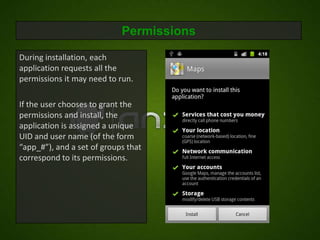
During installation, each
application requests all the
permissions it may need to run.

If the user chooses to grant the
permissions and install, the
application is assigned a unique
UID and user name (of the form
“app_#”), and a set of groups that
correspond to its permissions.
How Zygote Sets UIDS and GIDS:

                              [android/platform/dalvik.git]/vm/native/dalvik_system_Zygote.cpp
Set by Zygote. How?
                              static pid_t forkAndSpecializeCommon(const u4* args, bool
                              isSystemServer)
Before the application is     {
run, the spawning process,        pid_t pid;
                                  uid_t uid = (uid_t) args[0];
zygote, uses standard UNIX        gid_t gid = (gid_t) args[1];
system calls to set its UID       ArrayObject* gids = (ArrayObject *)args[2];
                                         ……
and GIDs.                         pid = fork();
                                  if (pid == 0) {
                                      /* The child process */
                                         ……
                                      err = setgroupsIntarray(gids);
                                         ……
                                      err = setgid(gid);
                                         ……
                                      err = setuid(uid);
                                         ……
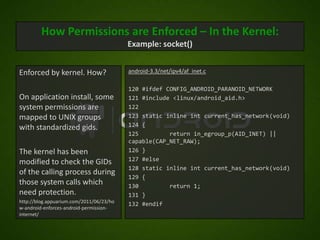
How Permissions are Enforced – In the Kernel:
                           Example: socket()

                           [android/platform/system/core.git]/include/private/android_filesystem_config.h
Enforced by kernel. How?
                           /* The 3000 series are intended for use as supplemental group id's
                           only. */
                           /* They indicate special Android capabilities that the kernel is aware
On application install,    of. */
                           AID_NET_BT_ADMIN 3001 /* bluetooth: create any socket */
some system permissions    AID_NET_BT        3002 /* bluetooth: create sco, rfcomm or l2cap
are mapped to UNIX         sockets */
                           AID_INET          3003 /* can create AF_INET and AF_INET6 sockets */
groups with standardized   AID_NET_RAW       3004 /* can create raw INET sockets */

gids.
How Permissions are Enforced – In the Kernel:
                                          Example: socket()


Enforced by kernel. How?                  android-3.3/net/ipv4/af_inet.c

                                          120 #ifdef CONFIG_ANDROID_PARANOID_NETWORK
On application install, some              121 #include <linux/android_aid.h>
system permissions are                    122
mapped to UNIX groups                     123 static inline int current_has_network(void)
with standardized gids.                   124 {
                                          125         return in_egroup_p(AID_INET) ||
                                          capable(CAP_NET_RAW);
The kernel has been                       126 }
modified to check the GIDs                127 #else
                                          128 static inline int current_has_network(void)
of the calling process during
                                          129 {
those system calls which                  130         return 1;
need protection.                          131 }
http://blog.appuarium.com/2011/06/23/ho
                                          132 #endif
w-android-enforces-android-permission-
internet/
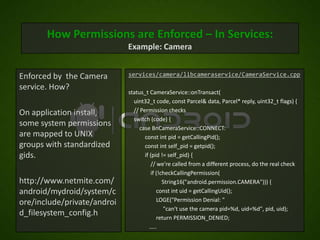
How Permissions are Enforced – In Services:
                             Example: Camera


Enforced by the Camera       services/camera/libcameraservice/CameraService.cpp

service. How?
                             status_t CameraService::onTransact(
                               uint32_t code, const Parcel& data, Parcel* reply, uint32_t flags) {
On application install,        // Permission checks
                               switch (code) {
some system permissions           case BnCameraService::CONNECT:
are mapped to UNIX                  const int pid = getCallingPid();
groups with standardized            const int self_pid = getpid();
gids.                               if (pid != self_pid) {
                                       // we're called from a different process, do the real check
                                       if (!checkCallingPermission(
http://www.netmite.com/                      String16("android.permission.CAMERA"))) {
android/mydroid/system/c                  const int uid = getCallingUid();
ore/include/private/androi                LOGE("Permission Denial: "
                                             "can't use the camera pid=%d, uid=%d", pid, uid);
d_filesystem_config.h                     return PERMISSION_DENIED;
                                       …..
How Permissions are Enforced – In Activities:
                            Example: Phone


Enforced by the Phone       platform_packages_apps_phone/AndroidManifest.xml
                            <activity android:name="OutgoingCallBroadcaster"
activity. How?
                                       android:permission="android.permission.CALL_PHONE">
                                    <!-- CALL action intent filters, for the various ways
An XML attribute called     of initiating an outgoing call. -->
                                    <intent-filter>
permission:                            <action android:name="android.intent.action.CALL" />
http://developer.android.              <category
com/guide/topics/manife     android:name="android.intent.category.DEFAULT" />
st/activity-element.html               <data android:scheme="tel" />
                                           ……..
Remote Kill
REMOVE_ASSET
INSTALL_ASSET
http://jon.oberheide.org/blog/2010/06/25/remote-kill-and-install-on-google-android/
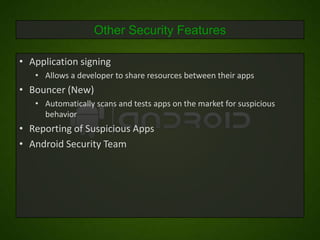
Other Security Features

• Application signing
   • Allows a developer to share resources between their apps
• Bouncer (New)
   • Automatically scans and tests apps on the market for suspicious
     behavior
• Reporting of Suspicious Apps
• Android Security Team
PROBLEMS WITH ANDROID’S
            APPROACH
• Many users are unable to weigh potential risks when granting
  permissions to an application
• No way to be sure that an application will act appropriately based on
  the given permission
• Coarse grained – users must allow all possible permissions for an app
  or developers must create multiple versions.
• Developers tend to ask for more permissions than they need because
  of sparse documentation.
• Sophisticated users are limited by the standard permissions made
  available by Android unless they root the phone.
• “Remote kill“ removes autonomy from the user.
• Difficulty of rolling out OS updates causes vulnerabilities to stick
  around on some devices forever.
• Apps can access external storage without permissions.
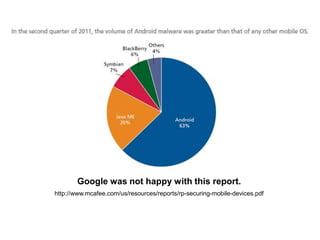
Google was not happy with this report.
http://www.mcafee.com/us/resources/reports/rp-securing-mobile-devices.pdf
Possible Improvements

• Some of the fears about malware on Android are generated by
  antivirus companies to drum up sales
• Require a new permission to read photos or world_readable files
  in general on external storage
• Tighten licensing requirements of Android name and imagery
  around security and updates
• Fix documentation so developers have a better idea of what
  permissions they need
• Use Stowaway to scan the store for apps that take more
  permissions than they need, and inform the developers
• Extend Bouncer to unofficial stores to find more Trojan Horses
  and protect more users

Android security model

  • 1.
    Android Security Jesus Cox Richard Rand Jonathan Heide Luis Rodriguez
  • 2.
    Overview • Built on the Linux kernel. • Android is open source, meaning that developers can customize the operating system to suit each device. • As a result, Android has been adapted to a wide array of mobile devices, with varying hardware, price points, and market segments. • Manufacturers have also been able to experiment with many styles of Graphical User Interfaces. • This diversity has been a security challenge, because it takes longer to update the OS to fix security flaws.
  • 3.
    Permissions ACCESS_CHECKIN_PROPERTIES Allows read/write access to the "properties" table in the Traditionally UNIX security checkin database, to change values that get uploaded. is about protecting users ACCESS_COARSE_LOCATION location Allows an application to access coarse (e.g., Cell-ID, WiFi) from each other and the ACCESS_FINE_LOCATION Allows an application to access fine (e.g., GPS) location ACCESS_LOCATION_EXTRA_COMMANDS Allows an application to access extra location operating system from provider commands ACCESS_MOCK_LOCATION Allows an application to create mock location providers for users, by limiting the testing ACCESS_NETWORK_STATE Allows applications to access information about networks permissions of certain ACCESS_SURFACE_FLINGER Allows an application to use SurfaceFlinger's low level users. ACCESS_WIFI_STATE features Allows applications to access information about Wi-Fi networks ACCOUNT_MANAGER Allows applications to call into AccountAuthenticators. ADD_VOICEMAIL Allows an application to add voicemails into the system. Android extends this AUTHENTICATE_ACCOUNTS Allows an application to act as an AccountAuthenticator for concept to protect the BATTERY_STATS the AccountManager Allows an application to collect battery statistics user from apps they BIND_APPWIDGET Allows an application to tell the AppWidget service which application can access AppWidget's data. install. BIND_DEVICE_ADMIN Must be required by device administration receiver, to ensure that only the system can interact with it. BIND_INPUT_METHOD Must be required by an InputMethodService, to ensure that only the system can bind to it. BIND_REMOTEVIEWS Must be required by a RemoteViewsService, to ensure that only the system can bind to it. BIND_TEXT_SERVICE Must be required by a TextService (e.g. BIND_VPN_SERVICE Must be required by an VpnService, to ensure that only the system can bind to it. BIND_WALLPAPER Must be required by a WallpaperService, to ensure that
  • 4.
    Permissions During installation, each applicationrequests all the permissions it may need to run. If the user chooses to grant the permissions and install, the application is assigned a unique UID and user name (of the form “app_#”), and a set of groups that correspond to its permissions.
  • 5.
    How Zygote SetsUIDS and GIDS: [android/platform/dalvik.git]/vm/native/dalvik_system_Zygote.cpp Set by Zygote. How? static pid_t forkAndSpecializeCommon(const u4* args, bool isSystemServer) Before the application is { run, the spawning process, pid_t pid; uid_t uid = (uid_t) args[0]; zygote, uses standard UNIX gid_t gid = (gid_t) args[1]; system calls to set its UID ArrayObject* gids = (ArrayObject *)args[2]; …… and GIDs. pid = fork(); if (pid == 0) { /* The child process */ …… err = setgroupsIntarray(gids); …… err = setgid(gid); …… err = setuid(uid); ……
  • 6.
    How Permissions areEnforced – In the Kernel: Example: socket() [android/platform/system/core.git]/include/private/android_filesystem_config.h Enforced by kernel. How? /* The 3000 series are intended for use as supplemental group id's only. */ /* They indicate special Android capabilities that the kernel is aware On application install, of. */ AID_NET_BT_ADMIN 3001 /* bluetooth: create any socket */ some system permissions AID_NET_BT 3002 /* bluetooth: create sco, rfcomm or l2cap are mapped to UNIX sockets */ AID_INET 3003 /* can create AF_INET and AF_INET6 sockets */ groups with standardized AID_NET_RAW 3004 /* can create raw INET sockets */ gids.
  • 7.
    How Permissions areEnforced – In the Kernel: Example: socket() Enforced by kernel. How? android-3.3/net/ipv4/af_inet.c 120 #ifdef CONFIG_ANDROID_PARANOID_NETWORK On application install, some 121 #include <linux/android_aid.h> system permissions are 122 mapped to UNIX groups 123 static inline int current_has_network(void) with standardized gids. 124 { 125 return in_egroup_p(AID_INET) || capable(CAP_NET_RAW); The kernel has been 126 } modified to check the GIDs 127 #else 128 static inline int current_has_network(void) of the calling process during 129 { those system calls which 130 return 1; need protection. 131 } http://blog.appuarium.com/2011/06/23/ho 132 #endif w-android-enforces-android-permission- internet/
  • 8.
    How Permissions areEnforced – In Services: Example: Camera Enforced by the Camera services/camera/libcameraservice/CameraService.cpp service. How? status_t CameraService::onTransact( uint32_t code, const Parcel& data, Parcel* reply, uint32_t flags) { On application install, // Permission checks switch (code) { some system permissions case BnCameraService::CONNECT: are mapped to UNIX const int pid = getCallingPid(); groups with standardized const int self_pid = getpid(); gids. if (pid != self_pid) { // we're called from a different process, do the real check if (!checkCallingPermission( http://www.netmite.com/ String16("android.permission.CAMERA"))) { android/mydroid/system/c const int uid = getCallingUid(); ore/include/private/androi LOGE("Permission Denial: " "can't use the camera pid=%d, uid=%d", pid, uid); d_filesystem_config.h return PERMISSION_DENIED; …..
  • 9.
    How Permissions areEnforced – In Activities: Example: Phone Enforced by the Phone platform_packages_apps_phone/AndroidManifest.xml <activity android:name="OutgoingCallBroadcaster" activity. How? android:permission="android.permission.CALL_PHONE"> <!-- CALL action intent filters, for the various ways An XML attribute called of initiating an outgoing call. --> <intent-filter> permission: <action android:name="android.intent.action.CALL" /> http://developer.android. <category com/guide/topics/manife android:name="android.intent.category.DEFAULT" /> st/activity-element.html <data android:scheme="tel" /> ……..
  • 10.
  • 11.
    Other Security Features •Application signing • Allows a developer to share resources between their apps • Bouncer (New) • Automatically scans and tests apps on the market for suspicious behavior • Reporting of Suspicious Apps • Android Security Team
  • 13.
    PROBLEMS WITH ANDROID’S APPROACH • Many users are unable to weigh potential risks when granting permissions to an application • No way to be sure that an application will act appropriately based on the given permission • Coarse grained – users must allow all possible permissions for an app or developers must create multiple versions. • Developers tend to ask for more permissions than they need because of sparse documentation. • Sophisticated users are limited by the standard permissions made available by Android unless they root the phone. • “Remote kill“ removes autonomy from the user. • Difficulty of rolling out OS updates causes vulnerabilities to stick around on some devices forever. • Apps can access external storage without permissions.
  • 14.
    Google was nothappy with this report. http://www.mcafee.com/us/resources/reports/rp-securing-mobile-devices.pdf
  • 15.
    Possible Improvements • Someof the fears about malware on Android are generated by antivirus companies to drum up sales • Require a new permission to read photos or world_readable files in general on external storage • Tighten licensing requirements of Android name and imagery around security and updates • Fix documentation so developers have a better idea of what permissions they need • Use Stowaway to scan the store for apps that take more permissions than they need, and inform the developers • Extend Bouncer to unofficial stores to find more Trojan Horses and protect more users