Presented By:-
MD. Ayub Ali
201411038016
MD. Tofazzal Hossain 201411038066
MD. Mafijur Rahman 201411038072
MD. Azim Uddin 201411038098
Android
Android is a mobile operating system developed by Google, based on
the Linux kernel and designed primarily for touchscreen mobile devices
such as smartphones and tablets.
Android is open source and Google releases the code under the Apache
Software License(ASL)
History
Android Inc. was founded in Palo Alto, California in October 2003 by
Andy Rubin, Rich Miner, Nick Sears, and Chris White.
In July 2005,[12] Google acquired Android Inc. for at least $50 million,
making it a wholly owned subsidiary of Google. Its key employees,
including Rubin, Miner and White, joined Google as part of the
acquisition.
At Google, the team led by Rubin developed a mobile device platform
powered by the Linux kernel.
The first commercially available smartphone running Android was the
HTC Dream, also known as T-Mobile G1, announced on September 23,
2008.
Features
SOFTWARE FEATURES
Integrated browser based on the open source WebKit engine
SQLite for relational data storage
Media support for common audio, video, and still image formats
(MPEG4, H.264, MP3, AAC, AMR, JPG, PNG, GIF)
Dalvik Virtual Machine optimized for mobile devices
HARDWARE FEATURES
Cellular networking : GSM, EDGE, 3G (hardware dependent)
LAN : Bluetooth, and Wi-Fi (hardware dependent)
Graphics Hardware Acceleration
Camera, GPS and Compass (hardware dependent)
Touch screen and accelerometer for motion sensing
Linux Karnel
Linux Version 2.6
Security, Memory & Process Management
Proven driver model
Efficient computing resource management
Stable and proven OS for mobile platform
Libraries
Written in C/C++ - System C Library(libc)
 Display/Graphics(SGL)
Media Libraries
SQLite –RDB engine-light weight
LibWebCore–web browser engine–embeddable web view
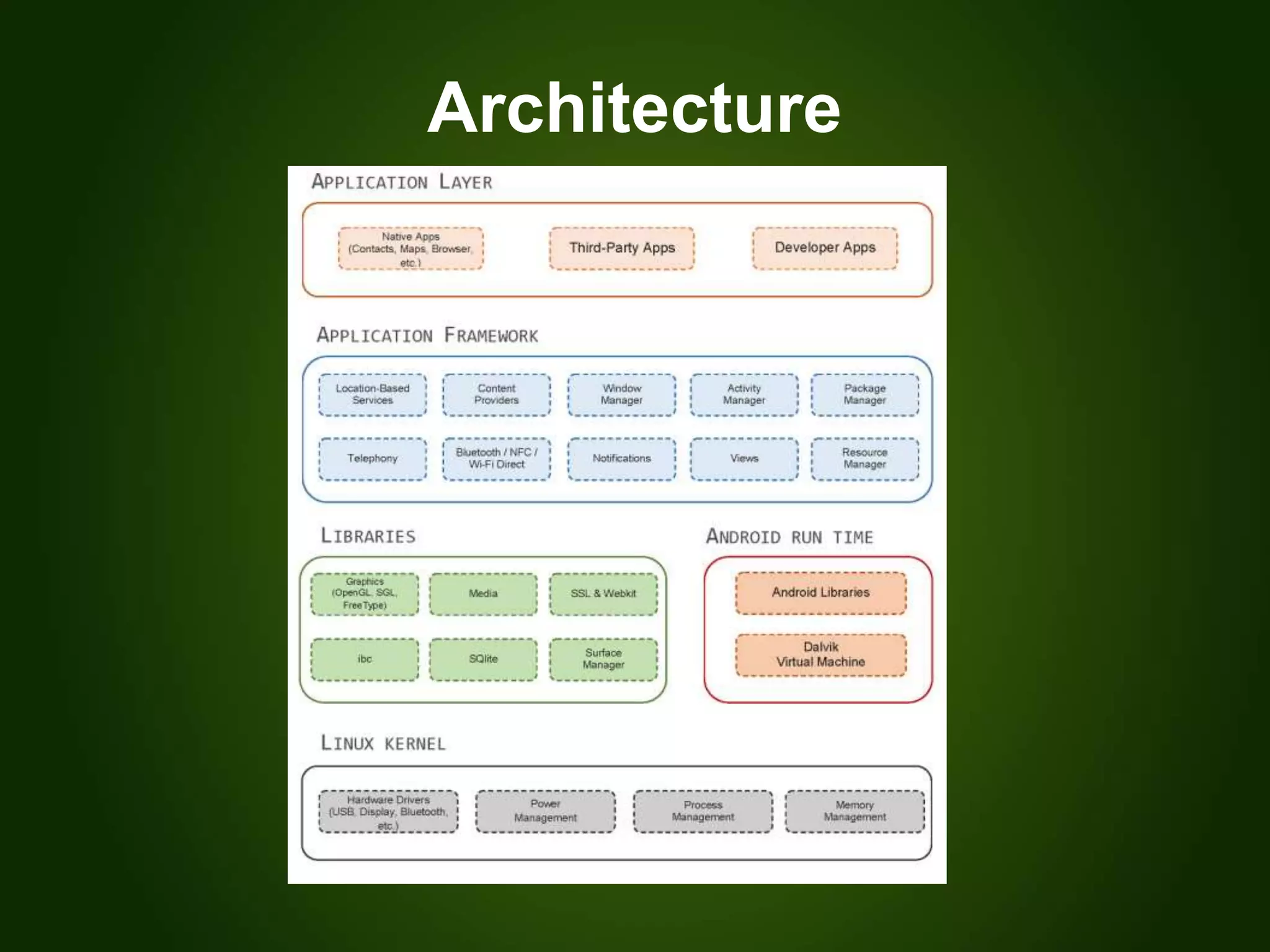
Architecture
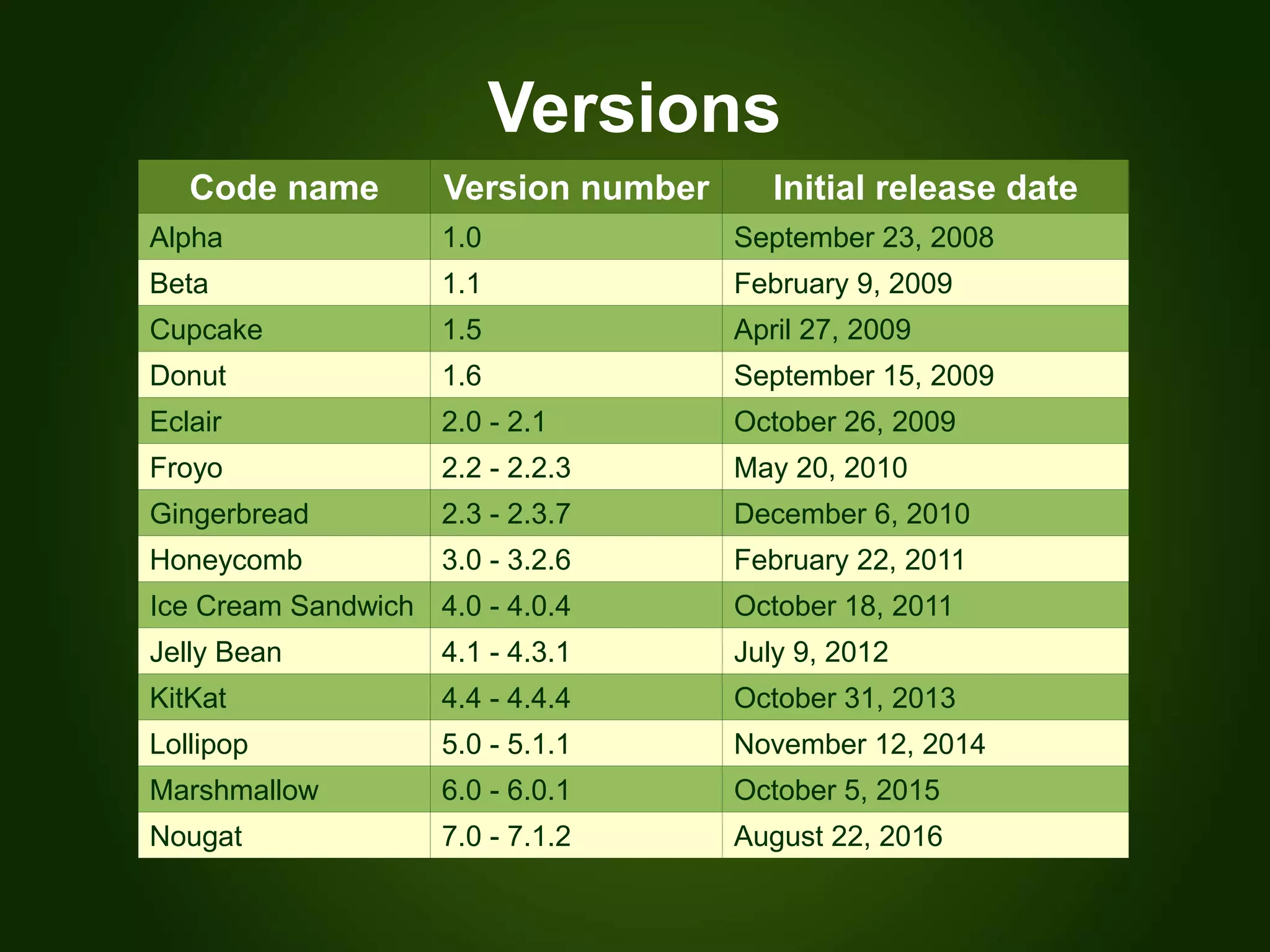
Code name Version number Initial release date
Alpha 1.0 September 23, 2008
Beta 1.1 February 9, 2009
Cupcake 1.5 April 27, 2009
Donut 1.6 September 15, 2009
Eclair 2.0 - 2.1 October 26, 2009
Froyo 2.2 - 2.2.3 May 20, 2010
Gingerbread 2.3 - 2.3.7 December 6, 2010
Honeycomb 3.0 - 3.2.6 February 22, 2011
Ice Cream Sandwich 4.0 - 4.0.4 October 18, 2011
Jelly Bean 4.1 - 4.3.1 July 9, 2012
KitKat 4.4 - 4.4.4 October 31, 2013
Lollipop 5.0 - 5.1.1 November 12, 2014
Marshmallow 6.0 - 6.0.1 October 5, 2015
Nougat 7.0 - 7.1.2 August 22, 2016
Versions
Version History
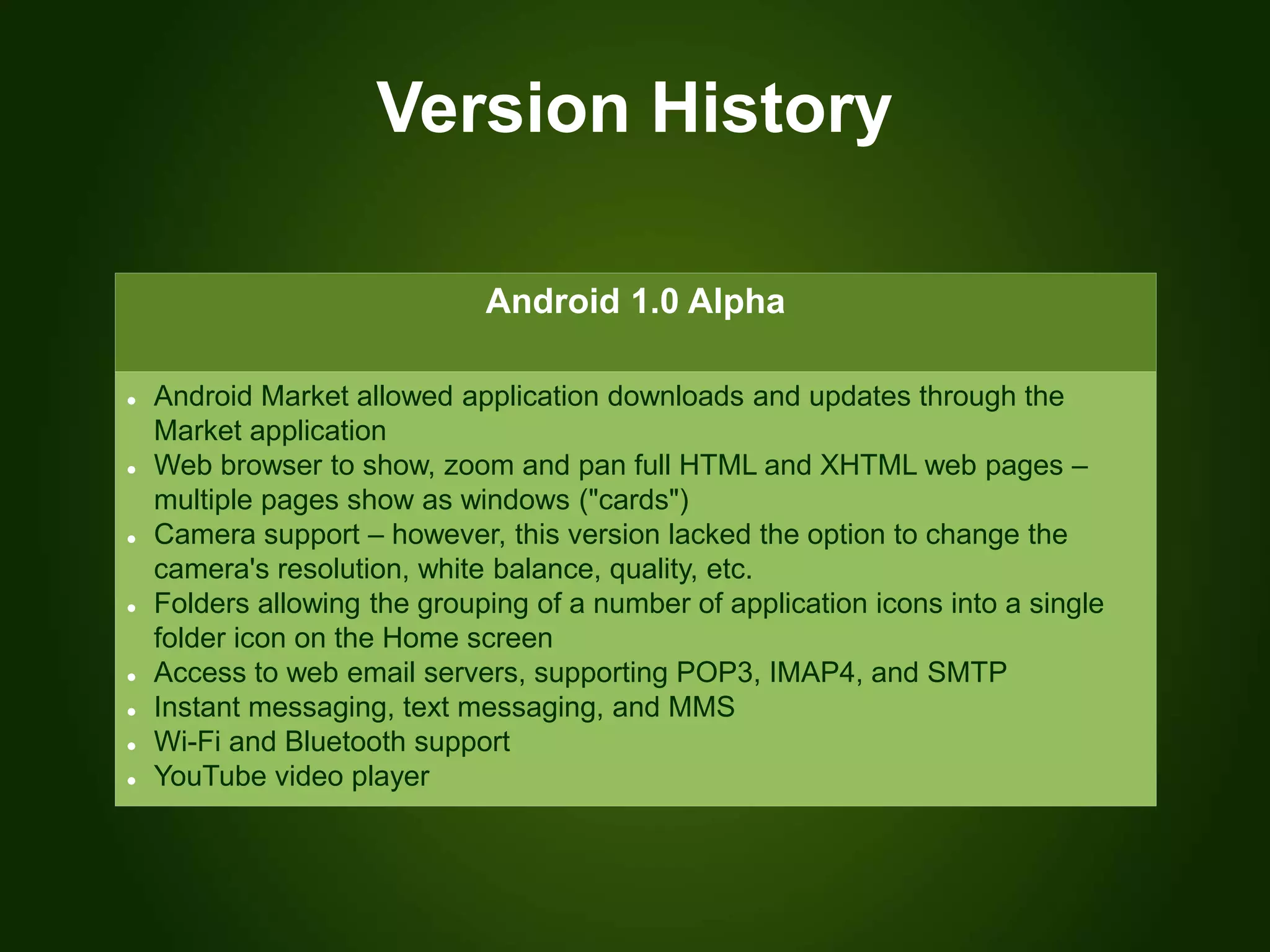
Android 1.0 Alpha
 Android Market allowed application downloads and updates through the
Market application
 Web browser to show, zoom and pan full HTML and XHTML web pages –
multiple pages show as windows ("cards")
 Camera support – however, this version lacked the option to change the
camera's resolution, white balance, quality, etc.
 Folders allowing the grouping of a number of application icons into a single
folder icon on the Home screen
 Access to web email servers, supporting POP3, IMAP4, and SMTP
 Instant messaging, text messaging, and MMS
 Wi-Fi and Bluetooth support
 YouTube video player
Version History
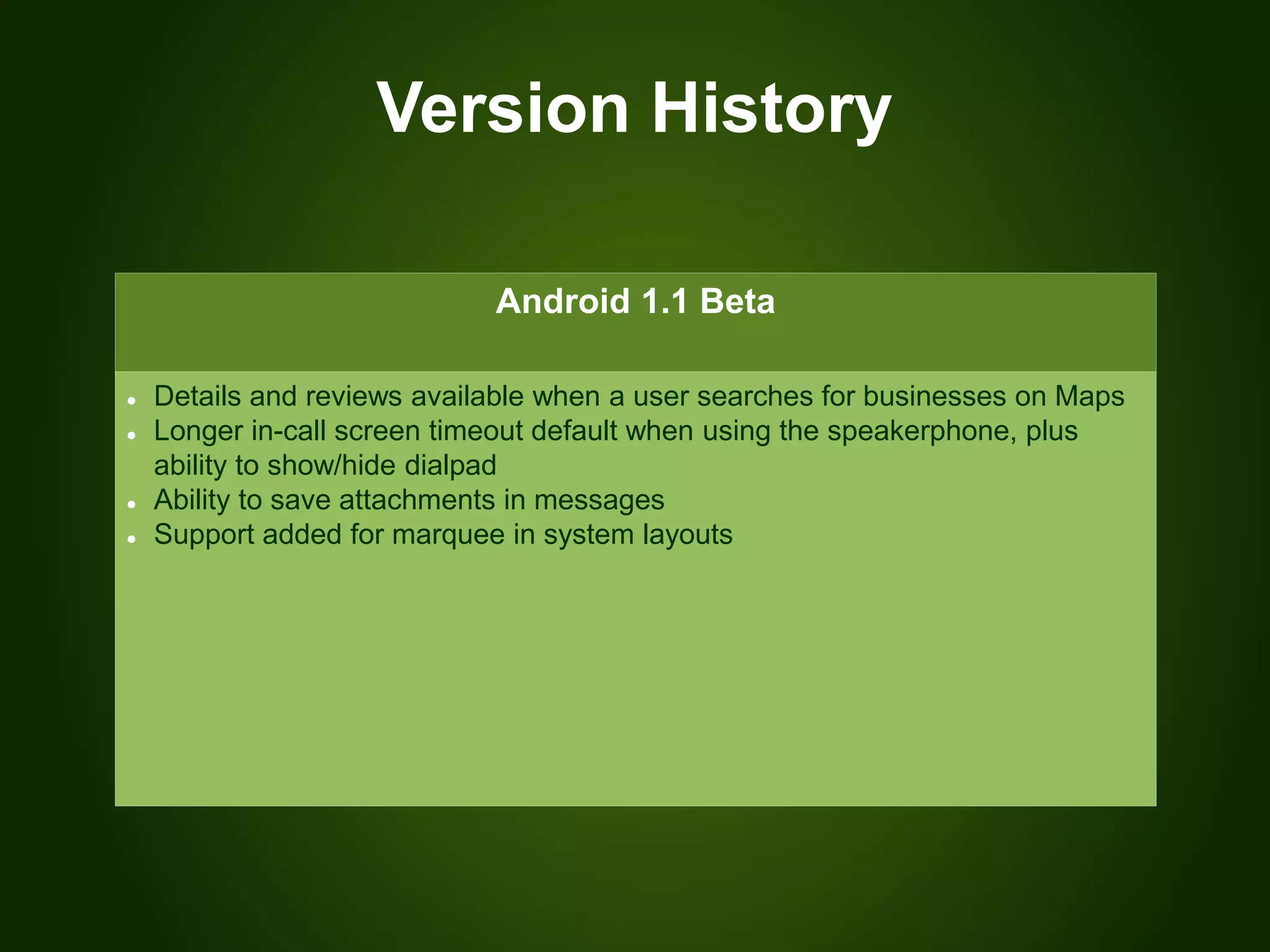
Android 1.1 Beta
 Details and reviews available when a user searches for businesses on Maps
 Longer in-call screen timeout default when using the speakerphone, plus
ability to show/hide dialpad
 Ability to save attachments in messages
 Support added for marquee in system layouts
Version History
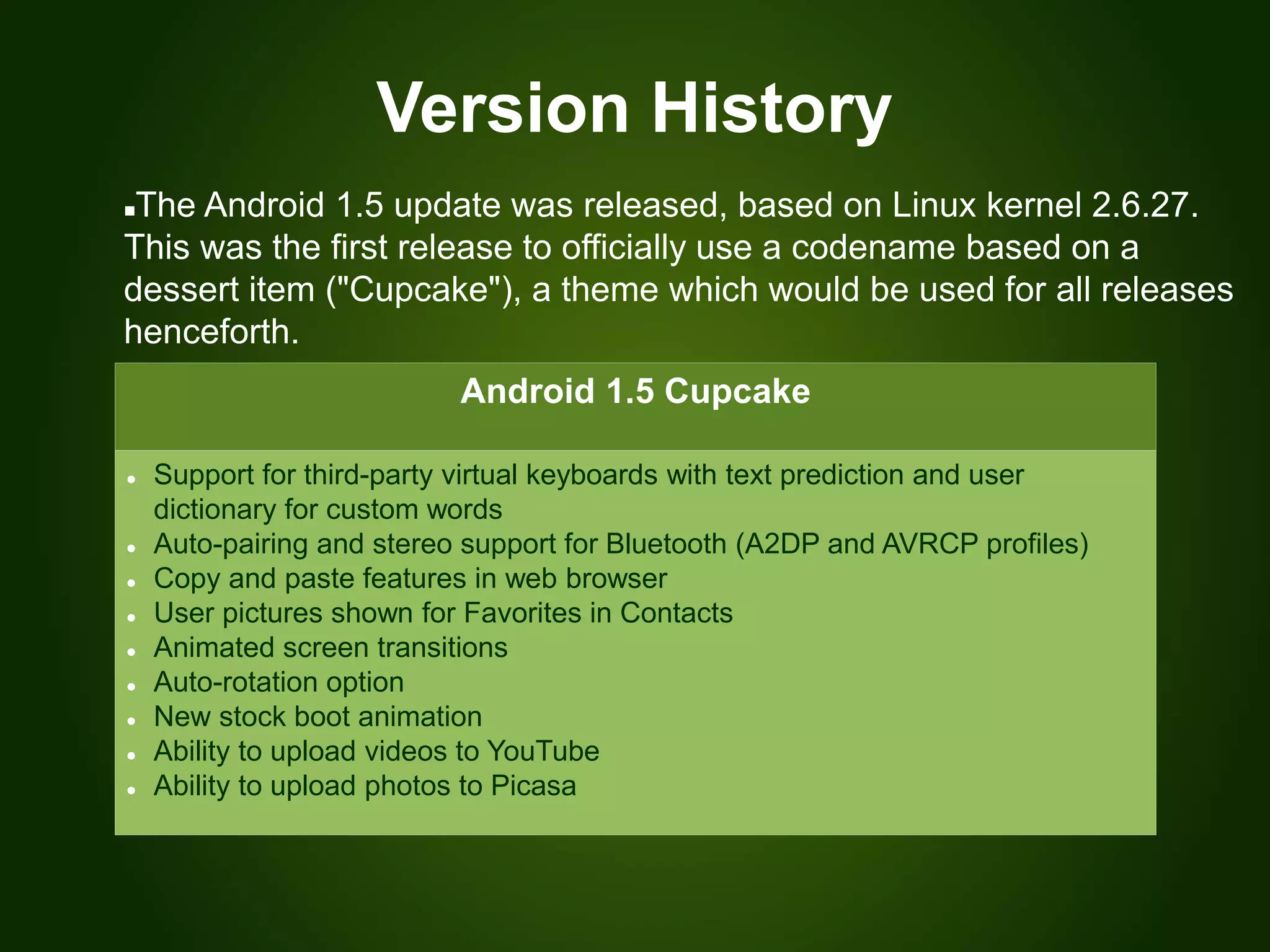
Android 1.5 Cupcake
 Support for third-party virtual keyboards with text prediction and user
dictionary for custom words
 Auto-pairing and stereo support for Bluetooth (A2DP and AVRCP profiles)
 Copy and paste features in web browser
 User pictures shown for Favorites in Contacts
 Animated screen transitions
 Auto-rotation option
 New stock boot animation
 Ability to upload videos to YouTube
 Ability to upload photos to Picasa
The Android 1.5 update was released, based on Linux kernel 2.6.27.
This was the first release to officially use a codename based on a
dessert item ("Cupcake"), a theme which would be used for all releases
henceforth.
Version History
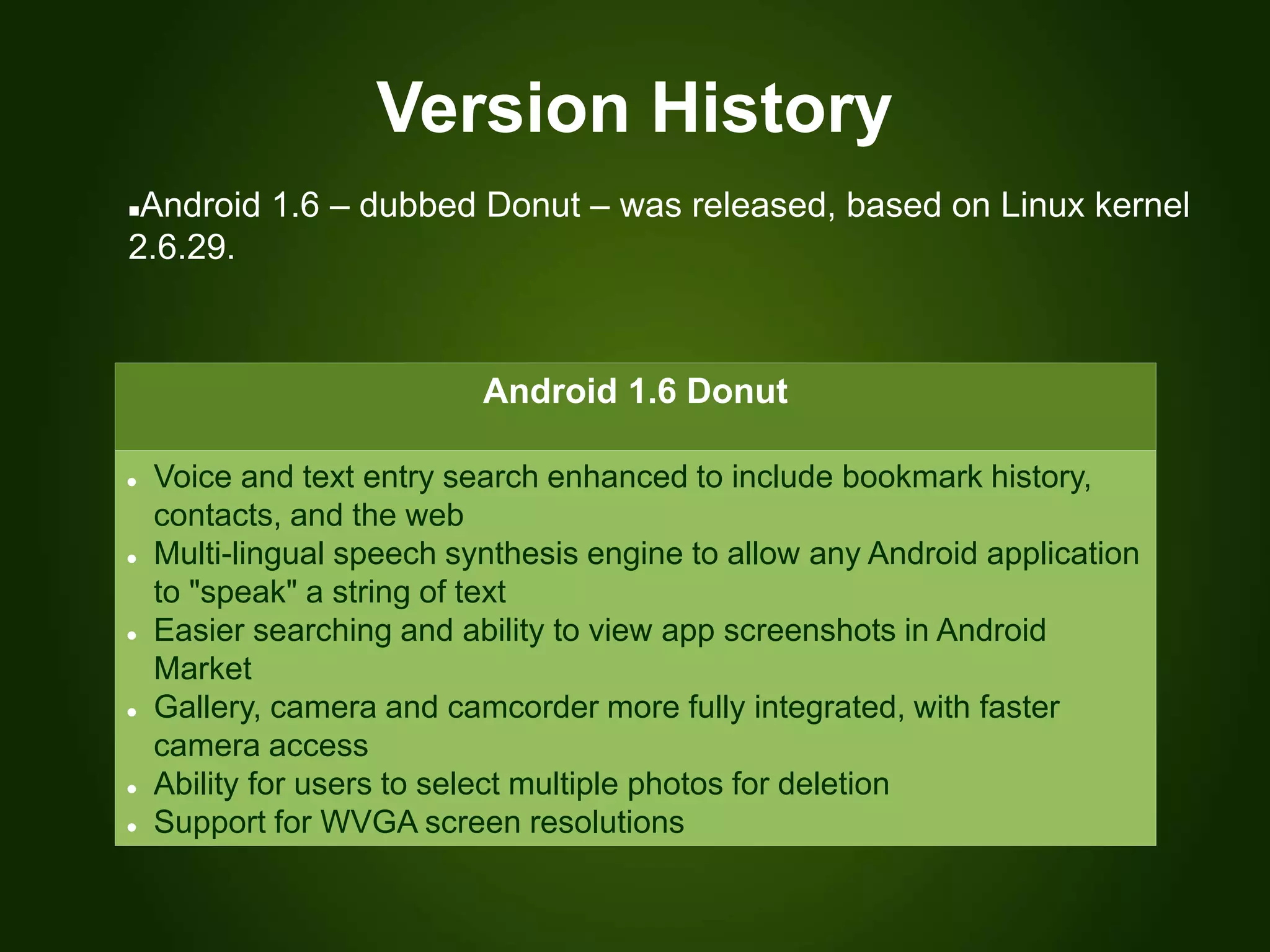
Android 1.6 Donut
 Voice and text entry search enhanced to include bookmark history,
contacts, and the web
 Multi-lingual speech synthesis engine to allow any Android application
to "speak" a string of text
 Easier searching and ability to view app screenshots in Android
Market
 Gallery, camera and camcorder more fully integrated, with faster
camera access
 Ability for users to select multiple photos for deletion
 Support for WVGA screen resolutions
Android 1.6 – dubbed Donut – was released, based on Linux kernel
2.6.29.
Version History
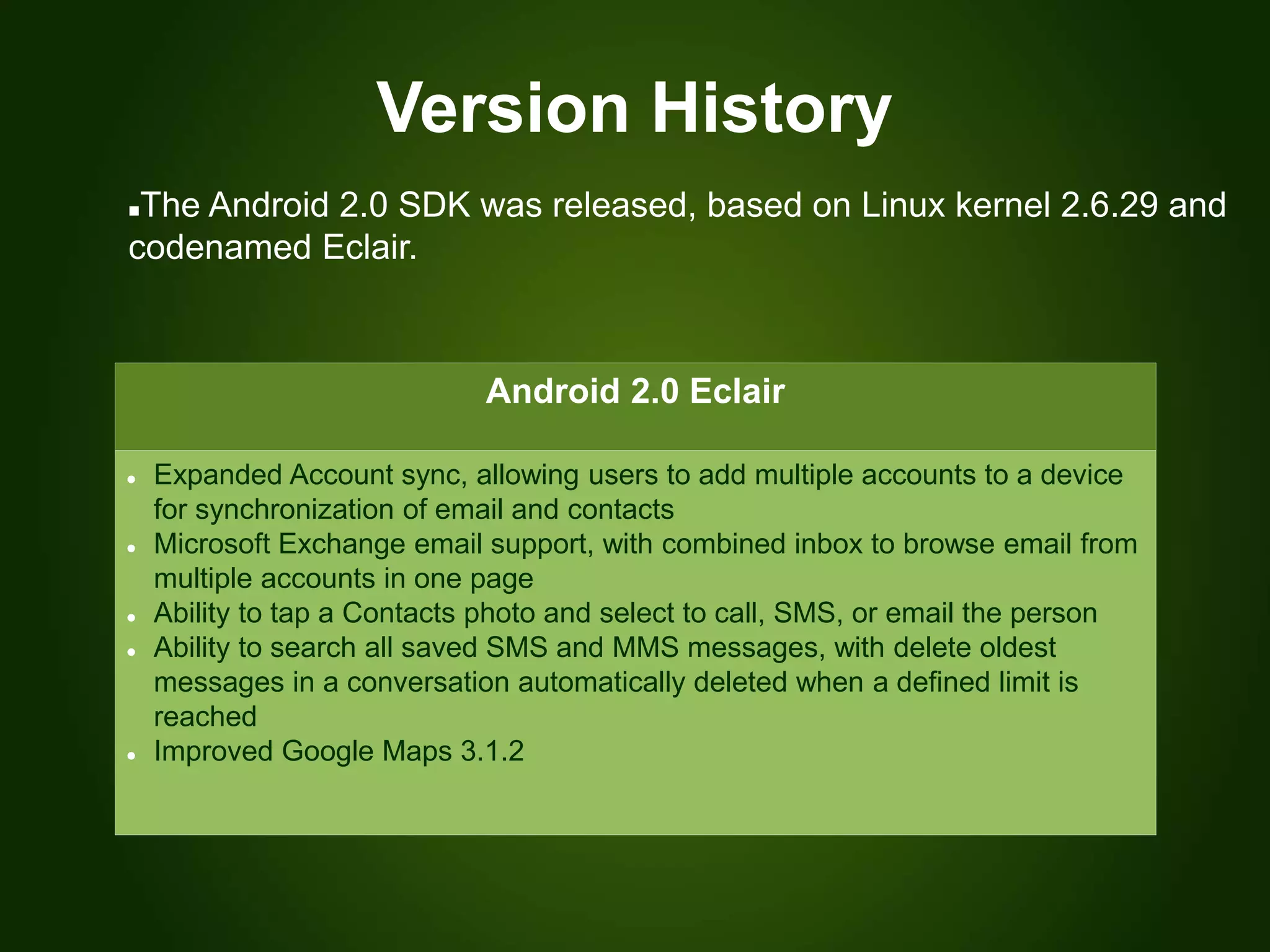
Android 2.0 Eclair
 Expanded Account sync, allowing users to add multiple accounts to a device
for synchronization of email and contacts
 Microsoft Exchange email support, with combined inbox to browse email from
multiple accounts in one page
 Ability to tap a Contacts photo and select to call, SMS, or email the person
 Ability to search all saved SMS and MMS messages, with delete oldest
messages in a conversation automatically deleted when a defined limit is
reached
 Improved Google Maps 3.1.2
The Android 2.0 SDK was released, based on Linux kernel 2.6.29 and
codenamed Eclair.
Version History
Android 2.2 Froyo
 Integration of Chrome's V8 JavaScript engine into the Browser application
 Improved application launcher with shortcuts to Phone and Browser
applications
 USB tethering and Wi-Fi hotspot functionality[46]
 Option to disable data access over mobile network
 Support for installing applications to the expandable memory
 Adobe Flash support
The SDK for Android 2.2 (Froyo, short for frozen yogurt) was released,
based on Linux kernel 2.6.32.
Version History
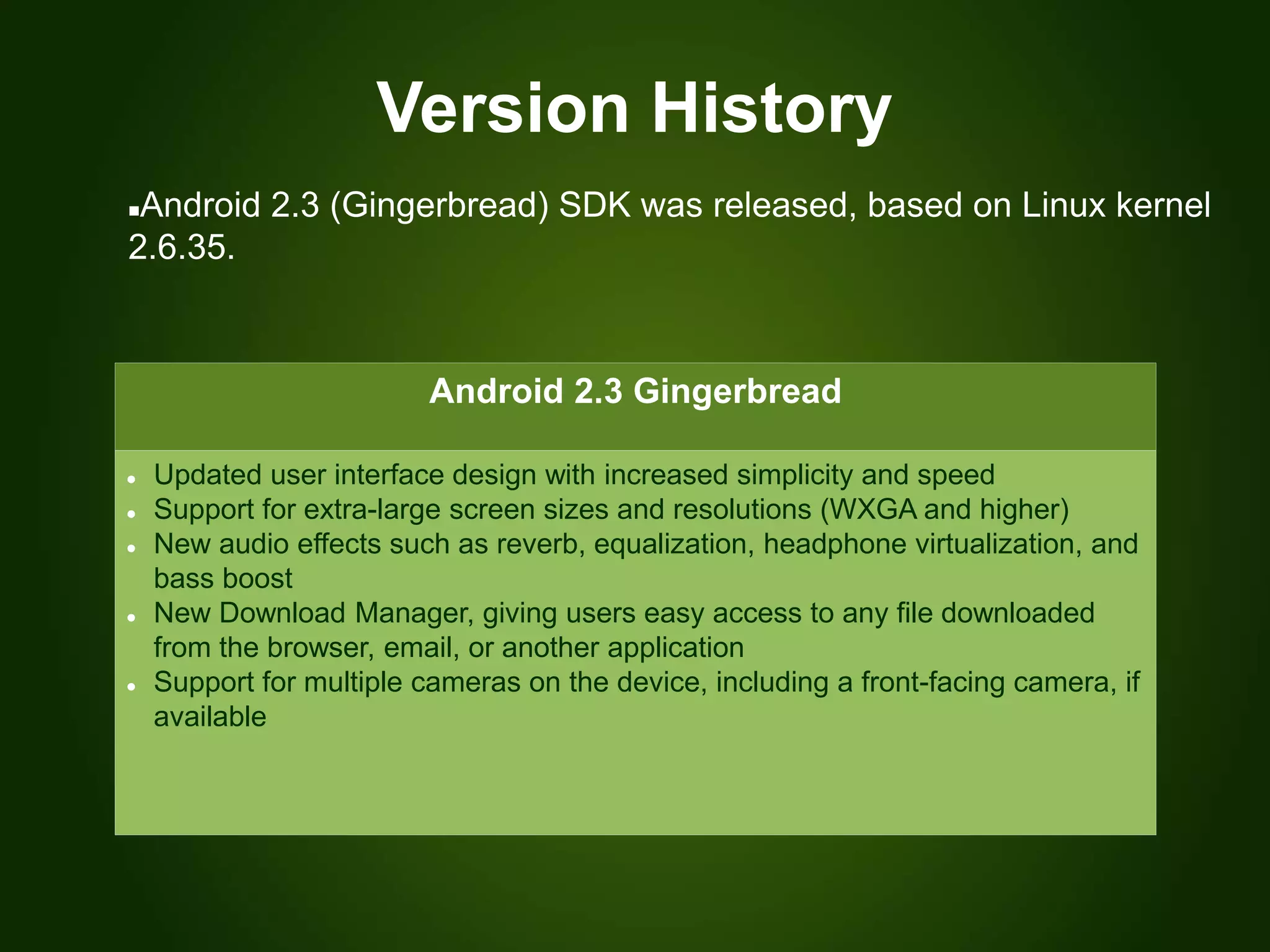
Android 2.3 Gingerbread
 Updated user interface design with increased simplicity and speed
 Support for extra-large screen sizes and resolutions (WXGA and higher)
 New audio effects such as reverb, equalization, headphone virtualization, and
bass boost
 New Download Manager, giving users easy access to any file downloaded
from the browser, email, or another application
 Support for multiple cameras on the device, including a front-facing camera, if
available
Android 2.3 (Gingerbread) SDK was released, based on Linux kernel
2.6.35.
Version History
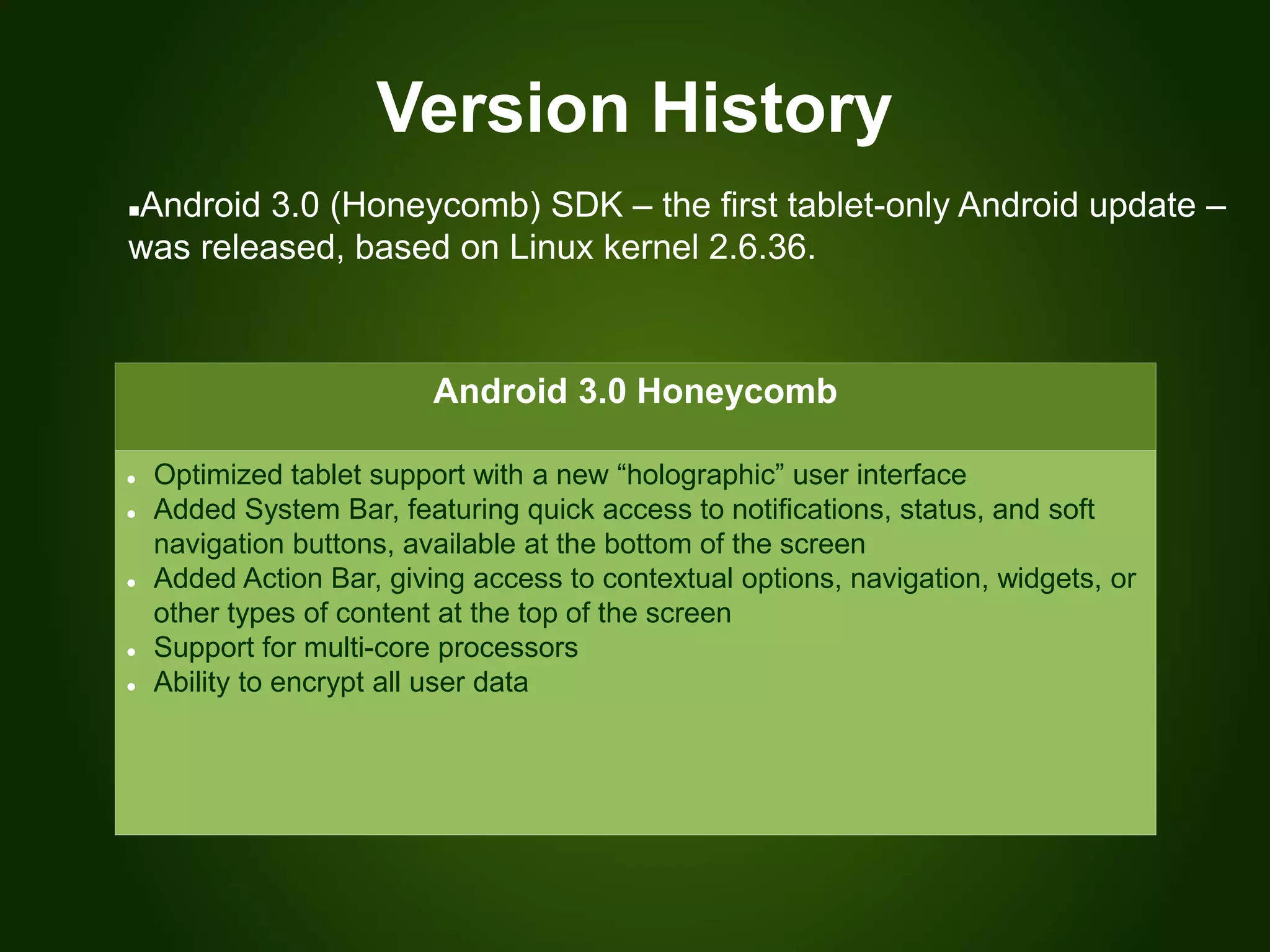
Android 3.0 Honeycomb
 Optimized tablet support with a new “holographic” user interface
 Added System Bar, featuring quick access to notifications, status, and soft
navigation buttons, available at the bottom of the screen
 Added Action Bar, giving access to contextual options, navigation, widgets, or
other types of content at the top of the screen
 Support for multi-core processors
 Ability to encrypt all user data
Android 3.0 (Honeycomb) SDK – the first tablet-only Android update –
was released, based on Linux kernel 2.6.36.
Version History
Android 4.0 Ice Cream Sandwich
 Major refinements to the "Holo" interface with new Roboto font family
 Soft buttons from Android 3.x are now available for use on phones
 Built-in photo editor
 Ability to shut down applications from the recent apps list with a swipe[87]
 Improved camera application with zero shutter lag, time lapse settings,
panorama mode, and the ability to zoom while recording
The SDK for Android 4.0.1 (Ice Cream Sandwich), based on Linux
kernel 3.0.1,[79] was publicly released on October 19, 2011.
Version History
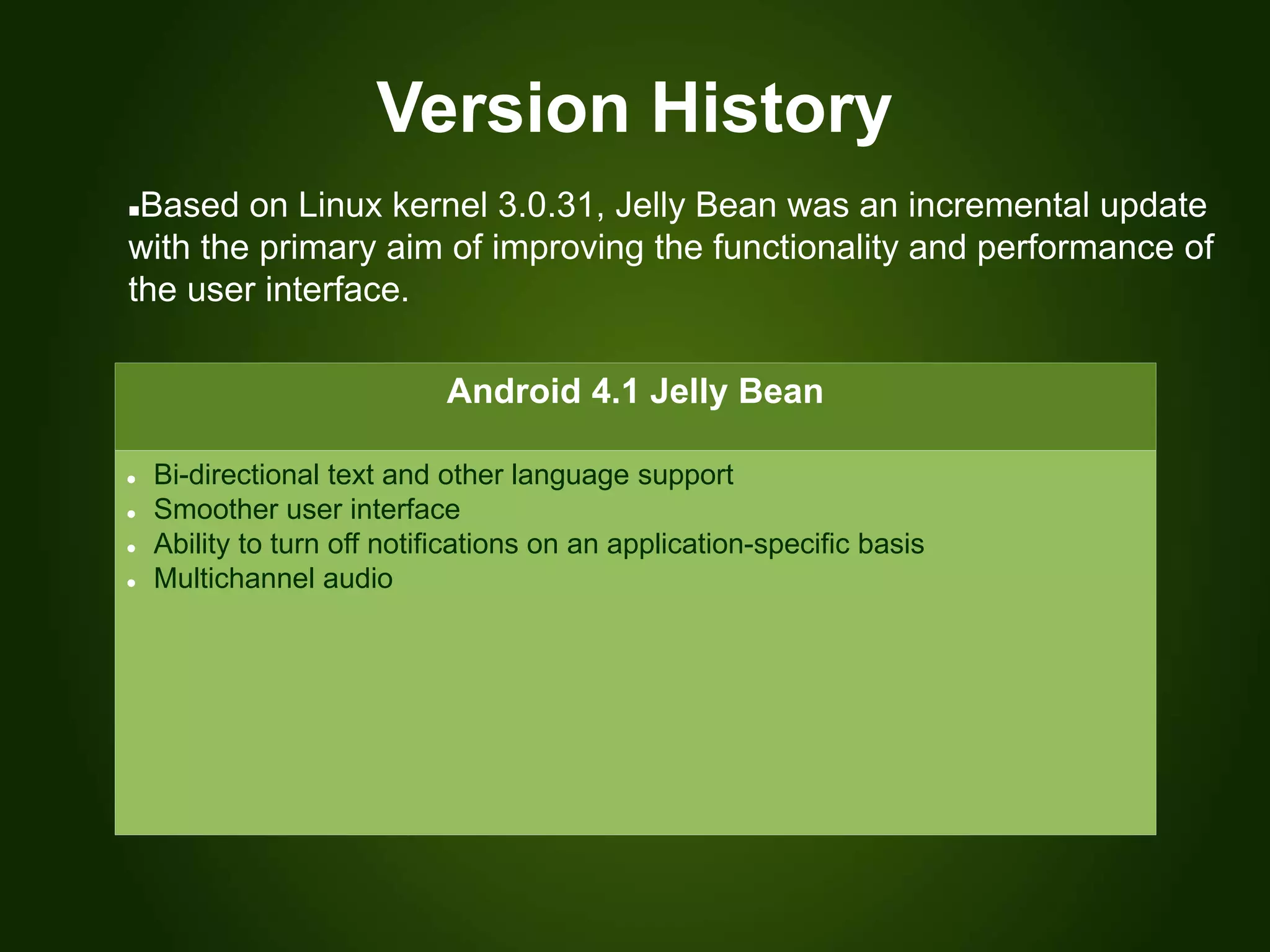
Android 4.1 Jelly Bean
 Bi-directional text and other language support
 Smoother user interface
 Ability to turn off notifications on an application-specific basis
 Multichannel audio
Based on Linux kernel 3.0.31, Jelly Bean was an incremental update
with the primary aim of improving the functionality and performance of
the user interface.
Version History
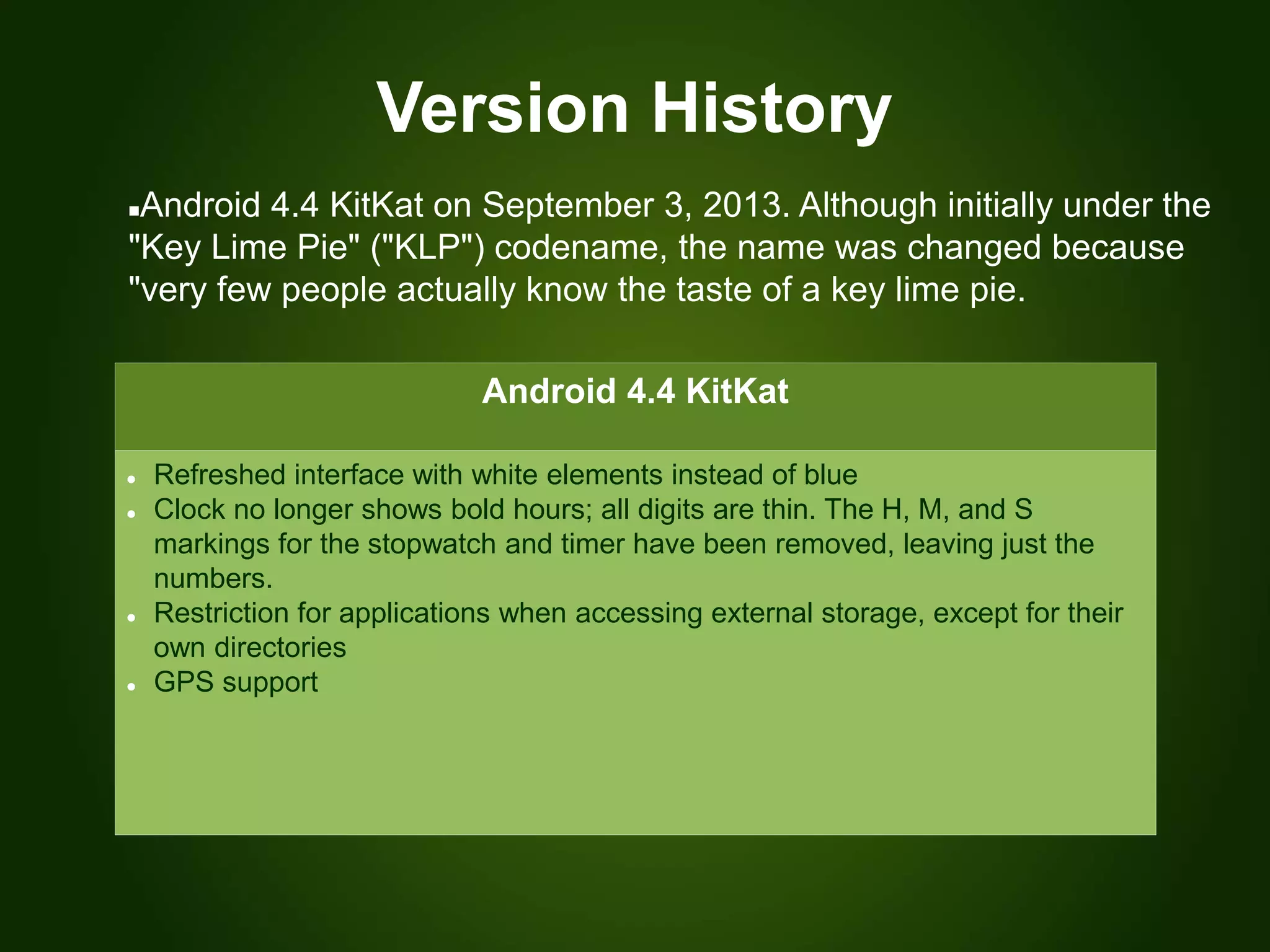
Android 4.4 KitKat
 Refreshed interface with white elements instead of blue
 Clock no longer shows bold hours; all digits are thin. The H, M, and S
markings for the stopwatch and timer have been removed, leaving just the
numbers.
 Restriction for applications when accessing external storage, except for their
own directories
 GPS support
Android 4.4 KitKat on September 3, 2013. Although initially under the
"Key Lime Pie" ("KLP") codename, the name was changed because
"very few people actually know the taste of a key lime pie.
Version History
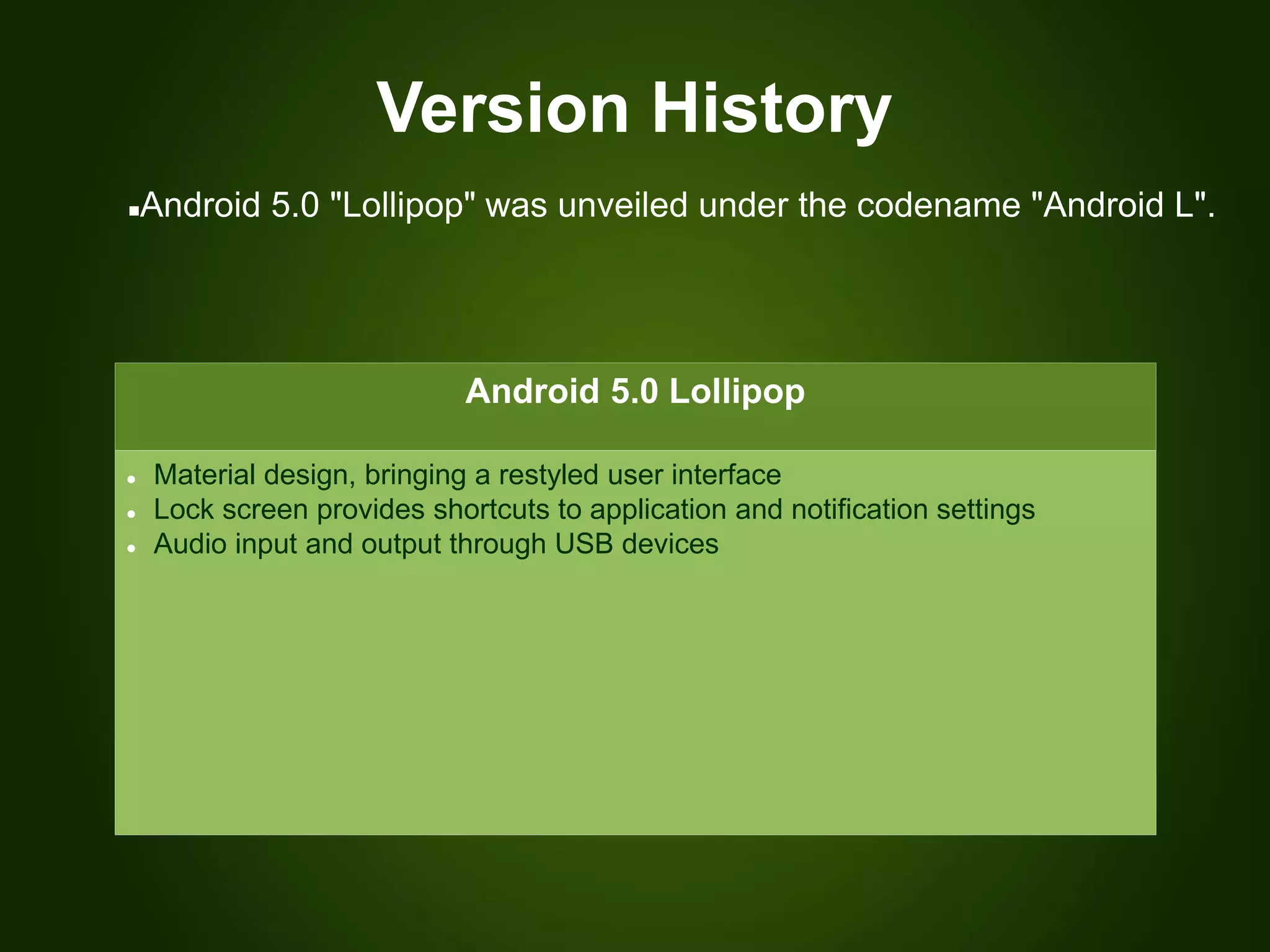
Android 5.0 Lollipop
 Material design, bringing a restyled user interface
 Lock screen provides shortcuts to application and notification settings
 Audio input and output through USB devices
Android 5.0 "Lollipop" was unveiled under the codename "Android L".
Version History
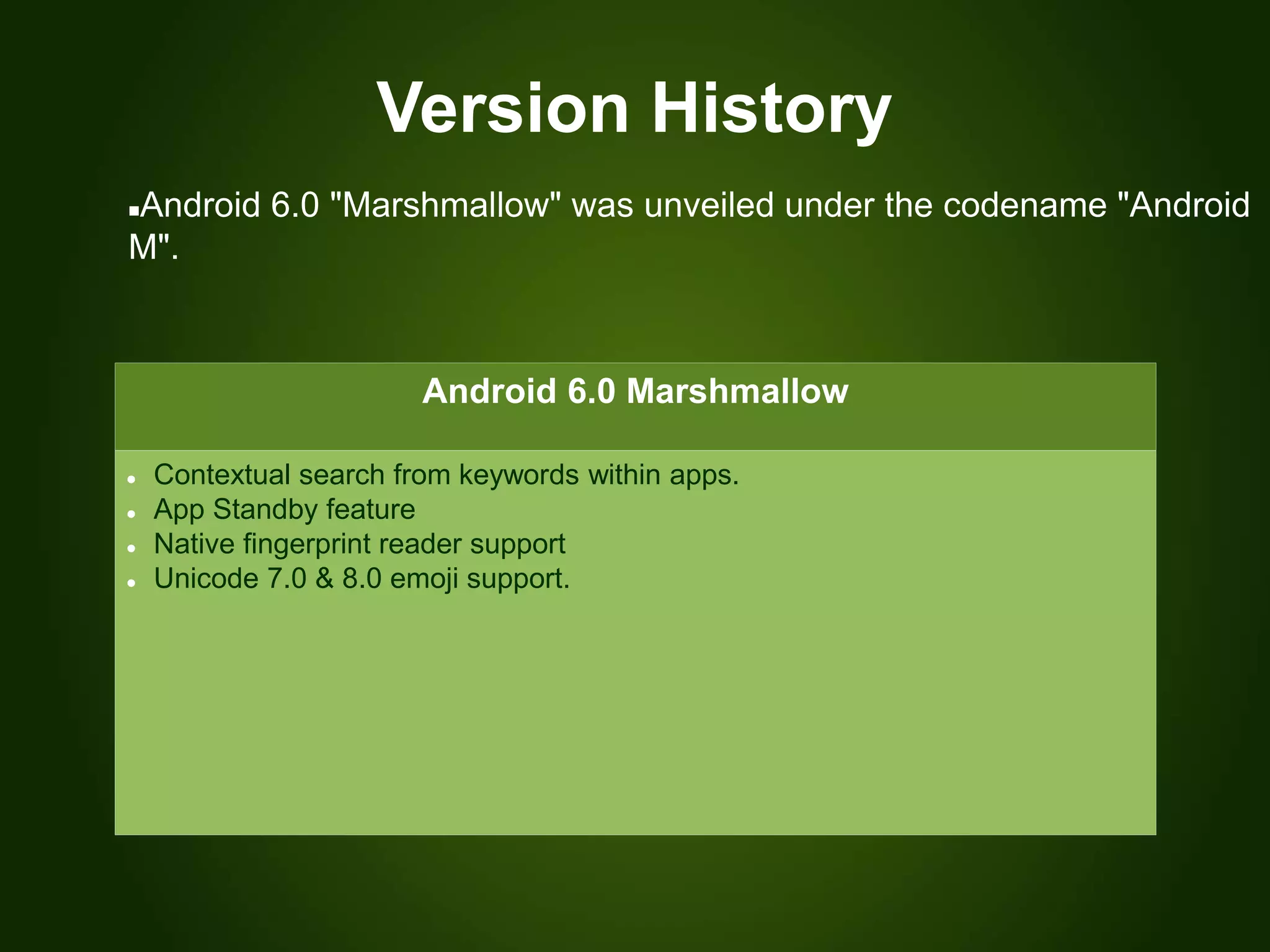
Android 6.0 Marshmallow
 Contextual search from keywords within apps.
 App Standby feature
 Native fingerprint reader support
 Unicode 7.0 & 8.0 emoji support.
Android 6.0 "Marshmallow" was unveiled under the codename "Android
M".
Version History
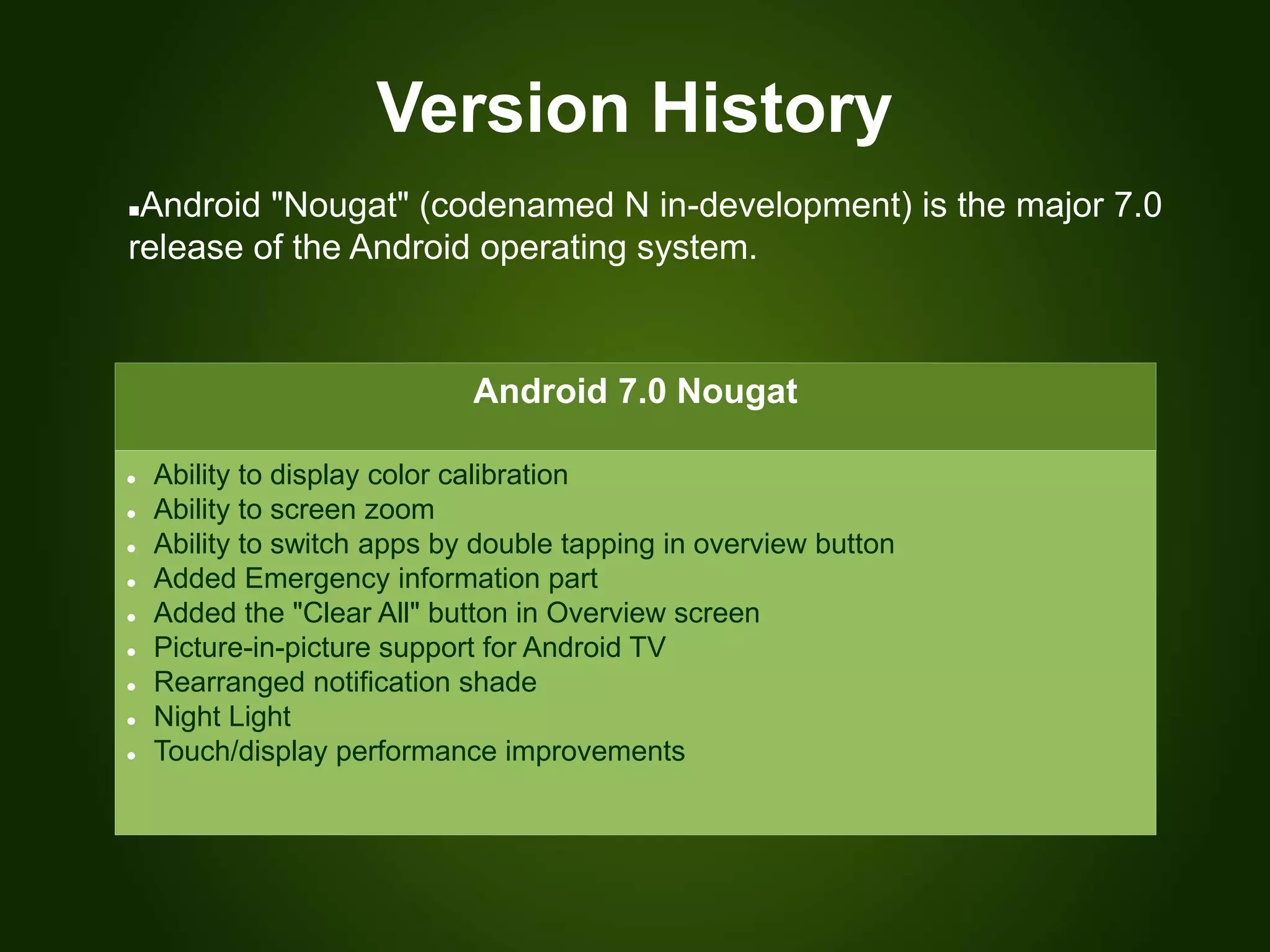
Android 7.0 Nougat
 Ability to display color calibration
 Ability to screen zoom
 Ability to switch apps by double tapping in overview button
 Added Emergency information part
 Added the "Clear All" button in Overview screen
 Picture-in-picture support for Android TV
 Rearranged notification shade
 Night Light
 Touch/display performance improvements
Android "Nougat" (codenamed N in-development) is the major 7.0
release of the Android operating system.
Version History
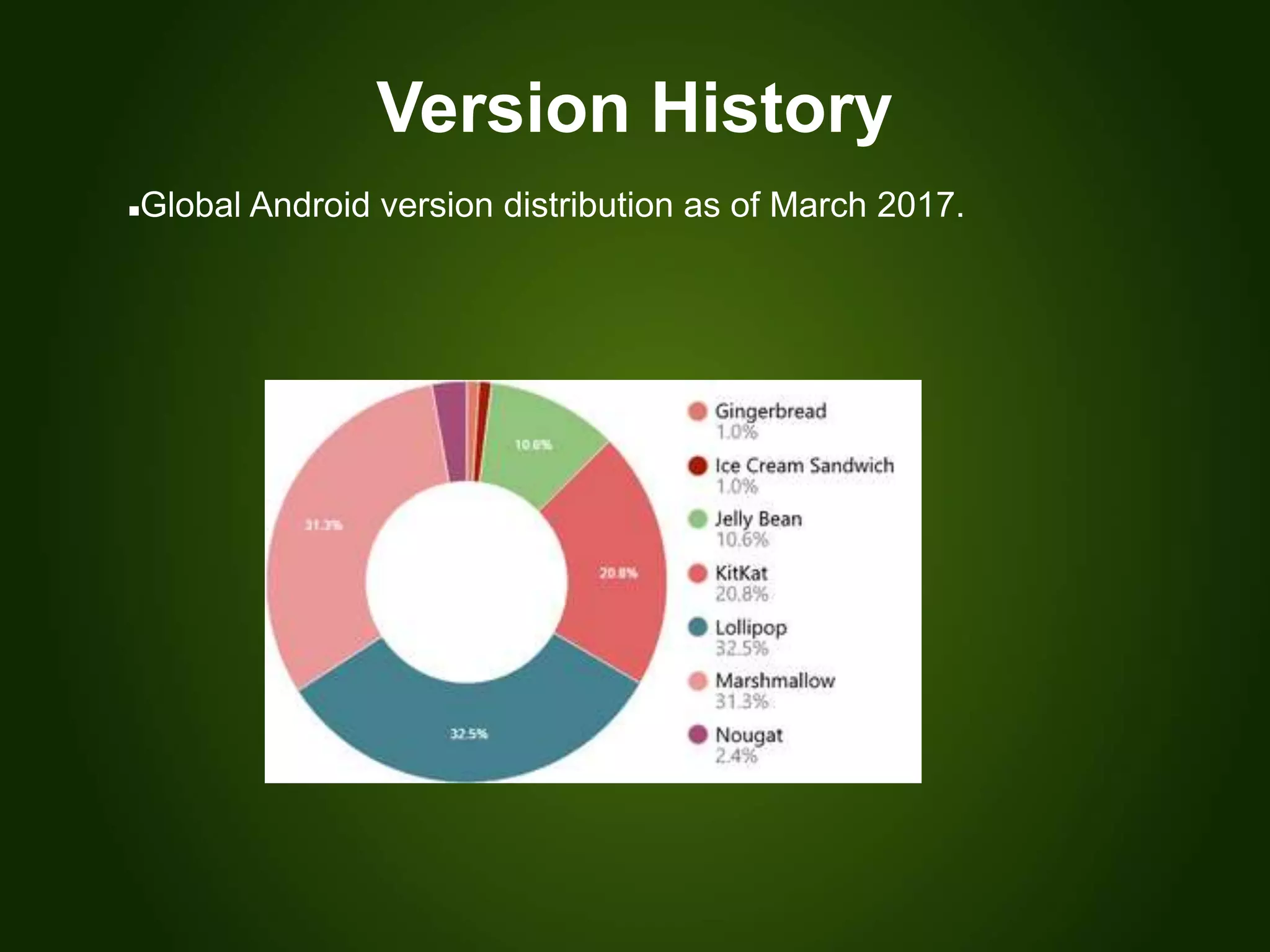
Global Android version distribution as of March 2017.
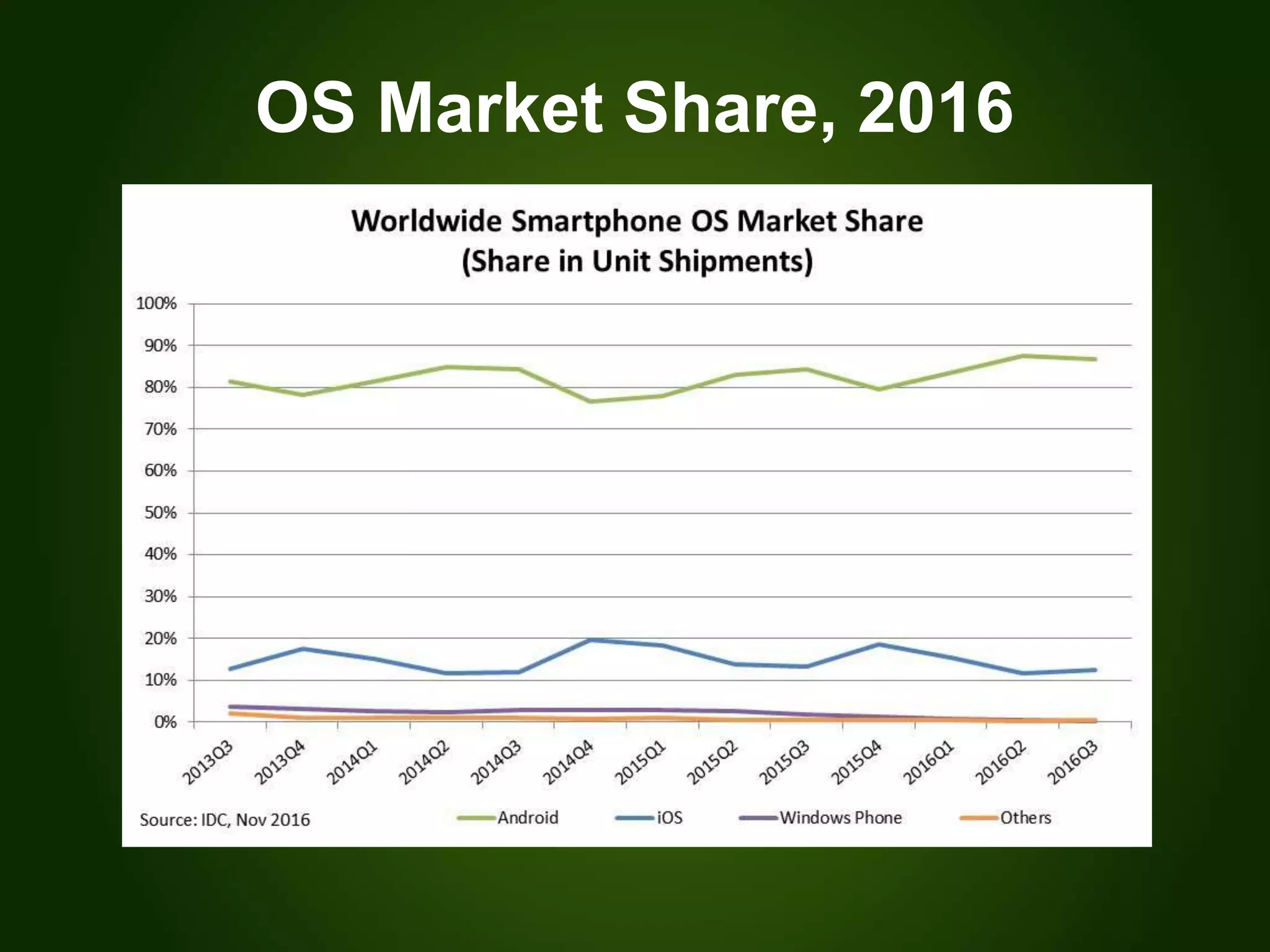
OS Market Share, 2016
Why we use android phone?
Customizable
The Google Play Store
Widgets & Multitasking
Expandable Memory
Universal Chargers
Cost Effective
Thank You

Android for-all

  • 2.
    Presented By:- MD. AyubAli 201411038016 MD. Tofazzal Hossain 201411038066 MD. Mafijur Rahman 201411038072 MD. Azim Uddin 201411038098
  • 3.
    Android Android is amobile operating system developed by Google, based on the Linux kernel and designed primarily for touchscreen mobile devices such as smartphones and tablets. Android is open source and Google releases the code under the Apache Software License(ASL)
  • 4.
    History Android Inc. wasfounded in Palo Alto, California in October 2003 by Andy Rubin, Rich Miner, Nick Sears, and Chris White. In July 2005,[12] Google acquired Android Inc. for at least $50 million, making it a wholly owned subsidiary of Google. Its key employees, including Rubin, Miner and White, joined Google as part of the acquisition. At Google, the team led by Rubin developed a mobile device platform powered by the Linux kernel. The first commercially available smartphone running Android was the HTC Dream, also known as T-Mobile G1, announced on September 23, 2008.
  • 5.
    Features SOFTWARE FEATURES Integrated browserbased on the open source WebKit engine SQLite for relational data storage Media support for common audio, video, and still image formats (MPEG4, H.264, MP3, AAC, AMR, JPG, PNG, GIF) Dalvik Virtual Machine optimized for mobile devices HARDWARE FEATURES Cellular networking : GSM, EDGE, 3G (hardware dependent) LAN : Bluetooth, and Wi-Fi (hardware dependent) Graphics Hardware Acceleration Camera, GPS and Compass (hardware dependent) Touch screen and accelerometer for motion sensing
  • 6.
    Linux Karnel Linux Version2.6 Security, Memory & Process Management Proven driver model Efficient computing resource management Stable and proven OS for mobile platform
  • 7.
    Libraries Written in C/C++- System C Library(libc)  Display/Graphics(SGL) Media Libraries SQLite –RDB engine-light weight LibWebCore–web browser engine–embeddable web view
  • 8.
  • 9.
    Code name Versionnumber Initial release date Alpha 1.0 September 23, 2008 Beta 1.1 February 9, 2009 Cupcake 1.5 April 27, 2009 Donut 1.6 September 15, 2009 Eclair 2.0 - 2.1 October 26, 2009 Froyo 2.2 - 2.2.3 May 20, 2010 Gingerbread 2.3 - 2.3.7 December 6, 2010 Honeycomb 3.0 - 3.2.6 February 22, 2011 Ice Cream Sandwich 4.0 - 4.0.4 October 18, 2011 Jelly Bean 4.1 - 4.3.1 July 9, 2012 KitKat 4.4 - 4.4.4 October 31, 2013 Lollipop 5.0 - 5.1.1 November 12, 2014 Marshmallow 6.0 - 6.0.1 October 5, 2015 Nougat 7.0 - 7.1.2 August 22, 2016 Versions
  • 10.
    Version History Android 1.0Alpha  Android Market allowed application downloads and updates through the Market application  Web browser to show, zoom and pan full HTML and XHTML web pages – multiple pages show as windows ("cards")  Camera support – however, this version lacked the option to change the camera's resolution, white balance, quality, etc.  Folders allowing the grouping of a number of application icons into a single folder icon on the Home screen  Access to web email servers, supporting POP3, IMAP4, and SMTP  Instant messaging, text messaging, and MMS  Wi-Fi and Bluetooth support  YouTube video player
  • 11.
    Version History Android 1.1Beta  Details and reviews available when a user searches for businesses on Maps  Longer in-call screen timeout default when using the speakerphone, plus ability to show/hide dialpad  Ability to save attachments in messages  Support added for marquee in system layouts
  • 12.
    Version History Android 1.5Cupcake  Support for third-party virtual keyboards with text prediction and user dictionary for custom words  Auto-pairing and stereo support for Bluetooth (A2DP and AVRCP profiles)  Copy and paste features in web browser  User pictures shown for Favorites in Contacts  Animated screen transitions  Auto-rotation option  New stock boot animation  Ability to upload videos to YouTube  Ability to upload photos to Picasa The Android 1.5 update was released, based on Linux kernel 2.6.27. This was the first release to officially use a codename based on a dessert item ("Cupcake"), a theme which would be used for all releases henceforth.
  • 13.
    Version History Android 1.6Donut  Voice and text entry search enhanced to include bookmark history, contacts, and the web  Multi-lingual speech synthesis engine to allow any Android application to "speak" a string of text  Easier searching and ability to view app screenshots in Android Market  Gallery, camera and camcorder more fully integrated, with faster camera access  Ability for users to select multiple photos for deletion  Support for WVGA screen resolutions Android 1.6 – dubbed Donut – was released, based on Linux kernel 2.6.29.
  • 14.
    Version History Android 2.0Eclair  Expanded Account sync, allowing users to add multiple accounts to a device for synchronization of email and contacts  Microsoft Exchange email support, with combined inbox to browse email from multiple accounts in one page  Ability to tap a Contacts photo and select to call, SMS, or email the person  Ability to search all saved SMS and MMS messages, with delete oldest messages in a conversation automatically deleted when a defined limit is reached  Improved Google Maps 3.1.2 The Android 2.0 SDK was released, based on Linux kernel 2.6.29 and codenamed Eclair.
  • 15.
    Version History Android 2.2Froyo  Integration of Chrome's V8 JavaScript engine into the Browser application  Improved application launcher with shortcuts to Phone and Browser applications  USB tethering and Wi-Fi hotspot functionality[46]  Option to disable data access over mobile network  Support for installing applications to the expandable memory  Adobe Flash support The SDK for Android 2.2 (Froyo, short for frozen yogurt) was released, based on Linux kernel 2.6.32.
  • 16.
    Version History Android 2.3Gingerbread  Updated user interface design with increased simplicity and speed  Support for extra-large screen sizes and resolutions (WXGA and higher)  New audio effects such as reverb, equalization, headphone virtualization, and bass boost  New Download Manager, giving users easy access to any file downloaded from the browser, email, or another application  Support for multiple cameras on the device, including a front-facing camera, if available Android 2.3 (Gingerbread) SDK was released, based on Linux kernel 2.6.35.
  • 17.
    Version History Android 3.0Honeycomb  Optimized tablet support with a new “holographic” user interface  Added System Bar, featuring quick access to notifications, status, and soft navigation buttons, available at the bottom of the screen  Added Action Bar, giving access to contextual options, navigation, widgets, or other types of content at the top of the screen  Support for multi-core processors  Ability to encrypt all user data Android 3.0 (Honeycomb) SDK – the first tablet-only Android update – was released, based on Linux kernel 2.6.36.
  • 18.
    Version History Android 4.0Ice Cream Sandwich  Major refinements to the "Holo" interface with new Roboto font family  Soft buttons from Android 3.x are now available for use on phones  Built-in photo editor  Ability to shut down applications from the recent apps list with a swipe[87]  Improved camera application with zero shutter lag, time lapse settings, panorama mode, and the ability to zoom while recording The SDK for Android 4.0.1 (Ice Cream Sandwich), based on Linux kernel 3.0.1,[79] was publicly released on October 19, 2011.
  • 19.
    Version History Android 4.1Jelly Bean  Bi-directional text and other language support  Smoother user interface  Ability to turn off notifications on an application-specific basis  Multichannel audio Based on Linux kernel 3.0.31, Jelly Bean was an incremental update with the primary aim of improving the functionality and performance of the user interface.
  • 20.
    Version History Android 4.4KitKat  Refreshed interface with white elements instead of blue  Clock no longer shows bold hours; all digits are thin. The H, M, and S markings for the stopwatch and timer have been removed, leaving just the numbers.  Restriction for applications when accessing external storage, except for their own directories  GPS support Android 4.4 KitKat on September 3, 2013. Although initially under the "Key Lime Pie" ("KLP") codename, the name was changed because "very few people actually know the taste of a key lime pie.
  • 21.
    Version History Android 5.0Lollipop  Material design, bringing a restyled user interface  Lock screen provides shortcuts to application and notification settings  Audio input and output through USB devices Android 5.0 "Lollipop" was unveiled under the codename "Android L".
  • 22.
    Version History Android 6.0Marshmallow  Contextual search from keywords within apps.  App Standby feature  Native fingerprint reader support  Unicode 7.0 & 8.0 emoji support. Android 6.0 "Marshmallow" was unveiled under the codename "Android M".
  • 23.
    Version History Android 7.0Nougat  Ability to display color calibration  Ability to screen zoom  Ability to switch apps by double tapping in overview button  Added Emergency information part  Added the "Clear All" button in Overview screen  Picture-in-picture support for Android TV  Rearranged notification shade  Night Light  Touch/display performance improvements Android "Nougat" (codenamed N in-development) is the major 7.0 release of the Android operating system.
  • 24.
    Version History Global Androidversion distribution as of March 2017.
  • 25.
  • 26.
    Why we useandroid phone? Customizable The Google Play Store Widgets & Multitasking Expandable Memory Universal Chargers Cost Effective
  • 27.