Presented by :- 
Sandeep Gupta 
ALL ABOUT ANDROID SYSTEM
ANDROID SYSTEM 
World is contracting with the growth of mobile phone technology. As the number of 
users is increasing day by day, facilities are also increasing. Starting with simple regular 
handsets which were used just for making phone calls, mobiles have changed our lives 
and have become part of it. Now they are not used just for making calls but they have 
innumerable uses and can be used as a Camera , Music player, Tablet PC, T.V. , Web 
browser etc . And with the new technologies, new software and operating systems are 
required. 
What is Android 
Operating system have developed a lot in last 15 years. Starting from black and white phones to 
recent smart phones or mini computers, mobile OS has come far away. Especially for smart phones, 
Mobile OS has greatly evolved from Palm OS in 1996 to Windows pocket PC in 2000 then to 
Blackberry OS and Android. 
One of the most widely used mobile OS these days is ANDROID. Android is a software bunch 
comprising not only operating system but also middleware and key applications. Android Inc was 
founded in Palo Alto of California, U.S. by Andy Rubin, Rich miner, Nick sears and Chris White in 
2003. Later Android Inc. was acquired by Google in 2005.
Applications 
ANDROID SYSTEM 
These are the basics of Android applications: 
1 Android applications are composed of one or more application components 
(activities, services, content providers, and broadcast receivers) 
2 Each component performs a different role in the overall application 
behavior, and each one can be activated individually (even by other 
applications) 
3 The manifest file must declare all components in the application and 
should also declare all application requirements, such as the minimum version 
of Android required and any hardware configurations required 
4 Non-code application resources (images, strings, layout files, etc.) should 
include alternatives for different device configurations (such as different 
strings for different languages)
ANDROID SYSTEM 
The version history of the Android operating system began with the release of the Android beta in 
November 2007. The first commercial version, Android 1.0, was released in September 2008. Android 
is under ongoing development by Google and the Open Handset Alliance (OHA), and has seen a 
number of updates to its base operating system since its initial release. 
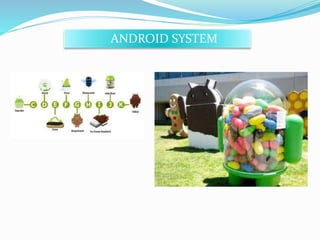
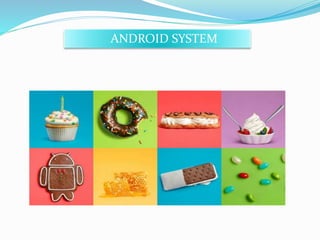
Since April 2009, Android versions have been developed under a confectionary -themed code name 
and released in alphabetical order; the exceptions are versions 1.0 and 1.1: 
1.) Android alpha (1.0) 
2.) Android beta (1.1) 
3.) Cupcake (1.5) 
4.) Doughnut (1.6) 
5.) Eclair (2.0–2.1) 
6.) Froyo (2.2–2.2.3) 
7.) Gingerbread (2.3–2.3.7) 
8.) Honeycomb (3.0–3.2.6) 
9.) Ice Cream Sandwich (4.0–4.0.4) 
10.) Jelly Bean (4.1–4.3.1) 
11.) KitKat (4.4–4.4.4) 
12.) “L” release (developer preview) 
On September 3, 2013, Google announced that 1 billion activated devices now use the Android OS 
worldwide. The most recent major Android update was KitKat 4.4, which was released to commercial 
devices on November 22, 2013, via an OTA updates
ANDROID SYSTEM
ANDROID SYSTEM
ANDROID SYSTEM
ANDROID SYSTEM 
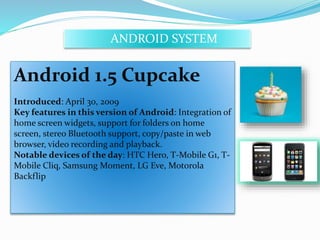
Android 1.5 Cupcake 
Introduced: April 30, 2009 
Key features in this version of Android: Integration of 
home screen widgets, support for folders on home 
screen, stereo Bluetooth support, copy/paste in web 
browser, video recording and playback. 
Notable devices of the day: HTC Hero, T-Mobile G1, T-Mobile 
Cliq, Samsung Moment, LG Eve, Motorola 
Backflip
ANDROID SYSTEM 
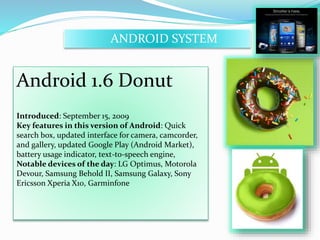
Android 1.6 Donut 
Introduced: September 15, 2009 
Key features in this version of Android: Quick 
search box, updated interface for camera, camcorder, 
and gallery, updated Google Play (Android Market), 
battery usage indicator, text-to-speech engine, 
Notable devices of the day: LG Optimus, Motorola 
Devour, Samsung Behold II, Samsung Galaxy, Sony 
Ericsson Xperia X10, Garminfone
ANDROID SYSTEM 
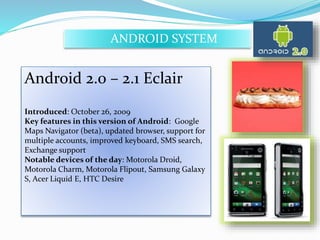
Android 2.0 – 2.1 Eclair 
Introduced: October 26, 2009 
Key features in this version of Android: Google 
Maps Navigator (beta), updated browser, support for 
multiple accounts, improved keyboard, SMS search, 
Exchange support 
Notable devices of the day: Motorola Droid, 
Motorola Charm, Motorola Flipout, Samsung Galaxy 
S, Acer Liquid E, HTC Desire
ANDROID SYSTEM 
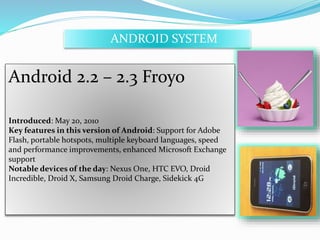
Android 2.2 – 2.3 Froyo 
Introduced: May 20, 2010 
Key features in this version of Android: Support for Adobe 
Flash, portable hotspots, multiple keyboard languages, speed 
and performance improvements, enhanced Microsoft Exchange 
support 
Notable devices of the day: Nexus One, HTC EVO, Droid 
Incredible, Droid X, Samsung Droid Charge, Sidekick 4G
ANDROID SYSTEM 
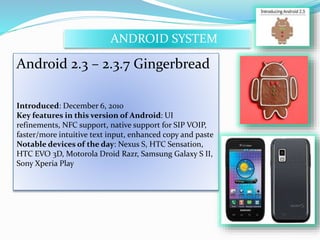
Android 2.3 – 2.3.7 Gingerbread 
Introduced: December 6, 2010 
Key features in this version of Android: UI 
refinements, NFC support, native support for SIP VOIP, 
faster/more intuitive text input, enhanced copy and paste 
Notable devices of the day: Nexus S, HTC Sensation, 
HTC EVO 3D, Motorola Droid Razr, Samsung Galaxy S II, 
Sony Xperia Play
ANDROID SYSTEM 
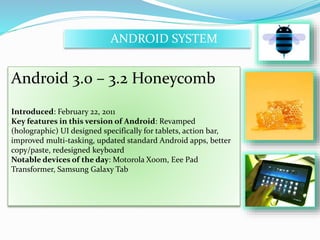
Android 3.0 – 3.2 Honeycomb 
Introduced: February 22, 2011 
Key features in this version of Android: Revamped 
(holographic) UI designed specifically for tablets, action bar, 
improved multi-tasking, updated standard Android apps, better 
copy/paste, redesigned keyboard 
Notable devices of the day: Motorola Xoom, Eee Pad 
Transformer, Samsung Galaxy Tab
ANDROID SYSTEM 
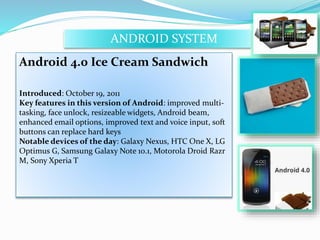
Android 4.0 Ice Cream Sandwich 
Introduced: October 19, 2011 
Key features in this version of Android: improved multi-tasking, 
face unlock, resizeable widgets, Android beam, 
enhanced email options, improved text and voice input, soft 
buttons can replace hard keys 
Notable devices of the day: Galaxy Nexus, HTC One X, LG 
Optimus G, Samsung Galaxy Note 10.1, Motorola Droid Razr 
M, Sony Xperia T
ANDROID SYSTEM 
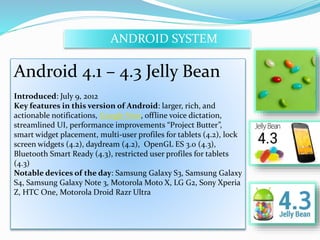
Android 4.1 – 4.3 Jelly Bean 
Introduced: July 9, 2012 
Key features in this version of Android: larger, rich, and 
actionable notifications, Google Now, offline voice dictation, 
streamlined UI, performance improvements “Project Butter”, 
smart widget placement, multi-user profiles for tablets (4.2), lock 
screen widgets (4.2), daydream (4.2), OpenGL ES 3.0 (4.3), 
Bluetooth Smart Ready (4.3), restricted user profiles for tablets 
(4.3) 
Notable devices of the day: Samsung Galaxy S3, Samsung Galaxy 
S4, Samsung Galaxy Note 3, Motorola Moto X, LG G2, Sony Xperia 
Z, HTC One, Motorola Droid Razr Ultra
ANDROID SYSTEM 
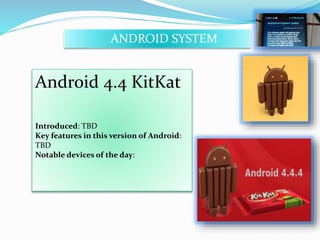
Android 4.4 KitKat 
Introduced: TBD 
Key features in this version of Android: 
TBD 
Notable devices of the day:

Android system

  • 1.
    Presented by :- Sandeep Gupta ALL ABOUT ANDROID SYSTEM
  • 2.
    ANDROID SYSTEM Worldis contracting with the growth of mobile phone technology. As the number of users is increasing day by day, facilities are also increasing. Starting with simple regular handsets which were used just for making phone calls, mobiles have changed our lives and have become part of it. Now they are not used just for making calls but they have innumerable uses and can be used as a Camera , Music player, Tablet PC, T.V. , Web browser etc . And with the new technologies, new software and operating systems are required. What is Android Operating system have developed a lot in last 15 years. Starting from black and white phones to recent smart phones or mini computers, mobile OS has come far away. Especially for smart phones, Mobile OS has greatly evolved from Palm OS in 1996 to Windows pocket PC in 2000 then to Blackberry OS and Android. One of the most widely used mobile OS these days is ANDROID. Android is a software bunch comprising not only operating system but also middleware and key applications. Android Inc was founded in Palo Alto of California, U.S. by Andy Rubin, Rich miner, Nick sears and Chris White in 2003. Later Android Inc. was acquired by Google in 2005.
  • 3.
    Applications ANDROID SYSTEM These are the basics of Android applications: 1 Android applications are composed of one or more application components (activities, services, content providers, and broadcast receivers) 2 Each component performs a different role in the overall application behavior, and each one can be activated individually (even by other applications) 3 The manifest file must declare all components in the application and should also declare all application requirements, such as the minimum version of Android required and any hardware configurations required 4 Non-code application resources (images, strings, layout files, etc.) should include alternatives for different device configurations (such as different strings for different languages)
  • 4.
    ANDROID SYSTEM Theversion history of the Android operating system began with the release of the Android beta in November 2007. The first commercial version, Android 1.0, was released in September 2008. Android is under ongoing development by Google and the Open Handset Alliance (OHA), and has seen a number of updates to its base operating system since its initial release. Since April 2009, Android versions have been developed under a confectionary -themed code name and released in alphabetical order; the exceptions are versions 1.0 and 1.1: 1.) Android alpha (1.0) 2.) Android beta (1.1) 3.) Cupcake (1.5) 4.) Doughnut (1.6) 5.) Eclair (2.0–2.1) 6.) Froyo (2.2–2.2.3) 7.) Gingerbread (2.3–2.3.7) 8.) Honeycomb (3.0–3.2.6) 9.) Ice Cream Sandwich (4.0–4.0.4) 10.) Jelly Bean (4.1–4.3.1) 11.) KitKat (4.4–4.4.4) 12.) “L” release (developer preview) On September 3, 2013, Google announced that 1 billion activated devices now use the Android OS worldwide. The most recent major Android update was KitKat 4.4, which was released to commercial devices on November 22, 2013, via an OTA updates
  • 5.
  • 6.
  • 7.
  • 8.
    ANDROID SYSTEM Android1.5 Cupcake Introduced: April 30, 2009 Key features in this version of Android: Integration of home screen widgets, support for folders on home screen, stereo Bluetooth support, copy/paste in web browser, video recording and playback. Notable devices of the day: HTC Hero, T-Mobile G1, T-Mobile Cliq, Samsung Moment, LG Eve, Motorola Backflip
  • 9.
    ANDROID SYSTEM Android1.6 Donut Introduced: September 15, 2009 Key features in this version of Android: Quick search box, updated interface for camera, camcorder, and gallery, updated Google Play (Android Market), battery usage indicator, text-to-speech engine, Notable devices of the day: LG Optimus, Motorola Devour, Samsung Behold II, Samsung Galaxy, Sony Ericsson Xperia X10, Garminfone
  • 10.
    ANDROID SYSTEM Android2.0 – 2.1 Eclair Introduced: October 26, 2009 Key features in this version of Android: Google Maps Navigator (beta), updated browser, support for multiple accounts, improved keyboard, SMS search, Exchange support Notable devices of the day: Motorola Droid, Motorola Charm, Motorola Flipout, Samsung Galaxy S, Acer Liquid E, HTC Desire
  • 11.
    ANDROID SYSTEM Android2.2 – 2.3 Froyo Introduced: May 20, 2010 Key features in this version of Android: Support for Adobe Flash, portable hotspots, multiple keyboard languages, speed and performance improvements, enhanced Microsoft Exchange support Notable devices of the day: Nexus One, HTC EVO, Droid Incredible, Droid X, Samsung Droid Charge, Sidekick 4G
  • 12.
    ANDROID SYSTEM Android2.3 – 2.3.7 Gingerbread Introduced: December 6, 2010 Key features in this version of Android: UI refinements, NFC support, native support for SIP VOIP, faster/more intuitive text input, enhanced copy and paste Notable devices of the day: Nexus S, HTC Sensation, HTC EVO 3D, Motorola Droid Razr, Samsung Galaxy S II, Sony Xperia Play
  • 13.
    ANDROID SYSTEM Android3.0 – 3.2 Honeycomb Introduced: February 22, 2011 Key features in this version of Android: Revamped (holographic) UI designed specifically for tablets, action bar, improved multi-tasking, updated standard Android apps, better copy/paste, redesigned keyboard Notable devices of the day: Motorola Xoom, Eee Pad Transformer, Samsung Galaxy Tab
  • 14.
    ANDROID SYSTEM Android4.0 Ice Cream Sandwich Introduced: October 19, 2011 Key features in this version of Android: improved multi-tasking, face unlock, resizeable widgets, Android beam, enhanced email options, improved text and voice input, soft buttons can replace hard keys Notable devices of the day: Galaxy Nexus, HTC One X, LG Optimus G, Samsung Galaxy Note 10.1, Motorola Droid Razr M, Sony Xperia T
  • 15.
    ANDROID SYSTEM Android4.1 – 4.3 Jelly Bean Introduced: July 9, 2012 Key features in this version of Android: larger, rich, and actionable notifications, Google Now, offline voice dictation, streamlined UI, performance improvements “Project Butter”, smart widget placement, multi-user profiles for tablets (4.2), lock screen widgets (4.2), daydream (4.2), OpenGL ES 3.0 (4.3), Bluetooth Smart Ready (4.3), restricted user profiles for tablets (4.3) Notable devices of the day: Samsung Galaxy S3, Samsung Galaxy S4, Samsung Galaxy Note 3, Motorola Moto X, LG G2, Sony Xperia Z, HTC One, Motorola Droid Razr Ultra
  • 16.
    ANDROID SYSTEM Android4.4 KitKat Introduced: TBD Key features in this version of Android: TBD Notable devices of the day: