What is ANDROID?
 It is a Linux-based operating system for mobile
   devices such as smart phones and tablet
computers, developed by Google in conjunction
   with the Open Handset Alliance.
People Behind...
Palo Alto, California, United States in October
 2003 by Andy Rubin (co-founder of Danger),
 Rich Miner (co-founder of Wildfire
 Communications, Inc.), Nick Sears (once VP
 at T-Mobile), and Chris White (headed design
 and interface development at WebTV)
Design
  Android consists of a kernel based on
the Linux kernel 2.6and Linux Kernel 3.x
(Android 4.0 onwards),
with middleware, libraries and APIs written
in C andapplication softwarerunning on
an application frameworkwhich includes Java-
compatible libraries based on Apache
Harmony.
WHAT’S IN IT
• Handset layouts
 The platform is adaptable to larger, VGA, 2D
 graphics library, 3D graphics library based on OpenGL ES 2.0
 specifications, and traditional smartphone layouts.
• Storage
 SQLite, a lightweight relational database, is used
 for data storage purposes.
• Connectivity
 Android supports connectivity technologies
 including GSM/EDGE, IDEN, CDMA, EV-
 DO, UMTS, Bluetooth, Wi-Fi, LTE, NFC and WiMAX
• Messaging
 SMS and MMS are available forms of messaging,
 including threaded text messaging and Android Cloud To
 Device Messaging (C2DM) and now enhanced version of
 C2DM, Android Google Cloud Messaging (GCM) is also a
 part of Android Push Messaging service.
• Multiple language support
  Android supports multiple languages.
• Web browser
 The web browser available in Android is based on the open-
 source WebKit layout engine, coupled with Chrome's V8
 JavaScript engine. The browser scores 100/100 on
 the Acid3 test on Android 4.0.
• Java support
 While most Android applications are written in Java, there is
 no Java Virtual Machine in the platform and Java byte code is
 not executed.
• Media support
• Streaming media support
• Additional hardware support
 Android can use video/still cameras, touch
 screens, GPS, accelerometers, gyroscopes, barometers, magn
 etometers, dedicated gaming controls, proximity and pressure
 sensors, thermometers, accelerated 2D bit blits(with
 hardware orientation, scaling, pixel format conversion) and
 accelerated 3D graphics.
• Multi-touch
 Android has native support for multi-touch which was
 initially made available in handsets such as the HTC
 Hero. The feature was originally disabled at the
 kernel level (possibly to avoid infringing Apple's
 patents on touch-screen technology at the time
 Bluetooth
• Video calling
 Android does not support native video calling, but some
 handsets have a customized version of the operating system
 that supports it, either via the UMTS network (like
 the Samsung Galaxy S) or over IP.
• Multitasking
  Multitasking of applications, with unique handling of memory
  allocation, is available.
• Voice based features
• Tethering
 Android supports tethering, which allows a phone to be used
 as a wireless/wired Wi-Fi hotspot.
• Screen capture
 Android supports capturing a screenshot by pressing the
 power and volume-down buttons at the same time
• External storage
 Most Android devices include microSD slot and can read
 microSD cards formatted with FAT32, Ext3 or Ext4 file system.
 To allow use of high-capacity storage media such as USB flash
 drivesandUSB HDDs, many Android tablets also
 include USB 'A' receptacle. Storage formatted with FAT32 is
 handled by Linux Kernel VFAT driver, while 3rd party solutions
 are required to handle other popular file systems such
 as NTFS, HFS Plusand exFAT.
TOP 10 ANDROID
    PHONES
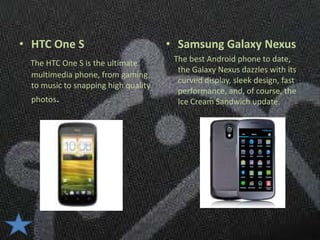
• HTC One S                          • Samsung Galaxy Nexus
 The HTC One S is the ultimate        The best Android phone to date,
                                       the Galaxy Nexus dazzles with its
 multimedia phone, from gaming
                                       curved display, sleek design, fast
 to music to snapping high quality
                                       performance, and, of course, the
  photos.                              Ice Cream Sandwich update.
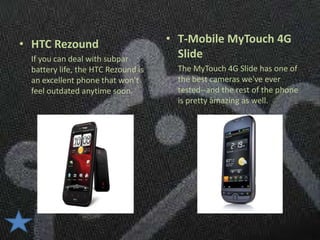
• HTC Rezound                       • T-Mobile MyTouch 4G
 If you can deal with subpar          Slide
 battery life, the HTC Rezound is    The MyTouch 4G Slide has one of
 an excellent phone that won't       the best cameras we've ever
 feel outdated anytime soon.         tested--and the rest of the phone
                                     is pretty amazing as well.
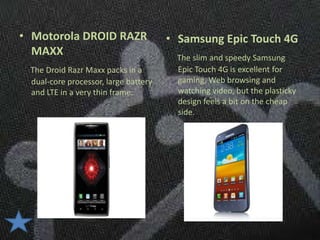
• Motorola DROID RAZR                 • Samsung Epic Touch 4G
  MAXX                                 The slim and speedy Samsung
 The Droid Razr Maxx packs in a        Epic Touch 4G is excellent for
 dual-core processor, large battery    gaming, Web browsing and
 and LTE in a very thin frame.         watching video, but the plasticky
                                       design feels a bit on the cheap
                                       side.
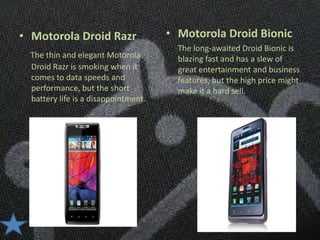
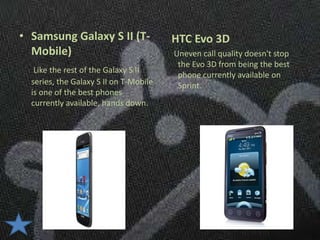
• Motorola Droid Razr                 • Motorola Droid Bionic
                                        The long-awaited Droid Bionic is
  The thin and elegant Motorola         blazing fast and has a slew of
  Droid Razr is smoking when it         great entertainment and business
  comes to data speeds and              features, but the high price might
  performance, but the short            make it a hard sell.
  battery life is a disappointment.
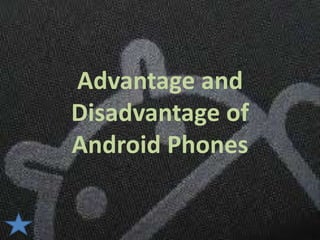
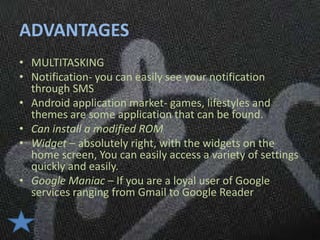
• Samsung Galaxy S II (T-               HTC Evo 3D
  Mobile)                               Uneven call quality doesn't stop
                                         the Evo 3D from being the best
   Like the rest of the Galaxy S II
                                         phone currently available on
  series, the Galaxy S II on T-Mobile    Sprint.
  is one of the best phones
  currently available, hands down.
Advantage and
Disadvantage of
Android Phones
ADVANTAGES
• MULTITASKING
• Notification- you can easily see your notification
  through SMS
• Android application market- games, lifestyles and
  themes are some application that can be found.
• Can install a modified ROM
• Widget – absolutely right, with the widgets on the
  home screen, You can easily access a variety of settings
  quickly and easily.
• Google Maniac – If you are a loyal user of Google
  services ranging from Gmail to Google Reader
DISADVANTAGES:
• continuous Internet connection – Yups,
  most Android phones require a simultaneous
  Internet connection alias continuously active.
  that means must be prepared to subscribe Agan
  GPRS packet that suits your needs.
• Advertising – Application in the Android
  phones can indeed be obtained easily and for
  free, but the consequences in each of these
  applications, will always be ads on display, either
  the top or bottom of the application
Credits
• http://mobilecon.info/advantages-and-disadvantages-
  android-mobile-phone.html

• ^ http://www.androidpolice.com/2012/06/27/breaking-
  jelly-bean-download-available-now-but-it-only-works-on-
  io-galaxy-nexuses-for-now/ ^
• https://groups.google.com/forum/m/#!topic/android-
  building/XBYeD-bhk1o ^ "What is Android?“
• http://en.wikipedia.org/wiki/Android_(operating_system)

• http://www.pcworld.com/reviews/collection/3286/top_10
  _android_phones.html
Submitted by: Ma. Kathyrn L. Barredo
              FV1216

Android

  • 2.
    What is ANDROID? It is a Linux-based operating system for mobile devices such as smart phones and tablet computers, developed by Google in conjunction with the Open Handset Alliance.
  • 3.
    People Behind... Palo Alto,California, United States in October 2003 by Andy Rubin (co-founder of Danger), Rich Miner (co-founder of Wildfire Communications, Inc.), Nick Sears (once VP at T-Mobile), and Chris White (headed design and interface development at WebTV)
  • 4.
    Design Androidconsists of a kernel based on the Linux kernel 2.6and Linux Kernel 3.x (Android 4.0 onwards), with middleware, libraries and APIs written in C andapplication softwarerunning on an application frameworkwhich includes Java- compatible libraries based on Apache Harmony.
  • 5.
    WHAT’S IN IT •Handset layouts The platform is adaptable to larger, VGA, 2D graphics library, 3D graphics library based on OpenGL ES 2.0 specifications, and traditional smartphone layouts. • Storage SQLite, a lightweight relational database, is used for data storage purposes.
  • 6.
    • Connectivity Androidsupports connectivity technologies including GSM/EDGE, IDEN, CDMA, EV- DO, UMTS, Bluetooth, Wi-Fi, LTE, NFC and WiMAX • Messaging SMS and MMS are available forms of messaging, including threaded text messaging and Android Cloud To Device Messaging (C2DM) and now enhanced version of C2DM, Android Google Cloud Messaging (GCM) is also a part of Android Push Messaging service. • Multiple language support Android supports multiple languages.
  • 7.
    • Web browser The web browser available in Android is based on the open- source WebKit layout engine, coupled with Chrome's V8 JavaScript engine. The browser scores 100/100 on the Acid3 test on Android 4.0. • Java support While most Android applications are written in Java, there is no Java Virtual Machine in the platform and Java byte code is not executed.
  • 8.
    • Media support •Streaming media support • Additional hardware support Android can use video/still cameras, touch screens, GPS, accelerometers, gyroscopes, barometers, magn etometers, dedicated gaming controls, proximity and pressure sensors, thermometers, accelerated 2D bit blits(with hardware orientation, scaling, pixel format conversion) and accelerated 3D graphics.
  • 9.
    • Multi-touch Androidhas native support for multi-touch which was initially made available in handsets such as the HTC Hero. The feature was originally disabled at the kernel level (possibly to avoid infringing Apple's patents on touch-screen technology at the time Bluetooth
  • 10.
    • Video calling Android does not support native video calling, but some handsets have a customized version of the operating system that supports it, either via the UMTS network (like the Samsung Galaxy S) or over IP. • Multitasking Multitasking of applications, with unique handling of memory allocation, is available.
  • 11.
    • Voice basedfeatures • Tethering Android supports tethering, which allows a phone to be used as a wireless/wired Wi-Fi hotspot. • Screen capture Android supports capturing a screenshot by pressing the power and volume-down buttons at the same time
  • 12.
    • External storage Most Android devices include microSD slot and can read microSD cards formatted with FAT32, Ext3 or Ext4 file system. To allow use of high-capacity storage media such as USB flash drivesandUSB HDDs, many Android tablets also include USB 'A' receptacle. Storage formatted with FAT32 is handled by Linux Kernel VFAT driver, while 3rd party solutions are required to handle other popular file systems such as NTFS, HFS Plusand exFAT.
  • 13.
  • 14.
    • HTC OneS • Samsung Galaxy Nexus The HTC One S is the ultimate The best Android phone to date, the Galaxy Nexus dazzles with its multimedia phone, from gaming curved display, sleek design, fast to music to snapping high quality performance, and, of course, the photos. Ice Cream Sandwich update.
  • 15.
    • HTC Rezound • T-Mobile MyTouch 4G If you can deal with subpar Slide battery life, the HTC Rezound is The MyTouch 4G Slide has one of an excellent phone that won't the best cameras we've ever feel outdated anytime soon. tested--and the rest of the phone is pretty amazing as well.
  • 16.
    • Motorola DROIDRAZR • Samsung Epic Touch 4G MAXX The slim and speedy Samsung The Droid Razr Maxx packs in a Epic Touch 4G is excellent for dual-core processor, large battery gaming, Web browsing and and LTE in a very thin frame. watching video, but the plasticky design feels a bit on the cheap side.
  • 17.
    • Motorola DroidRazr • Motorola Droid Bionic The long-awaited Droid Bionic is The thin and elegant Motorola blazing fast and has a slew of Droid Razr is smoking when it great entertainment and business comes to data speeds and features, but the high price might performance, but the short make it a hard sell. battery life is a disappointment.
  • 18.
    • Samsung GalaxyS II (T- HTC Evo 3D Mobile) Uneven call quality doesn't stop the Evo 3D from being the best Like the rest of the Galaxy S II phone currently available on series, the Galaxy S II on T-Mobile Sprint. is one of the best phones currently available, hands down.
  • 19.
  • 20.
    ADVANTAGES • MULTITASKING • Notification-you can easily see your notification through SMS • Android application market- games, lifestyles and themes are some application that can be found. • Can install a modified ROM • Widget – absolutely right, with the widgets on the home screen, You can easily access a variety of settings quickly and easily. • Google Maniac – If you are a loyal user of Google services ranging from Gmail to Google Reader
  • 21.
    DISADVANTAGES: • continuous Internetconnection – Yups, most Android phones require a simultaneous Internet connection alias continuously active. that means must be prepared to subscribe Agan GPRS packet that suits your needs. • Advertising – Application in the Android phones can indeed be obtained easily and for free, but the consequences in each of these applications, will always be ads on display, either the top or bottom of the application
  • 22.
    Credits • http://mobilecon.info/advantages-and-disadvantages- android-mobile-phone.html • ^ http://www.androidpolice.com/2012/06/27/breaking- jelly-bean-download-available-now-but-it-only-works-on- io-galaxy-nexuses-for-now/ ^ • https://groups.google.com/forum/m/#!topic/android- building/XBYeD-bhk1o ^ "What is Android?“ • http://en.wikipedia.org/wiki/Android_(operating_system) • http://www.pcworld.com/reviews/collection/3286/top_10 _android_phones.html
  • 23.
    Submitted by: Ma.Kathyrn L. Barredo FV1216