Ragavendran
By
What is android?
A Software platform and operating system for mobile
Based on the Linux kernel.
HISTORY
It was developed in Palo Alto, California
Android was developed by the Andy Rubin, Rich Miner, Nick Sears
and Chris White.
Android was purchased by the GOOGLE in AUGUST,2005 for
50 million $.
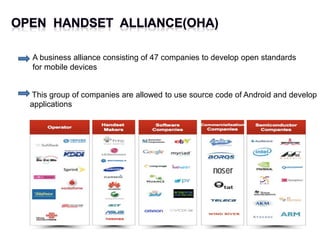
A business alliance consisting of 47 companies to develop open standards
for mobile devices
This group of companies are allowed to use source code of Android and develop
applications
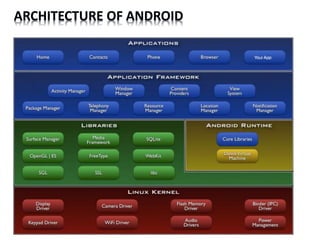
ARCHITECTURE OF ANDROID
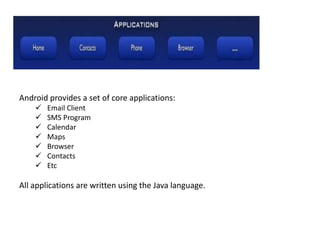
Android provides a set of core applications:
 Email Client
 SMS Program
 Calendar
 Maps
 Browser
 Contacts
 Etc
All applications are written using the Java language.
6
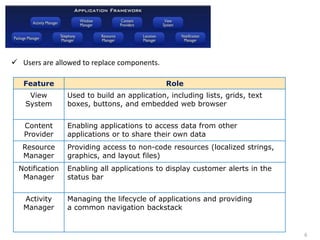
Feature Role
View
System
Used to build an application, including lists, grids, text
boxes, buttons, and embedded web browser
Content
Provider
Enabling applications to access data from other
applications or to share their own data
Resource
Manager
Providing access to non-code resources (localized strings,
graphics, and layout files)
Notification
Manager
Enabling all applications to display customer alerts in the
status bar
Activity
Manager
Managing the lifecycle of applications and providing
a common navigation backstack
 Users are allowed to replace components.
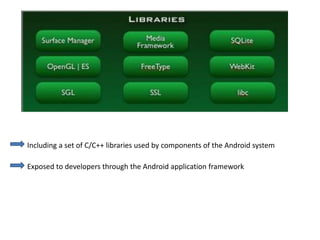
Exposed to developers through the Android application framework
Including a set of C/C++ libraries used by components of the Android system
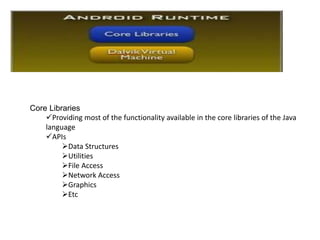
Core Libraries
Providing most of the functionality available in the core libraries of the Java
language
APIs
Data Structures
Utilities
File Access
Network Access
Graphics
Etc
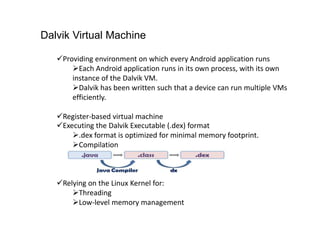
Dalvik Virtual Machine
Providing environment on which every Android application runs
Each Android application runs in its own process, with its own
instance of the Dalvik VM.
Dalvik has been written such that a device can run multiple VMs
efficiently.
Register-based virtual machine
Executing the Dalvik Executable (.dex) format
.dex format is optimized for minimal memory footprint.
Compilation
Relying on the Linux Kernel for:
Threading
Low-level memory management
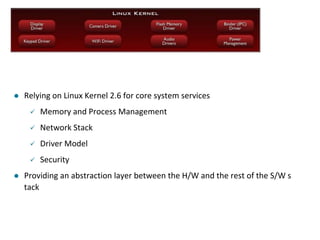
 Relying on Linux Kernel 2.6 for core system services
 Memory and Process Management
 Network Stack
 Driver Model
 Security
 Providing an abstraction layer between the H/W and the rest of the S/W s
tack
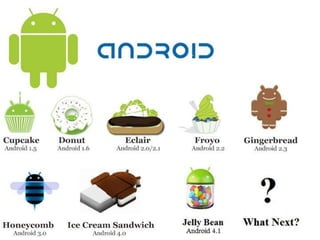
Versions
Android Astro 1.0
Android Beta
Android Cupcake 1.5
Android Donut 1.6
Android Éclair 2.0/2.1
Android Froyo 2.2
Android Gingerbread 2.3
Android Honeycomb 3.0
Android IceCreamSandwich(ICS) 4.0
Android JellyBean 4.1
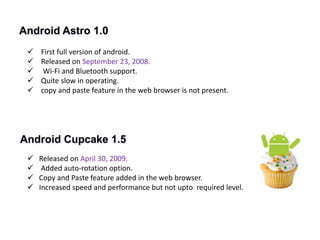
Android Astro 1.0
 First full version of android.
 Released on September 23, 2008.
 Wi-Fi and Bluetooth support.
 Quite slow in operating.
 copy and paste feature in the web browser is not present.
Android Cupcake 1.5
 Released on April 30, 2009.
 Added auto-rotation option.
 Copy and Paste feature added in the web browser.
 Increased speed and performance but not upto required level.
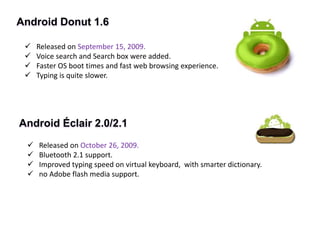
Android Donut 1.6
 Released on September 15, 2009.
 Voice search and Search box were added.
 Faster OS boot times and fast web browsing experience.
 Typing is quite slower.
Android Éclair 2.0/2.1
 Released on October 26, 2009.
 Bluetooth 2.1 support.
 Improved typing speed on virtual keyboard, with smarter dictionary.
 no Adobe flash media support.
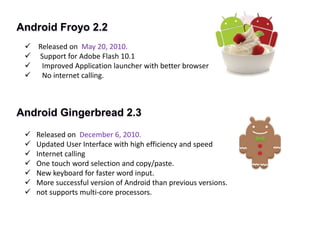
Android Froyo 2.2
 Released on May 20, 2010.
 Support for Adobe Flash 10.1
 Improved Application launcher with better browser
 No internet calling.
Android Gingerbread 2.3
 Released on December 6, 2010.
 Updated User Interface with high efficiency and speed
 Internet calling
 One touch word selection and copy/paste.
 New keyboard for faster word input.
 More successful version of Android than previous versions.
 not supports multi-core processors.
Android Honeycomb 3.0
 Released on February 22, 2011.
 Support for multi-core processors
 Ability to encrypt all user data.
 This version of android is only available for tablets.
Android IceCreamSandwich(ICS) 4.0
 Released on November 14, 2011.
 Virtual button in the UI.
 A new typeface family for the UI, Roboto.
 Ability to shut down apps that are using data in the background.
Android JellyBean 4.1
 Released on June 27, 2012.
 Smoother interface
 Bluetooth Smart Ready
 Dial-pad Autocomplete
 Simplified Setup Wizard
 Bluetooth AVRCP
 Location accuracy features via Wi-Fi scan only mode.
Android Kit Kat 4.4
 Released on October 31, 2013.
 Latest version of Android.
 Smoother user interface.
 NFC host card emulation, enabling a device to replace smart cards.
 Wireless printing capability
 New framework for UI transitions
 Bluetooth Message Access Profile (MAP) support
 Wi-Fi and mobile data activity (TX/RX) indicators are moved to quick settings
 Expanded functionality for notification listener services
 WebViews now based on Chromium engine
PLATFORM
Hardware
Android is not a single piece of hardware; it's a complete,
end-to-end software platform that can be adapted to work
on any number of hardware configurations. Everything is
there, from the bootloader all the way up to the
Applications. . .
Network Connectivity
It supports wireless communications using:
GSM mobile-phone technology
3G
Edge
802.11 Wi-Fi networks
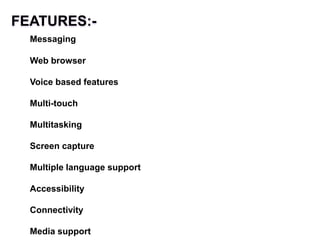
FEATURES:-
Messaging
Web browser
Voice based features
Multi-touch
Multitasking
Screen capture
Multiple language support
Accessibility
Connectivity
Media support
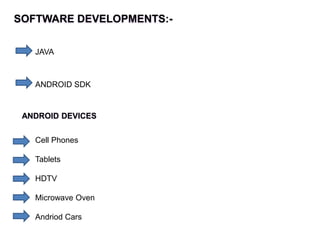
SOFTWARE DEVELOPMENTS:-
JAVA
ANDROID SDK
ANDROID DEVICES
Cell Phones
Tablets
HDTV
Microwave Oven
Andriod Cars
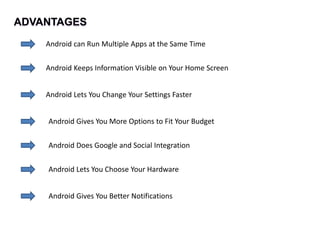
ADVANTAGES
Android can Run Multiple Apps at the Same Time
Android Keeps Information Visible on Your Home Screen
Android Lets You Change Your Settings Faster
Android Gives You More Options to Fit Your Budget
Android Does Google and Social Integration
Android Lets You Choose Your Hardware
Android Gives You Better Notifications
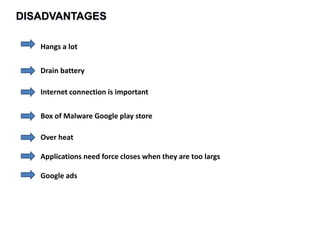
DISADVANTAGES
Hangs a lot
Drain battery
Internet connection is important
Box of Malware Google play store
Over heat
Applications need force closes when they are too largs
Google ads
CONCLUSION
Android is truly open,free development platform based on linux and open
sources.
Handset makers can use& customize the platform without paying a royalty.
Google android is stepping into the next level of mobile industry
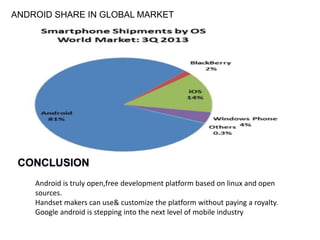
ANDROID SHARE IN GLOBAL MARKET
Presentation2

Presentation2

  • 1.
  • 2.
    What is android? ASoftware platform and operating system for mobile Based on the Linux kernel. HISTORY It was developed in Palo Alto, California Android was developed by the Andy Rubin, Rich Miner, Nick Sears and Chris White. Android was purchased by the GOOGLE in AUGUST,2005 for 50 million $.
  • 3.
    A business allianceconsisting of 47 companies to develop open standards for mobile devices This group of companies are allowed to use source code of Android and develop applications
  • 4.
  • 5.
    Android provides aset of core applications:  Email Client  SMS Program  Calendar  Maps  Browser  Contacts  Etc All applications are written using the Java language.
  • 6.
    6 Feature Role View System Used tobuild an application, including lists, grids, text boxes, buttons, and embedded web browser Content Provider Enabling applications to access data from other applications or to share their own data Resource Manager Providing access to non-code resources (localized strings, graphics, and layout files) Notification Manager Enabling all applications to display customer alerts in the status bar Activity Manager Managing the lifecycle of applications and providing a common navigation backstack  Users are allowed to replace components.
  • 7.
    Exposed to developersthrough the Android application framework Including a set of C/C++ libraries used by components of the Android system
  • 8.
    Core Libraries Providing mostof the functionality available in the core libraries of the Java language APIs Data Structures Utilities File Access Network Access Graphics Etc
  • 9.
    Dalvik Virtual Machine Providingenvironment on which every Android application runs Each Android application runs in its own process, with its own instance of the Dalvik VM. Dalvik has been written such that a device can run multiple VMs efficiently. Register-based virtual machine Executing the Dalvik Executable (.dex) format .dex format is optimized for minimal memory footprint. Compilation Relying on the Linux Kernel for: Threading Low-level memory management
  • 10.
     Relying onLinux Kernel 2.6 for core system services  Memory and Process Management  Network Stack  Driver Model  Security  Providing an abstraction layer between the H/W and the rest of the S/W s tack
  • 12.
    Versions Android Astro 1.0 AndroidBeta Android Cupcake 1.5 Android Donut 1.6 Android Éclair 2.0/2.1 Android Froyo 2.2 Android Gingerbread 2.3 Android Honeycomb 3.0 Android IceCreamSandwich(ICS) 4.0 Android JellyBean 4.1
  • 13.
    Android Astro 1.0 First full version of android.  Released on September 23, 2008.  Wi-Fi and Bluetooth support.  Quite slow in operating.  copy and paste feature in the web browser is not present. Android Cupcake 1.5  Released on April 30, 2009.  Added auto-rotation option.  Copy and Paste feature added in the web browser.  Increased speed and performance but not upto required level.
  • 14.
    Android Donut 1.6 Released on September 15, 2009.  Voice search and Search box were added.  Faster OS boot times and fast web browsing experience.  Typing is quite slower. Android Éclair 2.0/2.1  Released on October 26, 2009.  Bluetooth 2.1 support.  Improved typing speed on virtual keyboard, with smarter dictionary.  no Adobe flash media support.
  • 15.
    Android Froyo 2.2 Released on May 20, 2010.  Support for Adobe Flash 10.1  Improved Application launcher with better browser  No internet calling. Android Gingerbread 2.3  Released on December 6, 2010.  Updated User Interface with high efficiency and speed  Internet calling  One touch word selection and copy/paste.  New keyboard for faster word input.  More successful version of Android than previous versions.  not supports multi-core processors.
  • 16.
    Android Honeycomb 3.0 Released on February 22, 2011.  Support for multi-core processors  Ability to encrypt all user data.  This version of android is only available for tablets. Android IceCreamSandwich(ICS) 4.0  Released on November 14, 2011.  Virtual button in the UI.  A new typeface family for the UI, Roboto.  Ability to shut down apps that are using data in the background.
  • 17.
    Android JellyBean 4.1 Released on June 27, 2012.  Smoother interface  Bluetooth Smart Ready  Dial-pad Autocomplete  Simplified Setup Wizard  Bluetooth AVRCP  Location accuracy features via Wi-Fi scan only mode.
  • 18.
    Android Kit Kat4.4  Released on October 31, 2013.  Latest version of Android.  Smoother user interface.  NFC host card emulation, enabling a device to replace smart cards.  Wireless printing capability  New framework for UI transitions  Bluetooth Message Access Profile (MAP) support  Wi-Fi and mobile data activity (TX/RX) indicators are moved to quick settings  Expanded functionality for notification listener services  WebViews now based on Chromium engine
  • 20.
    PLATFORM Hardware Android is nota single piece of hardware; it's a complete, end-to-end software platform that can be adapted to work on any number of hardware configurations. Everything is there, from the bootloader all the way up to the Applications. . . Network Connectivity It supports wireless communications using: GSM mobile-phone technology 3G Edge 802.11 Wi-Fi networks
  • 21.
    FEATURES:- Messaging Web browser Voice basedfeatures Multi-touch Multitasking Screen capture Multiple language support Accessibility Connectivity Media support
  • 22.
    SOFTWARE DEVELOPMENTS:- JAVA ANDROID SDK ANDROIDDEVICES Cell Phones Tablets HDTV Microwave Oven Andriod Cars
  • 23.
    ADVANTAGES Android can RunMultiple Apps at the Same Time Android Keeps Information Visible on Your Home Screen Android Lets You Change Your Settings Faster Android Gives You More Options to Fit Your Budget Android Does Google and Social Integration Android Lets You Choose Your Hardware Android Gives You Better Notifications
  • 24.
    DISADVANTAGES Hangs a lot Drainbattery Internet connection is important Box of Malware Google play store Over heat Applications need force closes when they are too largs Google ads
  • 25.
    CONCLUSION Android is trulyopen,free development platform based on linux and open sources. Handset makers can use& customize the platform without paying a royalty. Google android is stepping into the next level of mobile industry ANDROID SHARE IN GLOBAL MARKET