WHAT IS ANDROID?
 A Software platform and operating system
for mobile.
 Based on the Linux kernel.
 Android was found way back in 2003.
 It was developed in Palo Alto, California.
 Android was developed by the Andy
Rubin, Rich Miner, Nick and Chris White.
 Android was purchased by the GOOGLE
in AUGUST,2005 for 50 million $.
Androidlogo was designed by Irina Blok
 It’s consortium of several companies.
 This group of companies are allowed to use
source code of Android and develop
applications.
 Reason for Nokia not to develop Android
Mobiles is Nokia is not part of OHA.
 Android supports wireless communication
using:-
 Android is a multi-process system, in
which each application (and parts of
the system) runs in its own process.
 3G Networks
 4G Networks
 802.11 Wi-Fi Networks
 Bluetooth Connectivity
 First Version of Android.
 The focus of Android beta is testing incorporating usability.
 Android beta will generally have many more problems on speed and
performance.
 The first commercial version of the software, was released
on 23 September 2008
 The first commercially available Android device was the
HTC DREAM
 Released on 9 February 2009
 Update released just for the HTC Dream only
 Longer in-call screen timeout default when using the
speakerphone, plus ability to show/hide dial pad
 Ability to save attachments in messages
 Support added for marquee in system layouts
HTC Dream
 Released on April 27, 2009.
 Added auto-rotation option.
 Copy and Paste feature added in the web
browser.
 Increased speed and performance but not upto
required level.
 Video recording and playback in MPEG-4 and 3GP
formats
 based on Linux kernel 2.6.27
 Released on September 15, 2009
 based on Linux kernel 2.6.29
 Voice search and Search box were added.
 Faster OS boot times and fast web browsing
experience.
 Ability for users to select multiple photos for
deletion
 Released on October 26, 2009.
 Bluetooth 2.1 support.
 Improved typing speed on virtual keyboard, with
smarter dictionary.
 Bluetooth 2.1 support
 Improved Google Maps 3.1.2
 Addition of live wallpapers, allowing the animation of
home-screen background images to show movement
 Some bugs are fixed in Android 2.1
 Released on May 20, 2010
 Based on Linux kernel 2.6.32
 Support for Adobe Flash 10.1
 Improved Application launcher & better browser
 USB tethering and Wi-Fi Hotspot functionality
 Speed, memory, and performance optimizations
 Released on December 6, 2010
 Based on Linux kernel 2.6.35
 Updated User Interface with high efficiency and speed
 Internet calling
 Support for multiple cameras on the device, including a front-
facing camera, if available
 New keyboard for faster word input.
 More successful version of Android than previous versions.
 Audio, graphical, and input enhancements for game
developers
 USB OTG Supports also introduced in Android 2.3.7
 Released on February 22, 2011.
 Based on Linux kernel 2.6.36
 Ability to encrypt all user data.
 This version of android is only available for tablets.
 Redesigned keyboard, making typing fast, efficient and accurate
on larger screen sizes
 Added System Bar, featuring quick access to notifications, status,
and soft navigation buttons, available at the bottom of the
screen
 Released on 10 May 2011
 Connectivity for USB accessories
 Resizable Home screen widgets
 Support for external keyboards and pointing devices
 Support for joysticks and gamepads
 Compatibility display mode for apps that have not been
optimized for tablet screen resolutions in Android 3.2
 Update to Google Books in Android 3.2
 Improved Adobe Flash support in browser in Android 3.2
 Released on 14 November 2011
 Based on Linux kernel 3.0.1
 Virtual button in the UI
 Easier-to-create folders, with a drag-and-drop style
 Wi-Fi Direct
 Separation of widgets in a new tab, listed in a similar manner
to apps
 Ability to shut down apps that are using data in the
background.
 A customizable launcher
 Released on June 27, 2012.
 Based on Linux kernel 3.0.31
 Smoother user interface.
 Ability to turn off notifications on an app specific
basis
 Improved camera app
 Google Wallet (for some devices like nexus 7)
 Released on 13 November 2012
 Based on Linux kernel 3.4.
 "Photo Sphere" panorama photos
 Lock screen improvements, including widget support and the ability
to swipe directly to camera Improved camera app
 Accessibility improvements: triple-tap to magnify the entire screen,
pan and zoom with two fingers
 Released on 24 July 2013
 Bluetooth Low Energy support
 Improvements to Photo Sphere
 Background Wi-Fi location still runs even when Wi-Fi is
turned off
 Release on 14 October 2013
 Notification and Navigation Bars Design
 QuickOffice integration
 Smoother UI
 Cloud Printing
 Low-power audio playback
 Material design : bold, colourful and responsive UI
 Battery : Power for the long haul
 Security : Keep your stuff safe and sound
Version Code name Release date Distribution
4.3 Jelly Bean July 24, 2013 0.2%
4.2.x Jelly Bean November 13, 2012 6.5%
4.1.x Jelly Bean July 9, 2012 34.0%
4.0.3–4.0.4 Ice Cream Sandwich December 16, 2011 22.5%
3.2 Honeycomb July 15, 2011 0.1%
3.1 Honeycomb May 10, 2011 0.0%
2.3.3–2.3.7 Gingerbread February 9, 2011 33.0%
2.3–2.3.2 Gingerbread December 6, 2010 0.1%
2.2 Froyo May 20, 2010 2.5%
2.0–2.1 Eclair October 26, 2009 1.2%
1.6 Donut September 15, 2009 0.1%
1.5 Cupcake April 30, 2009 0%
 Making source code available to everyone
inevitably invites the attention of hackers.
 Android operating system uses more
amount of battery as compared to normal
mobile phones.
 As we call Android is world of applications
we continuously need to connected with
the internet which is not possible for all the
users.
Drawbacks Android
• Hangs a lot
• Drain battery
• Internet connection is Important
• Over heats
• No Security
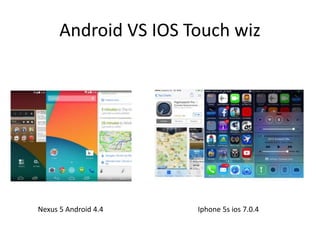
Android VS IOS Touch wiz
Nexus 5 Android 4.4 Iphone 5s ios 7.0.4
References
 en.wikipedia.org/wiki/Android_version_history#Android_1.0_.28API_level_1.29
Android.com
Android.ppt

Android.ppt

  • 2.
    WHAT IS ANDROID? A Software platform and operating system for mobile.  Based on the Linux kernel.  Android was found way back in 2003.  It was developed in Palo Alto, California.  Android was developed by the Andy Rubin, Rich Miner, Nick and Chris White.  Android was purchased by the GOOGLE in AUGUST,2005 for 50 million $.
  • 3.
  • 4.
     It’s consortiumof several companies.  This group of companies are allowed to use source code of Android and develop applications.  Reason for Nokia not to develop Android Mobiles is Nokia is not part of OHA.
  • 5.
     Android supportswireless communication using:-  Android is a multi-process system, in which each application (and parts of the system) runs in its own process.  3G Networks  4G Networks  802.11 Wi-Fi Networks  Bluetooth Connectivity
  • 7.
     First Versionof Android.  The focus of Android beta is testing incorporating usability.  Android beta will generally have many more problems on speed and performance.  The first commercial version of the software, was released on 23 September 2008  The first commercially available Android device was the HTC DREAM
  • 8.
     Released on9 February 2009  Update released just for the HTC Dream only  Longer in-call screen timeout default when using the speakerphone, plus ability to show/hide dial pad  Ability to save attachments in messages  Support added for marquee in system layouts
  • 9.
  • 11.
     Released onApril 27, 2009.  Added auto-rotation option.  Copy and Paste feature added in the web browser.  Increased speed and performance but not upto required level.  Video recording and playback in MPEG-4 and 3GP formats  based on Linux kernel 2.6.27
  • 13.
     Released onSeptember 15, 2009  based on Linux kernel 2.6.29  Voice search and Search box were added.  Faster OS boot times and fast web browsing experience.  Ability for users to select multiple photos for deletion
  • 15.
     Released onOctober 26, 2009.  Bluetooth 2.1 support.  Improved typing speed on virtual keyboard, with smarter dictionary.  Bluetooth 2.1 support  Improved Google Maps 3.1.2  Addition of live wallpapers, allowing the animation of home-screen background images to show movement  Some bugs are fixed in Android 2.1
  • 17.
     Released onMay 20, 2010  Based on Linux kernel 2.6.32  Support for Adobe Flash 10.1  Improved Application launcher & better browser  USB tethering and Wi-Fi Hotspot functionality  Speed, memory, and performance optimizations
  • 19.
     Released onDecember 6, 2010  Based on Linux kernel 2.6.35  Updated User Interface with high efficiency and speed  Internet calling  Support for multiple cameras on the device, including a front- facing camera, if available  New keyboard for faster word input.  More successful version of Android than previous versions.  Audio, graphical, and input enhancements for game developers  USB OTG Supports also introduced in Android 2.3.7
  • 21.
     Released onFebruary 22, 2011.  Based on Linux kernel 2.6.36  Ability to encrypt all user data.  This version of android is only available for tablets.  Redesigned keyboard, making typing fast, efficient and accurate on larger screen sizes  Added System Bar, featuring quick access to notifications, status, and soft navigation buttons, available at the bottom of the screen
  • 22.
     Released on10 May 2011  Connectivity for USB accessories  Resizable Home screen widgets  Support for external keyboards and pointing devices  Support for joysticks and gamepads  Compatibility display mode for apps that have not been optimized for tablet screen resolutions in Android 3.2  Update to Google Books in Android 3.2  Improved Adobe Flash support in browser in Android 3.2
  • 24.
     Released on14 November 2011  Based on Linux kernel 3.0.1  Virtual button in the UI  Easier-to-create folders, with a drag-and-drop style  Wi-Fi Direct  Separation of widgets in a new tab, listed in a similar manner to apps  Ability to shut down apps that are using data in the background.  A customizable launcher
  • 26.
     Released onJune 27, 2012.  Based on Linux kernel 3.0.31  Smoother user interface.  Ability to turn off notifications on an app specific basis  Improved camera app  Google Wallet (for some devices like nexus 7)
  • 27.
     Released on13 November 2012  Based on Linux kernel 3.4.  "Photo Sphere" panorama photos  Lock screen improvements, including widget support and the ability to swipe directly to camera Improved camera app  Accessibility improvements: triple-tap to magnify the entire screen, pan and zoom with two fingers  Released on 24 July 2013  Bluetooth Low Energy support  Improvements to Photo Sphere  Background Wi-Fi location still runs even when Wi-Fi is turned off
  • 29.
     Release on14 October 2013  Notification and Navigation Bars Design  QuickOffice integration  Smoother UI  Cloud Printing  Low-power audio playback
  • 31.
     Material design: bold, colourful and responsive UI  Battery : Power for the long haul  Security : Keep your stuff safe and sound
  • 32.
    Version Code nameRelease date Distribution 4.3 Jelly Bean July 24, 2013 0.2% 4.2.x Jelly Bean November 13, 2012 6.5% 4.1.x Jelly Bean July 9, 2012 34.0% 4.0.3–4.0.4 Ice Cream Sandwich December 16, 2011 22.5% 3.2 Honeycomb July 15, 2011 0.1% 3.1 Honeycomb May 10, 2011 0.0% 2.3.3–2.3.7 Gingerbread February 9, 2011 33.0% 2.3–2.3.2 Gingerbread December 6, 2010 0.1% 2.2 Froyo May 20, 2010 2.5% 2.0–2.1 Eclair October 26, 2009 1.2% 1.6 Donut September 15, 2009 0.1% 1.5 Cupcake April 30, 2009 0%
  • 33.
     Making sourcecode available to everyone inevitably invites the attention of hackers.  Android operating system uses more amount of battery as compared to normal mobile phones.  As we call Android is world of applications we continuously need to connected with the internet which is not possible for all the users.
  • 34.
    Drawbacks Android • Hangsa lot • Drain battery • Internet connection is Important • Over heats • No Security
  • 35.
    Android VS IOSTouch wiz Nexus 5 Android 4.4 Iphone 5s ios 7.0.4
  • 36.