Android
Seminar (2CE503)
RAVI N. PATEL
(17012012008)
U V PATEL COLLEGE OF ENGINEERING,
GANPAT UNIVERSITY,
KHERVA
Outline
 Introduction
 History
 Versions
 Pre-commercial release versions
 Version History
Introduction
Android is a mobile operating system developed by Google,
based on a modified version of the Linux kernel and other open
source software and designed primarily for touchscreen mobile
devices such as smartphones and tablets. In addition, Google
has further developed Android TV for televisions, Android
Auto for cars, and Wear OS for wrist watches, each with a
specialized user interface. [1]
History
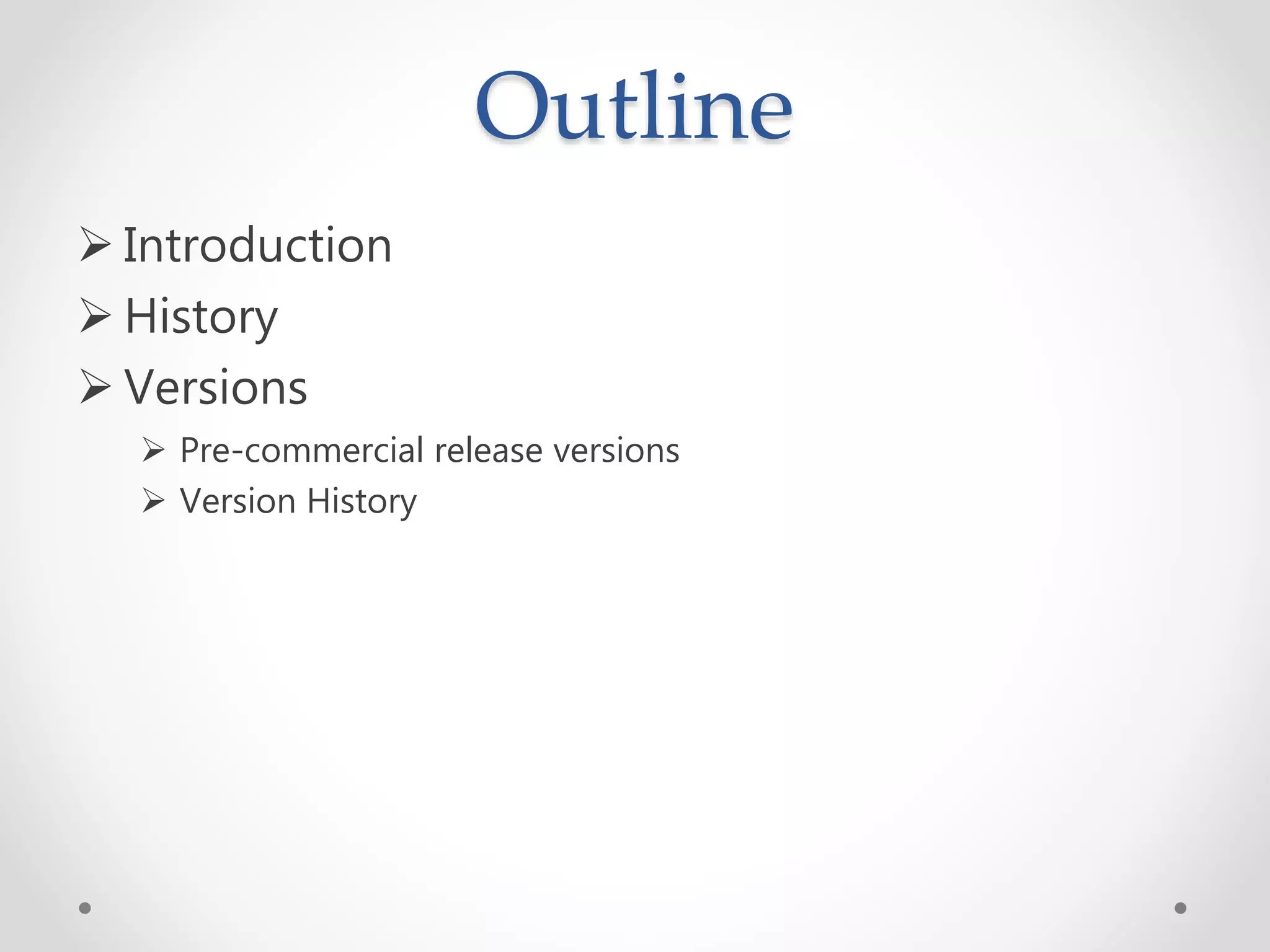
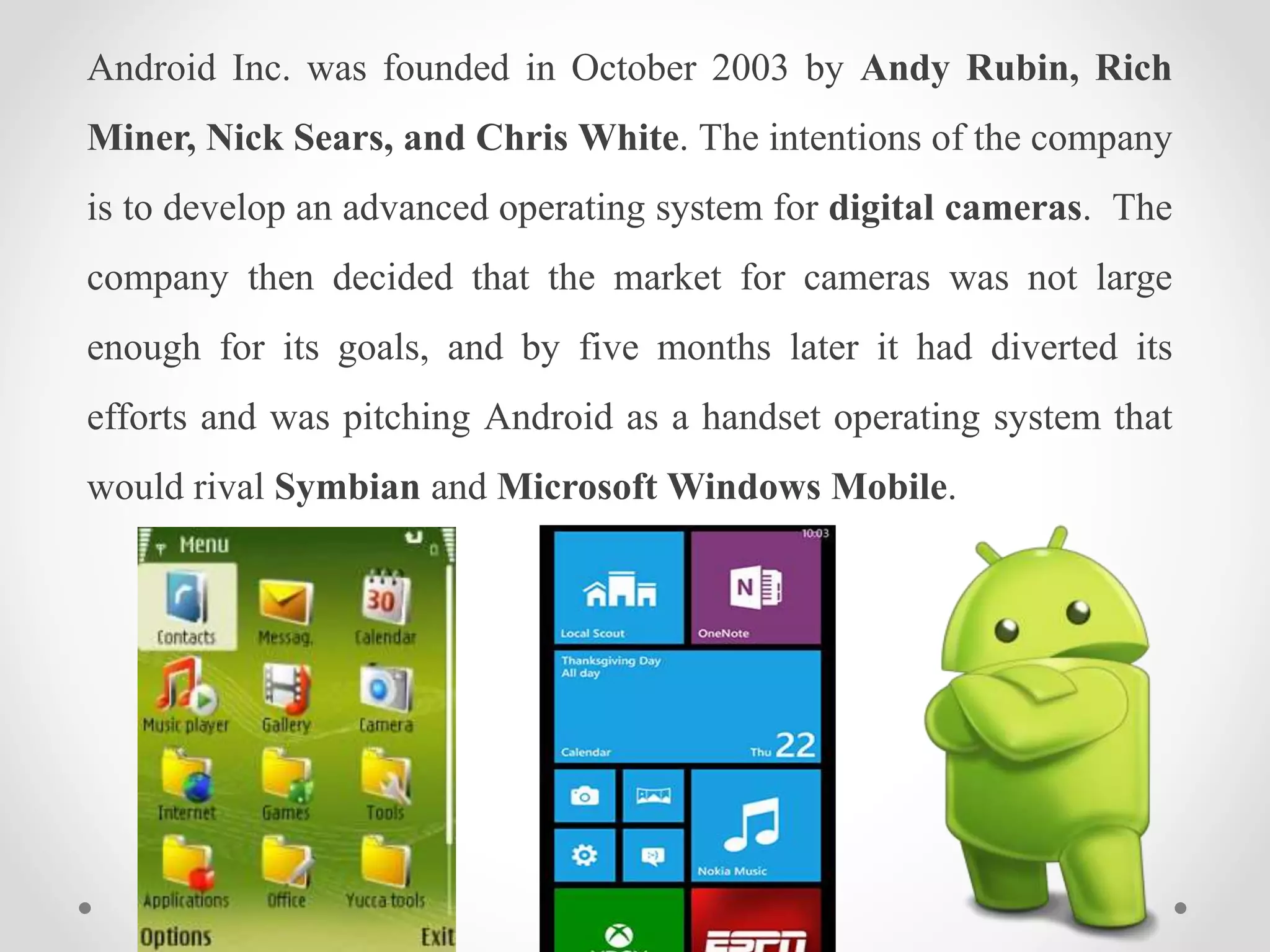
Android Inc. was founded in October 2003 by Andy Rubin, Rich
Miner, Nick Sears, and Chris White. The intentions of the company
is to develop an advanced operating system for digital cameras. The
company then decided that the market for cameras was not large
enough for its goals, and by five months later it had diverted its
efforts and was pitching Android as a handset operating system that
would rival Symbian and Microsoft Windows Mobile.
In July 2005, Google acquired Android Inc. for at least $50 million. Its key
employees, including Rubin, Miner and White, joined Google. At Google,
the team led by Rubin developed a mobile device platform powered by
the Linux kernel. Google marketed the platform to handset
makers and carriers on the promise of providing a flexible, upgradeable
system.
Google's intention was to enter the mobile communications market continued to
build through December 2006. But the arrival of 2007's Apple iPhone with
Touchscreen Displays meant that Android "had to go back to the drawing
board". Google later changed its Android specification that "Touchscreens will
be supported", although "the Product was designed with the presence of discrete
physical buttons as an assumption, therefore a touchscreen cannot completely
replace physical buttons". By 2008, both Nokia and BlackBerry announced
touch-based smartphones to rival the iPhone 3G, and Android's focus eventually
switched to just touchscreens. The first commercially available smartphone
running Android was the HTC Dream announced on September 23, 2008.
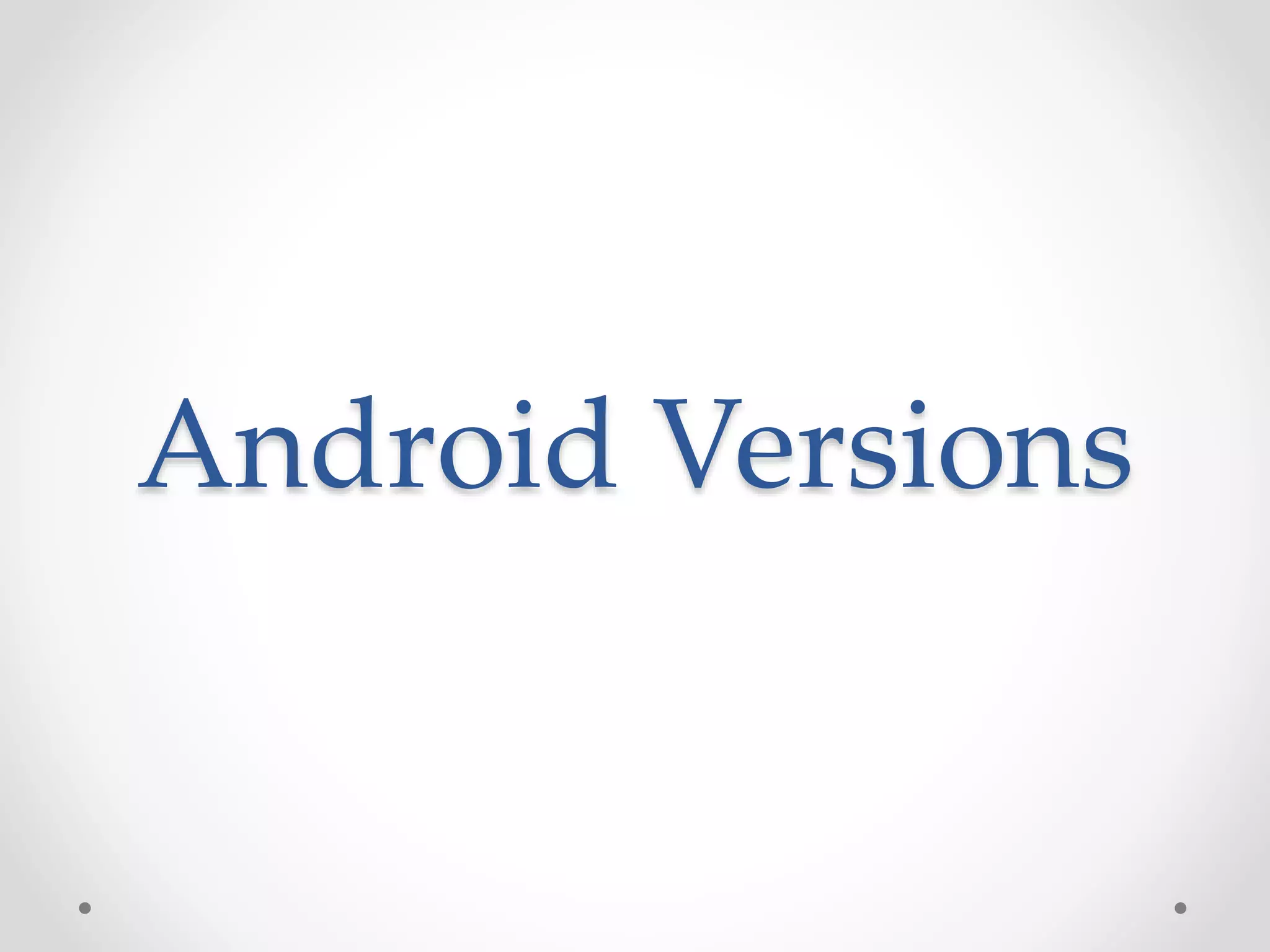
Android has been the best-selling OS worldwide on
smartphones since 2011 and on tablets since 2013. As of
May 2017, it has over two billion monthly active users, the
largest installed base of any operating system, and as of
June 2018, the Google Play store features over 3.3 million
apps.
Android Versions
The version history began with the public release of the Android beta on
November 5, 2007. The first commercial version Android 1.0 was released
on September 23, 2008. It has seen a number of updates since the initial
release.
Versions 1.0 and 1.1 were not released under specific code names and have
been in alphabetical order since 2009's Android 1.5 Cupcake, with the
most recent major version being Android 9 Pie released in August 6,
2018.[3]
Google explained that "Since these devices make our lives so sweet,
each Android version is named after a dessert"
 Pre-commercial release versions
 Alpha
 Beta
 Version history
 Android 1.0
 Android 1.1
 Cupcake
 Donut
 Eclair
 Froyo
 Gingerbread
 Honeycomb
 Ice Cream Sandwich
 Jelly Bean
 KitKat
 Lollipop
 Marshmallow
 Nougat
 Oreo
 Pie [2,3]
Version history by API level
 Android 1.0 (API 1)
 Android 1.1 (API 2)
 Android 1.5 Cupcake (API 3)
 Android 1.6 Donut (API 4)
 Android 2.0 Eclair (API 5)
 Android 2.0.1 Eclair (API 6)
 Android 2.1 Eclair (API 7)
 Android 2.2 Froyo (API 8)
 Android 2.3 Gingerbread (API 9)
 Android 2.3.3 Gingerbread (API 10)
 Android 3.0 Honeycomb (API 11)
 Android 3.1 Honeycomb (API 12)
 Android 3.2 Honeycomb (API 13)
 Android 4.0 Ice Cream Sandwich (API 14)
 Android 4.0.3 Ice Cream Sandwich (API 15)
Version history by API level :-
 Android 4.1 Jelly Bean (API 16)
 Android 4.2 Jelly Bean (API 17)
 Android 4.3 Jelly Bean (API 18)
 Android 4.4 KitKat (API 19)
 Android 4.4W KitKat, with wearable extensions (API 20)
 Android 5.0 Lollipop (API 21)
 Android 5.1 Lollipop (API 22)
 Android 6.0 Marshmallow (API 23)
 Android 7.0 Nougat (API 24)
 Android 7.1 Nougat (API 25)
 Android 8.0 Oreo (API 26)
 Android 8.1 Oreo (API 27)
 Android 9.0 Pie (API 28) [2,3]
[3]
References
1. https://en.wikipedia.org/wiki/Android_(operating_system)
2. https://www.android.com/history
3. https://en.wikipedia.org/wiki/Android_version_history
Thank You

Android introduction, history, version list till 9.0 Pie

  • 1.
    Android Seminar (2CE503) RAVI N.PATEL (17012012008) U V PATEL COLLEGE OF ENGINEERING, GANPAT UNIVERSITY, KHERVA
  • 2.
    Outline  Introduction  History Versions  Pre-commercial release versions  Version History
  • 3.
  • 4.
    Android is amobile operating system developed by Google, based on a modified version of the Linux kernel and other open source software and designed primarily for touchscreen mobile devices such as smartphones and tablets. In addition, Google has further developed Android TV for televisions, Android Auto for cars, and Wear OS for wrist watches, each with a specialized user interface. [1]
  • 5.
  • 6.
    Android Inc. wasfounded in October 2003 by Andy Rubin, Rich Miner, Nick Sears, and Chris White. The intentions of the company is to develop an advanced operating system for digital cameras. The company then decided that the market for cameras was not large enough for its goals, and by five months later it had diverted its efforts and was pitching Android as a handset operating system that would rival Symbian and Microsoft Windows Mobile.
  • 8.
    In July 2005,Google acquired Android Inc. for at least $50 million. Its key employees, including Rubin, Miner and White, joined Google. At Google, the team led by Rubin developed a mobile device platform powered by the Linux kernel. Google marketed the platform to handset makers and carriers on the promise of providing a flexible, upgradeable system.
  • 9.
    Google's intention wasto enter the mobile communications market continued to build through December 2006. But the arrival of 2007's Apple iPhone with Touchscreen Displays meant that Android "had to go back to the drawing board". Google later changed its Android specification that "Touchscreens will be supported", although "the Product was designed with the presence of discrete physical buttons as an assumption, therefore a touchscreen cannot completely replace physical buttons". By 2008, both Nokia and BlackBerry announced touch-based smartphones to rival the iPhone 3G, and Android's focus eventually switched to just touchscreens. The first commercially available smartphone running Android was the HTC Dream announced on September 23, 2008.
  • 10.
    Android has beenthe best-selling OS worldwide on smartphones since 2011 and on tablets since 2013. As of May 2017, it has over two billion monthly active users, the largest installed base of any operating system, and as of June 2018, the Google Play store features over 3.3 million apps.
  • 11.
  • 12.
    The version historybegan with the public release of the Android beta on November 5, 2007. The first commercial version Android 1.0 was released on September 23, 2008. It has seen a number of updates since the initial release. Versions 1.0 and 1.1 were not released under specific code names and have been in alphabetical order since 2009's Android 1.5 Cupcake, with the most recent major version being Android 9 Pie released in August 6, 2018.[3] Google explained that "Since these devices make our lives so sweet, each Android version is named after a dessert"
  • 13.
     Pre-commercial releaseversions  Alpha  Beta  Version history  Android 1.0  Android 1.1  Cupcake  Donut  Eclair  Froyo  Gingerbread  Honeycomb  Ice Cream Sandwich  Jelly Bean  KitKat  Lollipop  Marshmallow  Nougat  Oreo  Pie [2,3]
  • 14.
    Version history byAPI level  Android 1.0 (API 1)  Android 1.1 (API 2)  Android 1.5 Cupcake (API 3)  Android 1.6 Donut (API 4)  Android 2.0 Eclair (API 5)  Android 2.0.1 Eclair (API 6)  Android 2.1 Eclair (API 7)  Android 2.2 Froyo (API 8)  Android 2.3 Gingerbread (API 9)  Android 2.3.3 Gingerbread (API 10)  Android 3.0 Honeycomb (API 11)  Android 3.1 Honeycomb (API 12)  Android 3.2 Honeycomb (API 13)  Android 4.0 Ice Cream Sandwich (API 14)  Android 4.0.3 Ice Cream Sandwich (API 15)
  • 15.
    Version history byAPI level :-  Android 4.1 Jelly Bean (API 16)  Android 4.2 Jelly Bean (API 17)  Android 4.3 Jelly Bean (API 18)  Android 4.4 KitKat (API 19)  Android 4.4W KitKat, with wearable extensions (API 20)  Android 5.0 Lollipop (API 21)  Android 5.1 Lollipop (API 22)  Android 6.0 Marshmallow (API 23)  Android 7.0 Nougat (API 24)  Android 7.1 Nougat (API 25)  Android 8.0 Oreo (API 26)  Android 8.1 Oreo (API 27)  Android 9.0 Pie (API 28) [2,3]
  • 16.
  • 17.
  • 18.