A Presentation on
Android
BY
Prabhat Kumar(CSE 2)
Roll. No:011 1CS141066
WHAT IS ANDROID?
• Android is a mobile operating system (OS) based on
the Linux kernel and currently developed by Google.
With a user interface based on direct manipulation,
Android is designed primarily for touch screen mobile
devices such as smart phones and tablet computers,
with specialized user interfaces for televisions (Android
TV), cars (Android Auto), and wrist watches (Android
Wear). The OS uses touch inputs that loosely
correspond to real-world actions, like swiping, tapping,
pinching, and reverse pinching to manipulate on-
screen objects, and a virtual keyboard
HISTORY
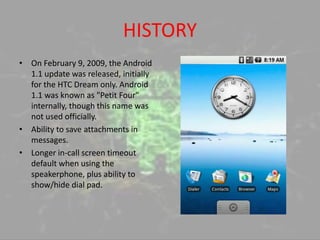
• On February 9, 2009, the Android
1.1 update was released, initially
for the HTC Dream only. Android
1.1 was known as "Petit Four"
internally, though this name was
not used officially.
• Ability to save attachments in
messages.
• Longer in-call screen timeout
default when using the
speakerphone, plus ability to
show/hide dial pad.
Android 1.5 Cupcake
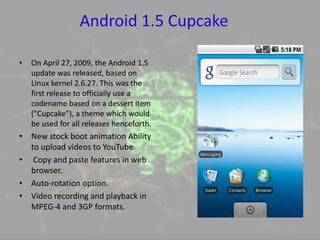
• On April 27, 2009, the Android 1.5
update was released, based on
Linux kernel 2.6.27. This was the
first release to officially use a
codename based on a dessert item
("Cupcake"), a theme which would
be used for all releases henceforth.
• New stock boot animation Ability
to upload videos to YouTube.
• Copy and paste features in web
browser.
• Auto-rotation option.
• Video recording and playback in
MPEG-4 and 3GP formats.
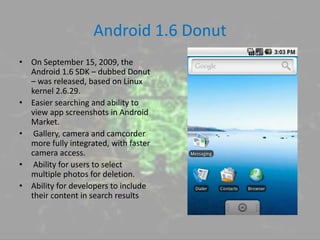
Android 1.6 Donut
• On September 15, 2009, the
Android 1.6 SDK – dubbed Donut
– was released, based on Linux
kernel 2.6.29.
• Easier searching and ability to
view app screenshots in Android
Market.
• Gallery, camera and camcorder
more fully integrated, with faster
camera access.
• Ability for users to select
multiple photos for deletion.
• Ability for developers to include
their content in search results
Android 2.0 Eclair
• On October 26, 2009, the Android
2.0 SDK was released, based on
Linux kernel 2.6.29 .
• Bluetooth 2.1 support.
• Ability to tap a Contacts photo
and select to call, SMS, or email
the person .
• Ability to search all saved SMS
and MMS messages, with delete
oldest messages in a conversation
automatically deleted when a
defined limit is reached.
• It was later updated to 2.0.1 and
then to 2.0.
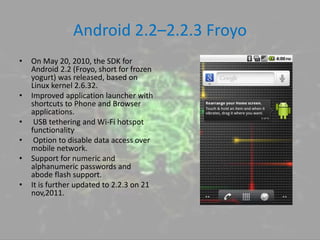
Android 2.2–2.2.3 Froyo
• On May 20, 2010, the SDK for
Android 2.2 (Froyo, short for frozen
yogurt) was released, based on
Linux kernel 2.6.32.
• Improved application launcher with
shortcuts to Phone and Browser
applications.
• USB tethering and Wi-Fi hotspot
functionality.
• Option to disable data access over
mobile network.
• Support for numeric and
alphanumeric passwords and
abode flash support.
• It is further updated to 2.2.3 on 21
nov,2011.
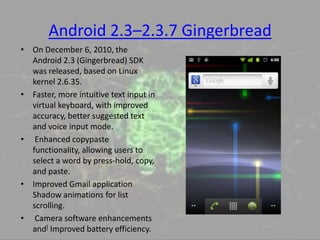
Android 2.3–2.3.7 Gingerbread
• On December 6, 2010, the
Android 2.3 (Gingerbread) SDK
was released, based on Linux
kernel 2.6.35.
• Faster, more intuitive text input in
virtual keyboard, with improved
accuracy, better suggested text
and voice input mode.
• Enhanced copypaste
functionality, allowing users to
select a word by press-hold, copy,
and paste.
• Improved Gmail application
Shadow animations for list
scrolling.
• Camera software enhancements
and[ Improved battery efficiency.
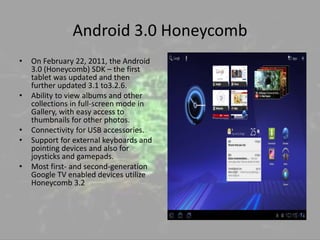
Android 3.0 Honeycomb
• On February 22, 2011, the Android
3.0 (Honeycomb) SDK – the first
tablet was updated and then
further updated 3.1 to3.2.6.
• Ability to view albums and other
collections in full-screen mode in
Gallery, with easy access to
thumbnails for other photos.
• Connectivity for USB accessories.
• Support for external keyboards and
pointing devices and also for
joysticks and gamepads.
• Most first- and second-generation
Google TV enabled devices utilize
Honeycomb 3.2
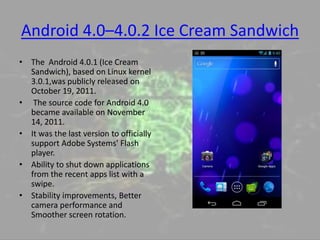
Android 4.0–4.0.2 Ice Cream Sandwich
• The Android 4.0.1 (Ice Cream
Sandwich), based on Linux kernel
3.0.1,was publicly released on
October 19, 2011.
• The source code for Android 4.0
became available on November
14, 2011.
• It was the last version to officially
support Adobe Systems' Flash
player.
• Ability to shut down applications
from the recent apps list with a
swipe.
• Stability improvements, Better
camera performance and
Smoother screen rotation.
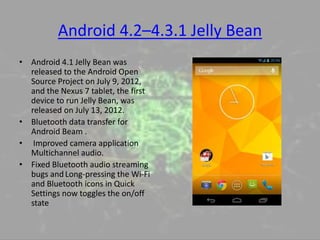
Android 4.2–4.3.1 Jelly Bean
• Android 4.1 Jelly Bean was
released to the Android Open
Source Project on July 9, 2012,
and the Nexus 7 tablet, the first
device to run Jelly Bean, was
released on July 13, 2012.
• Bluetooth data transfer for
Android Beam .
• Improved camera application
Multichannel audio.
• Fixed Bluetooth audio streaming
bugs andLong-pressing the Wi-Fi
and Bluetooth icons in Quick
Settings now toggles the on/off
state
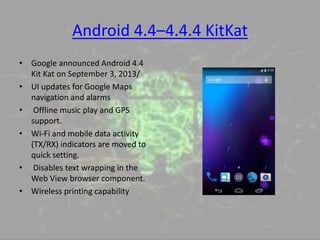
Android 4.4–4.4.4 KitKat
• Google announced Android 4.4
Kit Kat on September 3, 2013/
• UI updates for Google Maps
navigation and alarms
• Offline music play and GPS
support.
• Wi-Fi and mobile data activity
(TX/RX) indicators are moved to
quick setting.
• Disables text wrapping in the
Web View browser component.
• Wireless printing capability
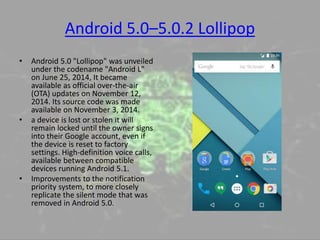
Android 5.0–5.0.2 Lollipop
• Android 5.0 "Lollipop" was unveiled
under the codename "Android L"
on June 25, 2014, It became
available as official over-the-air
(OTA) updates on November 12,
2014. Its source code was made
available on November 3, 2014.
• a device is lost or stolen it will
remain locked until the owner signs
into their Google account, even if
the device is reset to factory
settings. High-definition voice calls,
available between compatible
devices running Android 5.1.
• Improvements to the notification
priority system, to more closely
replicate the silent mode that was
removed in Android 5.0.
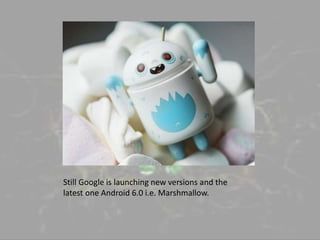
Still Google is launching new versions and the
latest one Android 6.0 i.e. Marshmallow.
Thank you

Ppt on android

  • 1.
    A Presentation on Android BY PrabhatKumar(CSE 2) Roll. No:011 1CS141066
  • 2.
    WHAT IS ANDROID? •Android is a mobile operating system (OS) based on the Linux kernel and currently developed by Google. With a user interface based on direct manipulation, Android is designed primarily for touch screen mobile devices such as smart phones and tablet computers, with specialized user interfaces for televisions (Android TV), cars (Android Auto), and wrist watches (Android Wear). The OS uses touch inputs that loosely correspond to real-world actions, like swiping, tapping, pinching, and reverse pinching to manipulate on- screen objects, and a virtual keyboard
  • 3.
    HISTORY • On February9, 2009, the Android 1.1 update was released, initially for the HTC Dream only. Android 1.1 was known as "Petit Four" internally, though this name was not used officially. • Ability to save attachments in messages. • Longer in-call screen timeout default when using the speakerphone, plus ability to show/hide dial pad.
  • 4.
    Android 1.5 Cupcake •On April 27, 2009, the Android 1.5 update was released, based on Linux kernel 2.6.27. This was the first release to officially use a codename based on a dessert item ("Cupcake"), a theme which would be used for all releases henceforth. • New stock boot animation Ability to upload videos to YouTube. • Copy and paste features in web browser. • Auto-rotation option. • Video recording and playback in MPEG-4 and 3GP formats.
  • 5.
    Android 1.6 Donut •On September 15, 2009, the Android 1.6 SDK – dubbed Donut – was released, based on Linux kernel 2.6.29. • Easier searching and ability to view app screenshots in Android Market. • Gallery, camera and camcorder more fully integrated, with faster camera access. • Ability for users to select multiple photos for deletion. • Ability for developers to include their content in search results
  • 6.
    Android 2.0 Eclair •On October 26, 2009, the Android 2.0 SDK was released, based on Linux kernel 2.6.29 . • Bluetooth 2.1 support. • Ability to tap a Contacts photo and select to call, SMS, or email the person . • Ability to search all saved SMS and MMS messages, with delete oldest messages in a conversation automatically deleted when a defined limit is reached. • It was later updated to 2.0.1 and then to 2.0.
  • 7.
    Android 2.2–2.2.3 Froyo •On May 20, 2010, the SDK for Android 2.2 (Froyo, short for frozen yogurt) was released, based on Linux kernel 2.6.32. • Improved application launcher with shortcuts to Phone and Browser applications. • USB tethering and Wi-Fi hotspot functionality. • Option to disable data access over mobile network. • Support for numeric and alphanumeric passwords and abode flash support. • It is further updated to 2.2.3 on 21 nov,2011.
  • 8.
    Android 2.3–2.3.7 Gingerbread •On December 6, 2010, the Android 2.3 (Gingerbread) SDK was released, based on Linux kernel 2.6.35. • Faster, more intuitive text input in virtual keyboard, with improved accuracy, better suggested text and voice input mode. • Enhanced copypaste functionality, allowing users to select a word by press-hold, copy, and paste. • Improved Gmail application Shadow animations for list scrolling. • Camera software enhancements and[ Improved battery efficiency.
  • 9.
    Android 3.0 Honeycomb •On February 22, 2011, the Android 3.0 (Honeycomb) SDK – the first tablet was updated and then further updated 3.1 to3.2.6. • Ability to view albums and other collections in full-screen mode in Gallery, with easy access to thumbnails for other photos. • Connectivity for USB accessories. • Support for external keyboards and pointing devices and also for joysticks and gamepads. • Most first- and second-generation Google TV enabled devices utilize Honeycomb 3.2
  • 10.
    Android 4.0–4.0.2 IceCream Sandwich • The Android 4.0.1 (Ice Cream Sandwich), based on Linux kernel 3.0.1,was publicly released on October 19, 2011. • The source code for Android 4.0 became available on November 14, 2011. • It was the last version to officially support Adobe Systems' Flash player. • Ability to shut down applications from the recent apps list with a swipe. • Stability improvements, Better camera performance and Smoother screen rotation.
  • 11.
    Android 4.2–4.3.1 JellyBean • Android 4.1 Jelly Bean was released to the Android Open Source Project on July 9, 2012, and the Nexus 7 tablet, the first device to run Jelly Bean, was released on July 13, 2012. • Bluetooth data transfer for Android Beam . • Improved camera application Multichannel audio. • Fixed Bluetooth audio streaming bugs andLong-pressing the Wi-Fi and Bluetooth icons in Quick Settings now toggles the on/off state
  • 12.
    Android 4.4–4.4.4 KitKat •Google announced Android 4.4 Kit Kat on September 3, 2013/ • UI updates for Google Maps navigation and alarms • Offline music play and GPS support. • Wi-Fi and mobile data activity (TX/RX) indicators are moved to quick setting. • Disables text wrapping in the Web View browser component. • Wireless printing capability
  • 13.
    Android 5.0–5.0.2 Lollipop •Android 5.0 "Lollipop" was unveiled under the codename "Android L" on June 25, 2014, It became available as official over-the-air (OTA) updates on November 12, 2014. Its source code was made available on November 3, 2014. • a device is lost or stolen it will remain locked until the owner signs into their Google account, even if the device is reset to factory settings. High-definition voice calls, available between compatible devices running Android 5.1. • Improvements to the notification priority system, to more closely replicate the silent mode that was removed in Android 5.0.
  • 14.
    Still Google islaunching new versions and the latest one Android 6.0 i.e. Marshmallow.
  • 15.