Submitted to : Nadeem Yaqoob
Submitted by : Zunair
Roll no : (17132120-005)
 Android's mobile operating
system is based on the Linux
kernel and is the world's best-
selling Smartphone.
 There are currently over 200,000
apps available for Android that
are made accessible through the
Android Market, which is the
online app store run by Google.
 The apps are primarily written in
Java.
INTRODUCTION
 The Android operating system,
including the Linux kernel, contains
approximately 12 million lines of
code.
 In this there are: 3 million lines of
XML, 2.8 million lines of C, 2.1
million lines of Java, and 1.75
million lines of C++.
INTRODUCTION
ANDROID FRAMEWORK
 Android Inc. was founded in Palo
Alto, California in October, 2003
by Andy Rubin, Rich Miner, Nick
Sears, and Chris White.
 Their goal was to develop a
"smarter mobile device that was
more aware of its owner's location
and preferences.”
 They operated secretively,
admitting only that they were
working on software for mobile
phones.
BACKGROUND
 Google acquired Android Inc. in
August, 2005, making Android
Inc. a wholly owned part of
Google Inc.
 Nick Sears was the only original
founder that did not stay with
Android Inc. after the acquisition.
 At this point in time, many
assumed that Google was
planning to enter the mobile
phone market with this move.
BACKGROUND
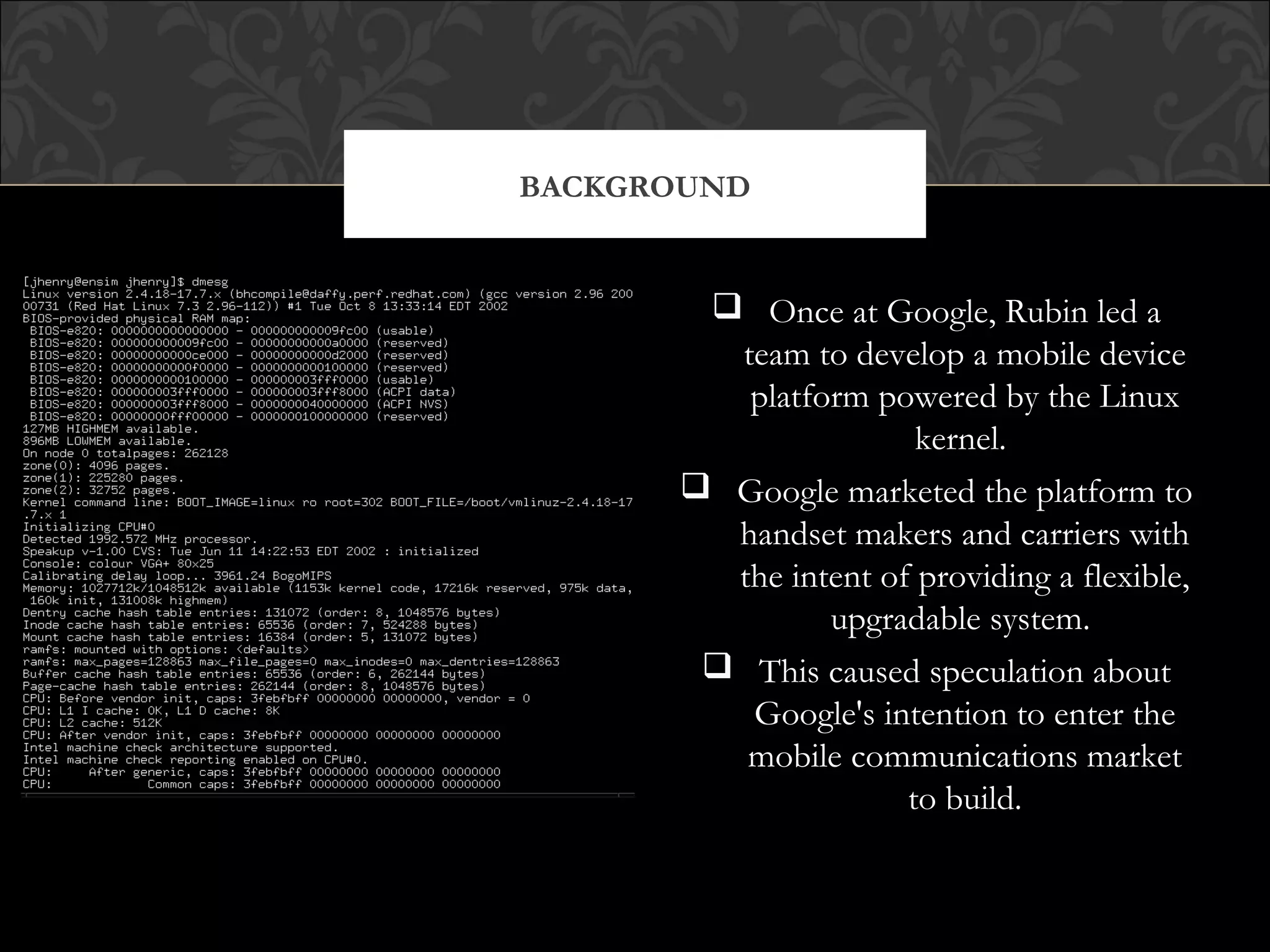
 Once at Google, Rubin led a
team to develop a mobile device
platform powered by the Linux
kernel.
 Google marketed the platform to
handset makers and carriers with
the intent of providing a flexible,
upgradable system.
 This caused speculation about
Google's intention to enter the
mobile communications market
to build.
BACKGROUND
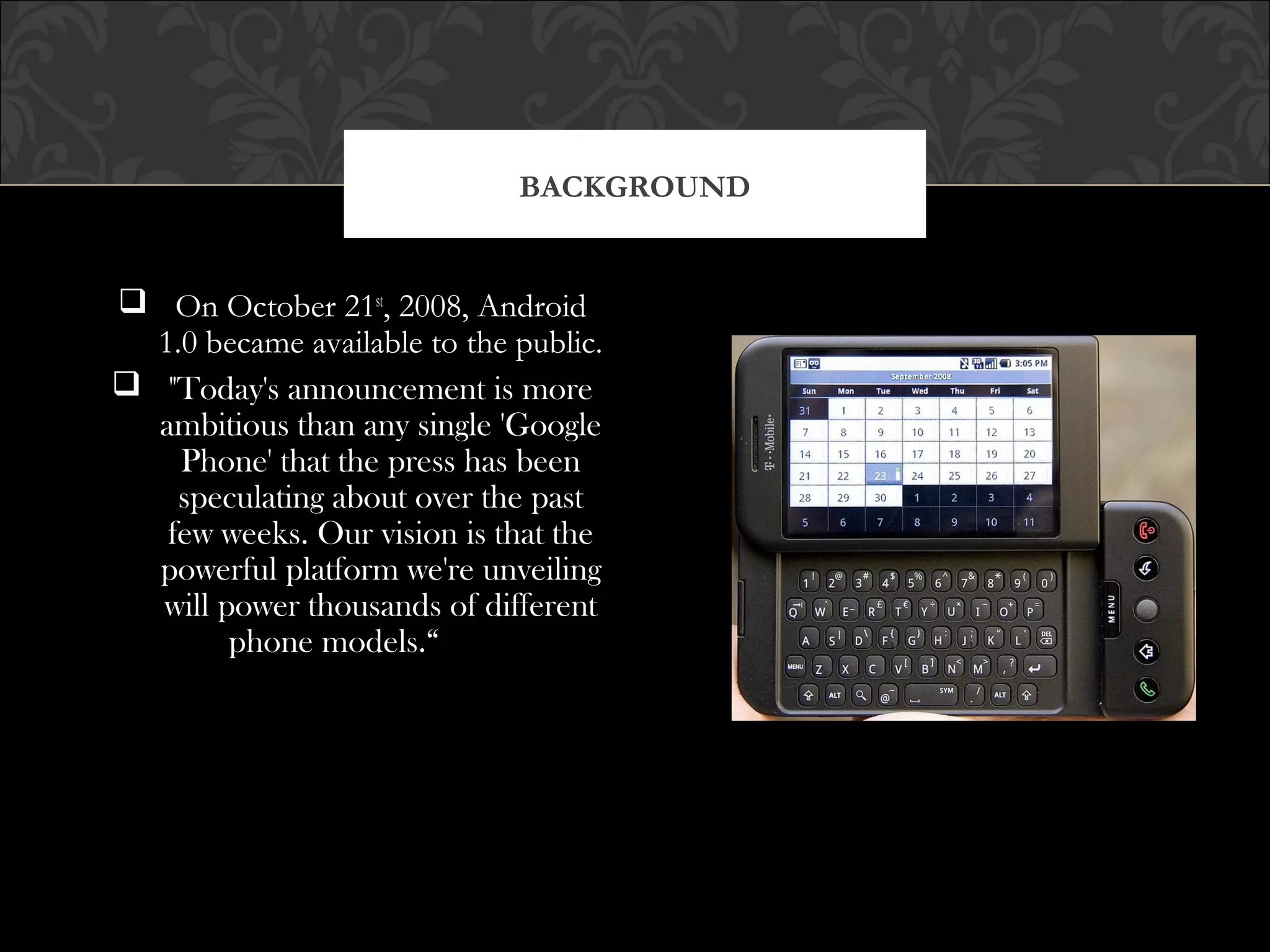
 On October 21st
, 2008, Android
1.0 became available to the public.
 "Today's announcement is more
ambitious than any single 'Google
Phone' that the press has been
speculating about over the past
few weeks. Our vision is that the
powerful platform we're unveiling
will power thousands of different
phone models.“
BACKGROUND
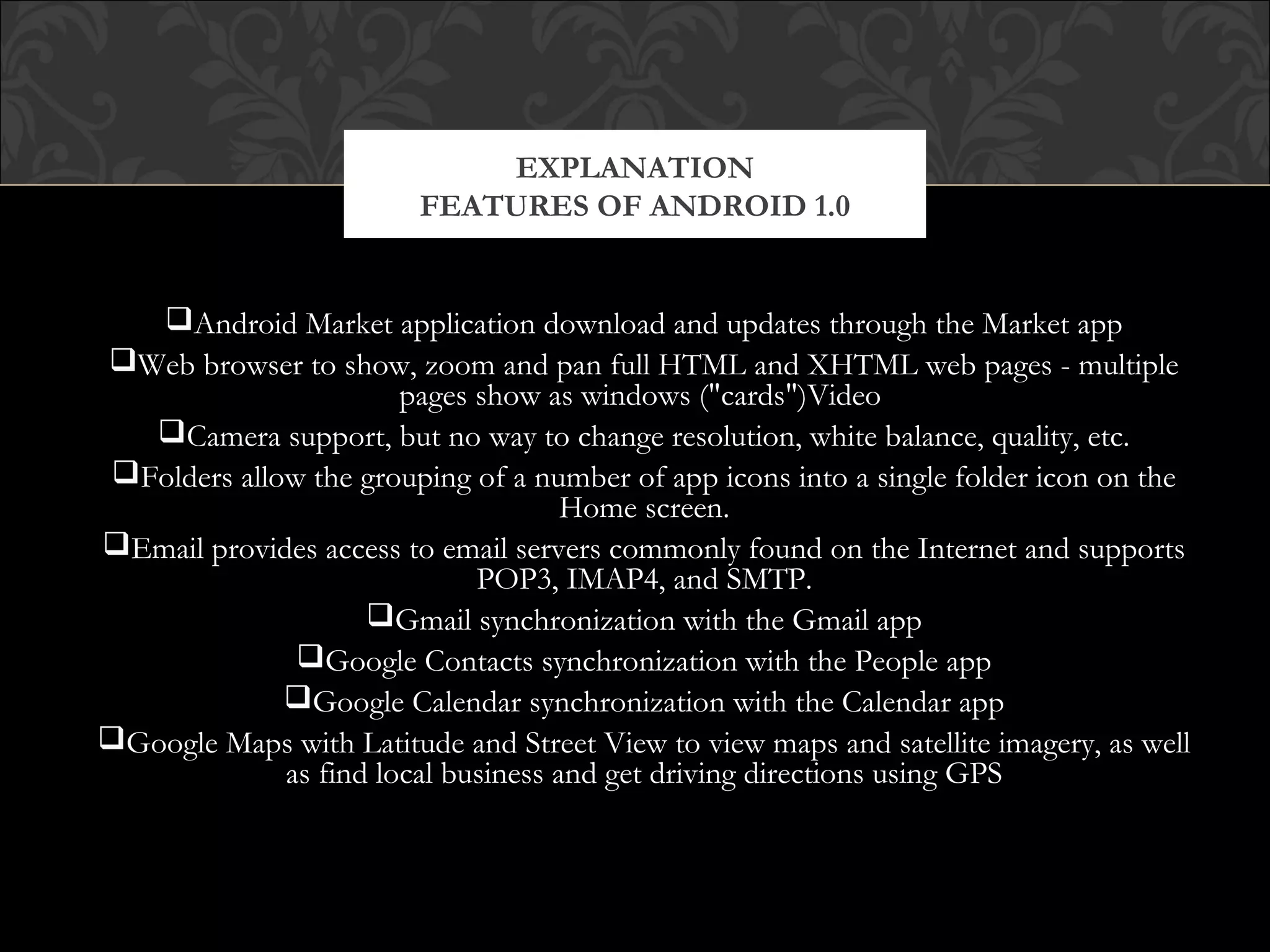
Android Market application download and updates through the Market app
Web browser to show, zoom and pan full HTML and XHTML web pages - multiple
pages show as windows ("cards")Video
Camera support, but no way to change resolution, white balance, quality, etc.
Folders allow the grouping of a number of app icons into a single folder icon on the
Home screen.
Email provides access to email servers commonly found on the Internet and supports
POP3, IMAP4, and SMTP.
Gmail synchronization with the Gmail app
Google Contacts synchronization with the People app
Google Calendar synchronization with the Calendar app
Google Maps with Latitude and Street View to view maps and satellite imagery, as well
as find local business and get driving directions using GPS
EXPLANATION
FEATURES OF ANDROID 1.0
 Google Search of the internet and phone apps, contacts, calendar, etc.
 Google Talk instant messaging.
 Instant messaging, text messaging, and MMS.
 Media Player enables managing, importing, and playing back but lacked video and stereo
Bluetooth support
 Notifications appear in the Status bar - drag down to see details, also ringtone, LEDs and
vibration options.
 Voice Dialer allows dialing and placing of phone calls without typing a name or number
 Wallpaper allows the user to set the background image or photo behind the Home screen
icons and widgets.
 YouTube video player.
 Other apps include: Alarm Clock, Calculator, Dialer (Phone), Home screen (launcher),
Pictures (Gallery), and Settings.
 Other supported features include: WiFi, and Bluetooth.
MORE FEATURES
 Handset Layouts
 The platform is adaptable to larger, VGA, 2D
graphics library, 3D graphics library based on
OpenGL ES 2.0 specifications, and traditional
smartphone layouts.
 Storage
 SQLite, a lightweight relational database, is used
for data storage purposes
 Connectivity
 Android supports connectivity technologies
including GSM/EDGE, IDEN, CDMA, EV-
DO, UMTS, Bluetooth, Wi-Fi (no connections
through Proxy serverand no Ad hoc wireless
network) LTE, NFC and WiMAX.
EXPLANATION
CURRENT FEATURES
 Messaging
 SMS and MMS are available forms of
messaging, including threaded text messaging
and now Android Cloud to Device Messaging
Framework is also a part of the Android
Messaging service.
 Multiple Language Support
 Several languages are available on Android.
The number of languages more than doubled
for the platform 2.3. However, it lacks font
rendering of several languages even after
official announcements of added support.
 Web Browser
 The web browser available for Android uses
the open-source WebKit layout engine, along
with Chrome's JavaScript engine.
FEATURES (CONT.)
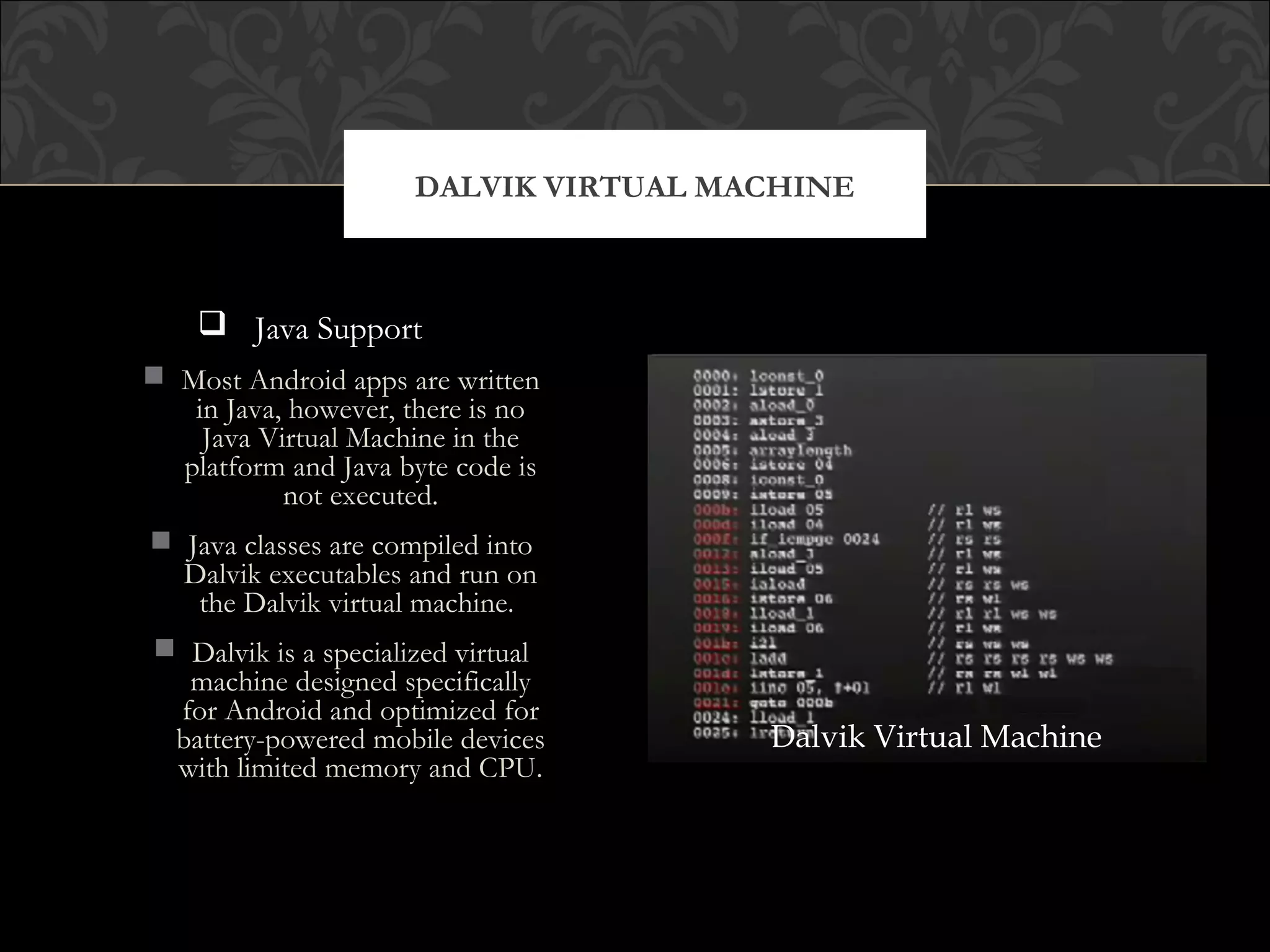
 Java Support
 Most Android apps are written
in Java, however, there is no
Java Virtual Machine in the
platform and Java byte code is
not executed.
 Java classes are compiled into
Dalvik executables and run on
the Dalvik virtual machine.
 Dalvik is a specialized virtual
machine designed specifically
for Android and optimized for
battery-powered mobile devices
with limited memory and CPU.
DALVIK VIRTUAL MACHINE
Dalvik Virtual Machine
WebM
H.263
H.264 (in 3GP or MP4
container)
MPEG-4 SP
AMR
AMR-WB (in 3GP
container)
AAC
HE-AAC (in MP4 or
3GP container)
MEDIA SUPPORT
 MP3
 MIDI
 Ogg
Vorbis
 FLAC
 WAV
 JPEG
 PNG
 GIF
 BMP
Android supports the following
audio/video/still media formats:
 Android has support for multi-
touch which was originally made
available in handsets such as the
HTC Hero.
 The feature was originally disabled
at the kernel level (possibly to
avoid infringing Apple's patents on
touch-screen technology at the
time).
 Google has since released an
update for the Nexus One and the
Motorola Droid which enables
multi-touch.
MULTI-TOUCH
 Latest version available for
mobile phones
 Enhanced UI with more polish
and several refinements
 Also adds support for NFC,
which allows for mobile
payments with only the use of
the device
ANDROID 2.3 GINGERBREAD
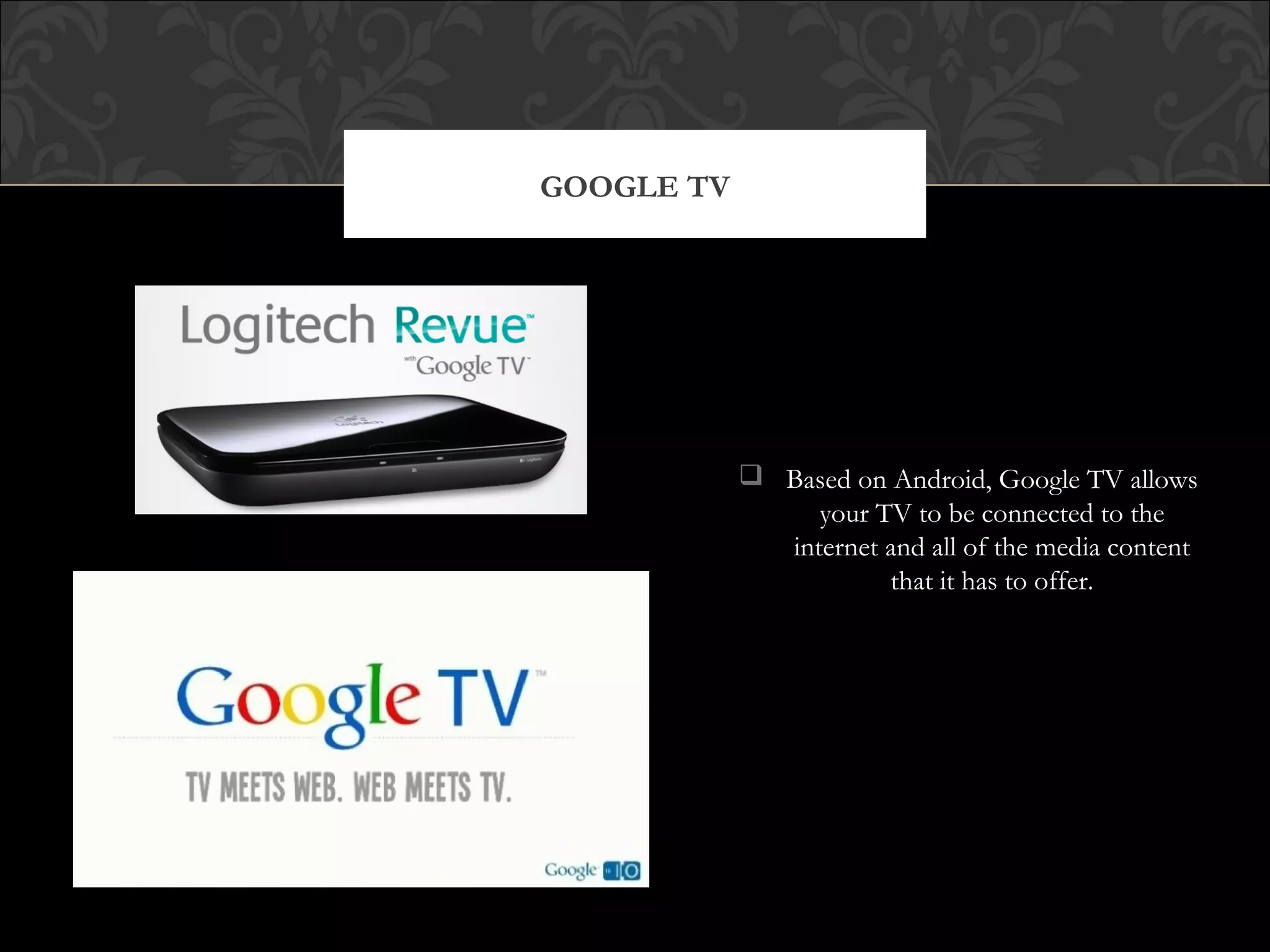
 Based on Android, Google TV allows
your TV to be connected to the
internet and all of the media content
that it has to offer.
GOOGLE TV
 Designed for use on Tablet
devices.
 Different UI compared to Version
2.3 Gingerbread
ANDROID 3.0 HONEYCOMB
 Android is the fastest growing
mobile operating system.
 Its growing even faster than
IOS!!
 More developers are choosing to
create Android applications
 There are more than 200,000
apps available.
SIGNIFICANCE
 Soon, Android will be able to communicate with your own
home and automate your life with Android@Home!
SIGNIFICANCE
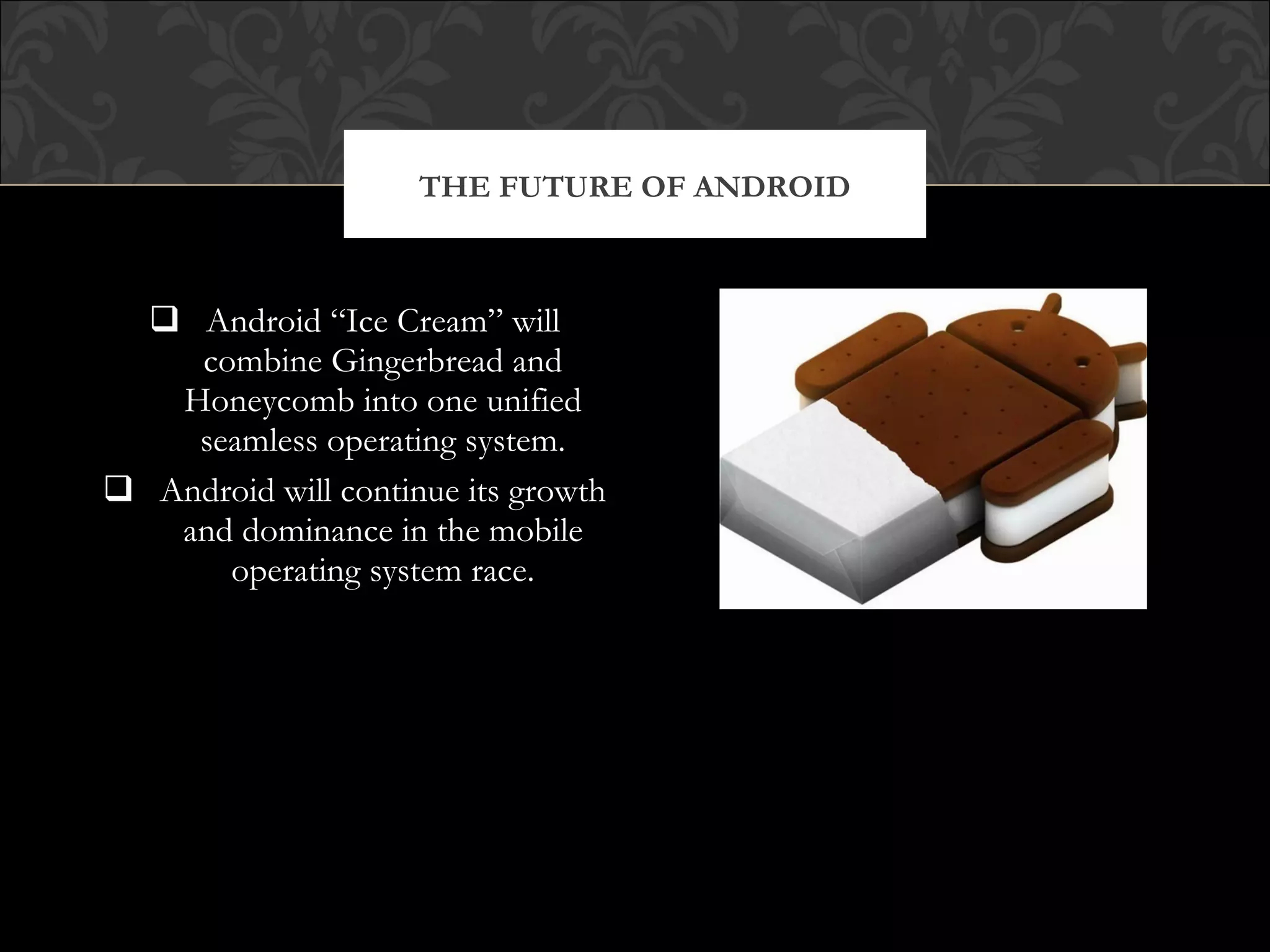
 Android “Ice Cream” will
combine Gingerbread and
Honeycomb into one unified
seamless operating system.
 Android will continue its growth
and dominance in the mobile
operating system race.
THE FUTURE OF ANDROID
 Started as a small idea by a few
developers
 Purchased by Google
 First open source mobile operating
system
 Set higher standards for what a
smartphone should be
 Fastest growing and most popular
mobile OS available
 The future of mobile computing is
Android!
 Puts Stucki’s Iphone to shame.
SUMMARY

Android Phone

  • 1.
    Submitted to :Nadeem Yaqoob Submitted by : Zunair Roll no : (17132120-005)
  • 2.
     Android's mobileoperating system is based on the Linux kernel and is the world's best- selling Smartphone.  There are currently over 200,000 apps available for Android that are made accessible through the Android Market, which is the online app store run by Google.  The apps are primarily written in Java. INTRODUCTION
  • 3.
     The Androidoperating system, including the Linux kernel, contains approximately 12 million lines of code.  In this there are: 3 million lines of XML, 2.8 million lines of C, 2.1 million lines of Java, and 1.75 million lines of C++. INTRODUCTION
  • 4.
  • 5.
     Android Inc.was founded in Palo Alto, California in October, 2003 by Andy Rubin, Rich Miner, Nick Sears, and Chris White.  Their goal was to develop a "smarter mobile device that was more aware of its owner's location and preferences.”  They operated secretively, admitting only that they were working on software for mobile phones. BACKGROUND
  • 6.
     Google acquiredAndroid Inc. in August, 2005, making Android Inc. a wholly owned part of Google Inc.  Nick Sears was the only original founder that did not stay with Android Inc. after the acquisition.  At this point in time, many assumed that Google was planning to enter the mobile phone market with this move. BACKGROUND
  • 7.
     Once atGoogle, Rubin led a team to develop a mobile device platform powered by the Linux kernel.  Google marketed the platform to handset makers and carriers with the intent of providing a flexible, upgradable system.  This caused speculation about Google's intention to enter the mobile communications market to build. BACKGROUND
  • 8.
     On October21st , 2008, Android 1.0 became available to the public.  "Today's announcement is more ambitious than any single 'Google Phone' that the press has been speculating about over the past few weeks. Our vision is that the powerful platform we're unveiling will power thousands of different phone models.“ BACKGROUND
  • 9.
    Android Market applicationdownload and updates through the Market app Web browser to show, zoom and pan full HTML and XHTML web pages - multiple pages show as windows ("cards")Video Camera support, but no way to change resolution, white balance, quality, etc. Folders allow the grouping of a number of app icons into a single folder icon on the Home screen. Email provides access to email servers commonly found on the Internet and supports POP3, IMAP4, and SMTP. Gmail synchronization with the Gmail app Google Contacts synchronization with the People app Google Calendar synchronization with the Calendar app Google Maps with Latitude and Street View to view maps and satellite imagery, as well as find local business and get driving directions using GPS EXPLANATION FEATURES OF ANDROID 1.0
  • 10.
     Google Searchof the internet and phone apps, contacts, calendar, etc.  Google Talk instant messaging.  Instant messaging, text messaging, and MMS.  Media Player enables managing, importing, and playing back but lacked video and stereo Bluetooth support  Notifications appear in the Status bar - drag down to see details, also ringtone, LEDs and vibration options.  Voice Dialer allows dialing and placing of phone calls without typing a name or number  Wallpaper allows the user to set the background image or photo behind the Home screen icons and widgets.  YouTube video player.  Other apps include: Alarm Clock, Calculator, Dialer (Phone), Home screen (launcher), Pictures (Gallery), and Settings.  Other supported features include: WiFi, and Bluetooth. MORE FEATURES
  • 11.
     Handset Layouts The platform is adaptable to larger, VGA, 2D graphics library, 3D graphics library based on OpenGL ES 2.0 specifications, and traditional smartphone layouts.  Storage  SQLite, a lightweight relational database, is used for data storage purposes  Connectivity  Android supports connectivity technologies including GSM/EDGE, IDEN, CDMA, EV- DO, UMTS, Bluetooth, Wi-Fi (no connections through Proxy serverand no Ad hoc wireless network) LTE, NFC and WiMAX. EXPLANATION CURRENT FEATURES
  • 12.
     Messaging  SMSand MMS are available forms of messaging, including threaded text messaging and now Android Cloud to Device Messaging Framework is also a part of the Android Messaging service.  Multiple Language Support  Several languages are available on Android. The number of languages more than doubled for the platform 2.3. However, it lacks font rendering of several languages even after official announcements of added support.  Web Browser  The web browser available for Android uses the open-source WebKit layout engine, along with Chrome's JavaScript engine. FEATURES (CONT.)
  • 13.
     Java Support Most Android apps are written in Java, however, there is no Java Virtual Machine in the platform and Java byte code is not executed.  Java classes are compiled into Dalvik executables and run on the Dalvik virtual machine.  Dalvik is a specialized virtual machine designed specifically for Android and optimized for battery-powered mobile devices with limited memory and CPU. DALVIK VIRTUAL MACHINE Dalvik Virtual Machine
  • 14.
    WebM H.263 H.264 (in 3GPor MP4 container) MPEG-4 SP AMR AMR-WB (in 3GP container) AAC HE-AAC (in MP4 or 3GP container) MEDIA SUPPORT  MP3  MIDI  Ogg Vorbis  FLAC  WAV  JPEG  PNG  GIF  BMP Android supports the following audio/video/still media formats:
  • 15.
     Android hassupport for multi- touch which was originally made available in handsets such as the HTC Hero.  The feature was originally disabled at the kernel level (possibly to avoid infringing Apple's patents on touch-screen technology at the time).  Google has since released an update for the Nexus One and the Motorola Droid which enables multi-touch. MULTI-TOUCH
  • 16.
     Latest versionavailable for mobile phones  Enhanced UI with more polish and several refinements  Also adds support for NFC, which allows for mobile payments with only the use of the device ANDROID 2.3 GINGERBREAD
  • 17.
     Based onAndroid, Google TV allows your TV to be connected to the internet and all of the media content that it has to offer. GOOGLE TV
  • 18.
     Designed foruse on Tablet devices.  Different UI compared to Version 2.3 Gingerbread ANDROID 3.0 HONEYCOMB
  • 19.
     Android isthe fastest growing mobile operating system.  Its growing even faster than IOS!!  More developers are choosing to create Android applications  There are more than 200,000 apps available. SIGNIFICANCE
  • 20.
     Soon, Androidwill be able to communicate with your own home and automate your life with Android@Home! SIGNIFICANCE
  • 21.
     Android “IceCream” will combine Gingerbread and Honeycomb into one unified seamless operating system.  Android will continue its growth and dominance in the mobile operating system race. THE FUTURE OF ANDROID
  • 22.
     Started asa small idea by a few developers  Purchased by Google  First open source mobile operating system  Set higher standards for what a smartphone should be  Fastest growing and most popular mobile OS available  The future of mobile computing is Android!  Puts Stucki’s Iphone to shame. SUMMARY