By
R.V.K Sandeep Reddy
13211A04B5
CONTENTS
• INTRODUCTION
• ORIGIN OF ANDROID
• PRECOMMERCIAL RELEASES
• VERSIONS OF ANDROID

• CONCLUSION
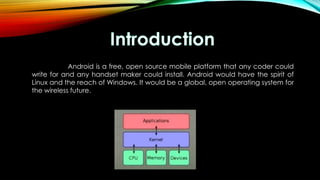
Android is a free, open source mobile platform that any coder could
write for and any handset maker could install. Android would have the spirit of
Linux and the reach of Windows. It would be a global, open operating system for
the wireless future.
ORIGIN
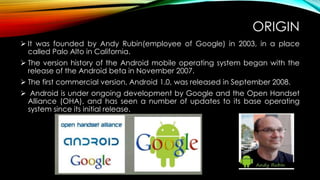
 It was founded by Andy Rubin(employee of Google) in 2003, in a place
called Palo Alto in California.
 The version history of the Android mobile operating system began with the
release of the Android beta in November 2007.
 The first commercial version, Android 1.0, was released in September 2008.
 Android is under ongoing development by Google and the Open Handset
Alliance (OHA), and has seen a number of updates to its base operating
system since its initial release.
PRE-COMMERCIAL RELEASES
Android alpha
 There were at least two internal releases inside Google and the OHA before
the Android beta was released in November 2007.
 The current green Android logo was designed by Irina Blok.
Android beta
 The Android beta was released on 5 November 2007. The 5 November date
is popularly celebrated as Android's "birthday".

 HTC Dream first sold out mobile which runs on android on Sept 23rd,2008.
REASON FOR ANDRIOID VERSION NAMES
• The project manager, Ryan Gibson, conceived of the confections naming scheme,
starting with Android 1.5.
• Since April 2009, android versions were released according to alphabetical order:
• Cupcake (1.5)
• Donut (1.6)
• Eclair (2.0–2.1)
• Froyo (2.2–2.2.3)
• Gingerbread (2.3–2.3.7)
• Honeycomb (3.0–3.2.6)
• Ice Cream Sandwich (4.0–4.0.4)
• Jelly Bean (4.1–4.3)
• KitKat (4.4).
ANDROID 1.5 CUPCAKE

• Released on 27 April 2009, based on Linux kernel .

• Support for third-party virtual keyboards with text prediction and user
dictionary for custom words
• Video recording and playback in MPEG-4 and 3GP formats
• Auto-pairing and stereo support for Bluetooth
• User pictures shown for Favorites in Contacts
• Specific date/time stamp shown for events in call log
• Ability to upload photos to Picasa
ANDROID DONUT 1.6









On 15 September 2009, the Android 1.6 was released, based on Linux kernel
Voice and text entry search enhanced to include bookmark history, contacts.
Ability for developers to include their content in search results
Multi-lingual speech synthesis engine to allow any Android application to "speak" a
string of text
Easier searching ability.
Gallery, camera and camcorder more fully integrated.
Speed improvements in searching and camera applications
Expanded Gesture framework.
ANDROID ECLAIR 2.0
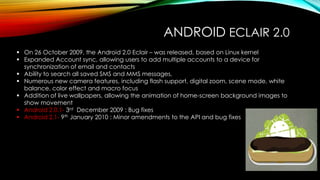
 On 26 October 2009, the Android 2.0 Eclair – was released, based on Linux kernel
 Expanded Account sync, allowing users to add multiple accounts to a device for
synchronization of email and contacts
 Ability to search all saved SMS and MMS messages,
 Numerous new camera features, including flash support, digital zoom, scene mode, white
balance, color effect and macro focus
 Addition of live wallpapers, allowing the animation of home-screen background images to
show movement
 Android 2.0.1- 3rd December 2009 : Bug fixes
 Android 2.1- 9th January 2010 : Minor amendments to the API and bug fixes
ANDROID 2.2-2.2.3 FROYO
 On 20TH May 2010, the SDK for Android 2.2 (Froyo, short for frozen yogurt) was
released, based on Linux kernel.
 2.2.1: 18th January 2011:: Bug fixes, security updates and performance
improvements
 2.2.2: 22nd January 2011::Minor bug fixes, including SMS routing issues
 2.2.3: 21st November 2011:: Two security patches
ANDROID 2.3-2.3.7 GINGER BREAD
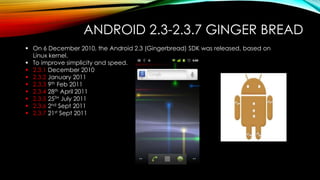
 On 6 December 2010, the Android 2.3 (Gingerbread) SDK was released, based on
Linux kernel.
 To improve simplicity and speed.
 2.3.1 December 2010
 2.3.2 January 2011
 2.3.3 9th Feb 2011
 2.3.4 28th April 2011
 2.3.5 25TH July 2011
 2.3.6 2nd Sept 2011
 2.3.7 21st Sept 2011
ANDROID 3.0-3.2 HONEY COMB
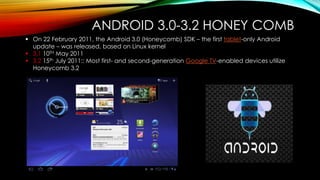
 On 22 February 2011, the Android 3.0 (Honeycomb) SDK – the first tablet-only Android
update – was released, based on Linux kernel
 3.1 10TH May 2011
 3.2 15th July 2011:: Most first- and second-generation Google TV-enabled devices utilize
Honeycomb 3.2
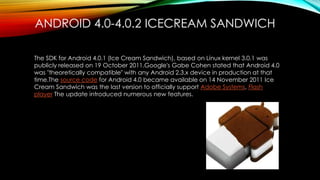
ANDROID 4.0-4.0.2 ICECREAM SANDWICH
The SDK for Android 4.0.1 (Ice Cream Sandwich), based on Linux kernel 3.0.1 was
publicly released on 19 October 2011.Google's Gabe Cohen stated that Android 4.0
was "theoretically compatible" with any Android 2.3.x device in production at that
time.The source code for Android 4.0 became available on 14 November 2011 Ice
Cream Sandwich was the last version to officially support Adobe Systems, Flash
player The update introduced numerous new features.
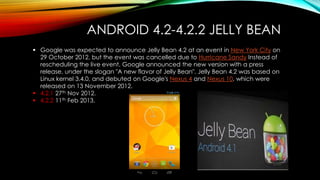
ANDROID 4.2-4.2.2 JELLY BEAN
 Google was expected to announce Jelly Bean 4.2 at an event in New York City on
29 October 2012, but the event was cancelled due to Hurricane Sandy Instead of
rescheduling the live event, Google announced the new version with a press
release, under the slogan "A new flavor of Jelly Bean". Jelly Bean 4.2 was based on
Linux kernel 3.4.0, and debuted on Google's Nexus 4 and Nexus 10, which were
released on 13 November 2012.
 4.2.1 27th Nov 2012.
 4.2.2 11th Feb 2013.
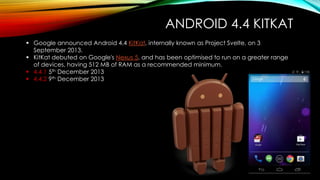
ANDROID 4.4 KITKAT
 Google announced Android 4.4 KitKat, internally known as Project Svelte, on 3
September 2013.
 KitKat debuted on Google's Nexus 5, and has been optimised to run on a greater range
of devices, having 512 MB of RAM as a recommended minimum.
 4.4.1 5th December 2013
 4.4.2 9th December 2013
ANDROID

ANDROID

  • 1.
  • 2.
    CONTENTS • INTRODUCTION • ORIGINOF ANDROID • PRECOMMERCIAL RELEASES • VERSIONS OF ANDROID • CONCLUSION
  • 3.
    Android is afree, open source mobile platform that any coder could write for and any handset maker could install. Android would have the spirit of Linux and the reach of Windows. It would be a global, open operating system for the wireless future.
  • 4.
    ORIGIN  It wasfounded by Andy Rubin(employee of Google) in 2003, in a place called Palo Alto in California.  The version history of the Android mobile operating system began with the release of the Android beta in November 2007.  The first commercial version, Android 1.0, was released in September 2008.  Android is under ongoing development by Google and the Open Handset Alliance (OHA), and has seen a number of updates to its base operating system since its initial release.
  • 5.
    PRE-COMMERCIAL RELEASES Android alpha There were at least two internal releases inside Google and the OHA before the Android beta was released in November 2007.  The current green Android logo was designed by Irina Blok. Android beta  The Android beta was released on 5 November 2007. The 5 November date is popularly celebrated as Android's "birthday".  HTC Dream first sold out mobile which runs on android on Sept 23rd,2008.
  • 6.
    REASON FOR ANDRIOIDVERSION NAMES • The project manager, Ryan Gibson, conceived of the confections naming scheme, starting with Android 1.5. • Since April 2009, android versions were released according to alphabetical order: • Cupcake (1.5) • Donut (1.6) • Eclair (2.0–2.1) • Froyo (2.2–2.2.3) • Gingerbread (2.3–2.3.7) • Honeycomb (3.0–3.2.6) • Ice Cream Sandwich (4.0–4.0.4) • Jelly Bean (4.1–4.3) • KitKat (4.4).
  • 7.
    ANDROID 1.5 CUPCAKE •Released on 27 April 2009, based on Linux kernel . • Support for third-party virtual keyboards with text prediction and user dictionary for custom words • Video recording and playback in MPEG-4 and 3GP formats • Auto-pairing and stereo support for Bluetooth • User pictures shown for Favorites in Contacts • Specific date/time stamp shown for events in call log • Ability to upload photos to Picasa
  • 8.
    ANDROID DONUT 1.6         On15 September 2009, the Android 1.6 was released, based on Linux kernel Voice and text entry search enhanced to include bookmark history, contacts. Ability for developers to include their content in search results Multi-lingual speech synthesis engine to allow any Android application to "speak" a string of text Easier searching ability. Gallery, camera and camcorder more fully integrated. Speed improvements in searching and camera applications Expanded Gesture framework.
  • 9.
    ANDROID ECLAIR 2.0 On 26 October 2009, the Android 2.0 Eclair – was released, based on Linux kernel  Expanded Account sync, allowing users to add multiple accounts to a device for synchronization of email and contacts  Ability to search all saved SMS and MMS messages,  Numerous new camera features, including flash support, digital zoom, scene mode, white balance, color effect and macro focus  Addition of live wallpapers, allowing the animation of home-screen background images to show movement  Android 2.0.1- 3rd December 2009 : Bug fixes  Android 2.1- 9th January 2010 : Minor amendments to the API and bug fixes
  • 10.
    ANDROID 2.2-2.2.3 FROYO On 20TH May 2010, the SDK for Android 2.2 (Froyo, short for frozen yogurt) was released, based on Linux kernel.  2.2.1: 18th January 2011:: Bug fixes, security updates and performance improvements  2.2.2: 22nd January 2011::Minor bug fixes, including SMS routing issues  2.2.3: 21st November 2011:: Two security patches
  • 11.
    ANDROID 2.3-2.3.7 GINGERBREAD  On 6 December 2010, the Android 2.3 (Gingerbread) SDK was released, based on Linux kernel.  To improve simplicity and speed.  2.3.1 December 2010  2.3.2 January 2011  2.3.3 9th Feb 2011  2.3.4 28th April 2011  2.3.5 25TH July 2011  2.3.6 2nd Sept 2011  2.3.7 21st Sept 2011
  • 12.
    ANDROID 3.0-3.2 HONEYCOMB  On 22 February 2011, the Android 3.0 (Honeycomb) SDK – the first tablet-only Android update – was released, based on Linux kernel  3.1 10TH May 2011  3.2 15th July 2011:: Most first- and second-generation Google TV-enabled devices utilize Honeycomb 3.2
  • 13.
    ANDROID 4.0-4.0.2 ICECREAMSANDWICH The SDK for Android 4.0.1 (Ice Cream Sandwich), based on Linux kernel 3.0.1 was publicly released on 19 October 2011.Google's Gabe Cohen stated that Android 4.0 was "theoretically compatible" with any Android 2.3.x device in production at that time.The source code for Android 4.0 became available on 14 November 2011 Ice Cream Sandwich was the last version to officially support Adobe Systems, Flash player The update introduced numerous new features.
  • 14.
    ANDROID 4.2-4.2.2 JELLYBEAN  Google was expected to announce Jelly Bean 4.2 at an event in New York City on 29 October 2012, but the event was cancelled due to Hurricane Sandy Instead of rescheduling the live event, Google announced the new version with a press release, under the slogan "A new flavor of Jelly Bean". Jelly Bean 4.2 was based on Linux kernel 3.4.0, and debuted on Google's Nexus 4 and Nexus 10, which were released on 13 November 2012.  4.2.1 27th Nov 2012.  4.2.2 11th Feb 2013.
  • 15.
    ANDROID 4.4 KITKAT Google announced Android 4.4 KitKat, internally known as Project Svelte, on 3 September 2013.  KitKat debuted on Google's Nexus 5, and has been optimised to run on a greater range of devices, having 512 MB of RAM as a recommended minimum.  4.4.1 5th December 2013  4.4.2 9th December 2013