Seminar on


android
Pranav Singh
BIT c.s. 3rd yr
1025410050
Main Topics


1.   Introduction
2.   Platform
3.   Development
4.   Versions
5.   Overall Evaluation
Introduction(1)
  A software platform and operating system for
  mobile devices

  Based on the Linux kernel

  Developed by Google and later the Open
  Handset Alliance (OHA)

  Allows writing managed code in the Java
  language

  Unveiling of the Android platform was
  announced on 5 November 2007 with the
  founding of OHA
Introduction(2)
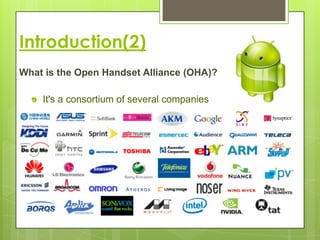
What is the Open Handset Alliance (OHA)?

    It's a consortium of several companies
Platform(1)

Operating System(s)

  Android uses Linux for its device drivers, memory
  management, process management, and
  networking.
  Android native libraries. They are all written in
  C/C++ internally, but you’ll be calling them through
  Java interfaces.
Platform(2)
Network Connectivity

It supports wireless communications using:

  GSM mobile-phone technology

  3G

  802.11 Wi-Fi networks
Platform(3)
Security

 Android is a multi-process system, in which each
 application (and parts of the system) runs in its own
 process. Most security between applications and the
 system is enforced at the process level through
 standard Linux facilities, such as user and group IDs
 that are assigned to applications.

 Additional finer-grained security features are provided
 through a "permission" mechanism that enforces
 restrictions on the specific operations that a particular
 process can perform, and per-URI permissions for
 granting ad-hoc access to specific pieces of data.
Development
IDE and Tools
Android SDK
    Class Library
    Developer Tools
    Emulator and System Images
    Documentation and Sample Code

Eclipse IDE + ADT (Android Development Tools)
    Reduces Development and Testing Time
    Makes User Interface-Creation easier
    Makes Application Description Easier
Versions(1)
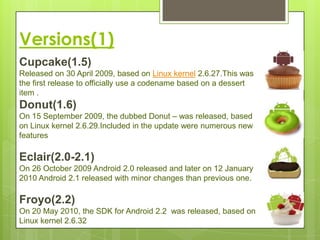
Cupcake(1.5)
Released on 30 April 2009, based on Linux kernel 2.6.27.This was
the first release to officially use a codename based on a dessert
item .
Donut(1.6)
On 15 September 2009, the dubbed Donut – was released, based
on Linux kernel 2.6.29.Included in the update were numerous new
features

Eclair(2.0-2.1)
On 26 October 2009 Android 2.0 released and later on 12 January
2010 Android 2.1 released with minor changes than previous one.

Froyo(2.2)
On 20 May 2010, the SDK for Android 2.2 was released, based on
Linux kernel 2.6.32
Versions(2)
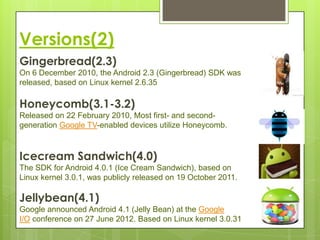
Gingerbread(2.3)
On 6 December 2010, the Android 2.3 (Gingerbread) SDK was
released, based on Linux kernel 2.6.35

Honeycomb(3.1-3.2)
Released on 22 February 2010, Most first- and second-
generation Google TV-enabled devices utilize Honeycomb.


Icecream Sandwich(4.0)
The SDK for Android 4.0.1 (Ice Cream Sandwich), based on
Linux kernel 3.0.1, was publicly released on 19 October 2011.

Jellybean(4.1)
Google announced Android 4.1 (Jelly Bean) at the Google
I/O conference on 27 June 2012. Based on Linux kernel 3.0.31
Code
Version                       Release date           API level    Distribution
                name

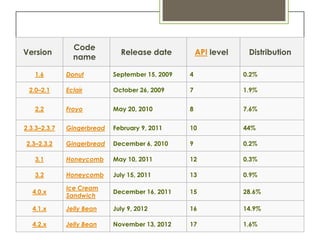
   1.6        Donut         September 15, 2009   4               0.2%

 2.0–2.1      Eclair        October 26, 2009     7               1.9%


   2.2        Froyo         May 20, 2010         8               7.6%


2.3.3–2.3.7   Gingerbread   February 9, 2011     10              44%

2.3–2.3.2     Gingerbread   December 6, 2010     9               0.2%

   3.1        Honeycomb     May 10, 2011         12              0.3%

   3.2        Honeycomb     July 15, 2011        13              0.9%

              Ice Cream
   4.0.x                    December 16, 2011    15              28.6%
              Sandwich

   4.1.x      Jelly Bean    July 9, 2012         16              14.9%

   4.2.x      Jelly Bean    November 13, 2012    17              1.6%
Overall Evaluation(1)
Advantages
Some of the advantages include:

   The ability for anyone to customize the Google
   Android platform
   Wide range of mobile applications to choose
   Customize a mobile phones using Google Android
   platform like never before
   Features like weather details, opening screen, even
   the icons on the opening screen will be able to be
   customized
   Offer online real time multiplayer games
Overall Evaluation(2)
Limitations
  Bluetooth limitations
         Bluetooth stereo
         Contacts exchange
         Modem pairing
         Wireless keyboards

  Firefox Mobile isn't coming to Android
  Apps in Android Market need to be programmed with a
  custom form of Java
      Mozilla and the Fennec won't have that
Overall Evaluation(3)
Future possibilities

   Intel doesn’t want to lose ownership of the
   netbook market, so they need to prepare for
   anything, including Android
   Fujitsu launched an initiative to offer consulting
   and engineering expertise to help run Android on
   embedded hardware
   More Android devices are coming and some will
   push the envelope even further
Overall Evaluation(4)
Conclusion

We can only hope that the next versions of
Android have overcome the actual limitations
and that the future possibilities became a reality.
Android

Android

  • 1.
  • 2.
    Main Topics 1. Introduction 2. Platform 3. Development 4. Versions 5. Overall Evaluation
  • 3.
    Introduction(1) Asoftware platform and operating system for mobile devices Based on the Linux kernel Developed by Google and later the Open Handset Alliance (OHA) Allows writing managed code in the Java language Unveiling of the Android platform was announced on 5 November 2007 with the founding of OHA
  • 4.
    Introduction(2) What is theOpen Handset Alliance (OHA)? It's a consortium of several companies
  • 5.
    Platform(1) Operating System(s) Android uses Linux for its device drivers, memory management, process management, and networking. Android native libraries. They are all written in C/C++ internally, but you’ll be calling them through Java interfaces.
  • 6.
    Platform(2) Network Connectivity It supportswireless communications using: GSM mobile-phone technology 3G 802.11 Wi-Fi networks
  • 7.
    Platform(3) Security Android isa multi-process system, in which each application (and parts of the system) runs in its own process. Most security between applications and the system is enforced at the process level through standard Linux facilities, such as user and group IDs that are assigned to applications. Additional finer-grained security features are provided through a "permission" mechanism that enforces restrictions on the specific operations that a particular process can perform, and per-URI permissions for granting ad-hoc access to specific pieces of data.
  • 8.
    Development IDE and Tools AndroidSDK Class Library Developer Tools Emulator and System Images Documentation and Sample Code Eclipse IDE + ADT (Android Development Tools) Reduces Development and Testing Time Makes User Interface-Creation easier Makes Application Description Easier
  • 9.
    Versions(1) Cupcake(1.5) Released on 30April 2009, based on Linux kernel 2.6.27.This was the first release to officially use a codename based on a dessert item . Donut(1.6) On 15 September 2009, the dubbed Donut – was released, based on Linux kernel 2.6.29.Included in the update were numerous new features Eclair(2.0-2.1) On 26 October 2009 Android 2.0 released and later on 12 January 2010 Android 2.1 released with minor changes than previous one. Froyo(2.2) On 20 May 2010, the SDK for Android 2.2 was released, based on Linux kernel 2.6.32
  • 10.
    Versions(2) Gingerbread(2.3) On 6 December2010, the Android 2.3 (Gingerbread) SDK was released, based on Linux kernel 2.6.35 Honeycomb(3.1-3.2) Released on 22 February 2010, Most first- and second- generation Google TV-enabled devices utilize Honeycomb. Icecream Sandwich(4.0) The SDK for Android 4.0.1 (Ice Cream Sandwich), based on Linux kernel 3.0.1, was publicly released on 19 October 2011. Jellybean(4.1) Google announced Android 4.1 (Jelly Bean) at the Google I/O conference on 27 June 2012. Based on Linux kernel 3.0.31
  • 11.
    Code Version Release date API level Distribution name 1.6 Donut September 15, 2009 4 0.2% 2.0–2.1 Eclair October 26, 2009 7 1.9% 2.2 Froyo May 20, 2010 8 7.6% 2.3.3–2.3.7 Gingerbread February 9, 2011 10 44% 2.3–2.3.2 Gingerbread December 6, 2010 9 0.2% 3.1 Honeycomb May 10, 2011 12 0.3% 3.2 Honeycomb July 15, 2011 13 0.9% Ice Cream 4.0.x December 16, 2011 15 28.6% Sandwich 4.1.x Jelly Bean July 9, 2012 16 14.9% 4.2.x Jelly Bean November 13, 2012 17 1.6%
  • 12.
    Overall Evaluation(1) Advantages Some ofthe advantages include: The ability for anyone to customize the Google Android platform Wide range of mobile applications to choose Customize a mobile phones using Google Android platform like never before Features like weather details, opening screen, even the icons on the opening screen will be able to be customized Offer online real time multiplayer games
  • 13.
    Overall Evaluation(2) Limitations Bluetooth limitations Bluetooth stereo Contacts exchange Modem pairing Wireless keyboards Firefox Mobile isn't coming to Android Apps in Android Market need to be programmed with a custom form of Java Mozilla and the Fennec won't have that
  • 14.
    Overall Evaluation(3) Future possibilities Intel doesn’t want to lose ownership of the netbook market, so they need to prepare for anything, including Android Fujitsu launched an initiative to offer consulting and engineering expertise to help run Android on embedded hardware More Android devices are coming and some will push the envelope even further
  • 15.
    Overall Evaluation(4) Conclusion We canonly hope that the next versions of Android have overcome the actual limitations and that the future possibilities became a reality.