the world's most popular mobile platform

   Android is the world's most popular mobile platform. With
  Android you can use all the Google apps you know and love,
  plus there are more than 600,000 apps and games available on
Google Play to keep you entertained, alongside millions of songs
and books, and thousands of movies. Android devices are already
  smart, and will only get smarter, with new features you won't
find on any other platform, letting you focus on what's important
      and putting you in control of your mobile experience


                                                                ©|1
Main topics


1.   Introduction

2.   What is OHA?

3 Android architecture

4. Platform

5. Software development

6. Overall evaluation
1. Introduction (1)
What is Android?
•   A software platform and operating system for mobile devices

•   Based on the Linux kernel

•   Developed by Google and later the Open Handset Alliance (OHA)

•   Allows writing managed code in the Java language

•   Possibility to write applications in other languages and compiling it to ARM
    native code (support of Google? No)

•   Unveiling of the Android platform was announced on 5 November 2007 with
    the founding of OHA

•   Android powers hundreds of millions of mobile devices in more than 190
    countries around the world
•   It is developed by robot invader
1. Introduction (2)
  What is the Open Handset Alliance (OHA)?

     → It's a combination of several companies
1. Introduction (3)
What is the Open Handset Alliance (OHA)? (2)

•   Devoted to advancing open standards for mobile devices

•   Develop technologies that will significantly lower the cost of developing and
    distributing mobile devices and services

•   The OHA is the group that is in charge of the Android smartphone operating
    system. It was created by Google and includes key members such as China Mobile,
    HTC, Intel, Motorola, NTT DoCoMo, Sprint, and T-Mobile USA. There are well
    over 30 member companies in total.
2.Android Architecture


                         6
3. Platform (1)
3.1 Hardware

Android is not a single piece of hardware; it's a complete, end-to-end software
platform that can be adapted to work on any number of hardware configurations.
Everything is there, from the bootloader all the way up to the applications.
3. Platform (2)
3.2 Operating System(s)

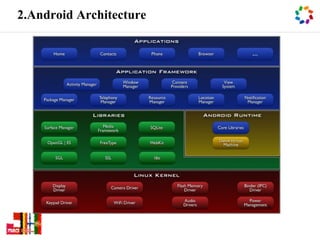
•   Android uses Linux for its device drivers, memory management, process
    management, and networking.

•   The next level up contains the Android native libraries. They are all written in
    C/C++ internally, but you’ll be calling them through Java interfaces. In this
    layer you can find the Surface Manager, 2D and 3D graphics, Media codecs,
    the SQL database (SQLite), and a native web browser engine (WebKit).

•   Dalvik Virtual Machine. Dalvik runs dex files, which are coverted at compile
    time from standard class and jar files.
3. Platform (3)
3.3 Network Connectivity

It supports wireless communications using:

       GSM mobile-phone technology

       3G

       Edge

       802.11 Wi-Fi networks

       Bluetooth
3. Platform (4)
3.4 Security

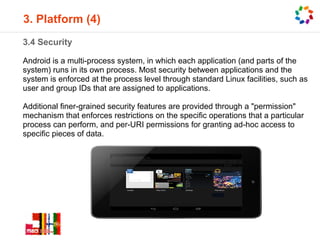
Android is a multi-process system, in which each application (and parts of the
system) runs in its own process. Most security between applications and the
system is enforced at the process level through standard Linux facilities, such as
user and group IDs that are assigned to applications.

Additional finer-grained security features are provided through a "permission"
mechanism that enforces restrictions on the specific operations that a particular
process can perform, and per-URI permissions for granting ad-hoc access to
specific pieces of data.
3. Platform (5)
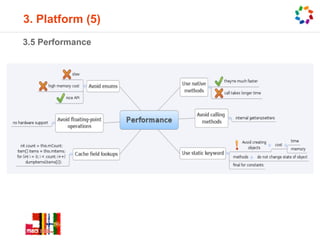
3.5 Performance
3. Platform (6)
3.6 Future possibilities

•   Google Android Sales to Overtake iPhone in 2012
•   The OHA is committed to make their vision a reality: to deploy the Android
    platform for every mobile operator, handset manufacturers and developers to
    build innovative devices
•   Intel doesn’t want to lose ownership of the netbook market, so they need to
    prepare for anything, including Android
•   Fujitsu launched an initiative to offer consulting and engineering expertise to
    help run Android on embedded hardware, which aside from cellphones, mobile
    internet devices, and portable media players, could include GPS devices, thin-
    client computers and set-top boxes.
•   More Android devices are coming and some will push the envelope even
    further
4. Software development
4.1 Development requirements

•   Java

•   Android SDK

•   Eclipse IDE (optional)


4.2 Programming Language(s)

•   Java – officially supported

•   C/C++ – also possible but not supported
4. Software development
4.3 IDE and Tools
Android SDK
 • Class Library
 • Developer Tools
         dx – Dalvik Cross-Assembler
         aapt – Android Asset Packaging Tool
         adb – Android Debug Bridge
         ddms – Dalvik Debug Monitor Service
 • Emulator and System Images
 • Documentation and Sample Code

Eclipse IDE + ADT (Android Development Tools)
 • Reduces Development and Testing Time
 • Makes User Interface-Creation easier
 • Makes Application Description Easier
5. Overall evaluation (1)
5.1 Advantages

There are a host of advantages that Google’s Android will derive from being an open
source software. Some of the advantages include:

 • The ability for anyone to customize the Google Android platform
 • The consumer will benefit from having a wide range of mobile applications to
   choose from since the monopoly will be broken by Google Android
 • Features like weather details, opening screen, live RSS feeds and even the icons on
   the opening screen will be able to be customized
 • Multitasking – Yups, Android phones can run many applications, it means you can
   browse, Facebook while listened to the song
    Easy access to thousands of applications via the Google Android Android
    AppMarket .
 • Phone options are diverse – Talk Android phone, it will feel ‘different’ than the IOS,
   if the IOS is limited to the iPhone from Apple, then Android is available on mobile
   phones from various manufacturers, from SonyEricson,motorlla ,htc to Samsung.
5. Overall evaluation (2)
5.2 Limitations

Bluetooth limitations
   o Android doesn't support:
        Bluetooth stereo
        Contacts exchange
        Modem pairing
        Wireless keyboards

But it'll work with Bluetooth headsets, but that's about it


Firefox Mobile isn't coming to Android
Apps in Android Market need to be programmed with a custom form of Java
   → Mozilla and the Fennec won't have that
    → Continuous Internet connection is required
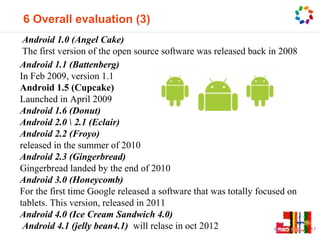
6 Overall evaluation (3)
 Android 1.0 (Angel Cake)
 The first version of the open source software was released back in 2008
Android 1.1 (Battenberg)
In Feb 2009, version 1.1
Android 1.5 (Cupcake)
Launched in April 2009
Android 1.6 (Donut)
Android 2.0  2.1 (Eclair)
Android 2.2 (Froyo)
released in the summer of 2010
Android 2.3 (Gingerbread)
Gingerbread landed by the end of 2010
Android 3.0 (Honeycomb)
For the first time Google released a software that was totally focused on
tablets. This version, released in 2011
Android 4.0 (Ice Cream Sandwich 4.0)
 Android 4.1 (jelly bean4.1) will relase in oct 2012                © artesis 2008 | 17
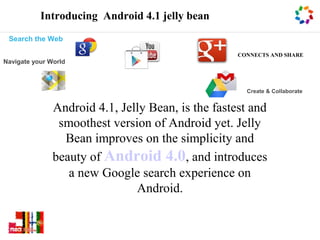
Introducing Android 4.1 jelly bean
 Search the Web

                                                    CONNECTS AND SHARE
Navigate your World


                                                      Create & Collaborate


               Android 4.1, Jelly Bean, is the fastest and
                smoothest version of Android yet. Jelly
                 Bean improves on the simplicity and
               beauty of Android 4.0, and introduces
                  a new Google search experience on
                               Android.

Android

  • 1.
    the world's mostpopular mobile platform Android is the world's most popular mobile platform. With Android you can use all the Google apps you know and love, plus there are more than 600,000 apps and games available on Google Play to keep you entertained, alongside millions of songs and books, and thousands of movies. Android devices are already smart, and will only get smarter, with new features you won't find on any other platform, letting you focus on what's important and putting you in control of your mobile experience ©|1
  • 2.
    Main topics 1. Introduction 2. What is OHA? 3 Android architecture 4. Platform 5. Software development 6. Overall evaluation
  • 3.
    1. Introduction (1) Whatis Android? • A software platform and operating system for mobile devices • Based on the Linux kernel • Developed by Google and later the Open Handset Alliance (OHA) • Allows writing managed code in the Java language • Possibility to write applications in other languages and compiling it to ARM native code (support of Google? No) • Unveiling of the Android platform was announced on 5 November 2007 with the founding of OHA • Android powers hundreds of millions of mobile devices in more than 190 countries around the world • It is developed by robot invader
  • 4.
    1. Introduction (2) What is the Open Handset Alliance (OHA)? → It's a combination of several companies
  • 5.
    1. Introduction (3) Whatis the Open Handset Alliance (OHA)? (2) • Devoted to advancing open standards for mobile devices • Develop technologies that will significantly lower the cost of developing and distributing mobile devices and services • The OHA is the group that is in charge of the Android smartphone operating system. It was created by Google and includes key members such as China Mobile, HTC, Intel, Motorola, NTT DoCoMo, Sprint, and T-Mobile USA. There are well over 30 member companies in total.
  • 6.
  • 7.
    3. Platform (1) 3.1Hardware Android is not a single piece of hardware; it's a complete, end-to-end software platform that can be adapted to work on any number of hardware configurations. Everything is there, from the bootloader all the way up to the applications.
  • 8.
    3. Platform (2) 3.2Operating System(s) • Android uses Linux for its device drivers, memory management, process management, and networking. • The next level up contains the Android native libraries. They are all written in C/C++ internally, but you’ll be calling them through Java interfaces. In this layer you can find the Surface Manager, 2D and 3D graphics, Media codecs, the SQL database (SQLite), and a native web browser engine (WebKit). • Dalvik Virtual Machine. Dalvik runs dex files, which are coverted at compile time from standard class and jar files.
  • 9.
    3. Platform (3) 3.3Network Connectivity It supports wireless communications using:  GSM mobile-phone technology  3G  Edge  802.11 Wi-Fi networks  Bluetooth
  • 10.
    3. Platform (4) 3.4Security Android is a multi-process system, in which each application (and parts of the system) runs in its own process. Most security between applications and the system is enforced at the process level through standard Linux facilities, such as user and group IDs that are assigned to applications. Additional finer-grained security features are provided through a "permission" mechanism that enforces restrictions on the specific operations that a particular process can perform, and per-URI permissions for granting ad-hoc access to specific pieces of data.
  • 11.
  • 12.
    3. Platform (6) 3.6Future possibilities • Google Android Sales to Overtake iPhone in 2012 • The OHA is committed to make their vision a reality: to deploy the Android platform for every mobile operator, handset manufacturers and developers to build innovative devices • Intel doesn’t want to lose ownership of the netbook market, so they need to prepare for anything, including Android • Fujitsu launched an initiative to offer consulting and engineering expertise to help run Android on embedded hardware, which aside from cellphones, mobile internet devices, and portable media players, could include GPS devices, thin- client computers and set-top boxes. • More Android devices are coming and some will push the envelope even further
  • 13.
    4. Software development 4.1Development requirements • Java • Android SDK • Eclipse IDE (optional) 4.2 Programming Language(s) • Java – officially supported • C/C++ – also possible but not supported
  • 14.
    4. Software development 4.3IDE and Tools Android SDK • Class Library • Developer Tools  dx – Dalvik Cross-Assembler  aapt – Android Asset Packaging Tool  adb – Android Debug Bridge  ddms – Dalvik Debug Monitor Service • Emulator and System Images • Documentation and Sample Code Eclipse IDE + ADT (Android Development Tools) • Reduces Development and Testing Time • Makes User Interface-Creation easier • Makes Application Description Easier
  • 15.
    5. Overall evaluation(1) 5.1 Advantages There are a host of advantages that Google’s Android will derive from being an open source software. Some of the advantages include: • The ability for anyone to customize the Google Android platform • The consumer will benefit from having a wide range of mobile applications to choose from since the monopoly will be broken by Google Android • Features like weather details, opening screen, live RSS feeds and even the icons on the opening screen will be able to be customized • Multitasking – Yups, Android phones can run many applications, it means you can browse, Facebook while listened to the song Easy access to thousands of applications via the Google Android Android AppMarket . • Phone options are diverse – Talk Android phone, it will feel ‘different’ than the IOS, if the IOS is limited to the iPhone from Apple, then Android is available on mobile phones from various manufacturers, from SonyEricson,motorlla ,htc to Samsung.
  • 16.
    5. Overall evaluation(2) 5.2 Limitations Bluetooth limitations o Android doesn't support:  Bluetooth stereo  Contacts exchange  Modem pairing  Wireless keyboards But it'll work with Bluetooth headsets, but that's about it Firefox Mobile isn't coming to Android Apps in Android Market need to be programmed with a custom form of Java → Mozilla and the Fennec won't have that → Continuous Internet connection is required
  • 17.
    6 Overall evaluation(3) Android 1.0 (Angel Cake) The first version of the open source software was released back in 2008 Android 1.1 (Battenberg) In Feb 2009, version 1.1 Android 1.5 (Cupcake) Launched in April 2009 Android 1.6 (Donut) Android 2.0 2.1 (Eclair) Android 2.2 (Froyo) released in the summer of 2010 Android 2.3 (Gingerbread) Gingerbread landed by the end of 2010 Android 3.0 (Honeycomb) For the first time Google released a software that was totally focused on tablets. This version, released in 2011 Android 4.0 (Ice Cream Sandwich 4.0) Android 4.1 (jelly bean4.1) will relase in oct 2012 © artesis 2008 | 17
  • 18.
    Introducing Android 4.1jelly bean Search the Web CONNECTS AND SHARE Navigate your World Create & Collaborate Android 4.1, Jelly Bean, is the fastest and smoothest version of Android yet. Jelly Bean improves on the simplicity and beauty of Android 4.0, and introduces a new Google search experience on Android.

Editor's Notes

  • #18 Android 4.0 builds on — easy multitasking, rich notifications, customizable home screens, resizable widgets, and deep interactivity — and adds powerful new ways of communicating and sharing.
  • #19 Bi-Directional Text and Other Language Support, Resizable app widgets , Animation and Graphics, New types of remoteable Views, Live wallpaper preview, Higher-resolution contact photos ,Android Beam