Seminar On Seminar Guide : Prof. B.R.Bhamare Seminar Delivered By : Devendra Gurav T.E. Comp.
Introduction To OHA Introduction To Android The Android Platform  Android Architecture Linux Kernel Libraries Android Runtime Application Framework Anatomy Of An Android Application Development Tools Software Requirements Conclusion Overview android  OS| 2
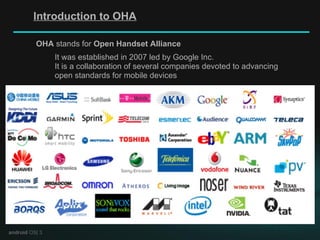
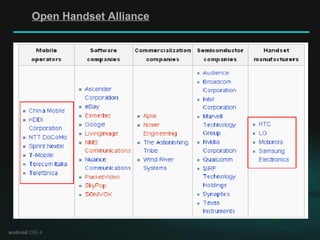
Introduction to OHA android  OS| 3 It was established in 2007 led by Google Inc.  It is a collaboration of several companies devoted to advancing open standards for mobile devices OHA  stands for  Open Handset Alliance
Open Handset Alliance android  OS| 4
Introduction To Android android  OS| 5 A software platform and an operating system for mobile devices Based on the Linux kernel What is Android? It is intended to be a complete stack that includes the OS, middleware and applications.
android  OS| 6 The Android Platform Software Features :- Integrated browser based on the open source  WebKit  engine SQLite  for data storage Media codecs support for common audio, video & image formats Dalvik Virtual Machine optimized for mobile devices
android  OS| 7 Hardware Features :- Cellular networking :  GSM,EDGE,3G LAN : Bluetooth and  Wi-Fi Graphics Hardware Acceleration Camera, GPS and  Compass Touch   Screen  and  accelerometer  for motion sensing The Android Platform
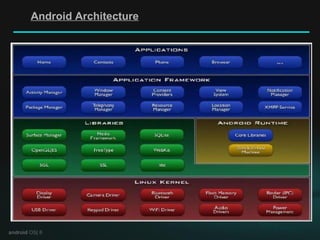
android  OS| 8 Android Architecture
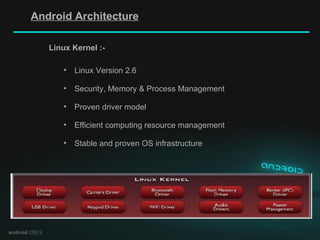
android  OS| 9 Linux Kernel :- Linux Version 2.6 Security, Memory & Process Management Proven driver model Efficient computing resource management Stable and proven OS infrastructure Android Architecture
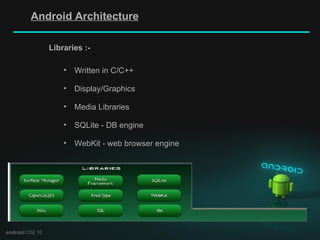
android  OS| 10 Libraries :- Written in C/C++ Display/Graphics Media Libraries SQLite - DB engine WebKit - web browser engine Android Architecture
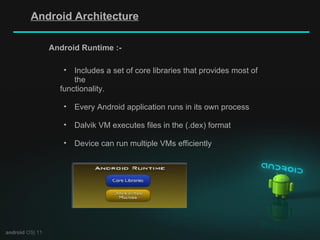
android  OS| 11 Android Runtime :- Includes a set of core libraries that provides most of the  functionality. Every Android application runs in its own process Dalvik VM executes files in the (.dex) format Device can run multiple VMs efficiently Android Architecture
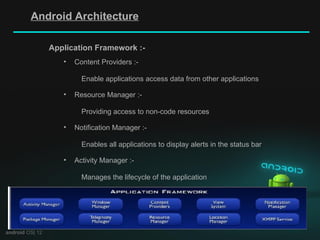
android  OS| 12 Application Framework :- Content Providers :- Resource Manager :- Notification Manager :- Activity Manager :- Enable applications access data from other applications Providing access to non-code resources Enables all applications to display alerts in the status bar Manages the lifecycle of the application Android Architecture
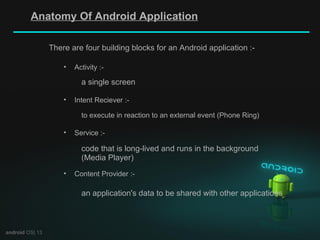
android  OS| 13 Anatomy Of Android Application There are four building blocks for an Android application :- Activity :- Intent Reciever :- Service :- Content Provider :- a single screen to execute in reaction to an external event (Phone Ring) code that is long-lived and runs in the background (Media Player) an application's data to be shared with other applications
android  OS| 14 Development Tools Software Requirements :- Android SDK 2. Eclipse IDE + ADT (Android Development Tools)
android  OS| 15 Development Tools The Android SDK includes a variety of custom tools that help you develop mobile applications on the Android platform.Three of the most significant tools are -: Android Emulator   A  virtual mobile device  that runs on our computer -use to design, debug, and test our applications in an actual Android run-time environment. Android Development Tools Plugin   (for the  Eclipse IDE   ) It adds powerful extensions to the Eclipse integrated environment. Dalvik Debug Monitor Service   (DDMS)  Integrated with  Dalvik  -this tool let us manage processes on an emulator and assists in debugging.
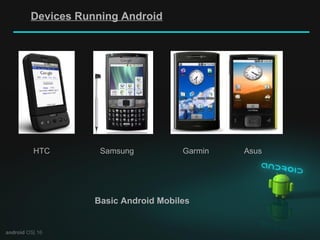
android  OS| 16 Devices Running Android Samsung Asus HTC Garmin Basic Android Mobiles
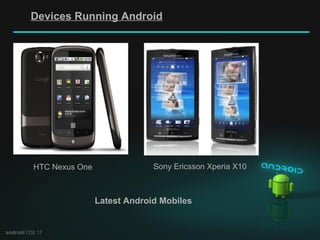
android  OS| 17 Devices Running Android HTC Nexus One Sony Ericsson Xperia X10 Latest Android Mobiles
android  OS| 18 Conclusion Android is  open   source 3 rd  Party application development system User friendly  SDK Use of various latest technologies
android  OS| 19 References Android Development http://developer.android.com/ Android Mobile OS By Michael T. Strove Google I/O Session videos Hosted on YouTube Android Operating System Wikipedia Search
Any questions? www.google.com android  OS| 20

Android seminar report

  • 1.
    Seminar On SeminarGuide : Prof. B.R.Bhamare Seminar Delivered By : Devendra Gurav T.E. Comp.
  • 2.
    Introduction To OHAIntroduction To Android The Android Platform Android Architecture Linux Kernel Libraries Android Runtime Application Framework Anatomy Of An Android Application Development Tools Software Requirements Conclusion Overview android OS| 2
  • 3.
    Introduction to OHAandroid OS| 3 It was established in 2007 led by Google Inc. It is a collaboration of several companies devoted to advancing open standards for mobile devices OHA stands for Open Handset Alliance
  • 4.
    Open Handset Allianceandroid OS| 4
  • 5.
    Introduction To Androidandroid OS| 5 A software platform and an operating system for mobile devices Based on the Linux kernel What is Android? It is intended to be a complete stack that includes the OS, middleware and applications.
  • 6.
    android OS|6 The Android Platform Software Features :- Integrated browser based on the open source WebKit engine SQLite for data storage Media codecs support for common audio, video & image formats Dalvik Virtual Machine optimized for mobile devices
  • 7.
    android OS|7 Hardware Features :- Cellular networking : GSM,EDGE,3G LAN : Bluetooth and Wi-Fi Graphics Hardware Acceleration Camera, GPS and Compass Touch Screen and accelerometer for motion sensing The Android Platform
  • 8.
    android OS|8 Android Architecture
  • 9.
    android OS|9 Linux Kernel :- Linux Version 2.6 Security, Memory & Process Management Proven driver model Efficient computing resource management Stable and proven OS infrastructure Android Architecture
  • 10.
    android OS|10 Libraries :- Written in C/C++ Display/Graphics Media Libraries SQLite - DB engine WebKit - web browser engine Android Architecture
  • 11.
    android OS|11 Android Runtime :- Includes a set of core libraries that provides most of the functionality. Every Android application runs in its own process Dalvik VM executes files in the (.dex) format Device can run multiple VMs efficiently Android Architecture
  • 12.
    android OS|12 Application Framework :- Content Providers :- Resource Manager :- Notification Manager :- Activity Manager :- Enable applications access data from other applications Providing access to non-code resources Enables all applications to display alerts in the status bar Manages the lifecycle of the application Android Architecture
  • 13.
    android OS|13 Anatomy Of Android Application There are four building blocks for an Android application :- Activity :- Intent Reciever :- Service :- Content Provider :- a single screen to execute in reaction to an external event (Phone Ring) code that is long-lived and runs in the background (Media Player) an application's data to be shared with other applications
  • 14.
    android OS|14 Development Tools Software Requirements :- Android SDK 2. Eclipse IDE + ADT (Android Development Tools)
  • 15.
    android OS|15 Development Tools The Android SDK includes a variety of custom tools that help you develop mobile applications on the Android platform.Three of the most significant tools are -: Android Emulator A virtual mobile device that runs on our computer -use to design, debug, and test our applications in an actual Android run-time environment. Android Development Tools Plugin (for the Eclipse IDE ) It adds powerful extensions to the Eclipse integrated environment. Dalvik Debug Monitor Service (DDMS) Integrated with Dalvik -this tool let us manage processes on an emulator and assists in debugging.
  • 16.
    android OS|16 Devices Running Android Samsung Asus HTC Garmin Basic Android Mobiles
  • 17.
    android OS|17 Devices Running Android HTC Nexus One Sony Ericsson Xperia X10 Latest Android Mobiles
  • 18.
    android OS|18 Conclusion Android is open source 3 rd Party application development system User friendly SDK Use of various latest technologies
  • 19.
    android OS|19 References Android Development http://developer.android.com/ Android Mobile OS By Michael T. Strove Google I/O Session videos Hosted on YouTube Android Operating System Wikipedia Search
  • 20.