WP 5: IHR core capacity
strengthening and assessment
Anders Wallensten, Deputy State Epidemiologist
Public Health Agency of Sweden
15 October 2019
One Health Security Conference
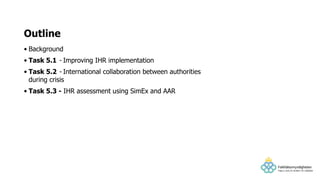
• Background
• Task 5.1 - Improving IHR implementation
• Task 5.2 - International collaboration between authorities
during crisis
• Task 5.3 - IHR assessment using SimEx and AAR
Outline
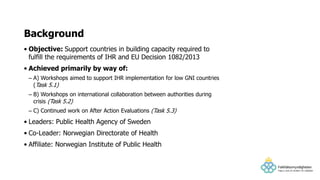
• Objective: Support countries in building capacity required to
fulfill the requirements of IHR and EU Decision 1082/2013
• Achieved primarily by way of:
– A) Workshops aimed to support IHR implementation for low GNI countries
(Task 5.1)
– B) Workshops on international collaboration between authorities during
crisis (Task 5.2)
– C) Continued work on After Action Evaluations (Task 5.3)
• Leaders: Public Health Agency of Sweden
• Co-Leader: Norwegian Directorate of Health
• Affiliate: Norwegian Institute of Public Health
Background
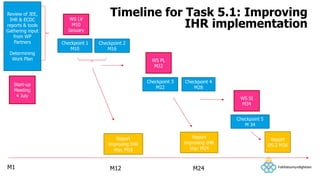
Report
improving IHR
imp. M16
Checkpoint 1
M10
Checkpoint 2
M16
Review of JEE,
IHR & ECDC
reports & tools
Gathering input
from WP
Partners
Determining
Work Plan
Start-up
Meeting
4 July
Report
D5.2 M36
Checkpoint 5
M 34
WS SI
M34
WS PL
M22
Checkpoint 4
M28
Checkpoint 3
M22
Report
improving IHR
imp. M24
WS LV
M10
January
M1 M12 M24
Timeline for Task 5.1: Improving
IHR implementation
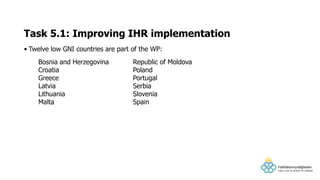
• Twelve low GNI countries are part of the WP:
Task 5.1: Improving IHR implementation
Bosnia and Herzegovina
Croatia
Greece
Latvia
Lithuania
Malta
Republic of Moldova
Poland
Portugal
Serbia
Slovenia
Spain
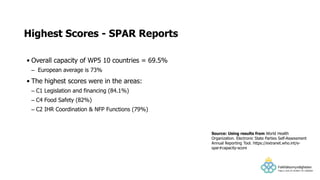
• Overall capacity of WP5 10 countries = 69.5%
– European average is 73%
• The highest scores were in the areas:
– C1 Legislation and financing (84.1%)
– C4 Food Safety (82%)
– C2 IHR Coordination & NFP Functions (79%)
Highest Scores - SPAR Reports
Source: Using results from World Health
Organization. Electronic State Parties Self-Assessment
Annual Reporting Tool. https://extranet.who.int/e-
spar#capacity-score
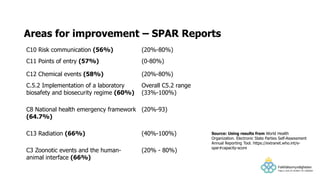
C10 Risk communication (56%) (20%-80%)
C11 Points of entry (57%) (0-80%)
C12 Chemical events (58%) (20%-80%)
C.5.2 Implementation of a laboratory
biosafety and biosecurity regime (60%)
Overall C5.2 range
(33%-100%)
C8 National health emergency framework
(64.7%)
(20%-93)
C13 Radiation (66%) (40%-100%)
C3 Zoonotic events and the human-
animal interface (66%)
(20% - 80%)
Areas for improvement – SPAR Reports
Source: Using results from World Health
Organization. Electronic State Parties Self-Assessment
Annual Reporting Tool. https://extranet.who.int/e-
spar#capacity-score
• Five low GNI Countries in WP5 have done a JEE
Within the scope of WP5 the areas seen for improvement
– Antimicrobial stewardship activities (P.3.4)
– Biosafety and biosecurity (P.6.1 and P.6.2)
– Risk Communication (R.5.1 and R. 5.4)
– Chemicals (CE.1 and CE.2)
Areas for improvement – JEE Reports
Source: Using results from World Health
Organization. Joint External Evaluation Reports for
Latvia, Lithuania, Slovenia, Serbia and Republic of
Moldova
• Strengthen preparedness and the implementation of IHR
and EU Decision 1082/2013
• Improving cross-sectoral (medical and civil protection)
preparedness and response capacity in Member States and
within EU
• Strengthening information exchange, cross-sectoral
response and mechanisms for rapid mobilization health
personnel and medical countermeasures across borders
Task 5.2 Objectives: International
collaboration between authorities during crisis
• Challenges to capacity, preparedness and response
• Gaps in roles and responsibilities; Member States, DG ECHO,
DG SANTE and WHO
• Identify legal and organizational issues in cross-border, cross
sectoral response to health threats and emergencies, for
example:
– Issues on authorization of health care personnel
– Health systems response and cooperation – procedures,
management and confidentiality
– Predictability on financial issues and reimbursement
Implementation Process 5.2 Prioritising WS
Topics
• Identify relevant health and civil authorities in the Member
States and invite them to collaborate
• M18 WS on legal issues: what are the main obstacles
against receiving help or assisting others
• M 34 WS in Portugal: Competent authorities from health and
civil protection (one from each) in line with the workshop
objectives.
• Report
Timeline for Task 5.2: Improving IHR
implementation
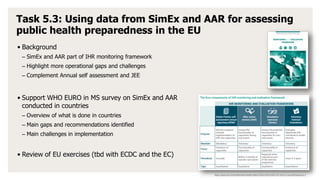
Task 5.3: Using data from SimEx and AAR for assessing
public health preparedness in the EU
• Background
– SimEx and AAR part of IHR monitoring framework
– Highlight more operational gaps and challenges
– Complement Annual self assessment and JEE
• Support WHO EURO in MS survey on SimEx and AAR
conducted in countries
– Overview of what is done in countries
– Main gaps and recommendations identified
– Main challenges in implementation
• Review of EU exercises (tbd with ECDC and the EC)
https://apps.who.int/iris/bitstream/handle/10665/276651/WHO-WHE-CPI-2018.51-eng.pdf?sequence=1
Primary contact points WP5
Anders Wallensten Public Health Agency of Sweden
Svein Høegh Henrichsen Norwegian Directorate of Health
Karin Nygård Norwegian Institute of Public Health
Thank you!

Anders Wallensten: SHARP WP5 Brief Introduction – Strengthening IHR Core Capacities

  • 1.
    WP 5: IHRcore capacity strengthening and assessment Anders Wallensten, Deputy State Epidemiologist Public Health Agency of Sweden 15 October 2019 One Health Security Conference
  • 2.
    • Background • Task5.1 - Improving IHR implementation • Task 5.2 - International collaboration between authorities during crisis • Task 5.3 - IHR assessment using SimEx and AAR Outline
  • 3.
    • Objective: Supportcountries in building capacity required to fulfill the requirements of IHR and EU Decision 1082/2013 • Achieved primarily by way of: – A) Workshops aimed to support IHR implementation for low GNI countries (Task 5.1) – B) Workshops on international collaboration between authorities during crisis (Task 5.2) – C) Continued work on After Action Evaluations (Task 5.3) • Leaders: Public Health Agency of Sweden • Co-Leader: Norwegian Directorate of Health • Affiliate: Norwegian Institute of Public Health Background
  • 4.
    Report improving IHR imp. M16 Checkpoint1 M10 Checkpoint 2 M16 Review of JEE, IHR & ECDC reports & tools Gathering input from WP Partners Determining Work Plan Start-up Meeting 4 July Report D5.2 M36 Checkpoint 5 M 34 WS SI M34 WS PL M22 Checkpoint 4 M28 Checkpoint 3 M22 Report improving IHR imp. M24 WS LV M10 January M1 M12 M24 Timeline for Task 5.1: Improving IHR implementation
  • 5.
    • Twelve lowGNI countries are part of the WP: Task 5.1: Improving IHR implementation Bosnia and Herzegovina Croatia Greece Latvia Lithuania Malta Republic of Moldova Poland Portugal Serbia Slovenia Spain
  • 6.
    • Overall capacityof WP5 10 countries = 69.5% – European average is 73% • The highest scores were in the areas: – C1 Legislation and financing (84.1%) – C4 Food Safety (82%) – C2 IHR Coordination & NFP Functions (79%) Highest Scores - SPAR Reports Source: Using results from World Health Organization. Electronic State Parties Self-Assessment Annual Reporting Tool. https://extranet.who.int/e- spar#capacity-score
  • 7.
    C10 Risk communication(56%) (20%-80%) C11 Points of entry (57%) (0-80%) C12 Chemical events (58%) (20%-80%) C.5.2 Implementation of a laboratory biosafety and biosecurity regime (60%) Overall C5.2 range (33%-100%) C8 National health emergency framework (64.7%) (20%-93) C13 Radiation (66%) (40%-100%) C3 Zoonotic events and the human- animal interface (66%) (20% - 80%) Areas for improvement – SPAR Reports Source: Using results from World Health Organization. Electronic State Parties Self-Assessment Annual Reporting Tool. https://extranet.who.int/e- spar#capacity-score
  • 8.
    • Five lowGNI Countries in WP5 have done a JEE Within the scope of WP5 the areas seen for improvement – Antimicrobial stewardship activities (P.3.4) – Biosafety and biosecurity (P.6.1 and P.6.2) – Risk Communication (R.5.1 and R. 5.4) – Chemicals (CE.1 and CE.2) Areas for improvement – JEE Reports Source: Using results from World Health Organization. Joint External Evaluation Reports for Latvia, Lithuania, Slovenia, Serbia and Republic of Moldova
  • 9.
    • Strengthen preparednessand the implementation of IHR and EU Decision 1082/2013 • Improving cross-sectoral (medical and civil protection) preparedness and response capacity in Member States and within EU • Strengthening information exchange, cross-sectoral response and mechanisms for rapid mobilization health personnel and medical countermeasures across borders Task 5.2 Objectives: International collaboration between authorities during crisis
  • 10.
    • Challenges tocapacity, preparedness and response • Gaps in roles and responsibilities; Member States, DG ECHO, DG SANTE and WHO • Identify legal and organizational issues in cross-border, cross sectoral response to health threats and emergencies, for example: – Issues on authorization of health care personnel – Health systems response and cooperation – procedures, management and confidentiality – Predictability on financial issues and reimbursement Implementation Process 5.2 Prioritising WS Topics
  • 11.
    • Identify relevanthealth and civil authorities in the Member States and invite them to collaborate • M18 WS on legal issues: what are the main obstacles against receiving help or assisting others • M 34 WS in Portugal: Competent authorities from health and civil protection (one from each) in line with the workshop objectives. • Report Timeline for Task 5.2: Improving IHR implementation
  • 12.
    Task 5.3: Usingdata from SimEx and AAR for assessing public health preparedness in the EU • Background – SimEx and AAR part of IHR monitoring framework – Highlight more operational gaps and challenges – Complement Annual self assessment and JEE • Support WHO EURO in MS survey on SimEx and AAR conducted in countries – Overview of what is done in countries – Main gaps and recommendations identified – Main challenges in implementation • Review of EU exercises (tbd with ECDC and the EC) https://apps.who.int/iris/bitstream/handle/10665/276651/WHO-WHE-CPI-2018.51-eng.pdf?sequence=1
  • 13.
    Primary contact pointsWP5 Anders Wallensten Public Health Agency of Sweden Svein Høegh Henrichsen Norwegian Directorate of Health Karin Nygård Norwegian Institute of Public Health Thank you!