2GeographySurrounded by seas on land known as a _______________.Small mountain ranges kept villages separated.
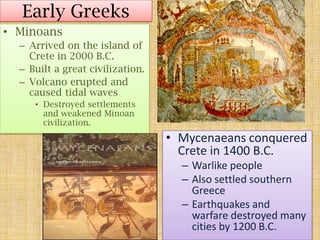
3Early GreeksMinoansArrived on the island of Crete in 2000 B.C.Built a great civilization. Volcano erupted and caused tidal wavesDestroyed settlements and weakened Minoan civilization.Mycenaeans conquered Crete in 1400 B.C.
Warlike people
Also settled southern Greece
Earthquakes and warfare destroyed many cities by 1200 B.C.4Greek City-StatesPolis (city)City surrounding a fort.Absolutely independent and self-sufficient.Small populations (most fewer than 10,000). Included surrounding farmland.Shared a common language and religious ideas.
 Each one had an ‘agora’.
 Regarded all non-Greeks as barbarians.
 Had their own government and laws.
Took great pride and loyalty in their polis.5Early sparta and athensTo begin with, most city-states were ruled by a single man but around 500 B.C. city-states became either an oligarchy or a democracy. The most famous of these were Athens and Sparta.Where a few wealthy people hold power = _____________ e.g. ______________A government of the people where the power lies in the hands of the people =_____________  e.g. ______________ Can you explain these two pictures and how they are linked to Athens and Sparta?
SPARTASparta was a Greek city-state but like other Greek polis’s, they did not have enough ________________. So they invaded neighbouring Messenia and took their land. They also forced the Messenian people to work for them. Sparta became wealthy and powerful but then in 645 BC the Messenians revolted. After 20 years of fighting, the Spartans won and the Messenians became their slaves, known as helots. These helots were important because their main duty was to farm the land and provide Spartans with food. Unlike slaves, they could live a family life on the land and sell excess produce for profit. Read p.11 in your books.To keep this huge population under control, Sparta became a military state. Its citizens spent their days training and Sparta became the greatest _____________ power in Greece.Learning to read and write in Sparta was not very important.Training to become a good soldier was important.Young boys were taken from their parents and trained to be soldiers, as well as good at sports such as running.Girls were also trained to be good at sports.
Spartan womenwere given more freedom than other Greek women and were brought up to be healthy like Spartan men. They did sports like wrestling, gymnastics and boxing. However, they could not take part in government. Newborn infants were examined by the government to determine health and unhealthy babies were placed on a hillside or thrown in a pit at night to die. Why do you think girls were trained to be good at sports? Read p.20/21 and find out! (+ Q 1 – 4).Classes in SpartaThere were three classes of people in Sparta:1.Citizens   	2. Non-citizens   	3. Slaves.Only men born in Sparta.Women were not allowed to become citizens, but they were allowed to own land and businesses.The 3rd classwere slaves, whohad no rights.These were people who came from other city-states or other countries.
A Military SocietyAt age 7, Boys placed in military trainingTaken from home and placed in barracksReading, writing, and use of weaponsAt 20, they were soldiersSent to frontier areasAt 30, they were expected to marryBut did not maintain households of their ownLived in barracks until 60, then retired Read p.12/13 in your books about the Spartan 	code of honour.What were Spartan soldiers called?Results of military society: 1. Strong government2. Almost unbeatable army3. No individual freedom4. Created almost no art or 	literature and made 	almost	no advances in 	science 10/12/2010John 3:168
ATHENSAthens was another important Greek city-state. The people of Athens wanted to rule themselves and not have a king or queen. Athens became the world’s first democracy around 508 B.C. A democracy is a government in which all citizens can vote and have equal say in what happens. Athens was a democracy because all citizens could vote, but only half the people in Athens were citizens.Women, people born outside of Athens, and slaves could not vote. Education was very important in Athens. Boys went to school to learn to read and write. They also learned many sports. Main textbooks were  ‘The Iliad’ and ‘The Odyssey’ and the students knew them by heart. They also learnt arithmetic, drawing, geometry, art and music. Girls were not allowed to go to school or learn to play sports.
The Parthenon and Acropolis These buildings were built in the 5th Century BC. Can you work out how long ago that is? ______________
Leaders of Athens and the Road to Democracy…While Sparta was becoming a military state, Athens had problems caused by the greed and power of the ruling noble families.  Most city-states were controlled by families of nobles and this rule was called and aristocracy.(aristo = ‘best’ and kratis = ‘rule’). Read p.6 and explain why other classes did not like this kind of rule.Solon (594): Tried to solve Athens’ problems by cancelling the peasants’ debts and freeing them from slavery and giving everyone a share in government according to their wealth. He also encouraged skilled workers and trade.Pisistratus and sons (545 – 510): Built temples and monuments, provided a public water supply (fountain house), made friends with other polis’s and introduced festivals and drama.Cleisthenes (508): He established democracy for Athens, by working out a system which gave all citizens a chance to vote, make laws and stand for office.Pericles (494 - 429): was the leader of creating democracy in Athens. He had many buildings constructed. Pericles had the Parthenon and the Acropolis built.Read more about Pericles on p.27…
Sparta v AthensThe Spartan and the Athenian societies were very different during the 5th century.Read through the differences on p.8 and do the exercise.We know that the Spartans had a strong army and were fierce warriors,  but what did the Athenians have? ________________ (see p.13-15)
Catastrophes in the 5th century!Read p. 15 – 17 in your books
Religious BeliefsAncient Greeks were polytheists and worshipped their gods and goddesses by building temples and shrines, carrying out sacrifices and celebrating festivals in their honour. Can you think of one of the festivals?
OraclesReligious BeliefsThe ancient Greeks believed that if they worshipped their gods, the gods in return would protect them, make their crops grow and grant them favours. In the same way if you were experiencing hardship, you were believed to be out of favour with the gods.They believed that the gods could talk to them through the oracles.Why would you want to go and see and oracle?
ArchitectureThe ancient Greeks left behind a legacy of great building and architecture which still influences us today. Look at the artist’s impression of the Parthenon in your books on p.39. What did it used to look like?

Ancient Greece

  • 2.
    2GeographySurrounded by season land known as a _______________.Small mountain ranges kept villages separated.
  • 3.
    3Early GreeksMinoansArrived onthe island of Crete in 2000 B.C.Built a great civilization. Volcano erupted and caused tidal wavesDestroyed settlements and weakened Minoan civilization.Mycenaeans conquered Crete in 1400 B.C.
  • 4.
  • 5.
  • 6.
    Earthquakes and warfaredestroyed many cities by 1200 B.C.4Greek City-StatesPolis (city)City surrounding a fort.Absolutely independent and self-sufficient.Small populations (most fewer than 10,000). Included surrounding farmland.Shared a common language and religious ideas.
  • 7.
    Each onehad an ‘agora’.
  • 8.
    Regarded allnon-Greeks as barbarians.
  • 9.
    Had theirown government and laws.
  • 10.
    Took great prideand loyalty in their polis.5Early sparta and athensTo begin with, most city-states were ruled by a single man but around 500 B.C. city-states became either an oligarchy or a democracy. The most famous of these were Athens and Sparta.Where a few wealthy people hold power = _____________ e.g. ______________A government of the people where the power lies in the hands of the people =_____________ e.g. ______________ Can you explain these two pictures and how they are linked to Athens and Sparta?
  • 11.
    SPARTASparta was aGreek city-state but like other Greek polis’s, they did not have enough ________________. So they invaded neighbouring Messenia and took their land. They also forced the Messenian people to work for them. Sparta became wealthy and powerful but then in 645 BC the Messenians revolted. After 20 years of fighting, the Spartans won and the Messenians became their slaves, known as helots. These helots were important because their main duty was to farm the land and provide Spartans with food. Unlike slaves, they could live a family life on the land and sell excess produce for profit. Read p.11 in your books.To keep this huge population under control, Sparta became a military state. Its citizens spent their days training and Sparta became the greatest _____________ power in Greece.Learning to read and write in Sparta was not very important.Training to become a good soldier was important.Young boys were taken from their parents and trained to be soldiers, as well as good at sports such as running.Girls were also trained to be good at sports.
  • 12.
    Spartan womenwere givenmore freedom than other Greek women and were brought up to be healthy like Spartan men. They did sports like wrestling, gymnastics and boxing. However, they could not take part in government. Newborn infants were examined by the government to determine health and unhealthy babies were placed on a hillside or thrown in a pit at night to die. Why do you think girls were trained to be good at sports? Read p.20/21 and find out! (+ Q 1 – 4).Classes in SpartaThere were three classes of people in Sparta:1.Citizens 2. Non-citizens 3. Slaves.Only men born in Sparta.Women were not allowed to become citizens, but they were allowed to own land and businesses.The 3rd classwere slaves, whohad no rights.These were people who came from other city-states or other countries.
  • 13.
    A Military SocietyAtage 7, Boys placed in military trainingTaken from home and placed in barracksReading, writing, and use of weaponsAt 20, they were soldiersSent to frontier areasAt 30, they were expected to marryBut did not maintain households of their ownLived in barracks until 60, then retired Read p.12/13 in your books about the Spartan code of honour.What were Spartan soldiers called?Results of military society: 1. Strong government2. Almost unbeatable army3. No individual freedom4. Created almost no art or literature and made almost no advances in science 10/12/2010John 3:168
  • 14.
    ATHENSAthens was anotherimportant Greek city-state. The people of Athens wanted to rule themselves and not have a king or queen. Athens became the world’s first democracy around 508 B.C. A democracy is a government in which all citizens can vote and have equal say in what happens. Athens was a democracy because all citizens could vote, but only half the people in Athens were citizens.Women, people born outside of Athens, and slaves could not vote. Education was very important in Athens. Boys went to school to learn to read and write. They also learned many sports. Main textbooks were ‘The Iliad’ and ‘The Odyssey’ and the students knew them by heart. They also learnt arithmetic, drawing, geometry, art and music. Girls were not allowed to go to school or learn to play sports.
  • 15.
    The Parthenon andAcropolis These buildings were built in the 5th Century BC. Can you work out how long ago that is? ______________
  • 16.
    Leaders of Athensand the Road to Democracy…While Sparta was becoming a military state, Athens had problems caused by the greed and power of the ruling noble families. Most city-states were controlled by families of nobles and this rule was called and aristocracy.(aristo = ‘best’ and kratis = ‘rule’). Read p.6 and explain why other classes did not like this kind of rule.Solon (594): Tried to solve Athens’ problems by cancelling the peasants’ debts and freeing them from slavery and giving everyone a share in government according to their wealth. He also encouraged skilled workers and trade.Pisistratus and sons (545 – 510): Built temples and monuments, provided a public water supply (fountain house), made friends with other polis’s and introduced festivals and drama.Cleisthenes (508): He established democracy for Athens, by working out a system which gave all citizens a chance to vote, make laws and stand for office.Pericles (494 - 429): was the leader of creating democracy in Athens. He had many buildings constructed. Pericles had the Parthenon and the Acropolis built.Read more about Pericles on p.27…
  • 17.
    Sparta v AthensTheSpartan and the Athenian societies were very different during the 5th century.Read through the differences on p.8 and do the exercise.We know that the Spartans had a strong army and were fierce warriors, but what did the Athenians have? ________________ (see p.13-15)
  • 18.
    Catastrophes in the5th century!Read p. 15 – 17 in your books
  • 19.
    Religious BeliefsAncient Greekswere polytheists and worshipped their gods and goddesses by building temples and shrines, carrying out sacrifices and celebrating festivals in their honour. Can you think of one of the festivals?
  • 20.
    OraclesReligious BeliefsThe ancientGreeks believed that if they worshipped their gods, the gods in return would protect them, make their crops grow and grant them favours. In the same way if you were experiencing hardship, you were believed to be out of favour with the gods.They believed that the gods could talk to them through the oracles.Why would you want to go and see and oracle?
  • 21.
    ArchitectureThe ancient Greeksleft behind a legacy of great building and architecture which still influences us today. Look at the artist’s impression of the Parthenon in your books on p.39. What did it used to look like?