FIRST HUMAN ORGANIZATIONSFIRST HUMAN ORGANIZATIONS
TYPES OF HUMAN ORGANIZATIONS: FAMILY, CLAN,TYPES OF HUMAN ORGANIZATIONS: FAMILY, CLAN,
TRIBE.TRIBE.
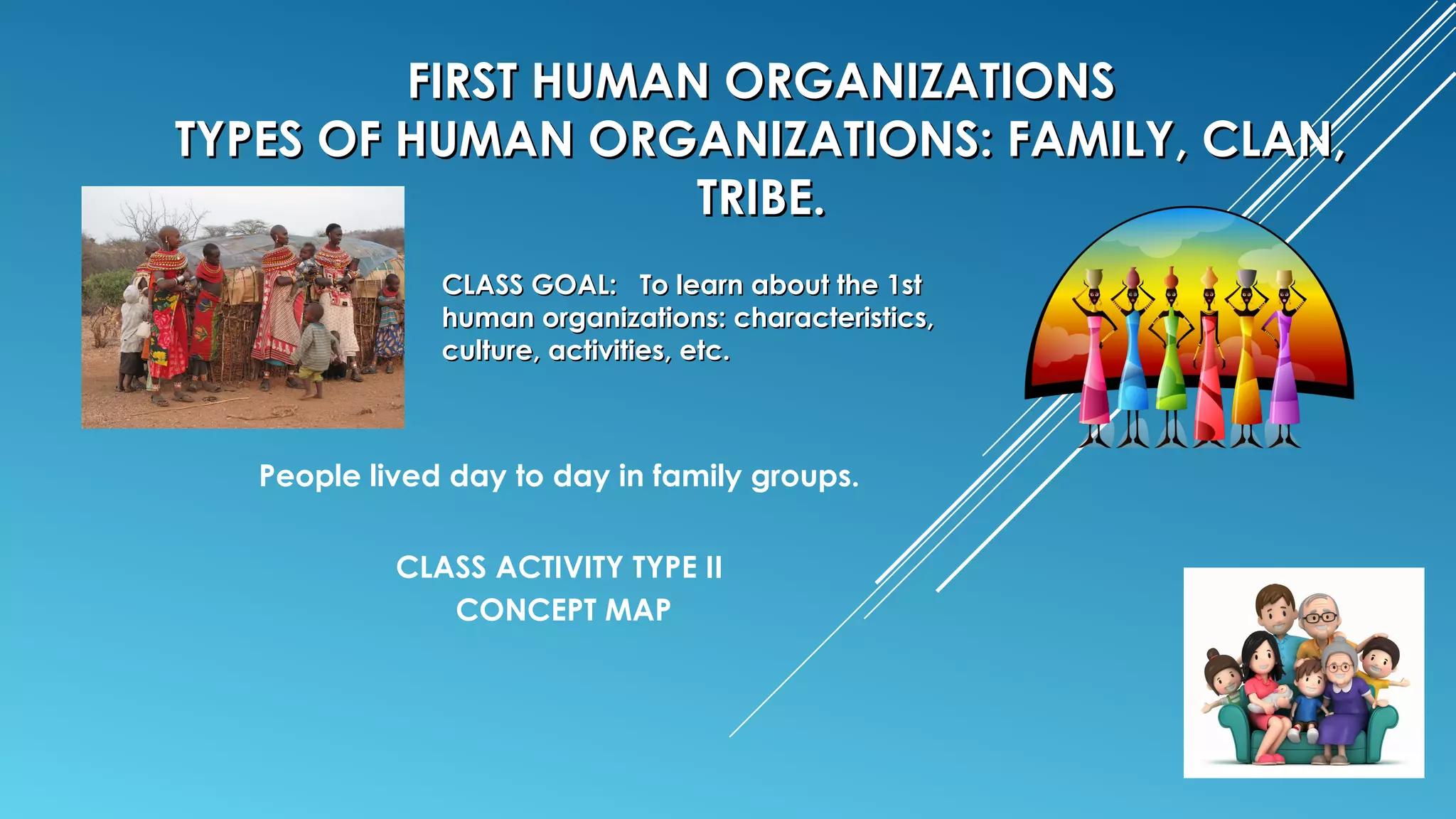
People lived day to day in family groups.
CLASS ACTIVITY TYPE II
CONCEPT MAP
CLASS GOAL: To learn about the 1stCLASS GOAL: To learn about the 1st
human organizations: characteristics,human organizations: characteristics,
culture, activities, etc.culture, activities, etc.
FAMILY.-FAMILY.-
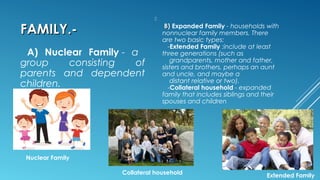
A) Nuclear Family - a
group consisting of
parents and dependent
children.

B)B) Expanded Family - households with
nonnuclear family members. There
are two basic types:
-Extended Family :include at least
three generations (such as
grandparents, mother and father,
sisters and brothers, perhaps an aunt
and uncle, and maybe a
distant relative or two).
-Collateral household - expanded
family that includes siblings and their
spouses and children
Extended Family
Nuclear Family
Collateral household
MOST FREQUENTLY, CLAN MEMBERSHIP IS DISPERSED,
USUALLY DOES NOT HOLD TANGIBLE PROPERTY
CORPORATELY, AND TENDS TO BE MORE A UNIT FOR
CEREMONIAL MATTERS. EXAMPLES OF FIRST NATIONS
WITH MATRICLANS ARE THE MANDAN AND HIDATSA,
AMONG OTHERS.
.
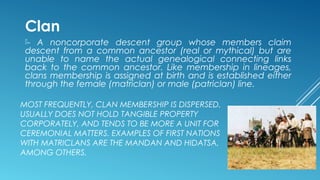
Clan 
- A noncorporate descent group whose members claim
descent from a common ancestor (real or mythical) but are
unable to name the actual genealogical connecting links
back to the common ancestor. Like membership in lineages,
clans membership is assigned at birth and is established either
through the female (matriclan) or male (patriclan) line.
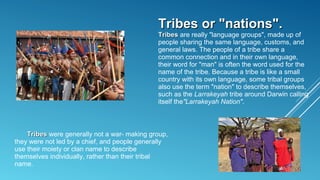
Tribes or "nations".Tribes or "nations".
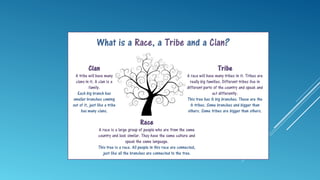
TribesTribes are really "language groups", made up of
people sharing the same language, customs, and
general laws. The people of a tribe share a
common connection and in their own language,
their word for "man" is often the word used for the
name of the tribe. Because a tribe is like a small
country with its own language, some tribal groups
also use the term "nation" to describe themselves,
such as the Larrakeyah tribe around Darwin calling
itself the"Larrakeyah Nation".
TribesTribes were generally not a war- making group,
they were not led by a chief, and people generally
use their moiety or clan name to describe
themselves individually, rather than their tribal
name.
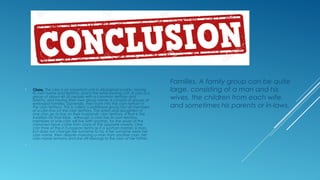
 Clans.Clans. The clan is an important unit in Aboriginal society, having
its own name and territory, and is the land-owning unit. A clan is a
group of about 40-50 people with a common territory and
totems, and having their own group name. It consists of groups of
extended families. Generally, men born into the clan remain in
the clan territory. This is called a patrilineal group.Not all members
of a clan live on the clan territory. The sisters and daughters of
one clan go to live on their husbands' clan territory, if that is the
tradition for that tribe.  Although a clan has its own territory,
members of one clan will live with another, for the wives of the
clansmen have come from clans of the opposite moiety. One
can think of this in European terms as if a woman marries a man,
but does not change her surname to his. If her surname were her
clan name, then despite marrying a man from another clan, her
clan name remains and she still belongs to the clan of her father.

Families. A family group can be quite
large, consisting of a man and his
wives, the children from each wife,
and sometimes his parents or in-laws.
 Tribe 
A tribe is a group of nominally independent communities
occupying a specific region, sharing a common language
and culture, which are integrated by some unifying factor.
 Separate bands or villages are integrated by pantribal
factors (e.g., lineages and or clans)
 Some degree of household autononmy is sacrificed to some
larger order group in return for greater security against
attacks by enemies or starvation
 Typically, though not invariably, has an economy based on
some form of farming or herding
 Population densities almost always exceed one person per
square mile, and may be as high as 250 per square mile
 Each tribe consists on one or more small autonomous local
communities, which may then form alliances with one
another for various purposes
 Political organization is informal and of a temporary nature
 Leadership is informal and not vested in a central authority
 In many tribal societies the organizing unit and seat of
political authority is the clan, an association of people who
believe themselves to share a common ancestry; or in age-
grades; or in common-interest groups
BAND TRIBE CHIEFDOM STATE
Total Numbers Less than 100 Up to a few thousand 5,000 - 20,000+ Generally 20,000+
Social
Organization
Egalitarian
Informal leadership
Segmentary society
Pan-tribal associations
Raids by small groups
Kinship-based ranking under
hereditary leader
High-ranking warriors
Class-based hierarchy under
king or emperor
Armies
Economic
Organization
Mobile gatherers-hunters Settled farmers
Pastoralist herders
Central accumulation and
redistribution
Some craft specialization
Centralized bureaucracy
Tribute-based
Taxation
Laws
Settlement
Pattern
Temporary camps Permanent villages Fortified centers
Ritual centers
Urban; cities, towns
Frontier defenses
Roads
Religious
Organization
Shamans Religious elders
Calendrical rituals
Hereditary chief with religous
duties
Priestly class
Pantheistic or monotheistic
religion
Architecture Temporary shelters Permanent structures
Burial mounds
Shrines
Large-scale monuments Palaces, temples, and other
public buildings
Archaeological
examples
Paleo-Indians Archaic peoples Formative societies Urban Mesoamerican
civilizations
Modern
examples
Inuit Pueblos Northwest Coast All modern states
Most recent update: 1 December 1999

Family, clan tribe

  • 1.
    FIRST HUMAN ORGANIZATIONSFIRSTHUMAN ORGANIZATIONS TYPES OF HUMAN ORGANIZATIONS: FAMILY, CLAN,TYPES OF HUMAN ORGANIZATIONS: FAMILY, CLAN, TRIBE.TRIBE. People lived day to day in family groups. CLASS ACTIVITY TYPE II CONCEPT MAP CLASS GOAL: To learn about the 1stCLASS GOAL: To learn about the 1st human organizations: characteristics,human organizations: characteristics, culture, activities, etc.culture, activities, etc.
  • 2.
    FAMILY.-FAMILY.- A) Nuclear Family -a group consisting of parents and dependent children.  B)B) Expanded Family - households with nonnuclear family members. There are two basic types: -Extended Family :include at least three generations (such as grandparents, mother and father, sisters and brothers, perhaps an aunt and uncle, and maybe a distant relative or two). -Collateral household - expanded family that includes siblings and their spouses and children Extended Family Nuclear Family Collateral household
  • 3.
    MOST FREQUENTLY, CLANMEMBERSHIP IS DISPERSED, USUALLY DOES NOT HOLD TANGIBLE PROPERTY CORPORATELY, AND TENDS TO BE MORE A UNIT FOR CEREMONIAL MATTERS. EXAMPLES OF FIRST NATIONS WITH MATRICLANS ARE THE MANDAN AND HIDATSA, AMONG OTHERS. . Clan  - A noncorporate descent group whose members claim descent from a common ancestor (real or mythical) but are unable to name the actual genealogical connecting links back to the common ancestor. Like membership in lineages, clans membership is assigned at birth and is established either through the female (matriclan) or male (patriclan) line.
  • 5.
    Tribes or "nations".Tribesor "nations". TribesTribes are really "language groups", made up of people sharing the same language, customs, and general laws. The people of a tribe share a common connection and in their own language, their word for "man" is often the word used for the name of the tribe. Because a tribe is like a small country with its own language, some tribal groups also use the term "nation" to describe themselves, such as the Larrakeyah tribe around Darwin calling itself the"Larrakeyah Nation". TribesTribes were generally not a war- making group, they were not led by a chief, and people generally use their moiety or clan name to describe themselves individually, rather than their tribal name.
  • 6.
     Clans.Clans. Theclan is an important unit in Aboriginal society, having its own name and territory, and is the land-owning unit. A clan is a group of about 40-50 people with a common territory and totems, and having their own group name. It consists of groups of extended families. Generally, men born into the clan remain in the clan territory. This is called a patrilineal group.Not all members of a clan live on the clan territory. The sisters and daughters of one clan go to live on their husbands' clan territory, if that is the tradition for that tribe.  Although a clan has its own territory, members of one clan will live with another, for the wives of the clansmen have come from clans of the opposite moiety. One can think of this in European terms as if a woman marries a man, but does not change her surname to his. If her surname were her clan name, then despite marrying a man from another clan, her clan name remains and she still belongs to the clan of her father.  Families. A family group can be quite large, consisting of a man and his wives, the children from each wife, and sometimes his parents or in-laws.
  • 7.
     Tribe  A tribeis a group of nominally independent communities occupying a specific region, sharing a common language and culture, which are integrated by some unifying factor.  Separate bands or villages are integrated by pantribal factors (e.g., lineages and or clans)  Some degree of household autononmy is sacrificed to some larger order group in return for greater security against attacks by enemies or starvation  Typically, though not invariably, has an economy based on some form of farming or herding  Population densities almost always exceed one person per square mile, and may be as high as 250 per square mile  Each tribe consists on one or more small autonomous local communities, which may then form alliances with one another for various purposes  Political organization is informal and of a temporary nature  Leadership is informal and not vested in a central authority  In many tribal societies the organizing unit and seat of political authority is the clan, an association of people who believe themselves to share a common ancestry; or in age- grades; or in common-interest groups BAND TRIBE CHIEFDOM STATE Total Numbers Less than 100 Up to a few thousand 5,000 - 20,000+ Generally 20,000+ Social Organization Egalitarian Informal leadership Segmentary society Pan-tribal associations Raids by small groups Kinship-based ranking under hereditary leader High-ranking warriors Class-based hierarchy under king or emperor Armies Economic Organization Mobile gatherers-hunters Settled farmers Pastoralist herders Central accumulation and redistribution Some craft specialization Centralized bureaucracy Tribute-based Taxation Laws Settlement Pattern Temporary camps Permanent villages Fortified centers Ritual centers Urban; cities, towns Frontier defenses Roads Religious Organization Shamans Religious elders Calendrical rituals Hereditary chief with religous duties Priestly class Pantheistic or monotheistic religion Architecture Temporary shelters Permanent structures Burial mounds Shrines Large-scale monuments Palaces, temples, and other public buildings Archaeological examples Paleo-Indians Archaic peoples Formative societies Urban Mesoamerican civilizations Modern examples Inuit Pueblos Northwest Coast All modern states Most recent update: 1 December 1999