Stellar Nucleosynthesis
and the Formation of
Heavy Elements
LessonTitle:
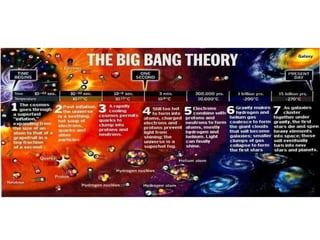
• In the Beginning (BigBang
Theory and Formationof
the LightElements)
 is a branch of astronomy
that
involves the origin and
evolution of the universe,
from the Big Bang to today
and on
into the future.
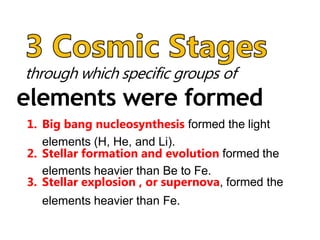
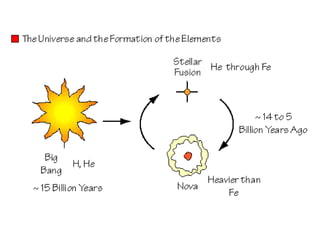
through which specific groups of
elements were formed
1. Big bang nucleosynthesis formed the light
elements (H, He, and Li).
2. Stellar formation and evolution formed the
elements heavier than Be to Fe.
3. Stellar explosion , or supernova, formed the
elements heavier than Fe.
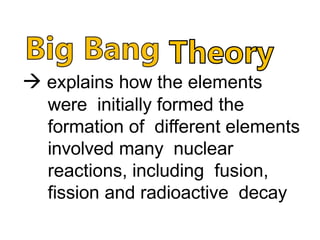
 explains how the elements
were initially formed the
formation of different elements
involved many nuclear
reactions, including fusion,
fission and radioactive decay
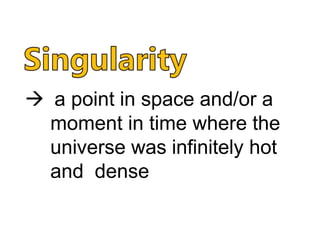
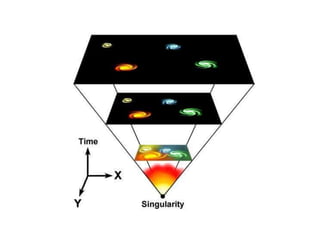
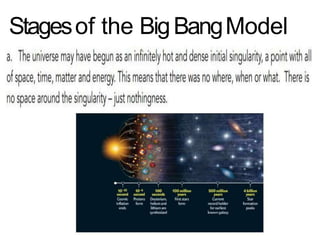
 a point in space and/or a
moment in time where the
universe was infinitely hot
and dense
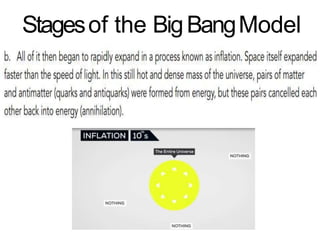
 is a theory of exponential
expansion of space in the
early universe. The
inflationary epoch lasted
from 10−36 seconds.
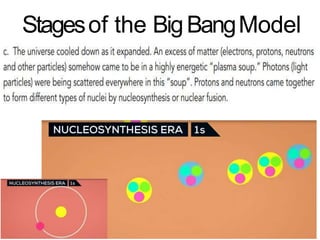
 is the process that creates
new atomic nucleifrom pre-
existing nucleons,primarily
protons and neutrons.
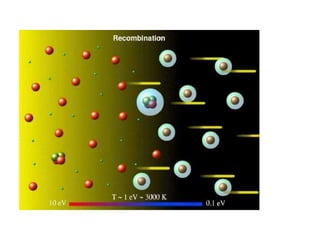
 refers to the epoch at which
charged electrons and
protons first became bound
to form electrically neutral
hydrogen atoms.
 in physics, reaction in which a
particle and its antiparticle
collide and disappear, releasing
energy.
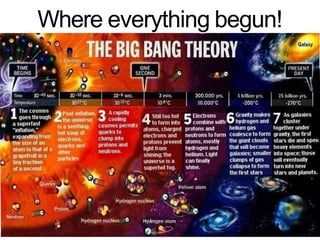
Where everything begun!
Stagesof the BigBangModel
POINTERS
1. TheBig Bang refers to the very start ofthe whole
process called the Big Bangmodel.
2. TheBig Bang was NOT an explosion that carried
matter outward from a point. Itrefers to the rapid
inflation of spaceitself.
3. Thetheory does not explain what caused it or
where the singularity came from, BUT the BigBang
model does not need a cause to be a valid theory.
It simply needs to show that observations and
evidence validate its assumptions. Themodel is a
work in progress that we are still finding evidence
for until now.
REDSHIFT
• is the first piece of evidence for the BigBang
Model.
LIGHTof other galaxies is found to be REDSHIFTED
(the light looks“stretched”)
*This suggests that other galaxiesare moving
farther away fromus.
*It was later determined that they are not moving
away.Instead, space itselfis expanding in all
directions causing the galaxies to be relatively
fartherapart.
• Theredshift tells us how fastthe
universe is expanding.
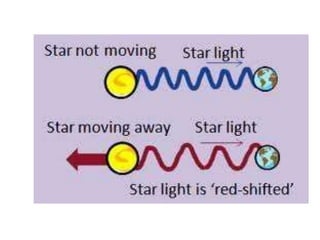
 the displacement of spectral
lines toward longer
wavelengths (the red end of the
spectrum) in radiation from
distant galaxies and celestial
objects.
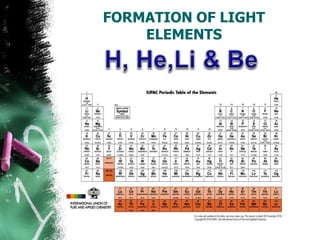
FORMATION OF LIGHT
ELEMENTS
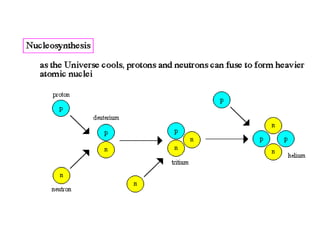
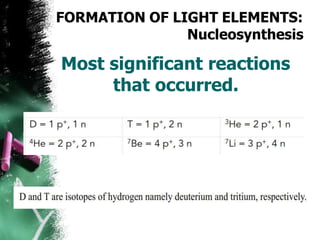
FORMATION OF LIGHT ELEMENTS:
Nucleosynthesis
Most significant reactions
that occurred.
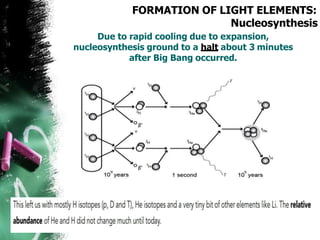
Due to rapid cooling due to expansion,
nucleosynthesis ground to a halt about 3 minutes
after Big Bang occurred.
FORMATION OF LIGHT ELEMENTS:
Nucleosynthesis
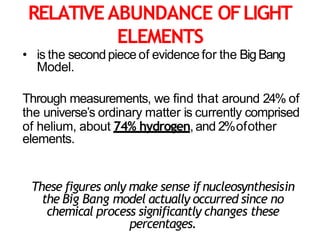
RELATIVEABUNDANCE OFLIGHT
ELEMENTS
• is the second piece of evidence for the BigBang
Model.
Through measurements, we find that around 24% of
the universe’s ordinary matter is currently comprised
of helium, about 74% hydrogen, and 2%ofother
elements.
These figures only make sense ifnucleosynthesisin
the Big Bang model actually occurred since no
chemical process significantly changes these
percentages.
COSMIC MICROWAVE
BACKGROUND
• is the third piece of evidence for the
BigBang Model.
CMBis the remnant energy (thermal
radiation) asaresult of recombination.
Atoms became neutral due tothe
binding of nuclei andelectrons.
 is electromagnetic radiation
left over from an early stage
of the universe in Big Bang
cosmology.
 is electromagnetic radiation
left over from an early stage
of the universe in Big Bang
cosmology.
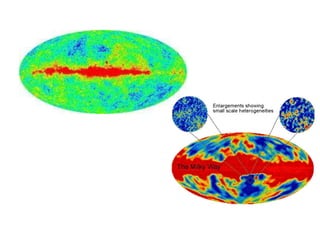
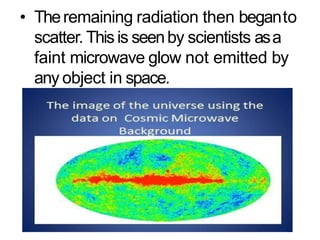
• Theremaining radiation then beganto
scatter. Thisis seenby scientists asa
faint microwave glow not emitted by
any object in space.
Physical Science 1

Physical Science 1

  • 1.
    Stellar Nucleosynthesis and theFormation of Heavy Elements
  • 2.
    LessonTitle: • In theBeginning (BigBang Theory and Formationof the LightElements)
  • 3.
     is abranch of astronomy that involves the origin and evolution of the universe, from the Big Bang to today and on into the future.
  • 4.
    through which specificgroups of elements were formed 1. Big bang nucleosynthesis formed the light elements (H, He, and Li). 2. Stellar formation and evolution formed the elements heavier than Be to Fe. 3. Stellar explosion , or supernova, formed the elements heavier than Fe.
  • 6.
     explains howthe elements were initially formed the formation of different elements involved many nuclear reactions, including fusion, fission and radioactive decay
  • 7.
     a pointin space and/or a moment in time where the universe was infinitely hot and dense
  • 9.
     is atheory of exponential expansion of space in the early universe. The inflationary epoch lasted from 10−36 seconds.
  • 10.
     is theprocess that creates new atomic nucleifrom pre- existing nucleons,primarily protons and neutrons.
  • 12.
     refers tothe epoch at which charged electrons and protons first became bound to form electrically neutral hydrogen atoms.
  • 14.
     in physics,reaction in which a particle and its antiparticle collide and disappear, releasing energy.
  • 15.
  • 16.
  • 17.
  • 18.
  • 19.
  • 20.
    POINTERS 1. TheBig Bangrefers to the very start ofthe whole process called the Big Bangmodel. 2. TheBig Bang was NOT an explosion that carried matter outward from a point. Itrefers to the rapid inflation of spaceitself. 3. Thetheory does not explain what caused it or where the singularity came from, BUT the BigBang model does not need a cause to be a valid theory. It simply needs to show that observations and evidence validate its assumptions. Themodel is a work in progress that we are still finding evidence for until now.
  • 21.
    REDSHIFT • is thefirst piece of evidence for the BigBang Model. LIGHTof other galaxies is found to be REDSHIFTED (the light looks“stretched”) *This suggests that other galaxiesare moving farther away fromus. *It was later determined that they are not moving away.Instead, space itselfis expanding in all directions causing the galaxies to be relatively fartherapart. • Theredshift tells us how fastthe universe is expanding.
  • 22.
     the displacementof spectral lines toward longer wavelengths (the red end of the spectrum) in radiation from distant galaxies and celestial objects.
  • 24.
  • 25.
    FORMATION OF LIGHTELEMENTS: Nucleosynthesis Most significant reactions that occurred.
  • 26.
    Due to rapidcooling due to expansion, nucleosynthesis ground to a halt about 3 minutes after Big Bang occurred. FORMATION OF LIGHT ELEMENTS: Nucleosynthesis
  • 27.
    RELATIVEABUNDANCE OFLIGHT ELEMENTS • isthe second piece of evidence for the BigBang Model. Through measurements, we find that around 24% of the universe’s ordinary matter is currently comprised of helium, about 74% hydrogen, and 2%ofother elements. These figures only make sense ifnucleosynthesisin the Big Bang model actually occurred since no chemical process significantly changes these percentages.
  • 28.
    COSMIC MICROWAVE BACKGROUND • isthe third piece of evidence for the BigBang Model. CMBis the remnant energy (thermal radiation) asaresult of recombination. Atoms became neutral due tothe binding of nuclei andelectrons.
  • 29.
     is electromagneticradiation left over from an early stage of the universe in Big Bang cosmology.
  • 31.
     is electromagneticradiation left over from an early stage of the universe in Big Bang cosmology.
  • 32.
    • Theremaining radiationthen beganto scatter. Thisis seenby scientists asa faint microwave glow not emitted by any object in space.