Constellations &
Astronavigation
Constellation:
a group of stars that
forms a particular
shape in the sky and
has been given a name
Orion
This constellation is best seen in the
winter sky. It is best seen in the month of
January at 9:00pm.
Orion, lies on the celestial equator. It is
one of the brightest and best known
constellations in the sky.
It is also one of the few constellations
known since ancient times
Mythology
• Perhaps second only to the Big Dipper in Ursa Major, the
constellation of Orion is one of the most recognizable patterns of
stars in the northern sky.
• Orion, the hunter, is accompanied by his faithful dogs, Canis Major
and Canis Minor. Together they hunt various animals, including
Lepus, the rabbit, and Taurus, the bull.
• According to Greek mythology, Orion was in love with Merope, one of
the Seven Sisters who form the Pleiades, but Merope would have
nothing to do with him. Orion's tragic life ended when he stepped on
Scorpius, the scorpion.
• The gods felt sorry for him, so they put him and his dogs in the sky
as constellations.
• They also put all of the animals he hunted up there near him.
Scorpius, however, was placed on the opposite side of the sky so
Orion would never be hurt by it again.
Picture by National Geographic Society (Copyright)
Ursa Major
This constellation can be seen best in the
spring sky. It can be seen best in the
month of April at 9:00pm.
Ursa Major is a prominent constellation in
the northern hemisphere. It is the third
largest constellation in the sky.
Its name is Latin for the Great Bear.
Also often referred to as the Big Dipper
Mythology
• According to some Native American legends, the bowl of the Big Dipper is a
giant bear and the stars of the handle are three warriors chasing it.
• The constellation is low in the sky in autumn evening sky, so it was said that
the hunters had injured the bear and its blood caused the trees to change
color to red.
• The Big Dipper is one of the most recognizable patterns in the northern sky.
• In other cultures it was identified as a wagon or cart, a plow, a bull's thigh,
and (to the Chinese) the government.
• The Big Dipper was also a very important part of the Underground Railroad
which helped slaves escape from the South before the Civil War. There
were songs spread among the slave population which included references
to the "Drinking Gourd." The songs said to follow it to get to a better life.
This veiled message for the slaves to flee northward was passed along in
the form of songs since a large fraction of the slave population was illiterate.
Picture by National Geographic Society (Copyright)
Ursa Minor
This constellation can be seen best in the summer
sky. It can be seen best in the month of June at
9:00pm.
Ursa Minor, or the Little Dipper, is a small
constellation in the northern hemisphere.
In Latin, its name means "little bear."
The constellation was originally listed by the Greek
astronomer Ptolemy in the 2nd century.
Ursa Minor is usually depicted as a small bear with
a long tail. It is said that the tail is so long because
the bear is held by its end and spun around the
Mythology
• The constellation Ursa Minor contains the group of stars commonly called
the Little Dipper.
• The handle of the Dipper is the Little Bear's tail and the Dipper's cup is the
Bear's flank.
• Arcas was the son of Callisto, who was transformed by Juno into a bear.
When Arcas was fifteen, he was out hunting in the forest when he came
across a bear. The bear behaved quite strangely, looking him in the eyes.
He of course could not recognize his mother in her strange shape, and was
preparing to shoot her when Jupiter prevented him. Arcas was transformed
into a bear like his mother, and the two were taken up into the sky.
• The mother bear is Ursa Major.
Picture by National Geographic Society (Copyright)
Early
Astronavigational
Tools
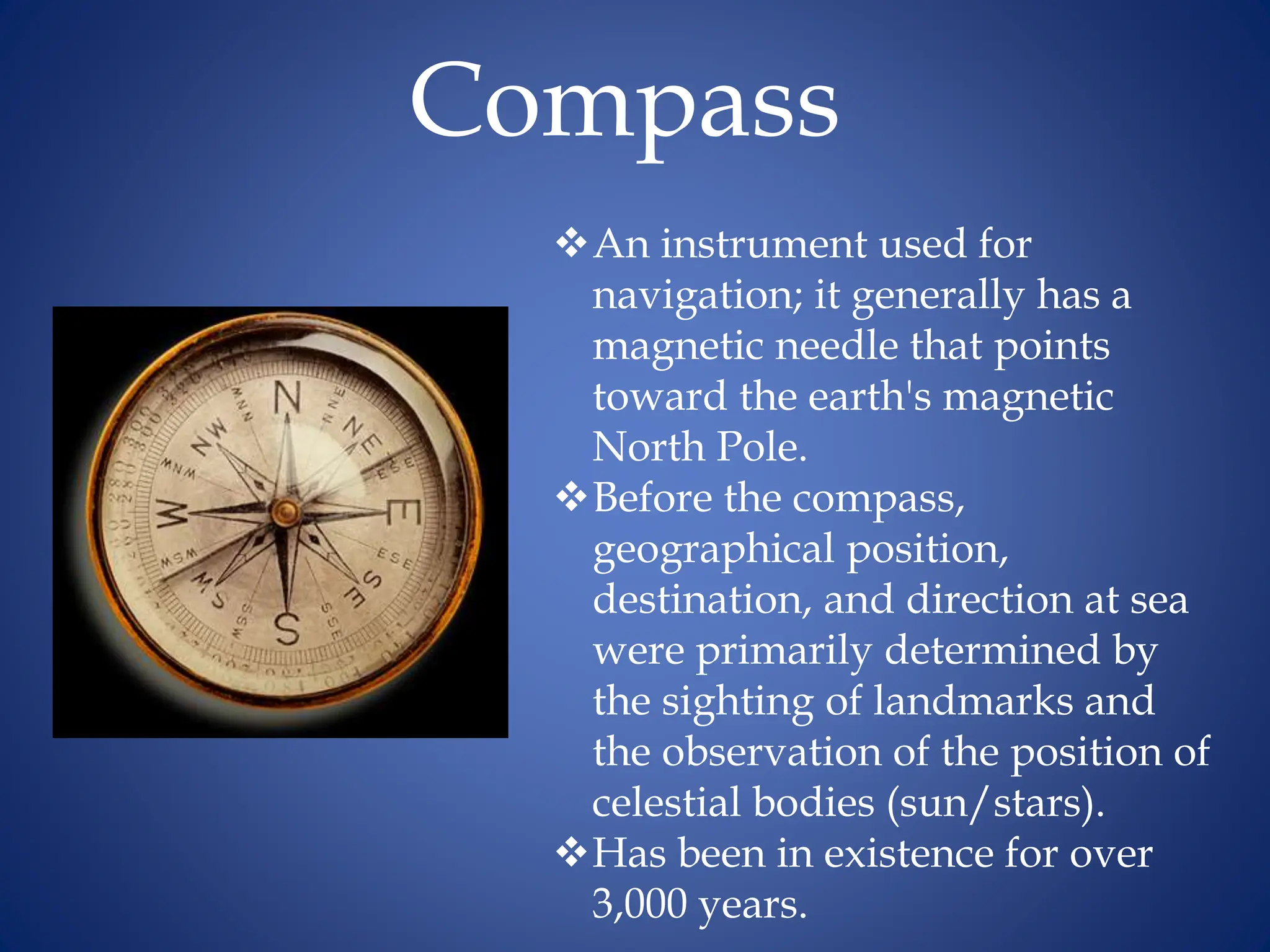
Compass
An instrument used for
navigation; it generally has a
magnetic needle that points
toward the earth's magnetic
North Pole.
Before the compass,
geographical position,
destination, and direction at sea
were primarily determined by
the sighting of landmarks and
the observation of the position of
celestial bodies (sun/stars).
Has been in existence for over
3,000 years.
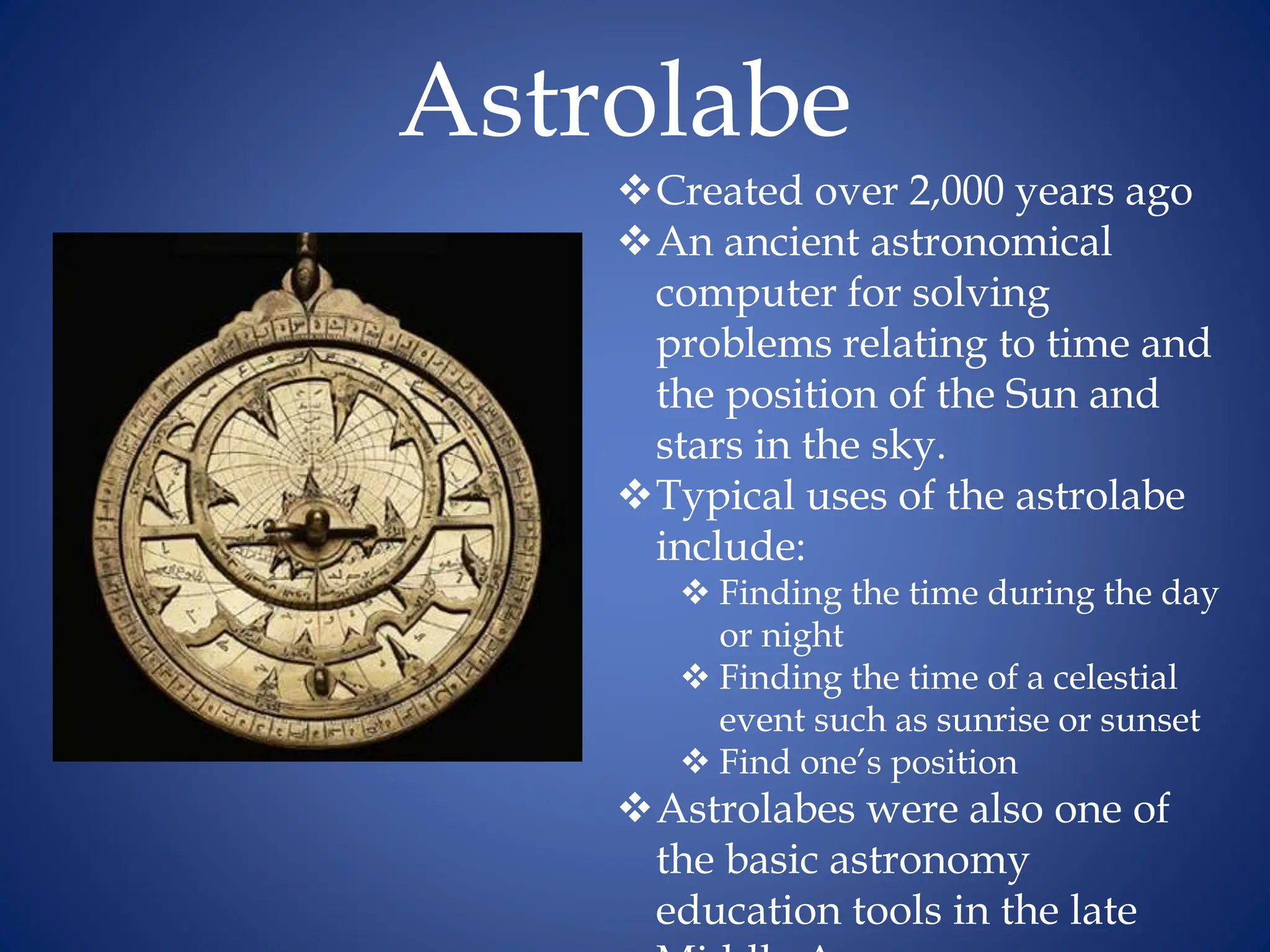
Astrolabe
Created over 2,000 years ago
An ancient astronomical
computer for solving
problems relating to time and
the position of the Sun and
stars in the sky.
Typical uses of the astrolabe
include:
 Finding the time during the day
or night
 Finding the time of a celestial
event such as sunrise or sunset
 Find one’s position
Astrolabes were also one of
the basic astronomy
education tools in the late
Sextant
Used as a navigational
tool out at sea
Helps determine a ship's
longitude and latitude
by measuring angles
between the horizon
and celestial bodies
(sun/stars).
A more advanced
version of the astrolabe.
First one was created by
Englishman John Bird in
1757.
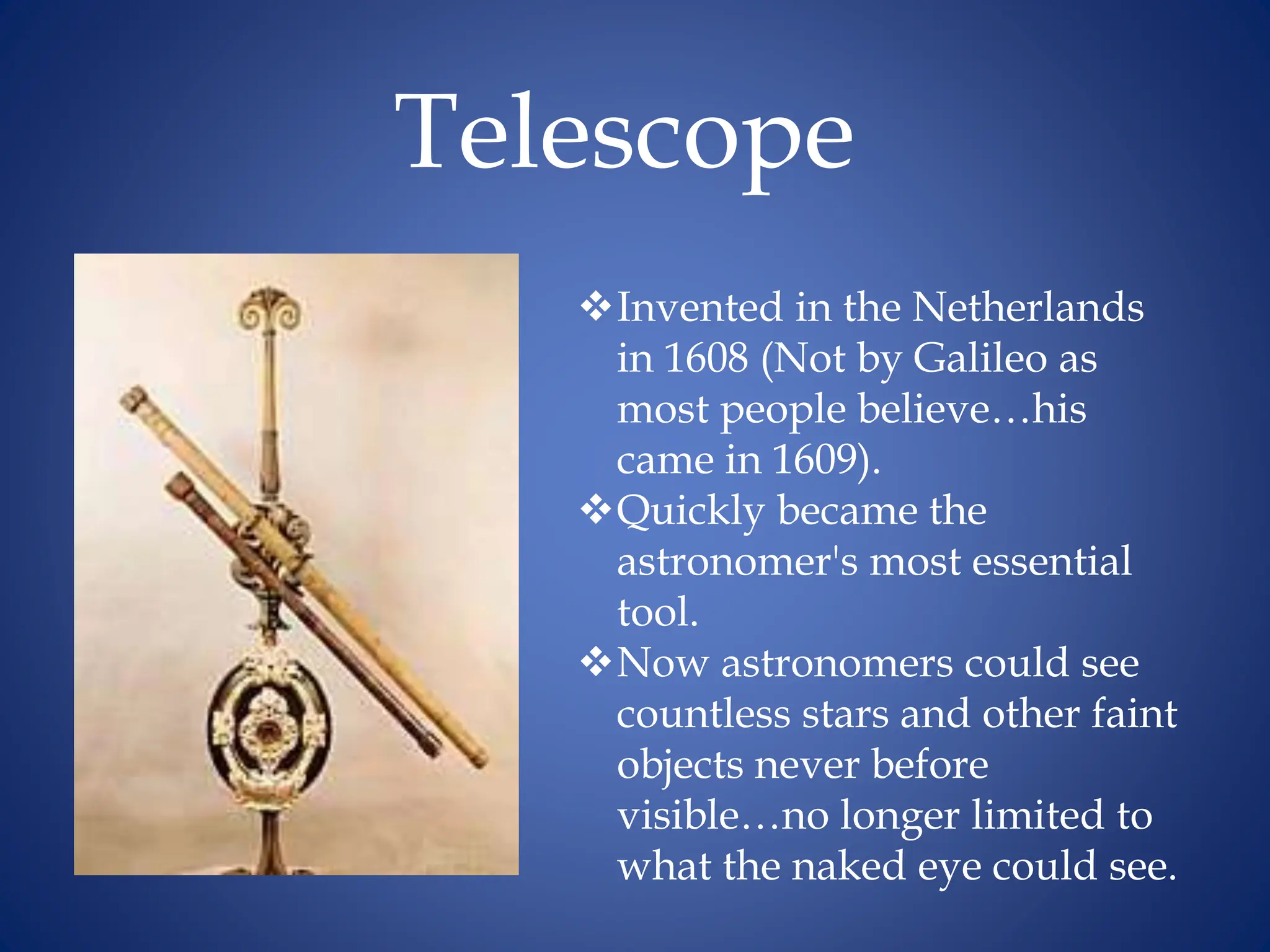
Telescope
Invented in the Netherlands
in 1608 (Not by Galileo as
most people believe…his
came in 1609).
Quickly became the
astronomer's most essential
tool.
Now astronomers could see
countless stars and other faint
objects never before
visible…no longer limited to
what the naked eye could see.

science 9 quarter 3: Constellations and Astronavigation PPT.pptx

  • 1.
  • 2.
    Constellation: a group ofstars that forms a particular shape in the sky and has been given a name
  • 3.
    Orion This constellation isbest seen in the winter sky. It is best seen in the month of January at 9:00pm. Orion, lies on the celestial equator. It is one of the brightest and best known constellations in the sky. It is also one of the few constellations known since ancient times
  • 4.
    Mythology • Perhaps secondonly to the Big Dipper in Ursa Major, the constellation of Orion is one of the most recognizable patterns of stars in the northern sky. • Orion, the hunter, is accompanied by his faithful dogs, Canis Major and Canis Minor. Together they hunt various animals, including Lepus, the rabbit, and Taurus, the bull. • According to Greek mythology, Orion was in love with Merope, one of the Seven Sisters who form the Pleiades, but Merope would have nothing to do with him. Orion's tragic life ended when he stepped on Scorpius, the scorpion. • The gods felt sorry for him, so they put him and his dogs in the sky as constellations. • They also put all of the animals he hunted up there near him. Scorpius, however, was placed on the opposite side of the sky so Orion would never be hurt by it again.
  • 5.
    Picture by NationalGeographic Society (Copyright)
  • 6.
    Ursa Major This constellationcan be seen best in the spring sky. It can be seen best in the month of April at 9:00pm. Ursa Major is a prominent constellation in the northern hemisphere. It is the third largest constellation in the sky. Its name is Latin for the Great Bear. Also often referred to as the Big Dipper
  • 7.
    Mythology • According tosome Native American legends, the bowl of the Big Dipper is a giant bear and the stars of the handle are three warriors chasing it. • The constellation is low in the sky in autumn evening sky, so it was said that the hunters had injured the bear and its blood caused the trees to change color to red. • The Big Dipper is one of the most recognizable patterns in the northern sky. • In other cultures it was identified as a wagon or cart, a plow, a bull's thigh, and (to the Chinese) the government. • The Big Dipper was also a very important part of the Underground Railroad which helped slaves escape from the South before the Civil War. There were songs spread among the slave population which included references to the "Drinking Gourd." The songs said to follow it to get to a better life. This veiled message for the slaves to flee northward was passed along in the form of songs since a large fraction of the slave population was illiterate.
  • 8.
    Picture by NationalGeographic Society (Copyright)
  • 9.
    Ursa Minor This constellationcan be seen best in the summer sky. It can be seen best in the month of June at 9:00pm. Ursa Minor, or the Little Dipper, is a small constellation in the northern hemisphere. In Latin, its name means "little bear." The constellation was originally listed by the Greek astronomer Ptolemy in the 2nd century. Ursa Minor is usually depicted as a small bear with a long tail. It is said that the tail is so long because the bear is held by its end and spun around the
  • 10.
    Mythology • The constellationUrsa Minor contains the group of stars commonly called the Little Dipper. • The handle of the Dipper is the Little Bear's tail and the Dipper's cup is the Bear's flank. • Arcas was the son of Callisto, who was transformed by Juno into a bear. When Arcas was fifteen, he was out hunting in the forest when he came across a bear. The bear behaved quite strangely, looking him in the eyes. He of course could not recognize his mother in her strange shape, and was preparing to shoot her when Jupiter prevented him. Arcas was transformed into a bear like his mother, and the two were taken up into the sky. • The mother bear is Ursa Major.
  • 11.
    Picture by NationalGeographic Society (Copyright)
  • 12.
  • 13.
    Compass An instrument usedfor navigation; it generally has a magnetic needle that points toward the earth's magnetic North Pole. Before the compass, geographical position, destination, and direction at sea were primarily determined by the sighting of landmarks and the observation of the position of celestial bodies (sun/stars). Has been in existence for over 3,000 years.
  • 14.
    Astrolabe Created over 2,000years ago An ancient astronomical computer for solving problems relating to time and the position of the Sun and stars in the sky. Typical uses of the astrolabe include:  Finding the time during the day or night  Finding the time of a celestial event such as sunrise or sunset  Find one’s position Astrolabes were also one of the basic astronomy education tools in the late
  • 15.
    Sextant Used as anavigational tool out at sea Helps determine a ship's longitude and latitude by measuring angles between the horizon and celestial bodies (sun/stars). A more advanced version of the astrolabe. First one was created by Englishman John Bird in 1757.
  • 16.
    Telescope Invented in theNetherlands in 1608 (Not by Galileo as most people believe…his came in 1609). Quickly became the astronomer's most essential tool. Now astronomers could see countless stars and other faint objects never before visible…no longer limited to what the naked eye could see.