GOOD AFTERNOON
Minu anna Emmanuel
3rd year
• ,
anchorage
• Introduction
• Definition
• Classification
• Sources
• Types
• Uses of TAD
• Anchorage planning
contents
INTRODUCTION
• Tooth movement in orthodontic treatment is
achieved by active components.
• It obeys NEWTON’S 3RD LAW.
• Resistance that anchorage areas offers to these
unwanted movement is called ANCHORAGE
DEFINITIONS
• Is the nature and degree of
resistance to displacement offered
by an anatomic unit for the purpose
of affecting tooth movement .
Anchorage is the site of deliver from
which a force is exerted.
According to Graber
According to White and Gardiner
INTRA ORAL SOURCES
☆teeth
☆alveolar bone
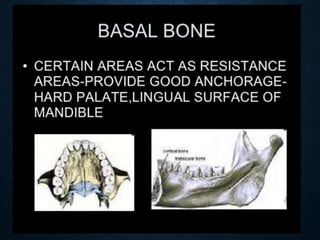
☆ basal bone
☆musculature
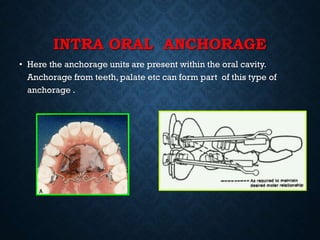
INTRA ORAL ANCHORAGE
• Here the anchorage units are present within the oral cavity.
Anchorage from teeth, palate etc can form part of this type of
anchorage .
EXTRA ORAL SOURCES
☆ CRANIUM ( occipital or
parietal anchorage)
☆ CERVICAL
ANCHORAGE
☆FACIAL BONES
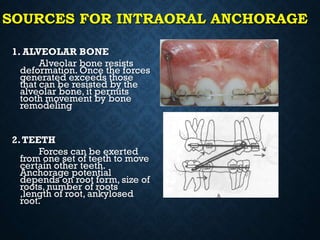
SOURCES FOR INTRAORAL ANCHORAGE
1. ALVEOLAR BONE
Alveolar bone resists
deformation. Once the forces
generated exceeds those
that can be resisted by the
alveolar bone, it permits
tooth movement by bone
remodeling
2.TEETH
Forces can be exerted
from one set of teeth to move
certain other teeth.
Anchorage potential
depends on root form, size of
roots, number of roots
,length of root, ankylosed
root.
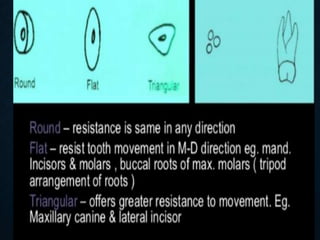
• Other types of anchorage are:
1. Cortical bone or cortical anchorage
• It offers more resistance to the resorption.
• If the roots are torqued more lingually the resistance
to the movement is increased.
• This principle is being used by Rickets and is known
as cortical anchorage
2 .Muscular anchorage : muscular forces can be
used for anchorage purpose
Eg: vestibular shield and lip bumper
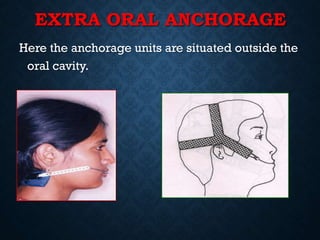
EXTRA ORAL ANCHORAGE
Here the anchorage units are situated outside the
oral cavity.
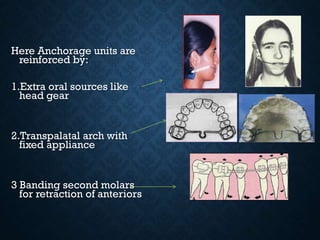
Here Anchorage units are
reinforced by:
1.Extra oral sources like
head gear
2.Transpalatal arch with
fixed appliance
3 Banding second molars
for retraction of anteriors
CLASSIFICATION OF ANCHORAGE
A. Anchorage classified according
to the manner of force application
1. Simple
2. Stationary
3. Reciprocal
B. Anchorage classified according
to the jaws involved as
1. Intra maxillary
2. Inter maxillary
C. Anchorage classified according
to the number of anchor units as
1. Single
2. Compound
3. Reinforced
D. Anchorage classified according
to the site of anchorage units as
1. Intraoral
2. Extra oral
3. Muscular
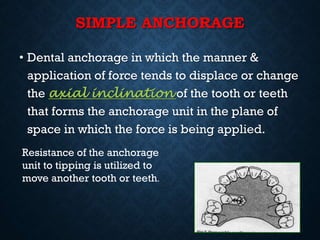
SIMPLE ANCHORAGE
• Dental anchorage in which the manner &
application of force tends to displace or change
the axial inclination of the tooth or teeth
that forms the anchorage unit in the plane of
space in which the force is being applied.
Resistance of the anchorage
unit to tipping is utilized to
move another tooth or teeth.
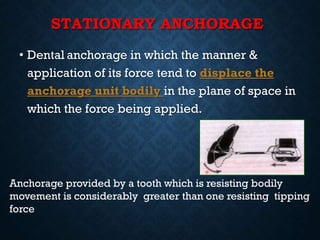
STATIONARY ANCHORAGE
• Dental anchorage in which the manner &
application of its force tend to displace the
anchorage unit bodily in the plane of space in
which the force being applied.
Anchorage provided by a tooth which is resisting bodily
movement is considerably greater than one resisting tipping
force
RECIPROCAL ANCHORAGE
Anchorage in which the resistance of one or more dental units is utilized to
move one or more opposing dental units
Two maxillary central incisors separated
by a diastema were connected by an
Active spring. Hence reciprocal anchorage
is produced when two teeth or resistance
units of equal size pull against each other
Cross elastics to correct molar cross-bite
is another example of Reciprocal
anchorage
REINFORCED ANCHORAGE
• It is an anchorage situation where more than
one resistance unit is employed
• Resistance units become more effective when
more unit are added because the reactionary
force is distributed over a large area
• This minimizes trauma and pain during
treatment
I In a first premolar extraction case,
we
use first molar and second
premolar as anchor units to bring
central incisor,lateral incisor and
canine back.Here the PDL area for
two posterior teeth is slightly
larger than the PDL area of three
anterior teeth. So with a simple
spring connecting the segments
the anterior teeth move slightly
more than the posterior teeth.This
movement is not truly reciprocal
but this is close to a Reciprocal
anchorage
In the same example if we include
second molar to the posterior unit
to retract anterior teeth, then it is
an example of Reinforced
anchorage
• Intra oral anchorage can be classified into :
Intra maxillary anchorage
Inter maxillary anchorage
INTRAMAXILLARYANCHORAGE
Resistance units are all situated
within the same jaw
INTERMAXILLARY ANCHORAGE
[BAKERS ANCHORAGE]
Anchorage units situated in one jaw are
used to effect
• Intra maxillary anchorage :
• Anchorage situated in the same jaw
• Where the appliance situated in the one jaw either in the maxilla or in the
mandible
• It is a , stationary, or reciprocal type of resistance
• Intra maxillary anchorage
• Anchorage unit situated in one jaw and used to bring about the change in
the opposite jaw
• Eg: cross bite correction ,usage of elastic traction in class 2
INTRA MAXILLARY ANCHORAGE
• Bakers anchorage
• It is form of inter maxillary anchorage
• For class 2 malocclusion correction elastics are
worn from lower molar to upper anterior
• For class 3 malocclusion correction elastics are worn
from upper molar to lower anteriors.
MAXIMUM ANCHORAGE
This category describes the critical
maintenance of the posterior tooth position.
Seventy-five percent or more of the
extraction space is needed for anterior
retraction. All care should be taken to
preserve anchorage and the use of
additional methods to augment anchorage
should be planned
MINIMUM ANCHORAGE
This category describes non critical
anchorage. Less amount of extraction space
is required to correct malocclusion.
Seventy-five percent or more of the space
closure is achieved through mesial
movement of the posterior teeth.This could
also be considered to be critical anterior
anchorage
IMPLANT AS ANCHORAGE UNITS OR
TEMPORARY ANCHORAGE DEVICES
(TAD)
• Temporary anchorage unit are temporarily fixed to the
bone for the purpose of enhancing orthodontic
anchorage.
• They can be located transosteally subperiosteally or
endosteally and they can be fixed to the bone either
mechanically or biomechanically
• TAD are called absolute anchorage because extracted or
available space is fully utilized for orthodontic treatment
without space loss due to the movement of anchor teeth.
Anchorage( orthodontics)

Anchorage( orthodontics)

  • 1.
    GOOD AFTERNOON Minu annaEmmanuel 3rd year
  • 2.
  • 4.
    • Introduction • Definition •Classification • Sources • Types • Uses of TAD • Anchorage planning contents
  • 5.
    INTRODUCTION • Tooth movementin orthodontic treatment is achieved by active components. • It obeys NEWTON’S 3RD LAW. • Resistance that anchorage areas offers to these unwanted movement is called ANCHORAGE
  • 6.
    DEFINITIONS • Is thenature and degree of resistance to displacement offered by an anatomic unit for the purpose of affecting tooth movement . Anchorage is the site of deliver from which a force is exerted. According to Graber According to White and Gardiner
  • 8.
    INTRA ORAL SOURCES ☆teeth ☆alveolarbone ☆ basal bone ☆musculature
  • 9.
    INTRA ORAL ANCHORAGE •Here the anchorage units are present within the oral cavity. Anchorage from teeth, palate etc can form part of this type of anchorage .
  • 10.
    EXTRA ORAL SOURCES ☆CRANIUM ( occipital or parietal anchorage) ☆ CERVICAL ANCHORAGE ☆FACIAL BONES
  • 11.
    SOURCES FOR INTRAORALANCHORAGE 1. ALVEOLAR BONE Alveolar bone resists deformation. Once the forces generated exceeds those that can be resisted by the alveolar bone, it permits tooth movement by bone remodeling 2.TEETH Forces can be exerted from one set of teeth to move certain other teeth. Anchorage potential depends on root form, size of roots, number of roots ,length of root, ankylosed root.
  • 14.
    • Other typesof anchorage are: 1. Cortical bone or cortical anchorage • It offers more resistance to the resorption. • If the roots are torqued more lingually the resistance to the movement is increased. • This principle is being used by Rickets and is known as cortical anchorage 2 .Muscular anchorage : muscular forces can be used for anchorage purpose Eg: vestibular shield and lip bumper
  • 16.
    EXTRA ORAL ANCHORAGE Herethe anchorage units are situated outside the oral cavity.
  • 18.
    Here Anchorage unitsare reinforced by: 1.Extra oral sources like head gear 2.Transpalatal arch with fixed appliance 3 Banding second molars for retraction of anteriors
  • 19.
    CLASSIFICATION OF ANCHORAGE A.Anchorage classified according to the manner of force application 1. Simple 2. Stationary 3. Reciprocal
  • 20.
    B. Anchorage classifiedaccording to the jaws involved as 1. Intra maxillary 2. Inter maxillary
  • 21.
    C. Anchorage classifiedaccording to the number of anchor units as 1. Single 2. Compound 3. Reinforced
  • 22.
    D. Anchorage classifiedaccording to the site of anchorage units as 1. Intraoral 2. Extra oral 3. Muscular
  • 23.
    SIMPLE ANCHORAGE • Dentalanchorage in which the manner & application of force tends to displace or change the axial inclination of the tooth or teeth that forms the anchorage unit in the plane of space in which the force is being applied. Resistance of the anchorage unit to tipping is utilized to move another tooth or teeth.
  • 24.
    STATIONARY ANCHORAGE • Dentalanchorage in which the manner & application of its force tend to displace the anchorage unit bodily in the plane of space in which the force being applied. Anchorage provided by a tooth which is resisting bodily movement is considerably greater than one resisting tipping force
  • 25.
    RECIPROCAL ANCHORAGE Anchorage inwhich the resistance of one or more dental units is utilized to move one or more opposing dental units Two maxillary central incisors separated by a diastema were connected by an Active spring. Hence reciprocal anchorage is produced when two teeth or resistance units of equal size pull against each other
  • 26.
    Cross elastics tocorrect molar cross-bite is another example of Reciprocal anchorage
  • 27.
    REINFORCED ANCHORAGE • Itis an anchorage situation where more than one resistance unit is employed • Resistance units become more effective when more unit are added because the reactionary force is distributed over a large area • This minimizes trauma and pain during treatment
  • 28.
    I In afirst premolar extraction case, we use first molar and second premolar as anchor units to bring central incisor,lateral incisor and canine back.Here the PDL area for two posterior teeth is slightly larger than the PDL area of three anterior teeth. So with a simple spring connecting the segments the anterior teeth move slightly more than the posterior teeth.This movement is not truly reciprocal but this is close to a Reciprocal anchorage In the same example if we include second molar to the posterior unit to retract anterior teeth, then it is an example of Reinforced anchorage
  • 30.
    • Intra oralanchorage can be classified into : Intra maxillary anchorage Inter maxillary anchorage
  • 31.
    INTRAMAXILLARYANCHORAGE Resistance units areall situated within the same jaw INTERMAXILLARY ANCHORAGE [BAKERS ANCHORAGE] Anchorage units situated in one jaw are used to effect
  • 32.
    • Intra maxillaryanchorage : • Anchorage situated in the same jaw • Where the appliance situated in the one jaw either in the maxilla or in the mandible • It is a , stationary, or reciprocal type of resistance • Intra maxillary anchorage • Anchorage unit situated in one jaw and used to bring about the change in the opposite jaw • Eg: cross bite correction ,usage of elastic traction in class 2
  • 33.
    INTRA MAXILLARY ANCHORAGE •Bakers anchorage • It is form of inter maxillary anchorage • For class 2 malocclusion correction elastics are worn from lower molar to upper anterior • For class 3 malocclusion correction elastics are worn from upper molar to lower anteriors.
  • 34.
    MAXIMUM ANCHORAGE This categorydescribes the critical maintenance of the posterior tooth position. Seventy-five percent or more of the extraction space is needed for anterior retraction. All care should be taken to preserve anchorage and the use of additional methods to augment anchorage should be planned
  • 35.
    MINIMUM ANCHORAGE This categorydescribes non critical anchorage. Less amount of extraction space is required to correct malocclusion. Seventy-five percent or more of the space closure is achieved through mesial movement of the posterior teeth.This could also be considered to be critical anterior anchorage
  • 36.
    IMPLANT AS ANCHORAGEUNITS OR TEMPORARY ANCHORAGE DEVICES (TAD) • Temporary anchorage unit are temporarily fixed to the bone for the purpose of enhancing orthodontic anchorage. • They can be located transosteally subperiosteally or endosteally and they can be fixed to the bone either mechanically or biomechanically • TAD are called absolute anchorage because extracted or available space is fully utilized for orthodontic treatment without space loss due to the movement of anchor teeth.