ANCHORAGE IN ORTHODONTICS
Learning Objective
 At the end of the lecture student should be
able to:
1. Define and explain the term anchorage
2. Classify various anchorage types
3. Enumerate the uses of various appliances
used for anchorage.
4. Explain source of anchorage
5. Explain Tweeds anchorage preparation
INTRODUCTION
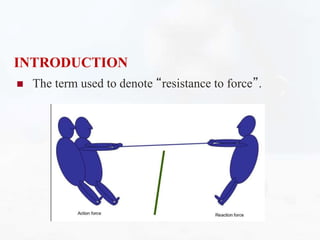
 The term used to denote “resistance to force”.
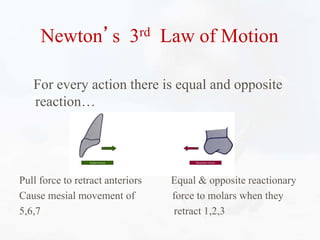
Newton’s 3rd Law of Motion
For every action there is equal and opposite
reaction…
Pull force to retract anteriors Equal & opposite reactionary
Cause mesial movement of force to molars when they
5,6,7 retract 1,2,3
 The force used to move the teeth is derived from certain
anatomic areas which act as an “ ANCHOR ”
 The resistance that the anchorage areas offer to these
unwanted tooth movements is known as
“ANCHORAGE”
 Accor. To Graber: The nature & degree of resistance to
displacement offered by an anatomic unit for the purpose
of effective tooth movement.
CLASSIFICATION
 According to Moyers:
1. As per site of anchorage
- Intraoral:-anchorage units
are present within
the oral cavity
- Extraoral:-Anchorage units are
situated outside the
oral cavity.
 2)According to the
jaws involved:-
 a)Intramaxillary:-
the anchorage units are
situated within the same
jaw
 b)Intermaxillary:-
Anchorage units situated
in one jaw are used to
provide the force to move
teeth in opposing jaw.
‘Bakers anchorage’
3) According to the
manner of force
application
A) Simple:-Manner &
application of force is
such that it tends to
change the axial
inclination of the tooth.
B) Stationary:-Manner &
application of force
tends to displace the
anchorage unit bodily.
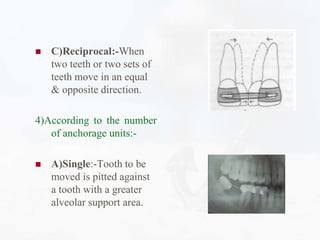
 C)Reciprocal:-When
two teeth or two sets of
teeth move in an equal
& opposite direction.
4)According to the number
of anchorage units:-
 A)Single:-Tooth to be
moved is pitted against
a tooth with a greater
alveolar support area.
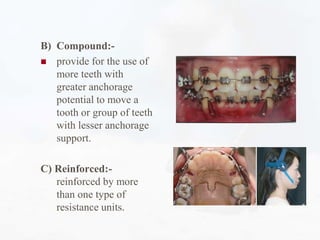
B) Compound:-
 provide for the use of
more teeth with
greater anchorage
potential to move a
tooth or group of teeth
with lesser anchorage
support.
C) Reinforced:-
reinforced by more
than one type of
resistance units.
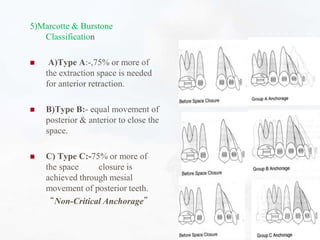
5)Marcotte & Burstone
Classification
 A)Type A:-,75% or more of
the extraction space is needed
for anterior retraction.
 B)Type B:- equal movement of
posterior & anterior to close the
space.
 C) Type C:-75% or more of
the space closure is
achieved through mesial
movement of posterior teeth.
“Non-Critical Anchorage”
 INTRAORAL
1. Teeth: it mainly depends upon:-
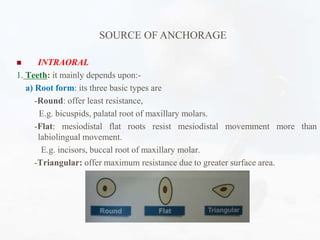
a) Root form: its three basic types are
-Round: offer least resistance,
E.g. bicuspids, palatal root of maxillary molars.
-Flat: mesiodistal flat roots resist mesiodistal movemment more than
labiolingual movement.
E.g. incisors, buccal root of maxillary molar.
-Triangular: offer maximum resistance due to greater surface area.
SOURCE OF ANCHORAGE
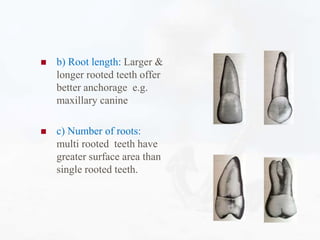
 b) Root length: Larger &
longer rooted teeth offer
better anchorage e.g.
maxillary canine
 c) Number of roots:
multi rooted teeth have
greater surface area than
single rooted teeth.
 d) Size of tooth: larger
tooth acts as better
anchorage due to large
surface area. E.g. molars
compared to anteriors
 e) Inclination of tooth:
greater resistance offered
when forces are exerted
in opposite direction.
 2. Bone:
• Mandible has less amount of
bone marrow & more dense
therefore better anchorage than
maxillary bone. E.g. hard
palate,lingual surface of
mandible.
 3. Implants : commonly used are
mini implants
EXTRAORAL SOURCES
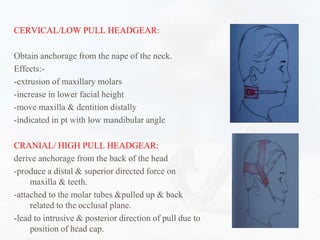
CERVICAL/LOW PULL HEADGEAR:
Obtain anchorage from the nape of the neck.
Effects:-
-extrusion of maxillary molars
-increase in lower facial height
-move maxilla & dentition distally
-indicated in pt with low mandibular angle
CRANIAL/ HIGH PULL HEADGEAR:
derive anchorage from the back of the head
-produce a distal & superior directed force on
maxilla & teeth.
-attached to the molar tubes &pulled up & back
related to the occlusal plane.
-lead to intrusive & posterior direction of pull due to
position of head cap.
OCCIPITAL/STRAIGHT PULL
HEADGEAR:
little or no angle with the occlusal plane in
contrast to cervical/cranial
(combination)
Adv:-pure posterior translatory force
-stabilize mandibular arch
-anchorage during class II & maxillary
anterior retraction
Uses:
- anchorage augmentation
- Orthopaedic effects
- Molar distallization
- Molar rotation
- Space maintenance
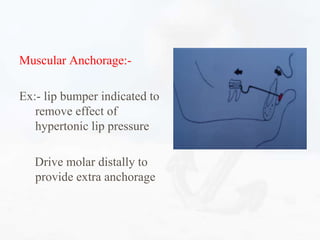
Muscular Anchorage:-
Ex:- lip bumper indicated to
remove effect of
hypertonic lip pressure
Drive molar distally to
provide extra anchorage
Cortical Anchorage:
- Given by Dr. R.M. Rickett’s
- Cortical bone more resistant to resorption & tooth movement is
slowed
- The bone is dense,less vascular & laminated
- Ex 1. Lower molar gives best anchorage than upper also aids in
anchorage by torquing the roots of posterior teeth outward
against cortical plate
2. In adults in whom molars & premolars lost many years
ago resulting in knife-edge ridge
Tweed’s Anchorage Preparation
Given by Dr. Charles Tweed
He found that anchorage to be stable when inclination of
lower molars are at right angle to the forces acting
over it as they resist forward displacement between
upper & lower apical bases.
He divided it into:-
1. 1st degree preparation
2. 2nd degree preparation
3. 3rd degree preparation
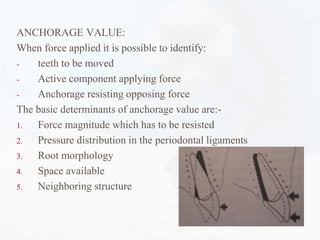
ANCHORAGE VALUE:
When force applied it is possible to identify:
- teeth to be moved
- Active component applying force
- Anchorage resisting opposing force
The basic determinants of anchorage value are:-
1. Force magnitude which has to be resisted
2. Pressure distribution in the periodontal ligaments
3. Root morphology
4. Space available
5. Neighboring structure
ANCHORAGE MANAGEMENT:
Increasing the anchorage value makes the anchored teeth more resistant
to force applied. Various methods are;
1. Incorporate as many teeth as possible
2. Use of anchor bends
3. Reinforce intraoral with extraoral anchorage
4. Use of nance palatal or lingual arch
5. Use of intermaxillary forces
6. Use of lip bumper
ANCHORAGE PLANNING:-
It mainly depends on the anchorage demand which depend on:-
- Number of teeth to be moved
- Type of teeth being moved
- Type of tooth movement
- Duration of tooth movement
ANCHORAGE LOSS:-
 unwanted movement of anchor teeth invariably
occurs during orthodontic treatment.
 Such unwanted movement of anchor teeth is known
as anchorage loss.
1/3rd after extraction of I premolars
2/3rd after extraction of II premolars
1/2 after extraction of I molars
ANCHORAGE DEMAND:
Depending upon the anchorage loss its of three types
1. Maximum anchorage case
2. Moderate anchorage case
3. Minimum anchorage cases
Summary
 Whenever a force is applied, it produces an equal and
opposite reactive force
 All orthodontic appliances can be said to have two
components, active and resistance components
 The active component is responsible for generating the
force and the resistance component is responsible for
providing the resistance to make the force effective
anchorage .pptx

anchorage .pptx

  • 1.
  • 2.
    Learning Objective  Atthe end of the lecture student should be able to: 1. Define and explain the term anchorage 2. Classify various anchorage types 3. Enumerate the uses of various appliances used for anchorage. 4. Explain source of anchorage 5. Explain Tweeds anchorage preparation
  • 3.
    INTRODUCTION  The termused to denote “resistance to force”.
  • 5.
    Newton’s 3rd Lawof Motion For every action there is equal and opposite reaction… Pull force to retract anteriors Equal & opposite reactionary Cause mesial movement of force to molars when they 5,6,7 retract 1,2,3
  • 6.
     The forceused to move the teeth is derived from certain anatomic areas which act as an “ ANCHOR ”  The resistance that the anchorage areas offer to these unwanted tooth movements is known as “ANCHORAGE”  Accor. To Graber: The nature & degree of resistance to displacement offered by an anatomic unit for the purpose of effective tooth movement.
  • 7.
    CLASSIFICATION  According toMoyers: 1. As per site of anchorage - Intraoral:-anchorage units are present within the oral cavity - Extraoral:-Anchorage units are situated outside the oral cavity.
  • 8.
     2)According tothe jaws involved:-  a)Intramaxillary:- the anchorage units are situated within the same jaw  b)Intermaxillary:- Anchorage units situated in one jaw are used to provide the force to move teeth in opposing jaw. ‘Bakers anchorage’
  • 9.
    3) According tothe manner of force application A) Simple:-Manner & application of force is such that it tends to change the axial inclination of the tooth. B) Stationary:-Manner & application of force tends to displace the anchorage unit bodily.
  • 10.
     C)Reciprocal:-When two teethor two sets of teeth move in an equal & opposite direction. 4)According to the number of anchorage units:-  A)Single:-Tooth to be moved is pitted against a tooth with a greater alveolar support area.
  • 11.
    B) Compound:-  providefor the use of more teeth with greater anchorage potential to move a tooth or group of teeth with lesser anchorage support. C) Reinforced:- reinforced by more than one type of resistance units.
  • 12.
    5)Marcotte & Burstone Classification A)Type A:-,75% or more of the extraction space is needed for anterior retraction.  B)Type B:- equal movement of posterior & anterior to close the space.  C) Type C:-75% or more of the space closure is achieved through mesial movement of posterior teeth. “Non-Critical Anchorage”
  • 13.
     INTRAORAL 1. Teeth:it mainly depends upon:- a) Root form: its three basic types are -Round: offer least resistance, E.g. bicuspids, palatal root of maxillary molars. -Flat: mesiodistal flat roots resist mesiodistal movemment more than labiolingual movement. E.g. incisors, buccal root of maxillary molar. -Triangular: offer maximum resistance due to greater surface area. SOURCE OF ANCHORAGE
  • 14.
     b) Rootlength: Larger & longer rooted teeth offer better anchorage e.g. maxillary canine  c) Number of roots: multi rooted teeth have greater surface area than single rooted teeth.
  • 15.
     d) Sizeof tooth: larger tooth acts as better anchorage due to large surface area. E.g. molars compared to anteriors  e) Inclination of tooth: greater resistance offered when forces are exerted in opposite direction.
  • 16.
     2. Bone: •Mandible has less amount of bone marrow & more dense therefore better anchorage than maxillary bone. E.g. hard palate,lingual surface of mandible.  3. Implants : commonly used are mini implants
  • 17.
  • 18.
    CERVICAL/LOW PULL HEADGEAR: Obtainanchorage from the nape of the neck. Effects:- -extrusion of maxillary molars -increase in lower facial height -move maxilla & dentition distally -indicated in pt with low mandibular angle CRANIAL/ HIGH PULL HEADGEAR: derive anchorage from the back of the head -produce a distal & superior directed force on maxilla & teeth. -attached to the molar tubes &pulled up & back related to the occlusal plane. -lead to intrusive & posterior direction of pull due to position of head cap.
  • 19.
    OCCIPITAL/STRAIGHT PULL HEADGEAR: little orno angle with the occlusal plane in contrast to cervical/cranial (combination) Adv:-pure posterior translatory force -stabilize mandibular arch -anchorage during class II & maxillary anterior retraction Uses: - anchorage augmentation - Orthopaedic effects - Molar distallization - Molar rotation - Space maintenance
  • 20.
    Muscular Anchorage:- Ex:- lipbumper indicated to remove effect of hypertonic lip pressure Drive molar distally to provide extra anchorage
  • 21.
    Cortical Anchorage: - Givenby Dr. R.M. Rickett’s - Cortical bone more resistant to resorption & tooth movement is slowed - The bone is dense,less vascular & laminated - Ex 1. Lower molar gives best anchorage than upper also aids in anchorage by torquing the roots of posterior teeth outward against cortical plate 2. In adults in whom molars & premolars lost many years ago resulting in knife-edge ridge
  • 22.
    Tweed’s Anchorage Preparation Givenby Dr. Charles Tweed He found that anchorage to be stable when inclination of lower molars are at right angle to the forces acting over it as they resist forward displacement between upper & lower apical bases. He divided it into:- 1. 1st degree preparation 2. 2nd degree preparation 3. 3rd degree preparation
  • 23.
    ANCHORAGE VALUE: When forceapplied it is possible to identify: - teeth to be moved - Active component applying force - Anchorage resisting opposing force The basic determinants of anchorage value are:- 1. Force magnitude which has to be resisted 2. Pressure distribution in the periodontal ligaments 3. Root morphology 4. Space available 5. Neighboring structure
  • 24.
    ANCHORAGE MANAGEMENT: Increasing theanchorage value makes the anchored teeth more resistant to force applied. Various methods are; 1. Incorporate as many teeth as possible 2. Use of anchor bends 3. Reinforce intraoral with extraoral anchorage 4. Use of nance palatal or lingual arch 5. Use of intermaxillary forces 6. Use of lip bumper
  • 25.
    ANCHORAGE PLANNING:- It mainlydepends on the anchorage demand which depend on:- - Number of teeth to be moved - Type of teeth being moved - Type of tooth movement - Duration of tooth movement
  • 26.
    ANCHORAGE LOSS:-  unwantedmovement of anchor teeth invariably occurs during orthodontic treatment.  Such unwanted movement of anchor teeth is known as anchorage loss. 1/3rd after extraction of I premolars 2/3rd after extraction of II premolars 1/2 after extraction of I molars ANCHORAGE DEMAND: Depending upon the anchorage loss its of three types 1. Maximum anchorage case 2. Moderate anchorage case 3. Minimum anchorage cases
  • 27.
    Summary  Whenever aforce is applied, it produces an equal and opposite reactive force  All orthodontic appliances can be said to have two components, active and resistance components  The active component is responsible for generating the force and the resistance component is responsible for providing the resistance to make the force effective