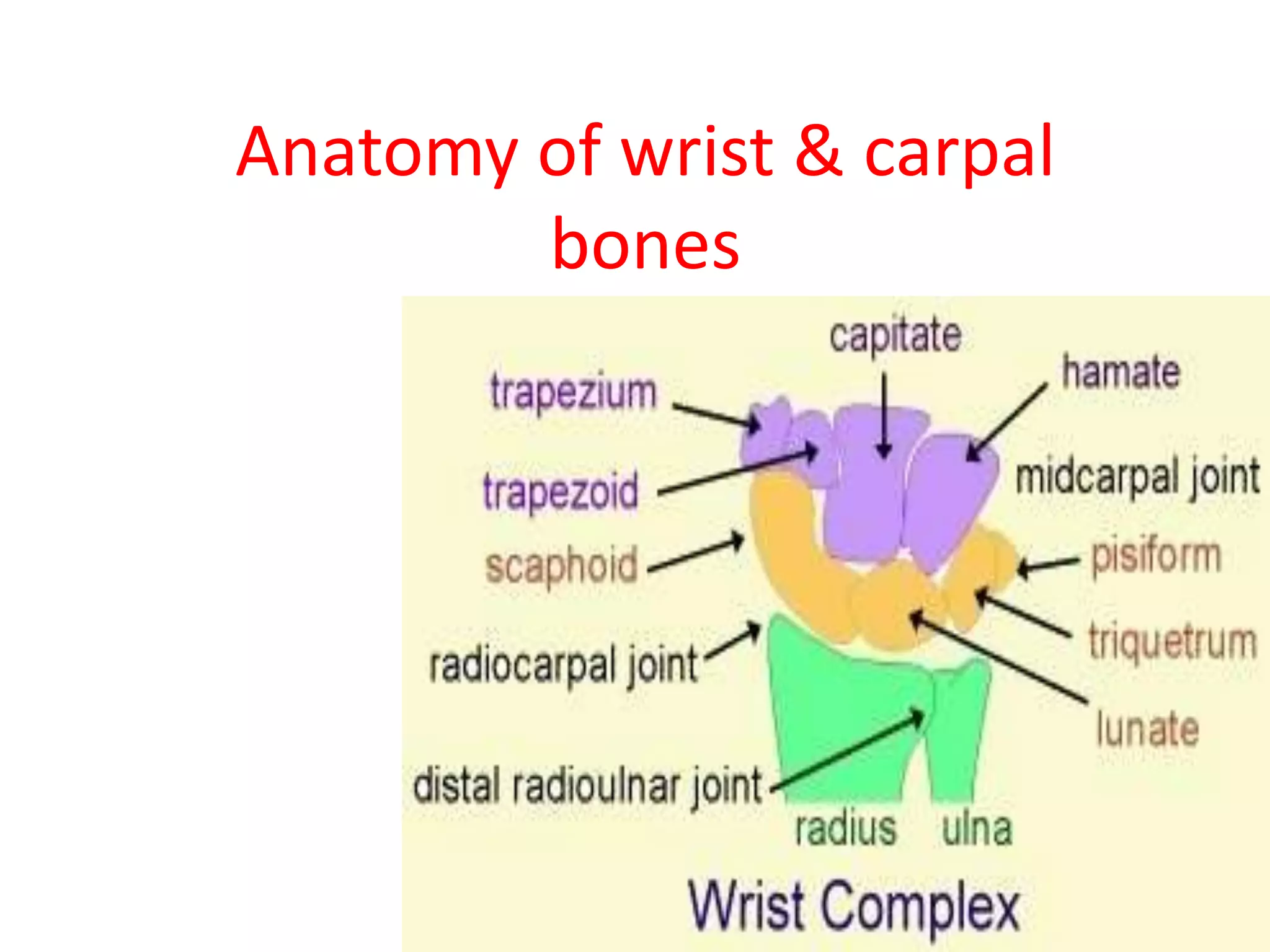
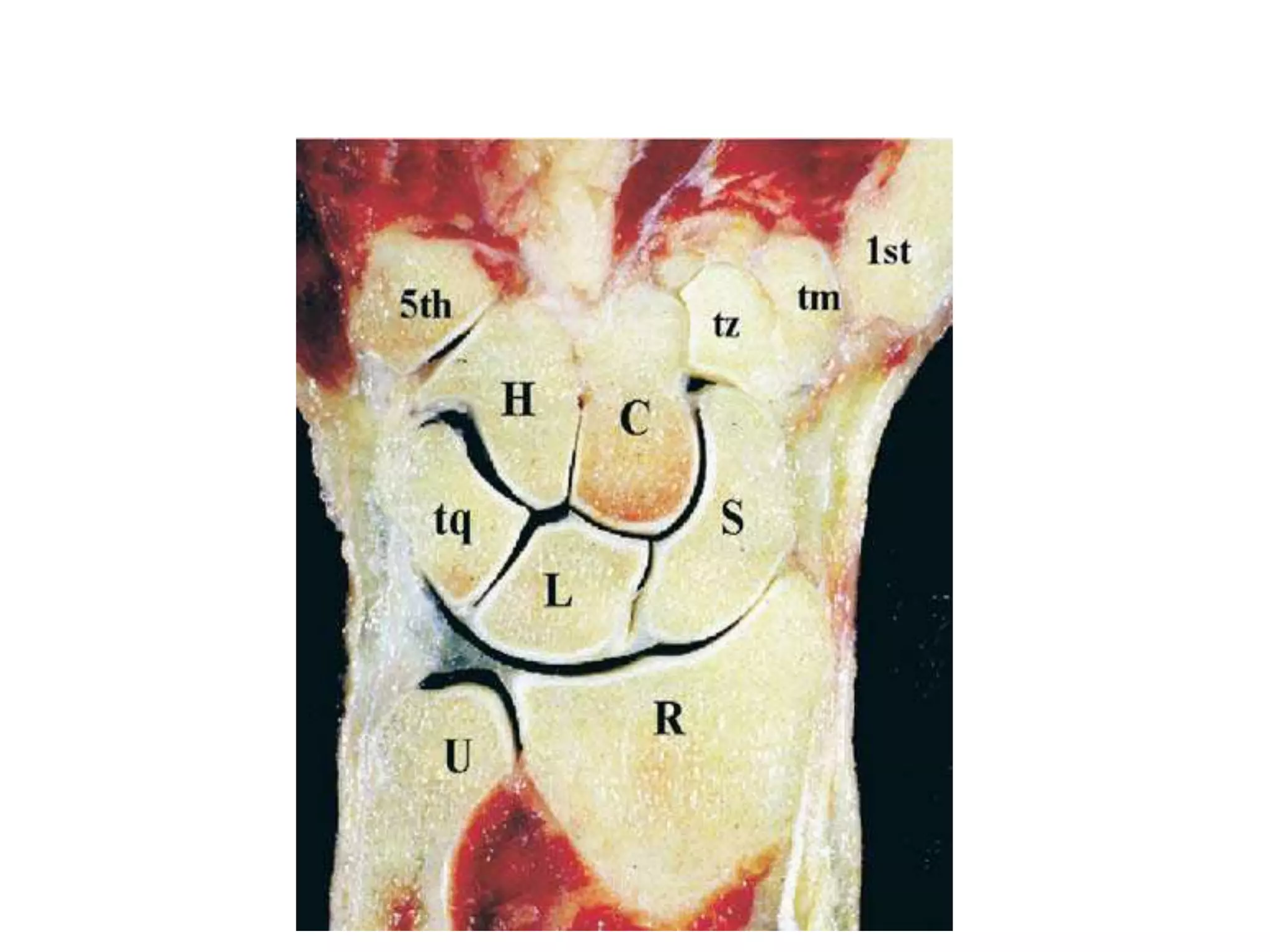
Anatomy of wrist & carpal
bones
Osseous anatomy
• The distal ends of the radius and ulna
articulate with the two carpal rows (proximal
and distal), and these articulate with the bases
of the five metacarpal bones .
• The proximal row of carpal bones termed as
intercalated segment because forces acting on
its proximal & distal articulations determine
its position
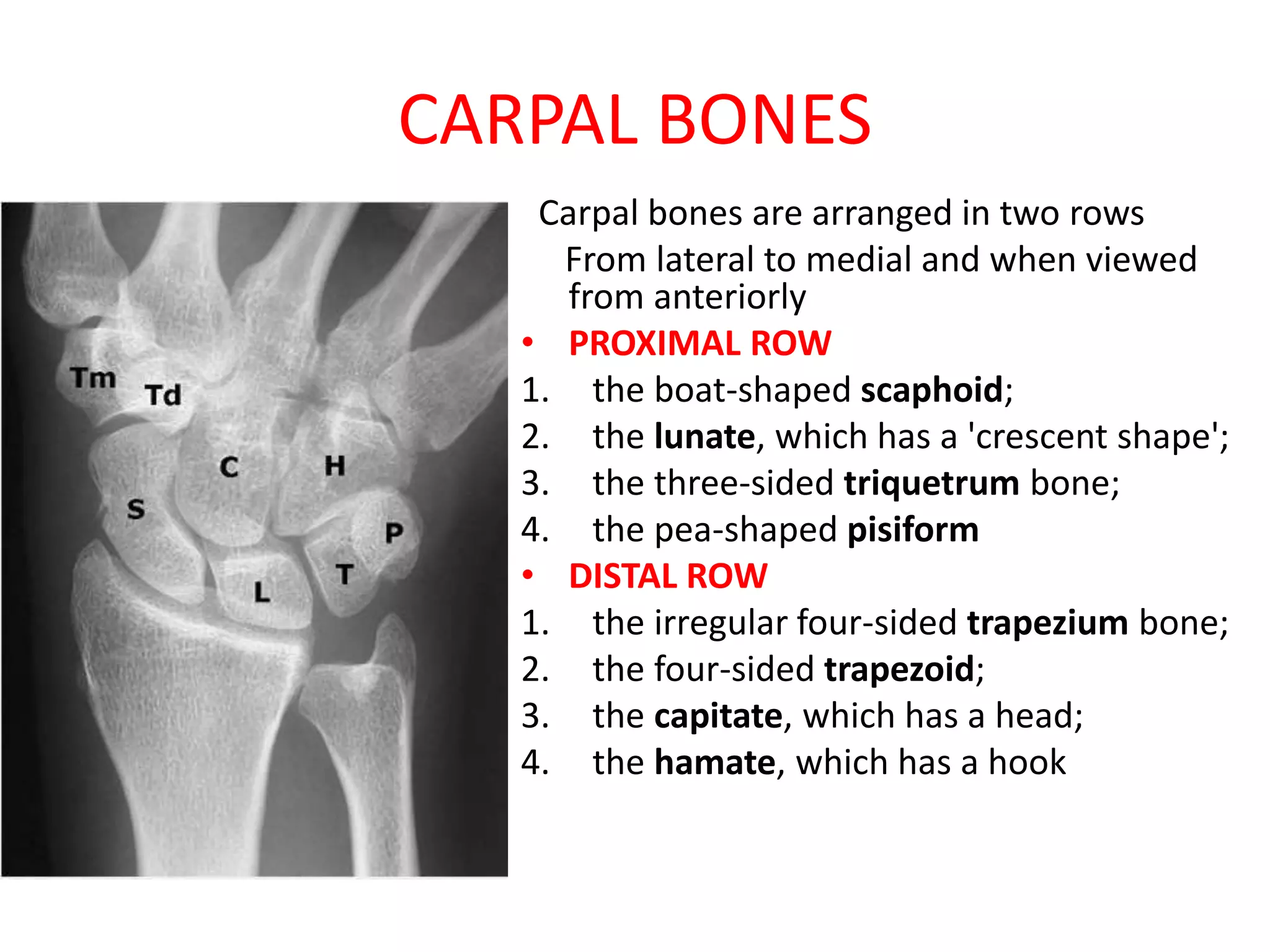
CARPAL BONES
Carpal bones are arranged in two rows
From lateral to medial and when viewed
from anteriorly
• PROXIMAL ROW
1. the boat-shaped scaphoid;
2. the lunate, which has a 'crescent shape';
3. the three-sided triquetrum bone;
4. the pea-shaped pisiform
• DISTAL ROW
1. the irregular four-sided trapezium bone;
2. the four-sided trapezoid;
3. the capitate, which has a head;
4. the hamate, which has a hook
General Features of Carpal Bones
• 1. The proximal row is convex proximally, and concave
distally.
2. The distal row is convex proximally and flat distally.
3. Each bone has 6 surfaces:
(i) The palmar and dorsal surfaces are non-articular
except for the triquetral and pisiform.
(ii) The lateral surfaces of the two lateral bones
(scaphoid and trapezium) are nonarticular.
(iii) The medial surfaces of the three medial bones
(triquetral, pisiform and hamate) are nonarticular.
• 4. The dorsal nonarticular surface is always larger than
the palmar nonarticular surface, except for the lunate,
in which the palmar surface is larger than the dorsal
Articular Compartmental Anatomy
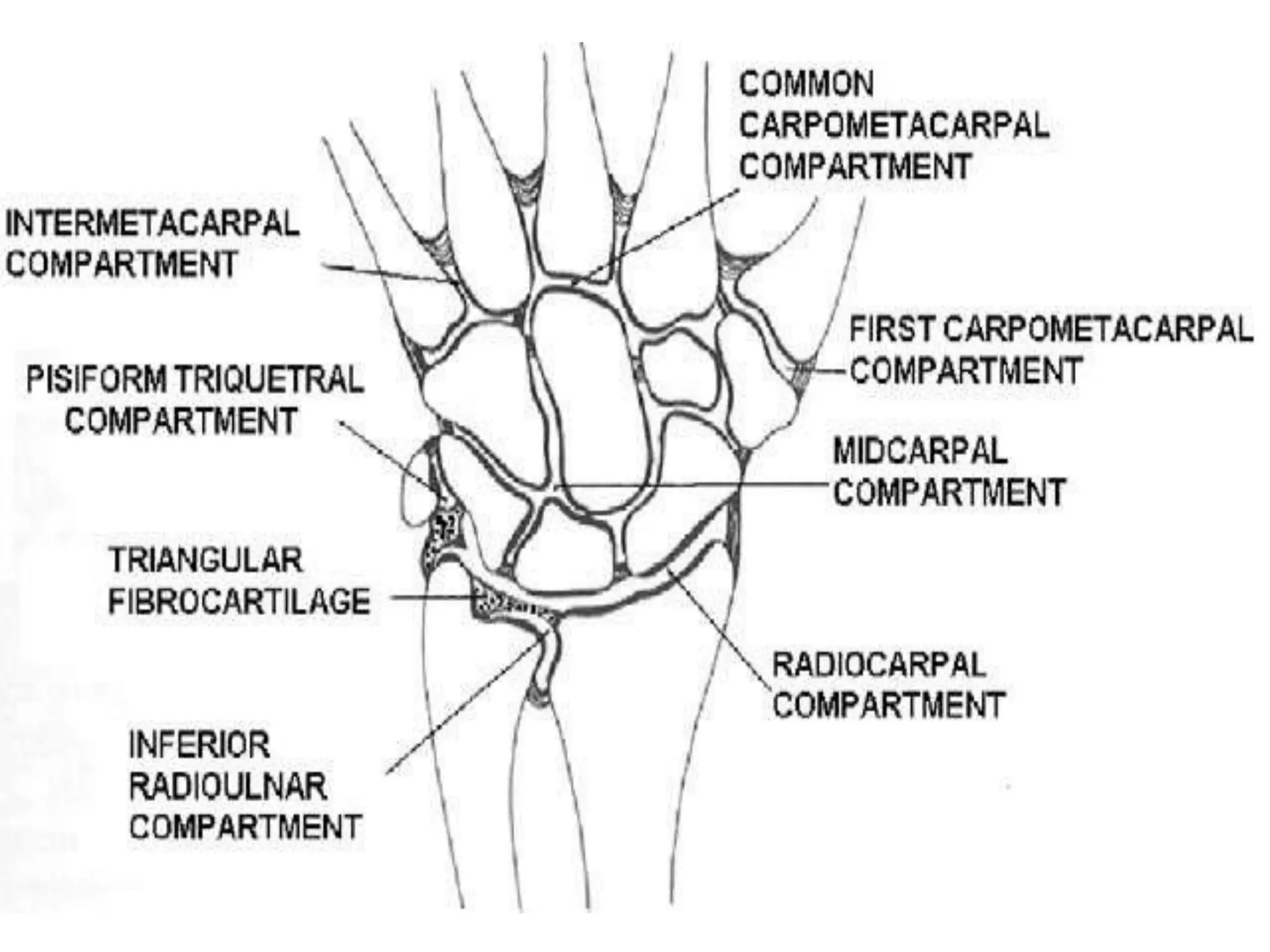
• The wrist joint is separated into a number of
compartments by the many ligaments that
attach to the carpal bones
• These compartments are of considerable
significance for the interpretation of standard
or MR arthrograms and for identifying various
patterns of arthritic involvement
• The compartments are as follows:
• 1. Radiocarpal compartment
• 2. Midcarpal compartment
• 3. Pisiform-triquetral compartment
• 4. Common carpometacarpal compartment
• 5. First carpometacarpal compartment
• 6. Intermetacarpal compartments
• 7. Inferior (distal) radioulnar compartment
Ligamentous anatomy
• Two categories - Intrinsic
- Extrinsic
• Intrinsic ligaments
- Scapho-lunate interosseous ligament
- Luno-triquetral interosseous ligament
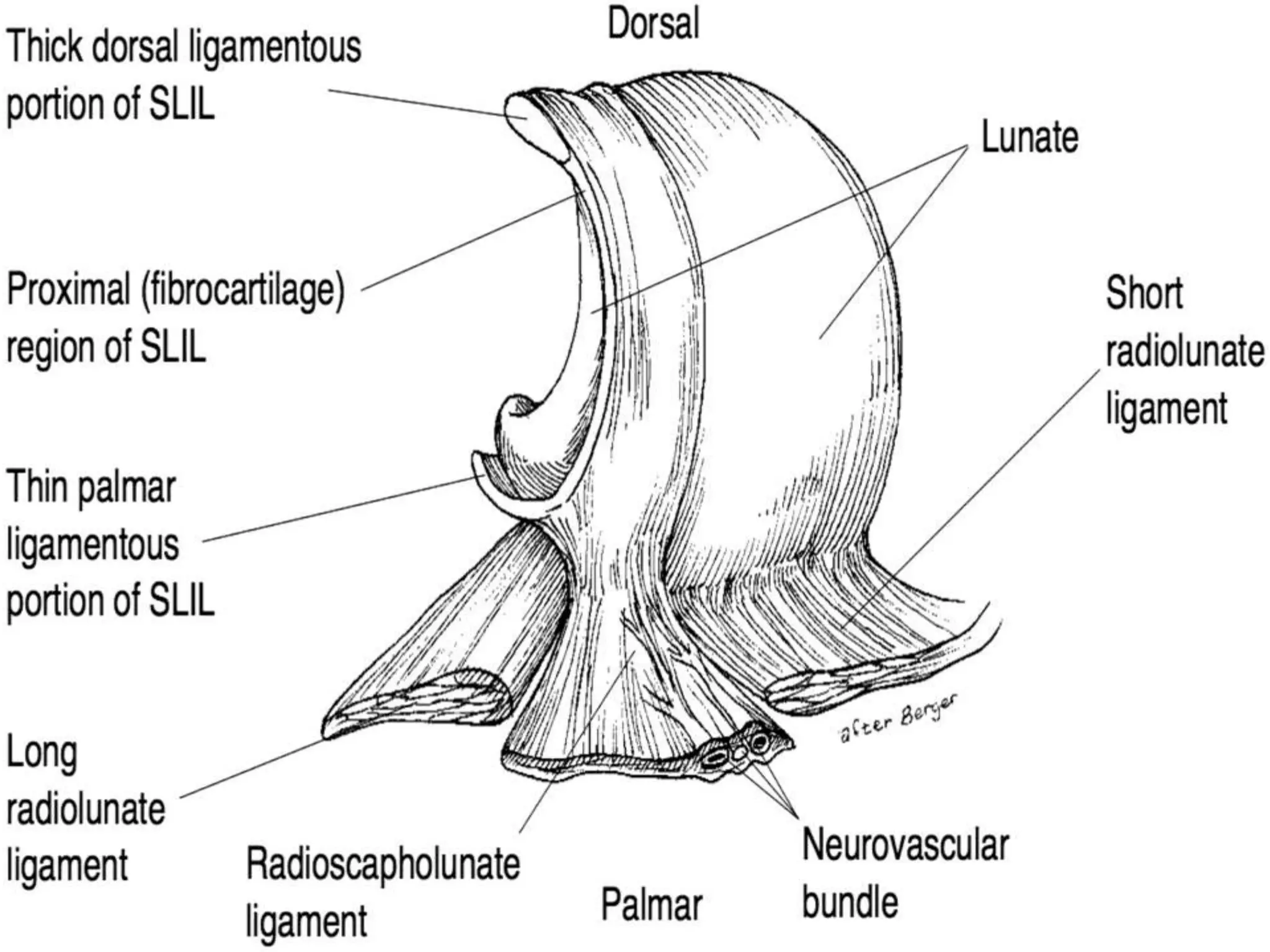
• Scapholunate interosseous ligament ( SLIL ) :
• C shaped structure
• 3 parts - dorsal
- proximal
- volar
• Dorsal part – 3mm thick, transverse or short
oblique fibers
• located in the depth of the dorsal capsule and
connects the dorsal-distal corners of the
scaphoid and lunate bones.
• Plays a key role in scapholunate stability.
• Volar part- has longer, more obliquely
oriented fibers
• allowing substantial sagittal rotation of the
scaphoid relative to the lunate
• playing a lesser role in carpal stability
• Proximal part – thin, fibrocartilagenous
• Follows the arc of the proximal edges of the
two bones from dorsal to palmar
• separating the radiocarpal and midcarpal
jointspaces
• Lunate Triquetrum Interosseous Ligaments :
• Three components- palmar, dorsal & proximal
• In contrast to the scapholunate ligaments, the
palmar lunate triquetrum ligament is thicker
and stronger than the dorsal one
Extrinsic ligaments
• Subdivided into three major subgroups
- palmar radiocarpal
- palmar ulnocarpal
- dorsal radiocarpal
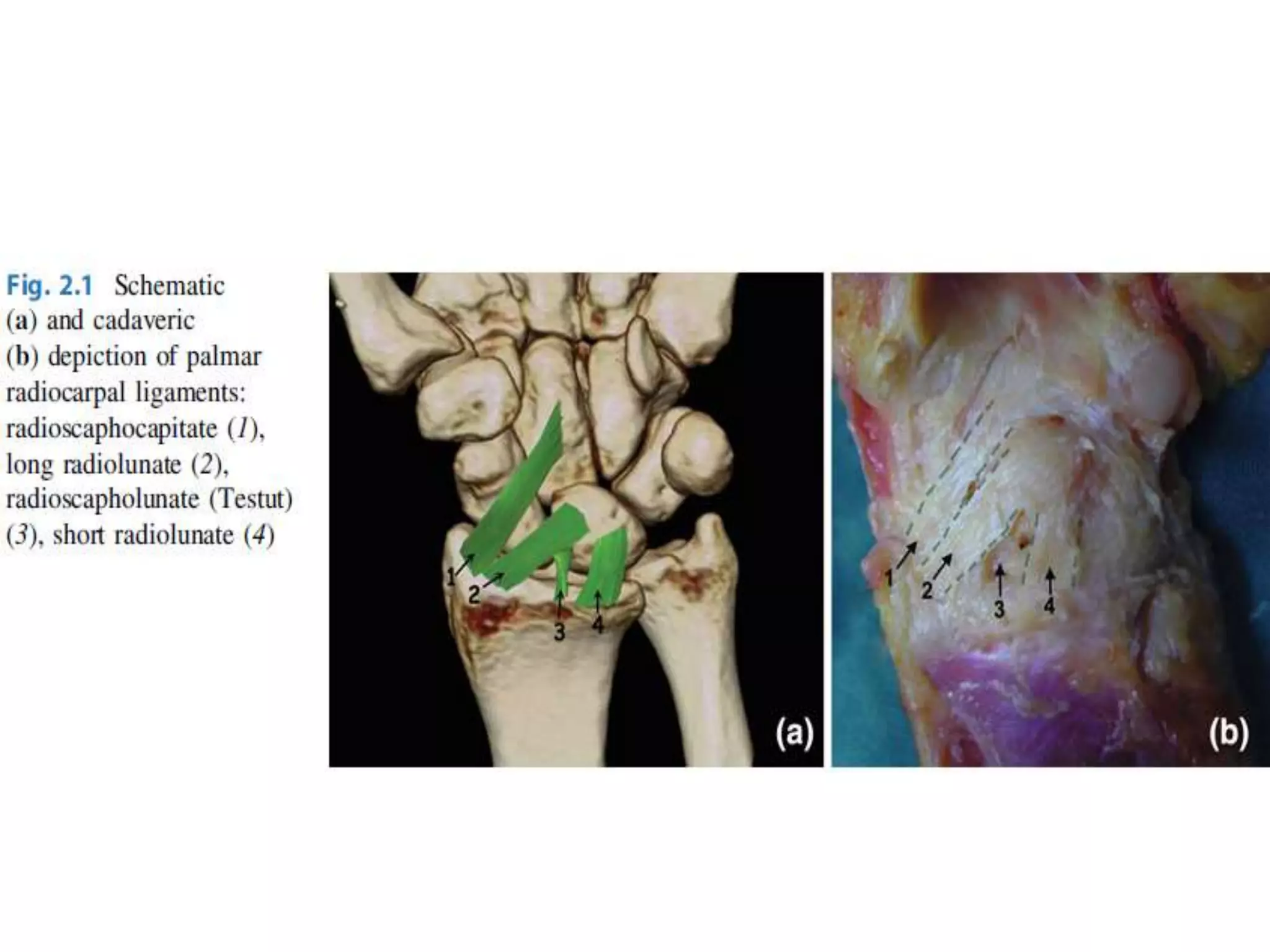
• Palmar radio-carpal ligaments :
• Four palmar ligaments connect the radius to
the carpus:
-radio-scapholunate
-radio-scaphoid-capitate
- long radio-lunate
-short radio-lunate ligaments
• The first three ligaments originate from the
lateral third of the palmar margin of the distal
radius and take an oblique course to insert
into the scaphoid tuberosity &
lunate(radioscapholunate), the palmar aspect
of the capitate (radioscaphoid-capitate), and
the lunate (long radiolunate).
• The short radiolunate ligament originates
from the medial anterior rim of the radius and
has a vertical direction until it inserts into the
palmar aspect of the lunate
• The radioscaphoid-capitate ligament courses
around the palmar concavity ofthe scaphoid,
forming a hinge over which the scaphoid
rotates.
• Between the two diverging radioscaphoid-
capitate and long radiolunate ligaments, there
is the so-called interligamentous sulcus (space
of Poirier), which represents a weak zone
through which perilunate dislocations
frequently occur
Palmar Ulnocarpal Ligaments
• Superficial extrinsic ulnar-capitate
• Ulnar-triquetrum
• Ulnar-lunate
• Volar radioulnar
Dorsal Radiocarpal Ligaments
• The only dorsal extrinsic radiocarpal ligament
is the dorsal radial triquetrum ligament, also
known as the dorsal radiocarpal ligament
• this is a wide, fan-shaped ligament that
connects the dorsal edge of the distal articular
surface of the radius to the dorsal rim of the
triquetrum, with some deep fibers inserting
onto the lunate, and rarely onto the scaphoid.
Midcarpal Ligaments
• Dorsal – dorsal intercarpal ligament
• Palmar –
• lateral group - scapho-trapezium-trapezoid
- scapho-capitate
- capitate-trapezium
• Medial group - triquetro-capitate
- triquetro-hamate
- palmar scaphotriquetrum
Lateral group are important in maintaining of
normal scaphoid alignment
• Dorsal intercarpal ligament-
• arises from the dorsal ridge of the triquetrum
• courses transversely along the distal edge of
the lunate
• fans out to insert on the dorsal rim of the
scaphoid the trapezium, and the trapezoid
bones
• contributes to increase the depth of the
midcarpal socket
• having a stabilizing role to the lunocapitate
joint
Vascularity of the Wrist
• The blood supply to the wrist is provided by
an extrinsic and an intrinsic vascular system
• The extrinsic blood supply is developed
through branches of the radial, ulnar, and
anterior interosseous arteries, which form an
arcade of anastomosing branches that
produce three dorsal and three palmar arches
• The dorsal and palmar radiocarpal arches
• The dorsal and palmar intercarpal arches
• The dorsal basal metacarpal and the deep
palmar arches
• Panagis et al. and Gelberman and Gross classified
the carpal bones into three groups on the basis of
• the number and location of nutrient vessels,
• the presence or absence of intraosseous
anastomoses
• and the dependence of large areas of bone on a
single vessel.
• The clinical significance of the various groups is
based on the risk of posttraumatic avascular
necrosis for the bones in each group
• Group I - Includes carpal bones which either
have vessels entering from only one surface or
• large areas of bone that are dependent on a
single vessel.
• This group is the most vulnerable to
posttraumatic avascular necrosis.
• Scaphoid, Capitate, and 8 % or 20 % of the
lunates
• Group II - two or more areas of vessel entry
but lack significant anastomoses within the
entire or a major part of the bones.
• Hamate, Trapezoid
• Group III - two or more areas of vessel entry
and consistent intraosseous anastomoses.
• Trapezium, triquetrum , pisiform, and 80 % or
92 % of the lunates
Innervation of wrist ligaments
• The main innervation to the wrist capsule derives from
• the anterior interosseous nerve,
• lateral antebrachial cutaneous nerve, and
• Posterior interosseous nerve.
• Other minor sources of capsular innervation include:
• The palmar cutaneous branch of the median nerve,
• The deep branch of the ulnar nerve,
• The superficial branch of the radial nerve, and
• The dorsal branch of the ulnar nerve
BIOMECHANICS
• The proximal carpal row has no direct tendon
attachments. The moment generated by
muscle contraction results in rotation that is
initiated at the distal carpal row.
• The bones of the proximal row follow
passively, when tension within the midcarpal
capsule reaches a certain level
• In kinematic terms, the distal carpal row can
be thought of as one rigid functional unit.
• The bones of the proximal carpal row seem to
be less tightly bound to one another than the
bones of the distal carpal row
• When the wrist is constrained along the sagittal
plane, the scaphoid has a larger amount of
rotation (average 90% of the total arc of motion)
than the lunate (50%) and the triquetrum (65%).
• The average scapholunate angle is 76 degrees in
full wrist flexion and 35 degrees in full extension.
• During radioulnar deviation of the wrist, the
three proximal carpal bones move synergistically
from a flexed position in radial deviation to an
extended position in ulnar deviation
• During unconstrained flexion of the wrist, the
distal row synchronously rotates into flexion,
but also into some degree of ulnar deviation.
• In contrast, during wrist extension, the
tendency of all distal carpal bones is to rotate
into extension and a slight radial deviation.
• It is widely accepted that the ligamentous
restraints stabilizing the scaphoid are
classified into primary and secondary
• Primary stabilizers – scapho-lunate
interosseous ligament
• Secondary stabilizers- STT, RSC, SC, and the
unique V-arrangement of the DIC and DRC
ligaments
• Primary rupture secondary intact -Such cases
manifest with SL dissociation without rotary
subluxation of the scaphoid (RSS) (widening of
the SL space, rupture of the dorsal SL
ligament, and normal SL angle)
• Primary intact secondary rupture - Such cases
manifest with RSS without SL dissociation
(foreshortened scaphoid on posteroanterior
radiographs with a positive ring sign,
increased SL angle, and the dorsal SL ligament
macroscopically intact)
• Biomechanic concepts that have been proposed for
better understanding of functioning,movements and
various types of forces acting.some of them are:
1. LINK CONCEPT
2. NAVARRO THREE COLUMN CONCEPT
3. ROWS CONCEPT
4. TALEISNIK’S CONCEPT
5. LICHTMAN’S RING CONCEPT
6. WEBER’S TWO COLUMN CONCEPT
LINK CONCEPT
• three links in a chain
composed of radius,
lunate and capitate
– head of capitate acts as
center of rotation
– proximal row (lunate)
acts as a unit and is an
intercalated segment
with no direct tendon
attachments
– distal row functions as
unit
3 COLUMN CONCEPT (Navarro 1935)
• lateral (mobile) column
– comprises scaphoid, trapezoid and trapezium
– scaphoid is center of motion and function is
mobile
• central (flexion-extension) column
– comprises lunate, capitate and hamate
– luno-capitate articulation is center of motion
– motion is flexion/extension
• medial (rotation) column
– comprises triquetrum and pisiform
– motion is rotation
ROWS CONCEPT (Johnston 1907)
• comprises proximal and
distal rows
– scaphoid is a bridge
between rows
• motion occurs within
and between rows
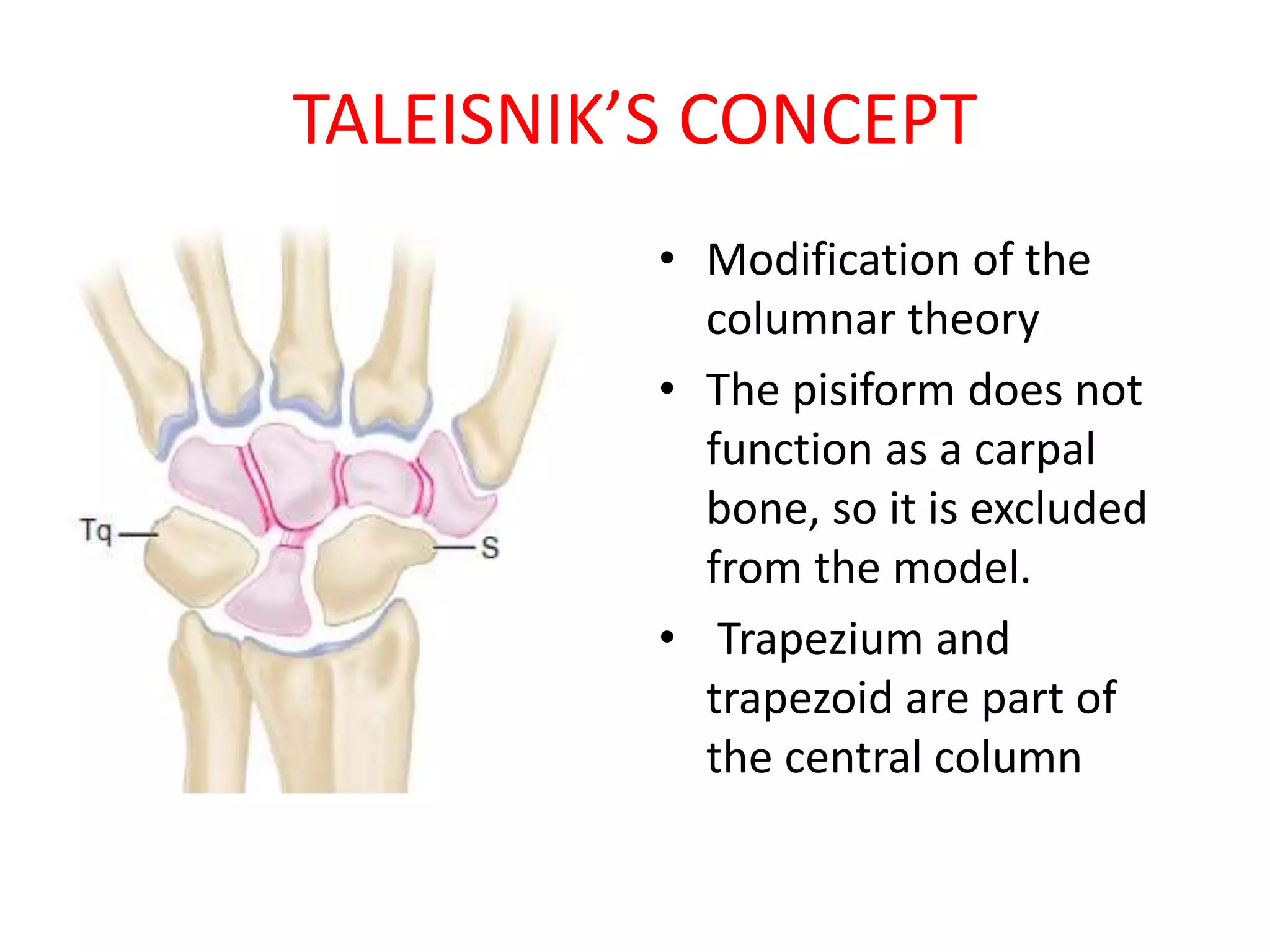
TALEISNIK’S CONCEPT
• Modification of the
columnar theory
• The pisiform does not
function as a carpal
bone, so it is excluded
from the model.
• Trapezium and
trapezoid are part of
the central column
WEBER’S TWO COLUMN CONCEPT
• Weber (1980): Two columns are the load-
bearing column (capitate, trapezoid, scaphoid,
and lunate) and
• the control column (triquetrum and hamate).
LICHTMAN’S RING CONCEPT
• proximal and distal rows are semirigid posts
stabilized by interosseous ligaments;
• Normal controlled mobility occurs at
scaphotrapezial and triquetrohamate joints.
• Any break in ring, either bony or ligamentous
(arrows), can produce dorsal intercalated
segmental instability or volar intercalated
segmental instability deformity.
Craigen and Stanley (1995)
• There are two patterns of motion during
radioulnar deviation:
• the proximal row rotates mostly along the
frontal plane (row pattern) or mostly along
the sagittal plane (column pattern).
Stabilizing Mechanism of the Distal
Row
• Tendons included in the carpal tunnel have divergent
directions when they emerge in the palm.
• If their corresponding muscles contract, the flexor
tendons of the little finger generate a compressive
force to the hook of the hamate toward the ulnar side.
• This force would be opposite in direction to the force
that is generated when the flexor pollicis longus
contracts against the inner surface of the trapezium.
• Such opposite forces would tend to open the palmar
carpal concavity (the trapezium toward the radial side,
the hamate toward the ulnar side).
Stabilizing Mechanism of the
Midcarpal Joint
• Under axial load, the distal carpal row exerts an axial
compressive force onto the proximal row.
• Because of its oblique orientation relative to the long
axis of the forearm, the loaded scaphoid tends to
rotate into flexion and pronation.
• If the scapholunate and lunate triquetrum interosseous
• ligaments are intact, the flexion moment generated by
the scaphoid is transmitted to the lunate and the
triquetrum.
• Consequently, the unconstrained proximal row would
rotate into flexion
• Especially important midcarpal stabilizers are the
STT and scaphoid capitate ligaments laterally
andtriquetrum-hamate-capitate ligament (the so-
called ulnar leg of the arcuate ligament) medially.
• Failure of these ligaments results in a typical
carpal collapse characterized by abnormal flexion
of the unconstrained proximal row, a fairly typical
pattern of carpal malalignment, known as volar
intercalated segment instability (VISI)
Stabilizing Mechanism of the Proximal
Row
• When axially loaded, the three proximal bones are not
equally constrained by the palmar-crossing midcarpal
ligaments.
• Because of the peculiar arrangement of the STT and
scaphoid capitate ligaments, the scaphoid is allowed larger
rotation into flexion and pronation than the lunate,
whereas the triquetrum is tightly constrained by its
attachments to the distal row.
• If palmar and dorsal scapholunate and lunate
• triquetrum ligaments are intact, such differences in angular
rotation are likely to generate increasing torque and
intercarpal coaptation of the scapholunate and lunate
triquetrum joints, contributing further to their stability
• . If the scapholunate ligaments are completely
torn, the scaphoid no longer is constrained by the
rest of the proximal row and tends to collapse
into an abnormally flexed and pronated posture
(the so-called rotatory subluxation of the
scaphoid)
• whereas the lunate and triquetrum are pushed by
the distal row into an abnormal extension, known
as a dorsal intercalated segment instability (DISI
• If, instead of the scapholunate, the lunate
triquetrum ligaments fail, the scaphoid
• and lunate tend to adopt an abnormal flexed
posture (VISI), whereas the triquetrum
remains solidly linked to the distal row
anatomy of wrist and carpal bones

anatomy of wrist and carpal bones

  • 1.
    Anatomy of wrist& carpal bones
  • 2.
    Osseous anatomy • Thedistal ends of the radius and ulna articulate with the two carpal rows (proximal and distal), and these articulate with the bases of the five metacarpal bones .
  • 4.
    • The proximalrow of carpal bones termed as intercalated segment because forces acting on its proximal & distal articulations determine its position
  • 5.
    CARPAL BONES Carpal bonesare arranged in two rows From lateral to medial and when viewed from anteriorly • PROXIMAL ROW 1. the boat-shaped scaphoid; 2. the lunate, which has a 'crescent shape'; 3. the three-sided triquetrum bone; 4. the pea-shaped pisiform • DISTAL ROW 1. the irregular four-sided trapezium bone; 2. the four-sided trapezoid; 3. the capitate, which has a head; 4. the hamate, which has a hook
  • 6.
    General Features ofCarpal Bones • 1. The proximal row is convex proximally, and concave distally. 2. The distal row is convex proximally and flat distally. 3. Each bone has 6 surfaces: (i) The palmar and dorsal surfaces are non-articular except for the triquetral and pisiform. (ii) The lateral surfaces of the two lateral bones (scaphoid and trapezium) are nonarticular. (iii) The medial surfaces of the three medial bones (triquetral, pisiform and hamate) are nonarticular. • 4. The dorsal nonarticular surface is always larger than the palmar nonarticular surface, except for the lunate, in which the palmar surface is larger than the dorsal
  • 7.
    Articular Compartmental Anatomy •The wrist joint is separated into a number of compartments by the many ligaments that attach to the carpal bones • These compartments are of considerable significance for the interpretation of standard or MR arthrograms and for identifying various patterns of arthritic involvement
  • 8.
    • The compartmentsare as follows: • 1. Radiocarpal compartment • 2. Midcarpal compartment • 3. Pisiform-triquetral compartment • 4. Common carpometacarpal compartment • 5. First carpometacarpal compartment • 6. Intermetacarpal compartments • 7. Inferior (distal) radioulnar compartment
  • 10.
    Ligamentous anatomy • Twocategories - Intrinsic - Extrinsic
  • 12.
    • Intrinsic ligaments -Scapho-lunate interosseous ligament - Luno-triquetral interosseous ligament
  • 13.
    • Scapholunate interosseousligament ( SLIL ) : • C shaped structure • 3 parts - dorsal - proximal - volar
  • 14.
    • Dorsal part– 3mm thick, transverse or short oblique fibers • located in the depth of the dorsal capsule and connects the dorsal-distal corners of the scaphoid and lunate bones. • Plays a key role in scapholunate stability.
  • 15.
    • Volar part-has longer, more obliquely oriented fibers • allowing substantial sagittal rotation of the scaphoid relative to the lunate • playing a lesser role in carpal stability • Proximal part – thin, fibrocartilagenous • Follows the arc of the proximal edges of the two bones from dorsal to palmar • separating the radiocarpal and midcarpal jointspaces
  • 17.
    • Lunate TriquetrumInterosseous Ligaments : • Three components- palmar, dorsal & proximal • In contrast to the scapholunate ligaments, the palmar lunate triquetrum ligament is thicker and stronger than the dorsal one
  • 19.
    Extrinsic ligaments • Subdividedinto three major subgroups - palmar radiocarpal - palmar ulnocarpal - dorsal radiocarpal
  • 20.
    • Palmar radio-carpalligaments : • Four palmar ligaments connect the radius to the carpus: -radio-scapholunate -radio-scaphoid-capitate - long radio-lunate -short radio-lunate ligaments
  • 22.
    • The firstthree ligaments originate from the lateral third of the palmar margin of the distal radius and take an oblique course to insert into the scaphoid tuberosity & lunate(radioscapholunate), the palmar aspect of the capitate (radioscaphoid-capitate), and the lunate (long radiolunate). • The short radiolunate ligament originates from the medial anterior rim of the radius and has a vertical direction until it inserts into the palmar aspect of the lunate
  • 23.
    • The radioscaphoid-capitateligament courses around the palmar concavity ofthe scaphoid, forming a hinge over which the scaphoid rotates. • Between the two diverging radioscaphoid- capitate and long radiolunate ligaments, there is the so-called interligamentous sulcus (space of Poirier), which represents a weak zone through which perilunate dislocations frequently occur
  • 24.
    Palmar Ulnocarpal Ligaments •Superficial extrinsic ulnar-capitate • Ulnar-triquetrum • Ulnar-lunate • Volar radioulnar
  • 26.
    Dorsal Radiocarpal Ligaments •The only dorsal extrinsic radiocarpal ligament is the dorsal radial triquetrum ligament, also known as the dorsal radiocarpal ligament • this is a wide, fan-shaped ligament that connects the dorsal edge of the distal articular surface of the radius to the dorsal rim of the triquetrum, with some deep fibers inserting onto the lunate, and rarely onto the scaphoid.
  • 28.
    Midcarpal Ligaments • Dorsal– dorsal intercarpal ligament • Palmar – • lateral group - scapho-trapezium-trapezoid - scapho-capitate - capitate-trapezium • Medial group - triquetro-capitate - triquetro-hamate - palmar scaphotriquetrum Lateral group are important in maintaining of normal scaphoid alignment
  • 30.
    • Dorsal intercarpalligament- • arises from the dorsal ridge of the triquetrum • courses transversely along the distal edge of the lunate • fans out to insert on the dorsal rim of the scaphoid the trapezium, and the trapezoid bones • contributes to increase the depth of the midcarpal socket • having a stabilizing role to the lunocapitate joint
  • 31.
    Vascularity of theWrist • The blood supply to the wrist is provided by an extrinsic and an intrinsic vascular system • The extrinsic blood supply is developed through branches of the radial, ulnar, and anterior interosseous arteries, which form an arcade of anastomosing branches that produce three dorsal and three palmar arches
  • 32.
    • The dorsaland palmar radiocarpal arches • The dorsal and palmar intercarpal arches • The dorsal basal metacarpal and the deep palmar arches
  • 34.
    • Panagis etal. and Gelberman and Gross classified the carpal bones into three groups on the basis of • the number and location of nutrient vessels, • the presence or absence of intraosseous anastomoses • and the dependence of large areas of bone on a single vessel. • The clinical significance of the various groups is based on the risk of posttraumatic avascular necrosis for the bones in each group
  • 35.
    • Group I- Includes carpal bones which either have vessels entering from only one surface or • large areas of bone that are dependent on a single vessel. • This group is the most vulnerable to posttraumatic avascular necrosis. • Scaphoid, Capitate, and 8 % or 20 % of the lunates
  • 36.
    • Group II- two or more areas of vessel entry but lack significant anastomoses within the entire or a major part of the bones. • Hamate, Trapezoid
  • 37.
    • Group III- two or more areas of vessel entry and consistent intraosseous anastomoses. • Trapezium, triquetrum , pisiform, and 80 % or 92 % of the lunates
  • 38.
    Innervation of wristligaments • The main innervation to the wrist capsule derives from • the anterior interosseous nerve, • lateral antebrachial cutaneous nerve, and • Posterior interosseous nerve. • Other minor sources of capsular innervation include: • The palmar cutaneous branch of the median nerve, • The deep branch of the ulnar nerve, • The superficial branch of the radial nerve, and • The dorsal branch of the ulnar nerve
  • 39.
    BIOMECHANICS • The proximalcarpal row has no direct tendon attachments. The moment generated by muscle contraction results in rotation that is initiated at the distal carpal row. • The bones of the proximal row follow passively, when tension within the midcarpal capsule reaches a certain level
  • 40.
    • In kinematicterms, the distal carpal row can be thought of as one rigid functional unit. • The bones of the proximal carpal row seem to be less tightly bound to one another than the bones of the distal carpal row
  • 41.
    • When thewrist is constrained along the sagittal plane, the scaphoid has a larger amount of rotation (average 90% of the total arc of motion) than the lunate (50%) and the triquetrum (65%). • The average scapholunate angle is 76 degrees in full wrist flexion and 35 degrees in full extension. • During radioulnar deviation of the wrist, the three proximal carpal bones move synergistically from a flexed position in radial deviation to an extended position in ulnar deviation
  • 42.
    • During unconstrainedflexion of the wrist, the distal row synchronously rotates into flexion, but also into some degree of ulnar deviation. • In contrast, during wrist extension, the tendency of all distal carpal bones is to rotate into extension and a slight radial deviation.
  • 45.
    • It iswidely accepted that the ligamentous restraints stabilizing the scaphoid are classified into primary and secondary
  • 46.
    • Primary stabilizers– scapho-lunate interosseous ligament • Secondary stabilizers- STT, RSC, SC, and the unique V-arrangement of the DIC and DRC ligaments
  • 47.
    • Primary rupturesecondary intact -Such cases manifest with SL dissociation without rotary subluxation of the scaphoid (RSS) (widening of the SL space, rupture of the dorsal SL ligament, and normal SL angle) • Primary intact secondary rupture - Such cases manifest with RSS without SL dissociation (foreshortened scaphoid on posteroanterior radiographs with a positive ring sign, increased SL angle, and the dorsal SL ligament macroscopically intact)
  • 48.
    • Biomechanic conceptsthat have been proposed for better understanding of functioning,movements and various types of forces acting.some of them are: 1. LINK CONCEPT 2. NAVARRO THREE COLUMN CONCEPT 3. ROWS CONCEPT 4. TALEISNIK’S CONCEPT 5. LICHTMAN’S RING CONCEPT 6. WEBER’S TWO COLUMN CONCEPT
  • 49.
    LINK CONCEPT • threelinks in a chain composed of radius, lunate and capitate – head of capitate acts as center of rotation – proximal row (lunate) acts as a unit and is an intercalated segment with no direct tendon attachments – distal row functions as unit
  • 50.
    3 COLUMN CONCEPT(Navarro 1935) • lateral (mobile) column – comprises scaphoid, trapezoid and trapezium – scaphoid is center of motion and function is mobile • central (flexion-extension) column – comprises lunate, capitate and hamate – luno-capitate articulation is center of motion – motion is flexion/extension • medial (rotation) column – comprises triquetrum and pisiform – motion is rotation
  • 51.
    ROWS CONCEPT (Johnston1907) • comprises proximal and distal rows – scaphoid is a bridge between rows • motion occurs within and between rows
  • 52.
    TALEISNIK’S CONCEPT • Modificationof the columnar theory • The pisiform does not function as a carpal bone, so it is excluded from the model. • Trapezium and trapezoid are part of the central column
  • 53.
    WEBER’S TWO COLUMNCONCEPT • Weber (1980): Two columns are the load- bearing column (capitate, trapezoid, scaphoid, and lunate) and • the control column (triquetrum and hamate).
  • 54.
    LICHTMAN’S RING CONCEPT •proximal and distal rows are semirigid posts stabilized by interosseous ligaments; • Normal controlled mobility occurs at scaphotrapezial and triquetrohamate joints. • Any break in ring, either bony or ligamentous (arrows), can produce dorsal intercalated segmental instability or volar intercalated segmental instability deformity.
  • 56.
    Craigen and Stanley(1995) • There are two patterns of motion during radioulnar deviation: • the proximal row rotates mostly along the frontal plane (row pattern) or mostly along the sagittal plane (column pattern).
  • 57.
    Stabilizing Mechanism ofthe Distal Row • Tendons included in the carpal tunnel have divergent directions when they emerge in the palm. • If their corresponding muscles contract, the flexor tendons of the little finger generate a compressive force to the hook of the hamate toward the ulnar side. • This force would be opposite in direction to the force that is generated when the flexor pollicis longus contracts against the inner surface of the trapezium. • Such opposite forces would tend to open the palmar carpal concavity (the trapezium toward the radial side, the hamate toward the ulnar side).
  • 58.
    Stabilizing Mechanism ofthe Midcarpal Joint • Under axial load, the distal carpal row exerts an axial compressive force onto the proximal row. • Because of its oblique orientation relative to the long axis of the forearm, the loaded scaphoid tends to rotate into flexion and pronation. • If the scapholunate and lunate triquetrum interosseous • ligaments are intact, the flexion moment generated by the scaphoid is transmitted to the lunate and the triquetrum. • Consequently, the unconstrained proximal row would rotate into flexion
  • 59.
    • Especially importantmidcarpal stabilizers are the STT and scaphoid capitate ligaments laterally andtriquetrum-hamate-capitate ligament (the so- called ulnar leg of the arcuate ligament) medially. • Failure of these ligaments results in a typical carpal collapse characterized by abnormal flexion of the unconstrained proximal row, a fairly typical pattern of carpal malalignment, known as volar intercalated segment instability (VISI)
  • 60.
    Stabilizing Mechanism ofthe Proximal Row • When axially loaded, the three proximal bones are not equally constrained by the palmar-crossing midcarpal ligaments. • Because of the peculiar arrangement of the STT and scaphoid capitate ligaments, the scaphoid is allowed larger rotation into flexion and pronation than the lunate, whereas the triquetrum is tightly constrained by its attachments to the distal row. • If palmar and dorsal scapholunate and lunate • triquetrum ligaments are intact, such differences in angular rotation are likely to generate increasing torque and intercarpal coaptation of the scapholunate and lunate triquetrum joints, contributing further to their stability
  • 61.
    • . Ifthe scapholunate ligaments are completely torn, the scaphoid no longer is constrained by the rest of the proximal row and tends to collapse into an abnormally flexed and pronated posture (the so-called rotatory subluxation of the scaphoid) • whereas the lunate and triquetrum are pushed by the distal row into an abnormal extension, known as a dorsal intercalated segment instability (DISI
  • 62.
    • If, insteadof the scapholunate, the lunate triquetrum ligaments fail, the scaphoid • and lunate tend to adopt an abnormal flexed posture (VISI), whereas the triquetrum remains solidly linked to the distal row