Function of the WRIST
COMPLEX
• Movements are caused by combination of active muscular
and passive ligamentous and joint reaction forces
• Although there are abundant passive forces on the
proximal carpal row, no muscular forces are applied
directly to the articular bones of the proximal row, given
that the flexor carpi ulnaris muscle applies its force via the
pisiform to the more distal bones.
• The proximal carpals, therefore, are effectively a mechanical link
that lies between the radius and the distal carpals and
metacarpals, to which the muscular forces are actually applied.
• The proximal carpal row functions as an intercalated segment
between the distal radius/triangular fibrocartilage complex and
the relatively less mobile distal carpal row.
• When compressive forces are applied across an intercalated
segment, the middle segment tends to collapse and move in the
opposite direction from the segments above and below.
• An intercalated segment requires some type of stabilizing mechanism to
normalize combined midcarpal/radiocarpal motion and prevent collapse of
the middle segment (the proximal carpal row).
• The stabilization mechanism appears to involve the scaphoid's functional and
anatomical (ligamentous) connections to the adjacent lunate and to the distal
carpal row.
• Garcia-Elias supported the hypothesis that the stability of the proximal carpal
row depends on the interaction of two opposite tendencies when the carpals
are axially loaded (compressed across a neutral wrist); the scaphoid tends to
flex, whereas the lunate and triquetrum tend to extend. These opposite
rotations within the proximal row are prevented by the ligamentous structure,
including the key scapholunate interosseous and lunotriquetral interosseous
ligaments.
• Much of the literature proposes that the head of the capitate,
frequently referred to as the keystone of the wrist.
• May serve as the location of the coronal axis for wrist
extension/flexion and the anteroposterior (A-P) axis for radial/ulnar
deviation, as well as providing the rigid center of the fixed carpal
arch.
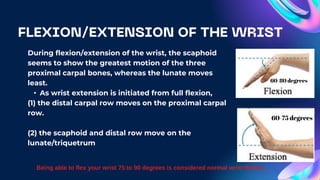
During flexion/extension of the wrist, the scaphoid
seems to show the greatest motion of the three
proximal carpal bones, whereas the lunate moves
least.
• As wrist extension is initiated from full flexion,
(1) the distal carpal row moves on the proximal carpal
row.
(2) the scaphoid and distal row move on the
lunate/triquetrum
Being able to flex your wrist 75 to 90 degrees is considered normal wrist flexion.
60-75 degrees
60-80 degrees
• Wrist motion from full extension to full flexion
occurs in the reverse sequence.
• In the context of this conceptual framework, the
scaphoid participates at different times in
scaphoid-capitate, scaphoid-lunate, or
radioscaphoid motion.
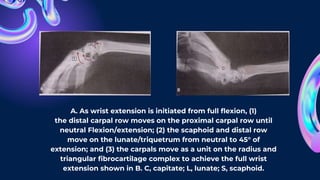
A. As wrist extension is initiated from full flexion, (1)
the distal carpal row moves on the proximal carpal row until
neutral Flexion/extension; (2) the scaphoid and distal row
move on the lunate/triquetrum from neutral to 45° of
extension; and (3) the carpals move as a unit on the radius and
triangular fibrocartilage complex to achieve the full wrist
extension shown in B. C, capitate; L, lunate; S, scaphoid.
• More Complex.
• The proximal carpal row displays a unique
reciprocal motion with radial and ulnar deviation.
• In radial deviation, the carpals slide medially on
the radius, The carpal motion not only produces
deviation of the proximal and distal carpals
radially, but simultaneous flexion of the proximal
carpals and extension of the distal carpals.
• The Opposite motion occurs at Ulnar deviation.
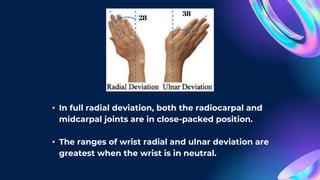
• In full radial deviation, both the radiocarpal and
midcarpal joints are in close-packed position.
• The ranges of wrist radial and ulnar deviation are
greatest when the wrist is in neutral.
28
38
With radial deviation of the
wrist (ulnar slide of the proximal
carpal row), the flexion of the
scaphoid makes the scaphoid
appear shorter than B., when the
scaphoid extends during ulnar
deviation (and radial slide of the
proximal carpal row). C, capitate;
L, lunate; S, scaphoid.
• Injury to one or more of the ligaments attached to the
scaphoid and lunate may diminish or remove the synergistic
stabilization of the lunate and scaphoid.
• When this occurs, the scaphoid behaves as an
unconstrained segment, following its natural tendency to
collapse into flexion on the volarly inclined surface of the
distal radius potentially including some out-of-plane motion
as well).
• The base of the flexed scaphoid slides dorsally on the radius
and may sublux.
• The muscles applying forces to the distal carpals, (none act on
the proximal carpals) cause the distal carpals to flex on the
extended lunate and triquetrum.
• The flexed distal carpals glide dorsally on the lunate and
triquetrum, accentuating the extension of the lunate and
triquetrum.
• This zigzag pattern of the three segments (the scaphoid, the
lunate/triquetrum, and the distal carpal row) is known as
intercalated segmental instability
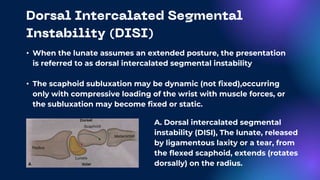
• When the lunate assumes an extended posture, the presentation
is referred to as dorsal intercalated segmental instability
• The scaphoid subluxation may be dynamic (not fixed),occurring
only with compressive loading of the wrist with muscle forces, or
the subluxation may become fixed or static.
A. Dorsal intercalated segmental
instability (DISI), The lunate, released
by ligamentous laxity or a tear, from
the flexed scaphoid, extends (rotates
dorsally) on the radius.
• A dorsal intercalated segmental instability problem, therefore, may result over
time in degenerative changes at the radioscaphoid joint and then, ultimately,
at the other intercarpal joints.
• With sufficient ligamentous laxity, the capitate may sublux dorsally off the
extended lunate or, more commonly, migrate into the gap between the flexed
scaphoid and extended lunate.
• The progressive degenerative problem from an untreated dorsal intercalated
segmental instability Is known as scapholunate advanced collapse (SLAC)
wrist.
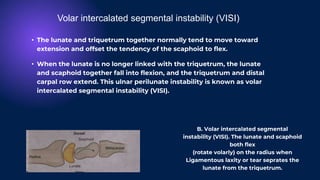
B. Volar intercalated segmental
instability (VISI). The lunate and scaphoid
both flex
(rotate volarly) on the radius when
Ligamentous laxity or tear seprates the
lunate from the triquetrum.
• The lunate and triquetrum together normally tend to move toward
extension and offset the tendency of the scaphoid to flex.
• When the lunate is no longer linked with the triquetrum, the lunate
and scaphoid together fall into flexion, and the triquetrum and distal
carpal row extend. This ulnar perilunate instability is known as volar
intercalated segmental instability (VISI).
Volar intercalated segmental instability (VISI)

Function of wrist complex.pptx

  • 1.
    Function of theWRIST COMPLEX
  • 2.
    • Movements arecaused by combination of active muscular and passive ligamentous and joint reaction forces • Although there are abundant passive forces on the proximal carpal row, no muscular forces are applied directly to the articular bones of the proximal row, given that the flexor carpi ulnaris muscle applies its force via the pisiform to the more distal bones.
  • 3.
    • The proximalcarpals, therefore, are effectively a mechanical link that lies between the radius and the distal carpals and metacarpals, to which the muscular forces are actually applied. • The proximal carpal row functions as an intercalated segment between the distal radius/triangular fibrocartilage complex and the relatively less mobile distal carpal row. • When compressive forces are applied across an intercalated segment, the middle segment tends to collapse and move in the opposite direction from the segments above and below.
  • 4.
    • An intercalatedsegment requires some type of stabilizing mechanism to normalize combined midcarpal/radiocarpal motion and prevent collapse of the middle segment (the proximal carpal row). • The stabilization mechanism appears to involve the scaphoid's functional and anatomical (ligamentous) connections to the adjacent lunate and to the distal carpal row. • Garcia-Elias supported the hypothesis that the stability of the proximal carpal row depends on the interaction of two opposite tendencies when the carpals are axially loaded (compressed across a neutral wrist); the scaphoid tends to flex, whereas the lunate and triquetrum tend to extend. These opposite rotations within the proximal row are prevented by the ligamentous structure, including the key scapholunate interosseous and lunotriquetral interosseous ligaments.
  • 5.
    • Much ofthe literature proposes that the head of the capitate, frequently referred to as the keystone of the wrist. • May serve as the location of the coronal axis for wrist extension/flexion and the anteroposterior (A-P) axis for radial/ulnar deviation, as well as providing the rigid center of the fixed carpal arch.
  • 6.
    During flexion/extension ofthe wrist, the scaphoid seems to show the greatest motion of the three proximal carpal bones, whereas the lunate moves least. • As wrist extension is initiated from full flexion, (1) the distal carpal row moves on the proximal carpal row. (2) the scaphoid and distal row move on the lunate/triquetrum Being able to flex your wrist 75 to 90 degrees is considered normal wrist flexion. 60-75 degrees 60-80 degrees
  • 7.
    • Wrist motionfrom full extension to full flexion occurs in the reverse sequence. • In the context of this conceptual framework, the scaphoid participates at different times in scaphoid-capitate, scaphoid-lunate, or radioscaphoid motion.
  • 8.
    A. As wristextension is initiated from full flexion, (1) the distal carpal row moves on the proximal carpal row until neutral Flexion/extension; (2) the scaphoid and distal row move on the lunate/triquetrum from neutral to 45° of extension; and (3) the carpals move as a unit on the radius and triangular fibrocartilage complex to achieve the full wrist extension shown in B. C, capitate; L, lunate; S, scaphoid.
  • 9.
    • More Complex. •The proximal carpal row displays a unique reciprocal motion with radial and ulnar deviation. • In radial deviation, the carpals slide medially on the radius, The carpal motion not only produces deviation of the proximal and distal carpals radially, but simultaneous flexion of the proximal carpals and extension of the distal carpals. • The Opposite motion occurs at Ulnar deviation.
  • 10.
    • In fullradial deviation, both the radiocarpal and midcarpal joints are in close-packed position. • The ranges of wrist radial and ulnar deviation are greatest when the wrist is in neutral. 28 38
  • 11.
    With radial deviationof the wrist (ulnar slide of the proximal carpal row), the flexion of the scaphoid makes the scaphoid appear shorter than B., when the scaphoid extends during ulnar deviation (and radial slide of the proximal carpal row). C, capitate; L, lunate; S, scaphoid.
  • 12.
    • Injury toone or more of the ligaments attached to the scaphoid and lunate may diminish or remove the synergistic stabilization of the lunate and scaphoid. • When this occurs, the scaphoid behaves as an unconstrained segment, following its natural tendency to collapse into flexion on the volarly inclined surface of the distal radius potentially including some out-of-plane motion as well). • The base of the flexed scaphoid slides dorsally on the radius and may sublux.
  • 13.
    • The musclesapplying forces to the distal carpals, (none act on the proximal carpals) cause the distal carpals to flex on the extended lunate and triquetrum. • The flexed distal carpals glide dorsally on the lunate and triquetrum, accentuating the extension of the lunate and triquetrum. • This zigzag pattern of the three segments (the scaphoid, the lunate/triquetrum, and the distal carpal row) is known as intercalated segmental instability
  • 14.
    • When thelunate assumes an extended posture, the presentation is referred to as dorsal intercalated segmental instability • The scaphoid subluxation may be dynamic (not fixed),occurring only with compressive loading of the wrist with muscle forces, or the subluxation may become fixed or static. A. Dorsal intercalated segmental instability (DISI), The lunate, released by ligamentous laxity or a tear, from the flexed scaphoid, extends (rotates dorsally) on the radius.
  • 15.
    • A dorsalintercalated segmental instability problem, therefore, may result over time in degenerative changes at the radioscaphoid joint and then, ultimately, at the other intercarpal joints. • With sufficient ligamentous laxity, the capitate may sublux dorsally off the extended lunate or, more commonly, migrate into the gap between the flexed scaphoid and extended lunate. • The progressive degenerative problem from an untreated dorsal intercalated segmental instability Is known as scapholunate advanced collapse (SLAC) wrist.
  • 16.
    B. Volar intercalatedsegmental instability (VISI). The lunate and scaphoid both flex (rotate volarly) on the radius when Ligamentous laxity or tear seprates the lunate from the triquetrum. • The lunate and triquetrum together normally tend to move toward extension and offset the tendency of the scaphoid to flex. • When the lunate is no longer linked with the triquetrum, the lunate and scaphoid together fall into flexion, and the triquetrum and distal carpal row extend. This ulnar perilunate instability is known as volar intercalated segmental instability (VISI). Volar intercalated segmental instability (VISI)