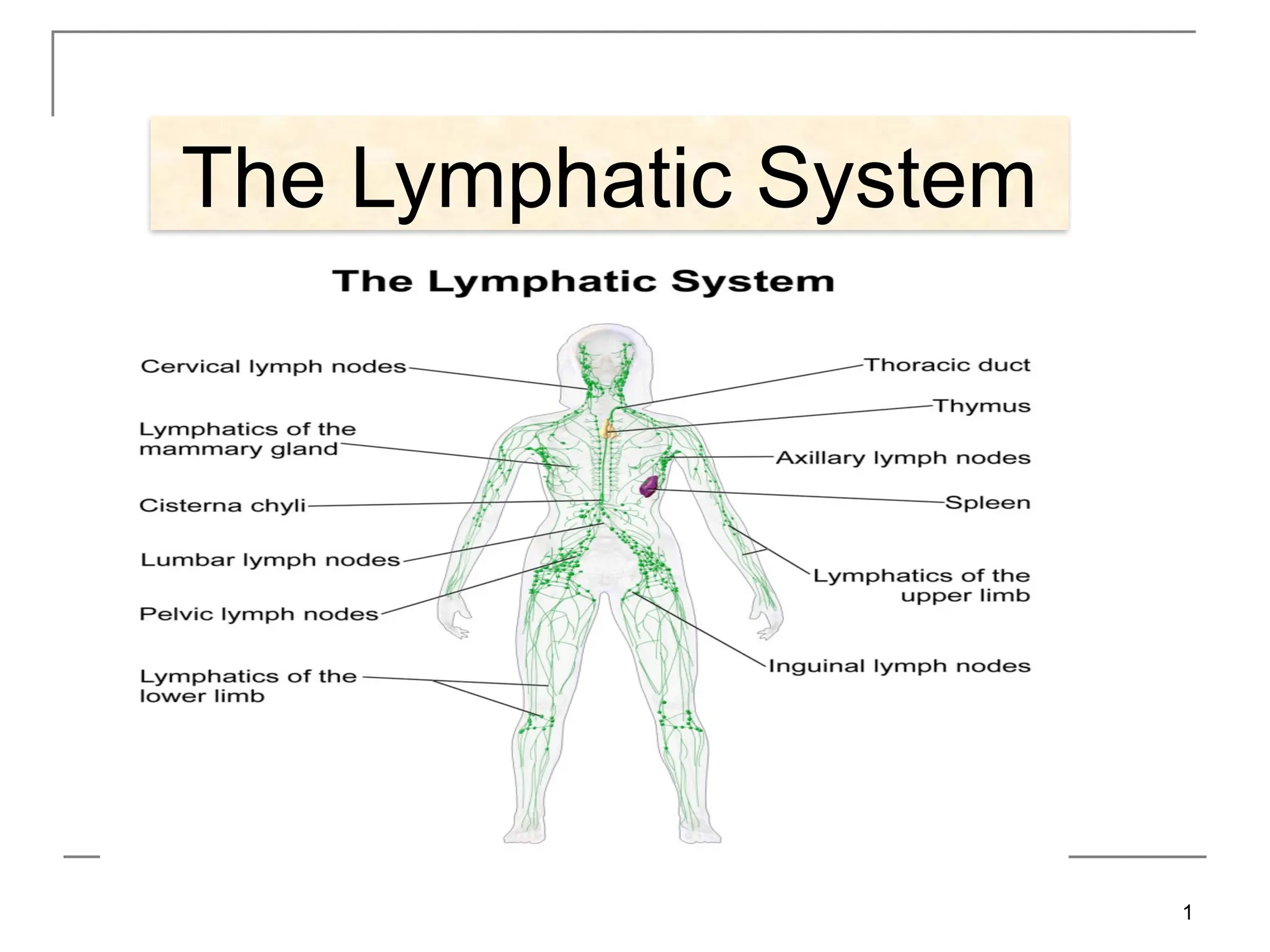
The Lymphatic System
1
 Consists of:
1. Lymph
2. Lymphatic vessels
3. Structures and organs containing
lymphatic tissue
4. Red bone marrow
Lymphatic System Structure and Function
2
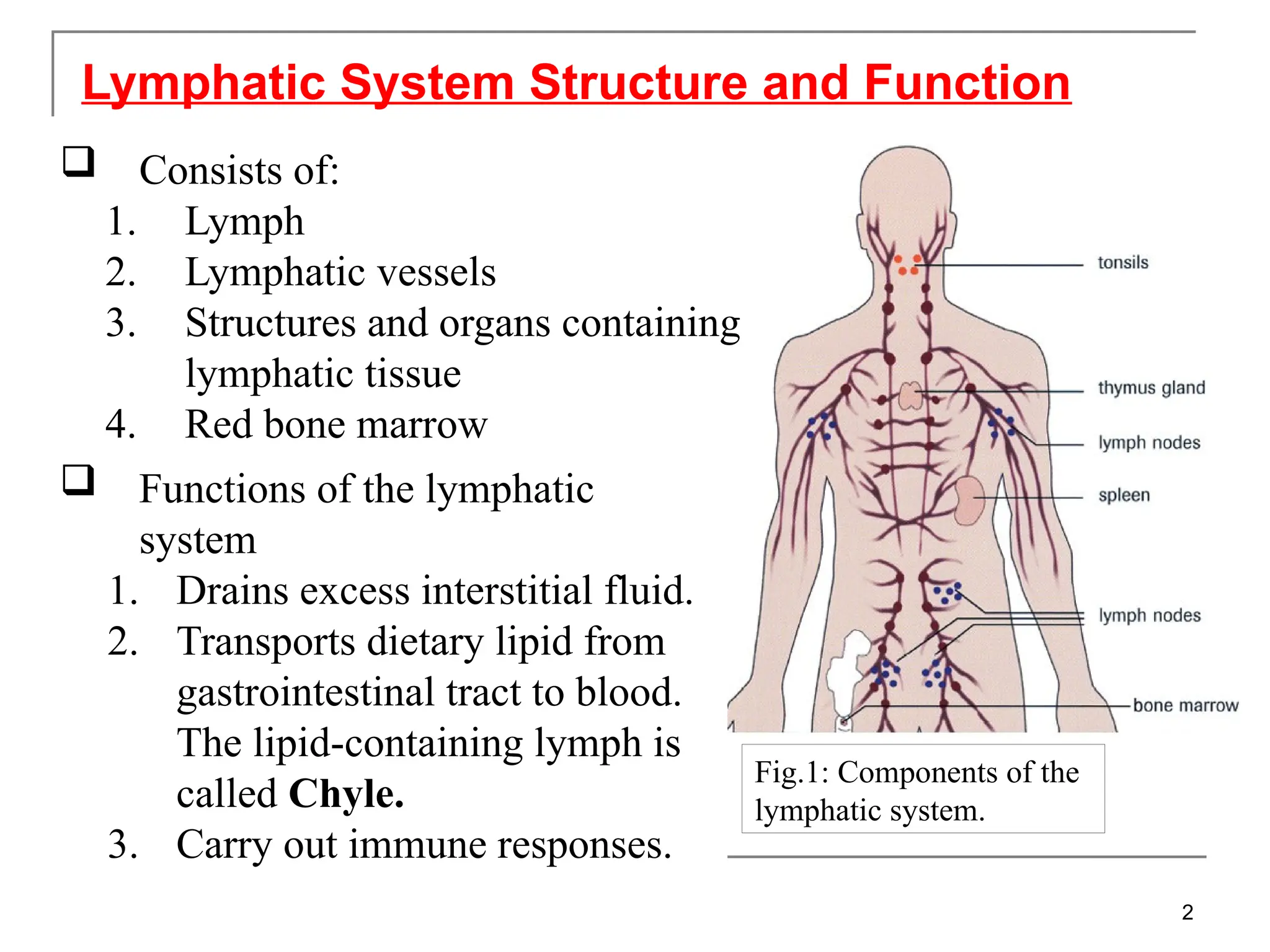
 Functions of the lymphatic
system
1. Drains excess interstitial fluid.
2. Transports dietary lipid from
gastrointestinal tract to blood.
The lipid-containing lymph is
called Chyle.
3. Carry out immune responses.
Fig.1: Components of the
lymphatic system.
Lymph
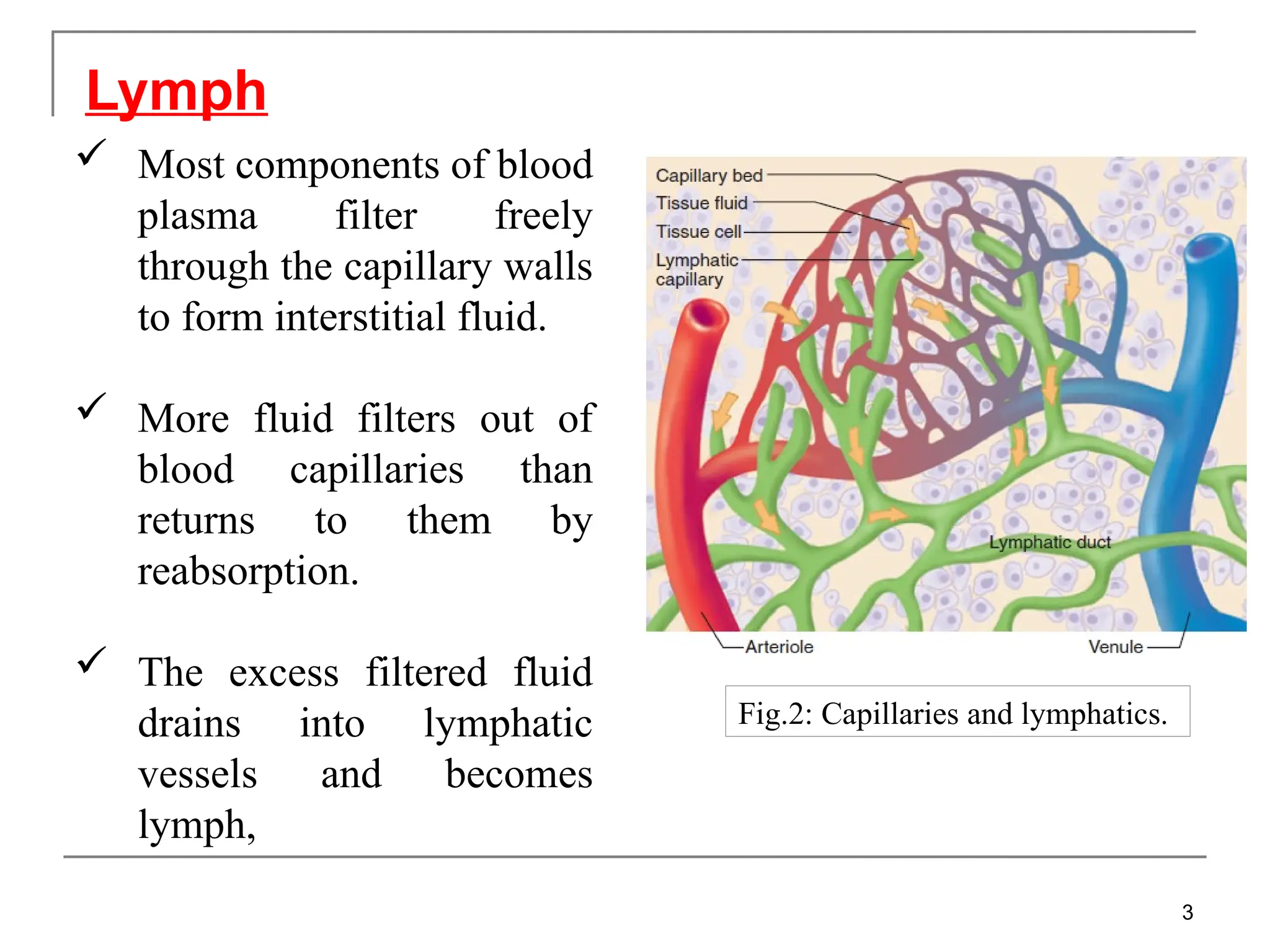
 Most components of blood
plasma filter freely
through the capillary walls
to form interstitial fluid.
 More fluid filters out of
blood capillaries than
returns to them by
reabsorption.
 The excess filtered fluid
drains into lymphatic
vessels and becomes
lymph,
3
Fig.2: Capillaries and lymphatics.
Lymphatic Vessels
4
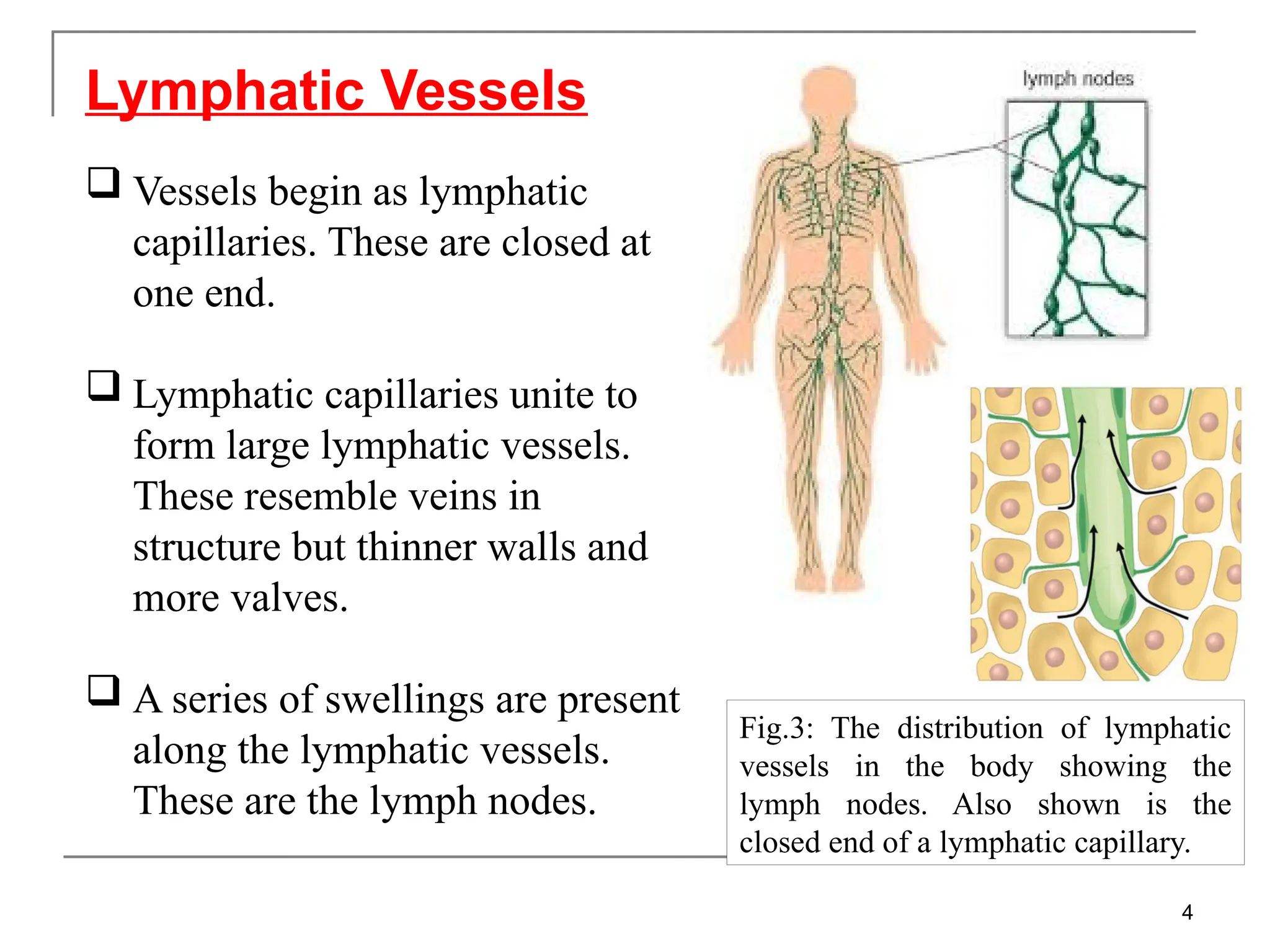
 Vessels begin as lymphatic
capillaries. These are closed at
one end.
 Lymphatic capillaries unite to
form large lymphatic vessels.
These resemble veins in
structure but thinner walls and
more valves.
 A series of swellings are present
along the lymphatic vessels.
These are the lymph nodes.
Fig.3: The distribution of lymphatic
vessels in the body showing the
lymph nodes. Also shown is the
closed end of a lymphatic capillary.
 Ultimately, the lymph drains into 2 main
channels:
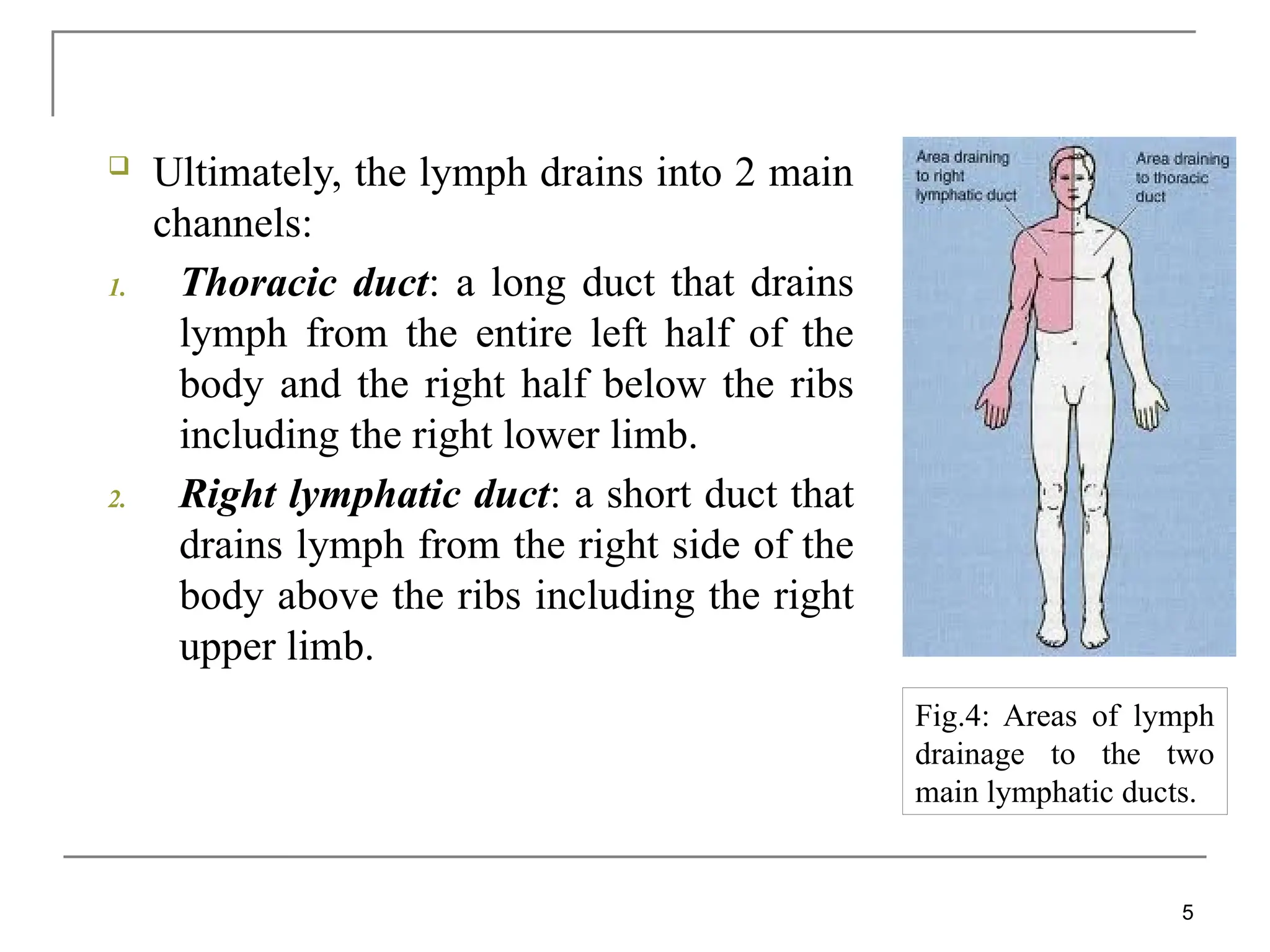
1. Thoracic duct: a long duct that drains
lymph from the entire left half of the
body and the right half below the ribs
including the right lower limb.
2. Right lymphatic duct: a short duct that
drains lymph from the right side of the
body above the ribs including the right
upper limb.
5
Fig.4: Areas of lymph
drainage to the two
main lymphatic ducts.
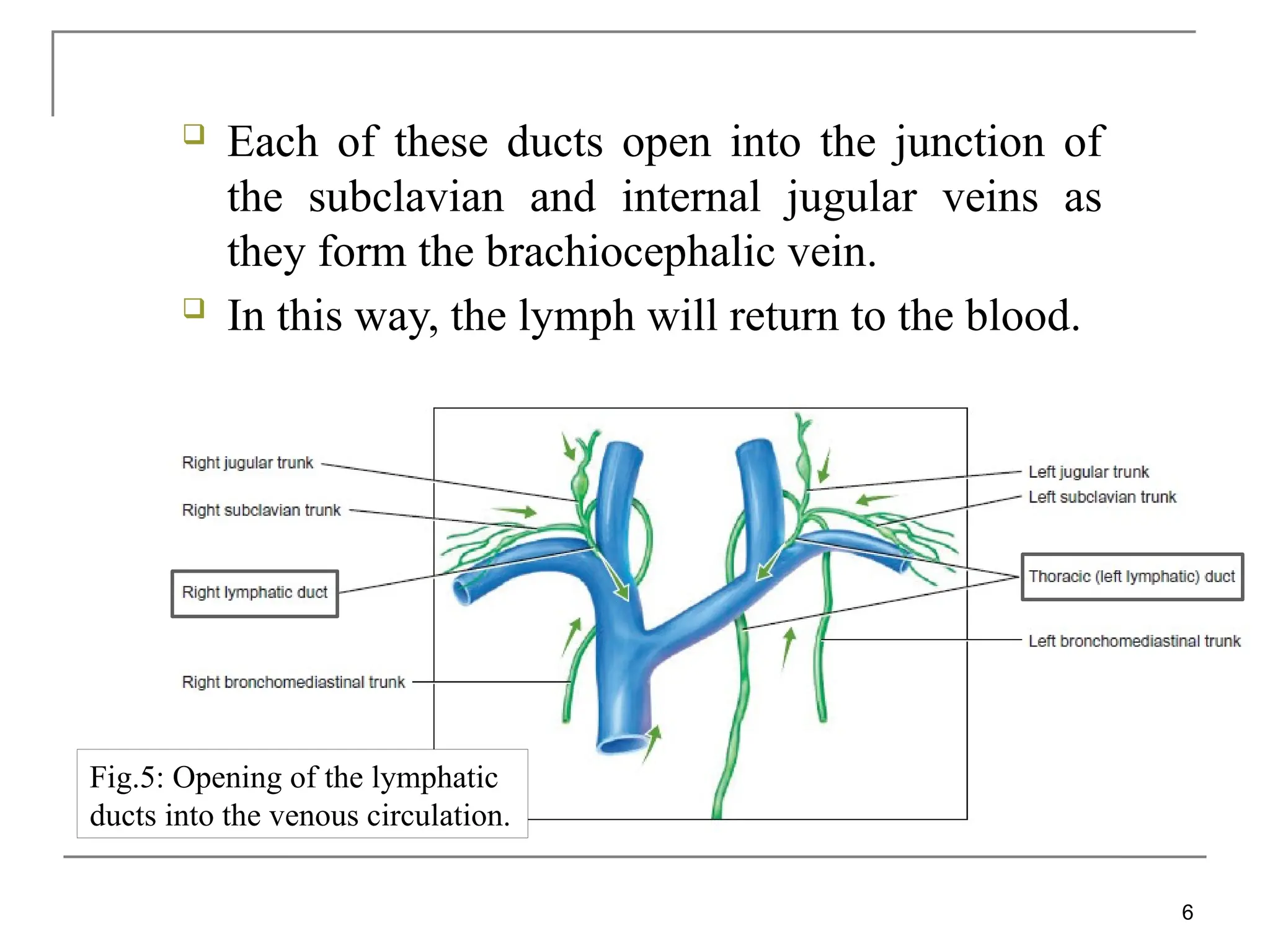
 Each of these ducts open into the junction of
the subclavian and internal jugular veins as
they form the brachiocephalic vein.
 In this way, the lymph will return to the blood.
6
Fig.5: Opening of the lymphatic
ducts into the venous circulation.
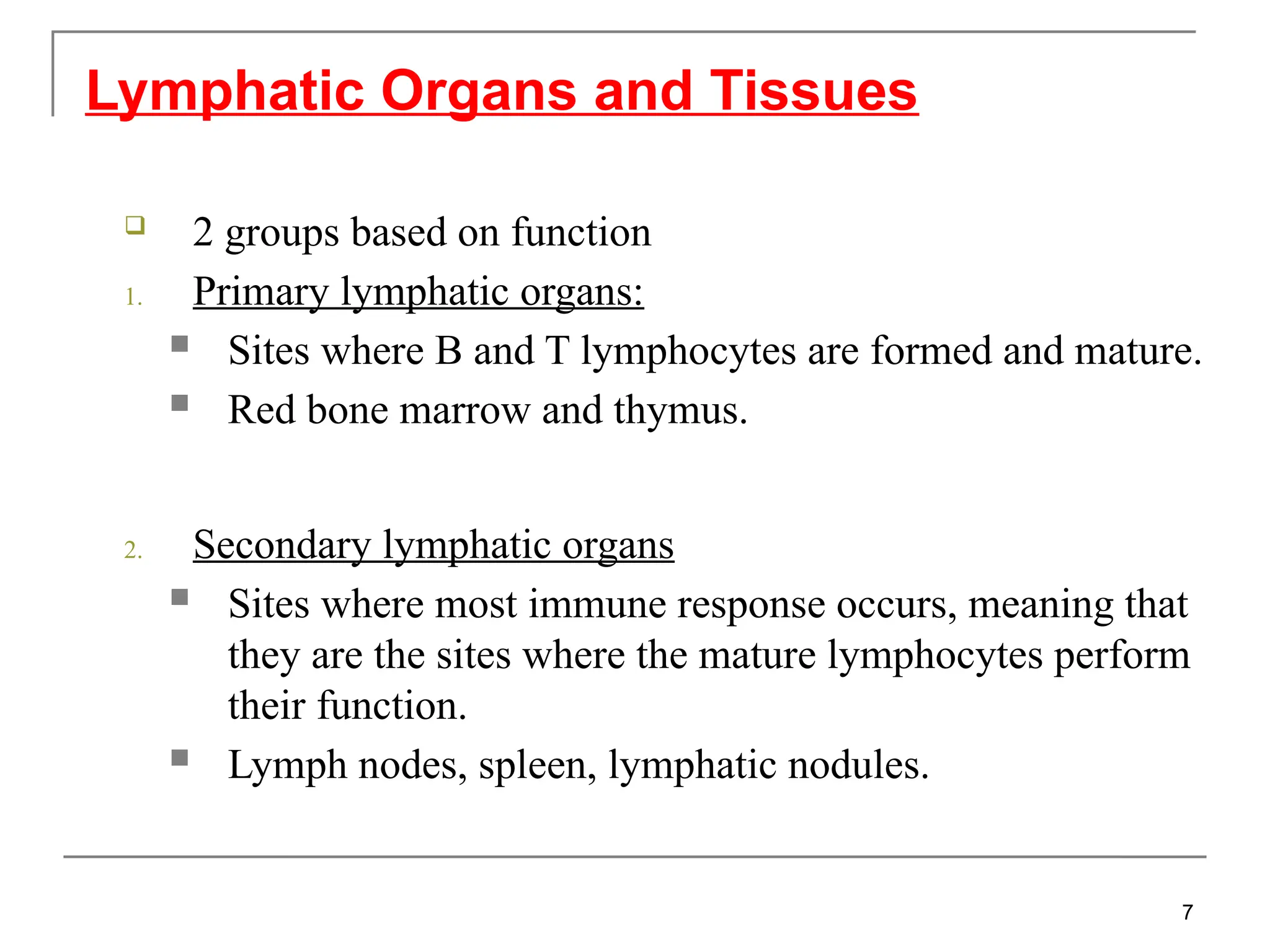
 2 groups based on function
1. Primary lymphatic organs:
 Sites where B and T lymphocytes are formed and mature.
 Red bone marrow and thymus.
2. Secondary lymphatic organs
 Sites where most immune response occurs, meaning that
they are the sites where the mature lymphocytes perform
their function.
 Lymph nodes, spleen, lymphatic nodules.
Lymphatic Organs and Tissues
7
The Thymus
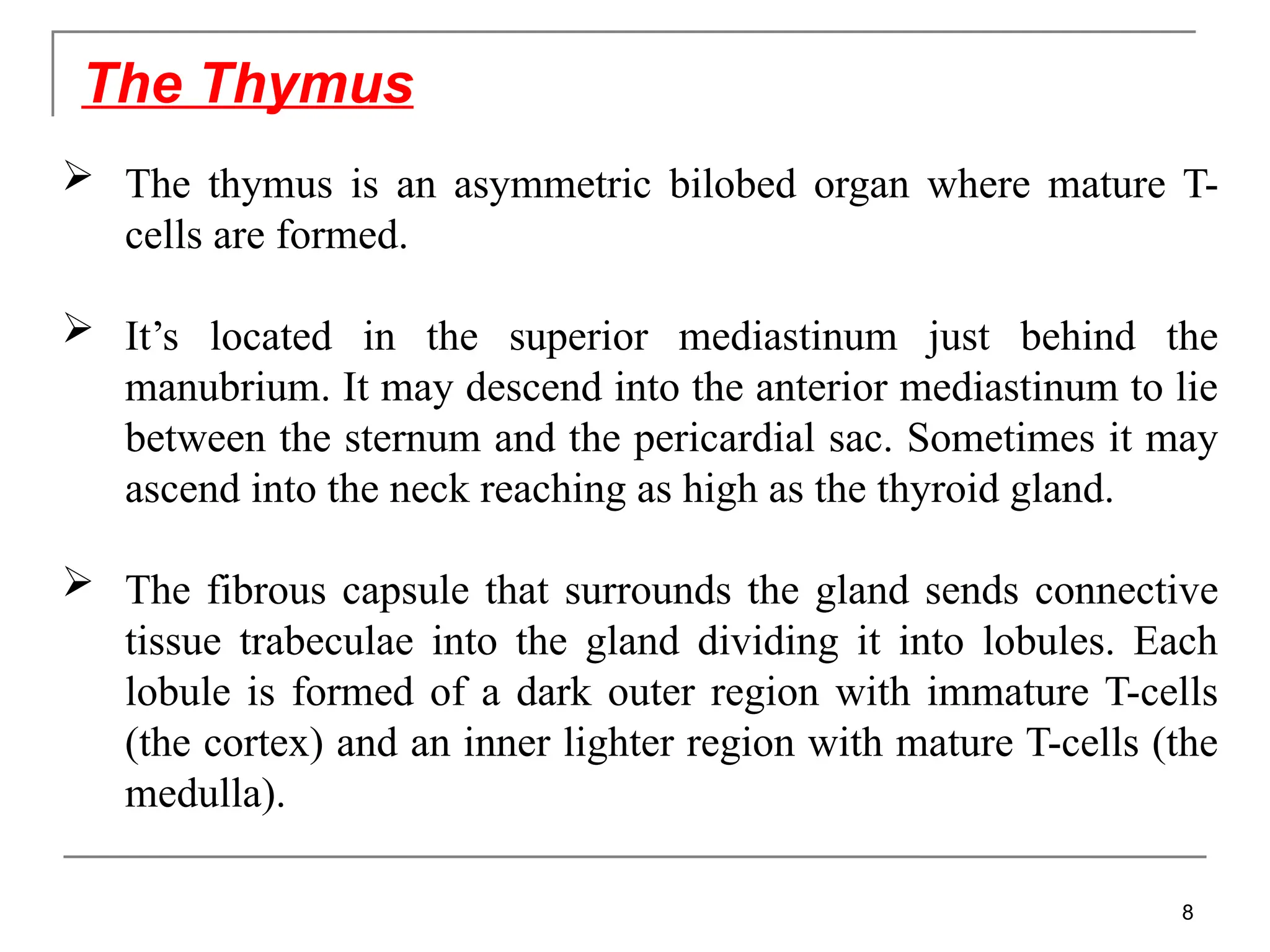
 The thymus is an asymmetric bilobed organ where mature T-
cells are formed.
 It’s located in the superior mediastinum just behind the
manubrium. It may descend into the anterior mediastinum to lie
between the sternum and the pericardial sac. Sometimes it may
ascend into the neck reaching as high as the thyroid gland.
 The fibrous capsule that surrounds the gland sends connective
tissue trabeculae into the gland dividing it into lobules. Each
lobule is formed of a dark outer region with immature T-cells
(the cortex) and an inner lighter region with mature T-cells (the
medulla).
8
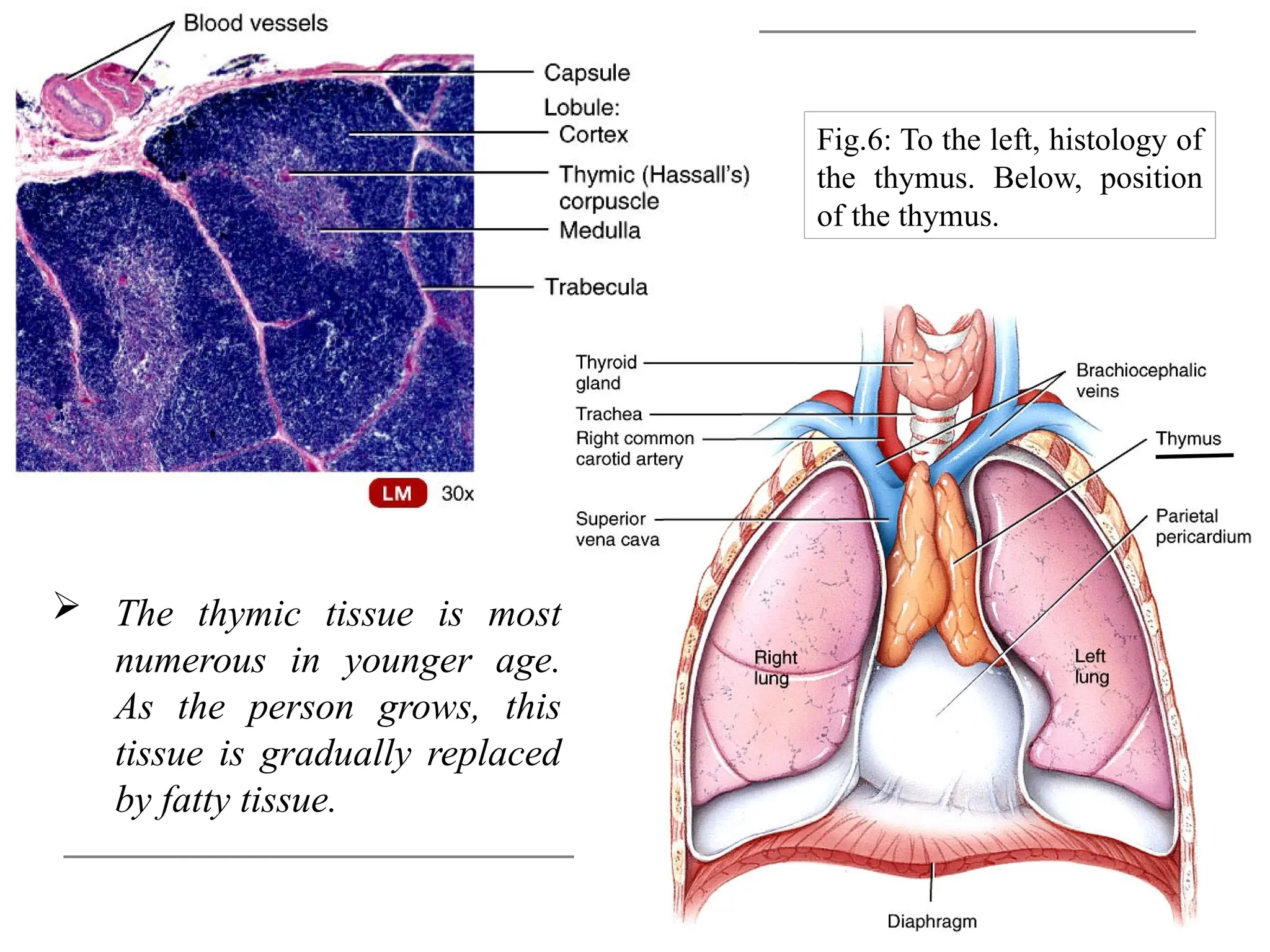
 The thymic tissue is most
numerous in younger age.
As the person grows, this
tissue is gradually replaced
by fatty tissue.
9
Fig.6: To the left, histology of
the thymus. Below, position
of the thymus.
Red Bone Marrow
 Red bone marrow is the site of formation of the blood
elements: red blood cells, white blood cells and platelets.
 Inside the red bone marrow B lymphocyte form and mature;
T lymphocytes are formed in the red bone marrow but
they’re immature. T-cells become mature in the thymus.
 Red bone marrow in adults is present in the flat bones and
the epiphyses of some long bones.
10
Lymph Nodes
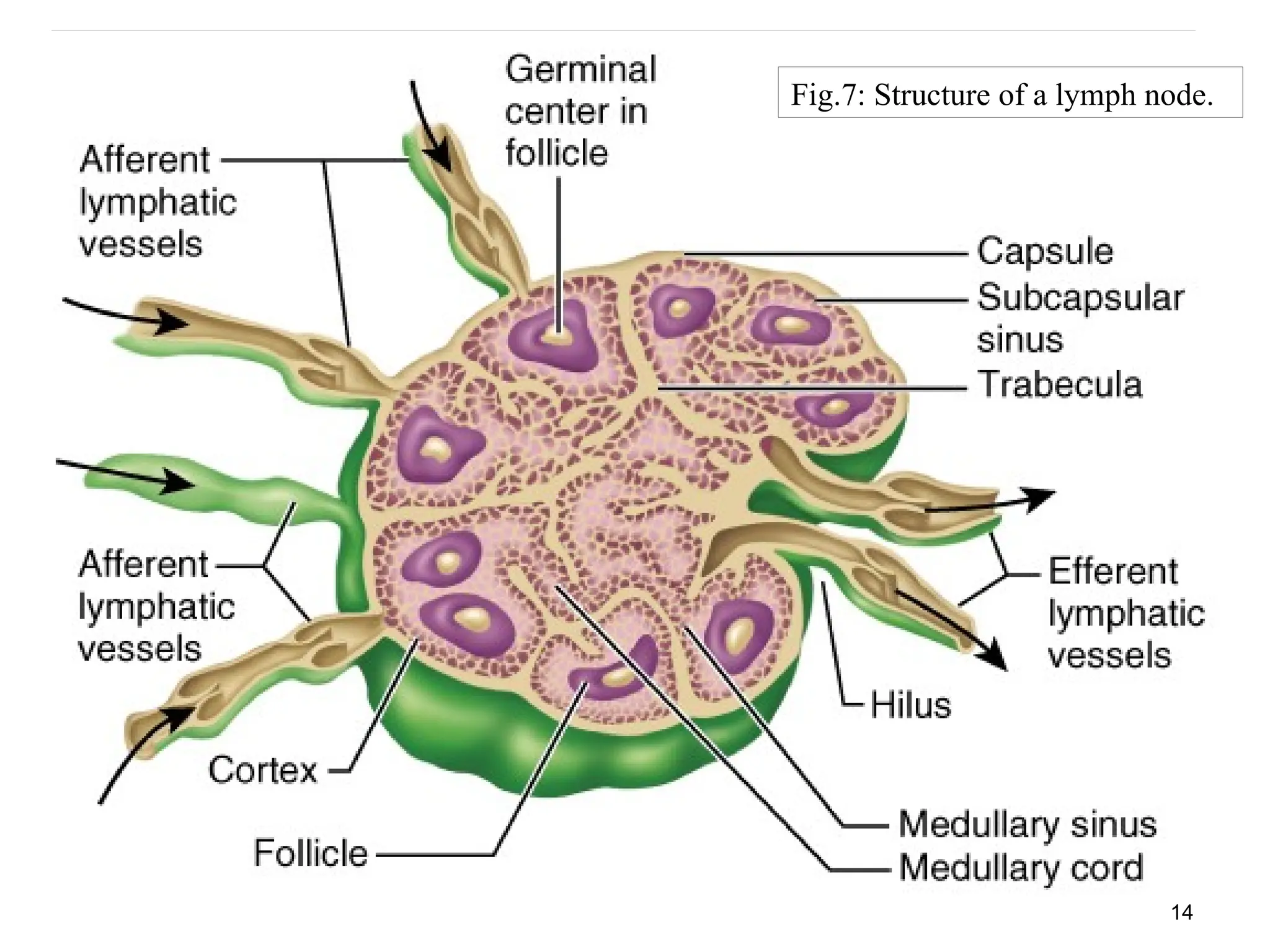
 Lymph nodes are capsulated bean shaped structures that are found
along the course of the lymphatic vessels. They’re usually present in
groups and they’re scattered all over the body.
 The capsule sends trabeculae into the node dividing it into
compartments. Beneath the capsule there’s a space called the
Subcapsular Sinus.
 The node has an outer cortex with lymphatic nodules formed of B-
cells and plasma cells. Deep to it is the inner cortex formed of T-cells
with no nodules. Deep to the cortex is the medulla which contains B-
cells, plasma cells and macrophages embedded in reticular fibers.
 Between the lymphatic tissue in the cortex and medulla are spaces
called cortical and medullary sinuses.
11
Important Note:
• In any organ in the body, the tissues forming the organ can be
divided into two types:
1. The Parenchyma: any tissue in the organ responsible for
performing the function of the organ. Example: in the lymph
nodes, the lymphoid tissue is the parenchyma.
2. The Stroma: tissues in the organ that are not related to the
function of the organ but play a supporting role. Example: in
the lymph nodes, the capsule, the trabeculae, the reticular
fibers and fibroblasts are the stroma.
12
Subcapsular
Sinus
Afferents
Cortical
Sinuses
Medullary
Sinuses
Efferents
 From the convex side of the lymph node several incoming
lymphatic vessels enter the node. These are called afferent
lymphatic vessels.
 The concave side of the node is called the hilum. From it, one or
two outgoing lymphatic vessels leave the node. These are called
efferent lymphatic vessels. Also through the hilum arteries and
nerves enter and veins exit the node.
13
The flow of lymph in a lymph node
14
Fig.7: Structure of a lymph node.
Functions of lymph nodes:  Filter of lymph
1. Antigens in the lymph are trapped and the lymphocytes in
the nodes react to it and initiate the immune response.
2. Macrophages in the node may directly destroy the
antigen.
 It’s important to know what lymphatic vessels drain a
certain organ and what are the lymph nodes in its
course, because this represent a pathway by which
infections and cancer cells can spread.
15
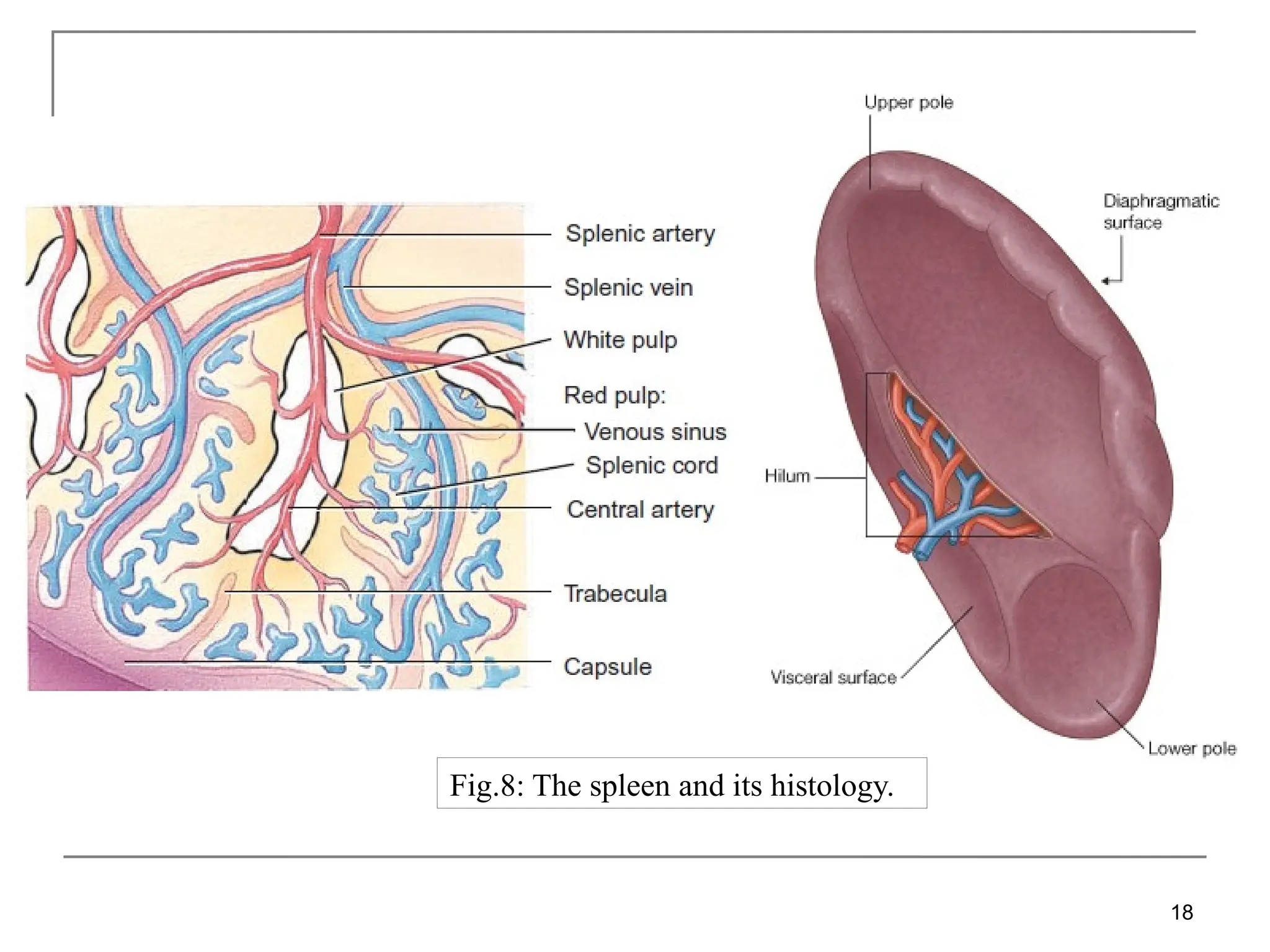
 Largest single mass of lymphatic tissue in the body.
 It’s an oval, soft organ located in the left hypochondriac region.
 Its superior surface is smooth and related to the diaphragm and
ribs 9,10 and 11. Its visceral surface is irregular and related to
the stomach, pancreas, kidney and colon.
 Stroma – capsule, trabeculae, reticular fibers, and fibroblasts.
 Parenchyma:
 White pulp – lymphatic tissue (lymphocytes and
macrophages) surrounds branches of splenic artery (the artery
that supplies the spleen and enters through the hilum).
The Spleen
16
 Red pulp – blood-filled venous sinuses surrounded
by splenic cords which contain red blood cells,
macrophages, lymphocytes and plasma cells.
 Macrophages remove ruptured, worn out or
defective blood cells.
 Storage of up to 1/3 of body’s platelet supply.
 Production of blood cells during fetal life.
 Function: Filter of Blood
17
18
Fig.8: The spleen and its histology.
 Collection of lymphatic tissue not surrounded by
a capsule.
 Scattered throughout lining of gastrointestinal,
urinary, reproductive and respiratory tracts.
 Most of them are small and solitary.
 Some are large – tonsils, Peyer’s patches,
appendix.
Lymphatic Nodules
19
Lymphatic System- power point presentation

  • 1.
  • 2.
     Consists of: 1.Lymph 2. Lymphatic vessels 3. Structures and organs containing lymphatic tissue 4. Red bone marrow Lymphatic System Structure and Function 2  Functions of the lymphatic system 1. Drains excess interstitial fluid. 2. Transports dietary lipid from gastrointestinal tract to blood. The lipid-containing lymph is called Chyle. 3. Carry out immune responses. Fig.1: Components of the lymphatic system.
  • 3.
    Lymph  Most componentsof blood plasma filter freely through the capillary walls to form interstitial fluid.  More fluid filters out of blood capillaries than returns to them by reabsorption.  The excess filtered fluid drains into lymphatic vessels and becomes lymph, 3 Fig.2: Capillaries and lymphatics.
  • 4.
    Lymphatic Vessels 4  Vesselsbegin as lymphatic capillaries. These are closed at one end.  Lymphatic capillaries unite to form large lymphatic vessels. These resemble veins in structure but thinner walls and more valves.  A series of swellings are present along the lymphatic vessels. These are the lymph nodes. Fig.3: The distribution of lymphatic vessels in the body showing the lymph nodes. Also shown is the closed end of a lymphatic capillary.
  • 5.
     Ultimately, thelymph drains into 2 main channels: 1. Thoracic duct: a long duct that drains lymph from the entire left half of the body and the right half below the ribs including the right lower limb. 2. Right lymphatic duct: a short duct that drains lymph from the right side of the body above the ribs including the right upper limb. 5 Fig.4: Areas of lymph drainage to the two main lymphatic ducts.
  • 6.
     Each ofthese ducts open into the junction of the subclavian and internal jugular veins as they form the brachiocephalic vein.  In this way, the lymph will return to the blood. 6 Fig.5: Opening of the lymphatic ducts into the venous circulation.
  • 7.
     2 groupsbased on function 1. Primary lymphatic organs:  Sites where B and T lymphocytes are formed and mature.  Red bone marrow and thymus. 2. Secondary lymphatic organs  Sites where most immune response occurs, meaning that they are the sites where the mature lymphocytes perform their function.  Lymph nodes, spleen, lymphatic nodules. Lymphatic Organs and Tissues 7
  • 8.
    The Thymus  Thethymus is an asymmetric bilobed organ where mature T- cells are formed.  It’s located in the superior mediastinum just behind the manubrium. It may descend into the anterior mediastinum to lie between the sternum and the pericardial sac. Sometimes it may ascend into the neck reaching as high as the thyroid gland.  The fibrous capsule that surrounds the gland sends connective tissue trabeculae into the gland dividing it into lobules. Each lobule is formed of a dark outer region with immature T-cells (the cortex) and an inner lighter region with mature T-cells (the medulla). 8
  • 9.
     The thymictissue is most numerous in younger age. As the person grows, this tissue is gradually replaced by fatty tissue. 9 Fig.6: To the left, histology of the thymus. Below, position of the thymus.
  • 10.
    Red Bone Marrow Red bone marrow is the site of formation of the blood elements: red blood cells, white blood cells and platelets.  Inside the red bone marrow B lymphocyte form and mature; T lymphocytes are formed in the red bone marrow but they’re immature. T-cells become mature in the thymus.  Red bone marrow in adults is present in the flat bones and the epiphyses of some long bones. 10
  • 11.
    Lymph Nodes  Lymphnodes are capsulated bean shaped structures that are found along the course of the lymphatic vessels. They’re usually present in groups and they’re scattered all over the body.  The capsule sends trabeculae into the node dividing it into compartments. Beneath the capsule there’s a space called the Subcapsular Sinus.  The node has an outer cortex with lymphatic nodules formed of B- cells and plasma cells. Deep to it is the inner cortex formed of T-cells with no nodules. Deep to the cortex is the medulla which contains B- cells, plasma cells and macrophages embedded in reticular fibers.  Between the lymphatic tissue in the cortex and medulla are spaces called cortical and medullary sinuses. 11
  • 12.
    Important Note: • Inany organ in the body, the tissues forming the organ can be divided into two types: 1. The Parenchyma: any tissue in the organ responsible for performing the function of the organ. Example: in the lymph nodes, the lymphoid tissue is the parenchyma. 2. The Stroma: tissues in the organ that are not related to the function of the organ but play a supporting role. Example: in the lymph nodes, the capsule, the trabeculae, the reticular fibers and fibroblasts are the stroma. 12
  • 13.
    Subcapsular Sinus Afferents Cortical Sinuses Medullary Sinuses Efferents  From theconvex side of the lymph node several incoming lymphatic vessels enter the node. These are called afferent lymphatic vessels.  The concave side of the node is called the hilum. From it, one or two outgoing lymphatic vessels leave the node. These are called efferent lymphatic vessels. Also through the hilum arteries and nerves enter and veins exit the node. 13 The flow of lymph in a lymph node
  • 14.
  • 15.
    Functions of lymphnodes:  Filter of lymph 1. Antigens in the lymph are trapped and the lymphocytes in the nodes react to it and initiate the immune response. 2. Macrophages in the node may directly destroy the antigen.  It’s important to know what lymphatic vessels drain a certain organ and what are the lymph nodes in its course, because this represent a pathway by which infections and cancer cells can spread. 15
  • 16.
     Largest singlemass of lymphatic tissue in the body.  It’s an oval, soft organ located in the left hypochondriac region.  Its superior surface is smooth and related to the diaphragm and ribs 9,10 and 11. Its visceral surface is irregular and related to the stomach, pancreas, kidney and colon.  Stroma – capsule, trabeculae, reticular fibers, and fibroblasts.  Parenchyma:  White pulp – lymphatic tissue (lymphocytes and macrophages) surrounds branches of splenic artery (the artery that supplies the spleen and enters through the hilum). The Spleen 16
  • 17.
     Red pulp– blood-filled venous sinuses surrounded by splenic cords which contain red blood cells, macrophages, lymphocytes and plasma cells.  Macrophages remove ruptured, worn out or defective blood cells.  Storage of up to 1/3 of body’s platelet supply.  Production of blood cells during fetal life.  Function: Filter of Blood 17
  • 18.
    18 Fig.8: The spleenand its histology.
  • 19.
     Collection oflymphatic tissue not surrounded by a capsule.  Scattered throughout lining of gastrointestinal, urinary, reproductive and respiratory tracts.  Most of them are small and solitary.  Some are large – tonsils, Peyer’s patches, appendix. Lymphatic Nodules 19