ELBOW
CRUTCHES
• What is non axillary crutch?
• Elbow crutch material and length specification
• Measurement of elbow crutch
•Advantages/Disadvantages
Objectives
•Non Axillary crutches transfer 40-50 % of body weight.
•Also called forearm crutches and "Lofstrand" crutch.
Types
1. Elbow crutch
2. Forearm trough
3. Canadian / elbow extensor crutch
Elbow crutch
• Elbow crutches have a cuff that supports the forearm of the user.
• For this reason they are sometimes referred to as forearm crutches.
• They are made of aluminum.
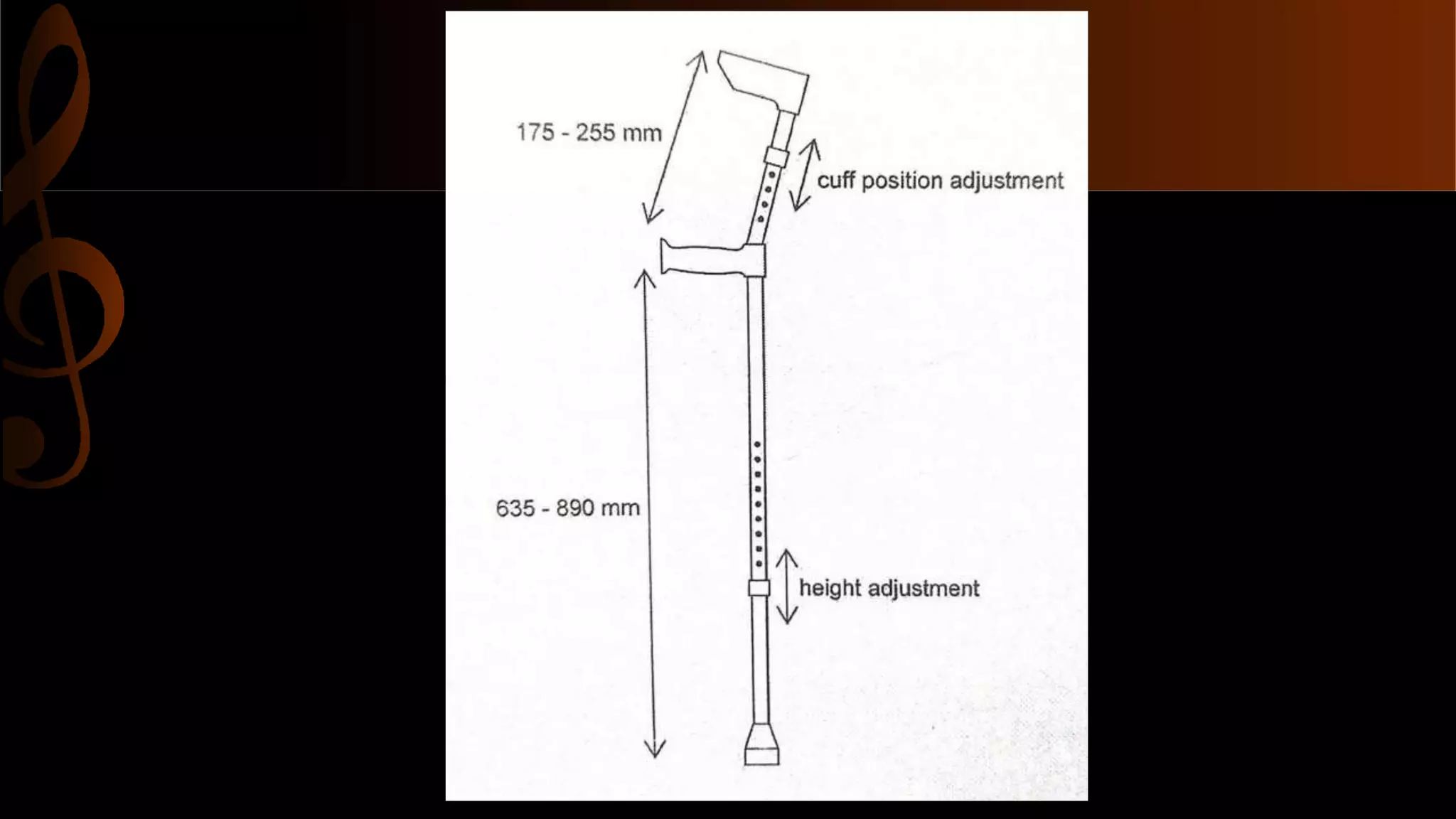
• Design includes a single upright, a forearm cuff & a handgrip.
• It adjusts both proximally (position of forearm cuff) & distally
(height of crutch); using push button mechanism.
•Most designs allow the length of the crutch to be adjusted so
that the height of the handle can be altered (termed single
adjustable).
• Some also allow the position of the cuff to be altered (termed
double adjustable).
• The handles are similar to the moulded and contoured ones
used for walking sticks.
• Generally adult sizes are 29-35inches (74-89cms).
• Distal end of crutch is covered with rubber suction tip.
• Forearm cuffs are available with either medial or anterior
opening.
• These crutches are particularly suitable for patients with good
balance and strong arms.
• Weight is transmitted exactly the same way as axillary
crutches.
• The cuffs are usually made from plastic and are either open or closed.
• CUFFS A closed cuff allows the crutch to be suspended from the
forearm when the handle is released.
•The diameter of the cuffs varies between 70 and 105 mm. Smaller
diameter cuffs provide more security.
•Open cuffs are generally not recommended though many "lightweight”
models have them as standard.
• Cuffs may be hinged so that they can rotate upwards by about 90°.
Advantages
• Forearm cuff allows use of hands.
• Easily adjusted & allows functional stair climbing
• Most functional for patients with bilateral KAFO.I
• There is no risk of injury to the neurovascular structures in the
axillary region when using this type of crutches.
Disadvantages
• Less lateral support
• Cuffs may be difficult to remove
• They require good standing balance and upper-body strength.
• Geriatric patient sometimes feel insecure.
MEASUREMENT
• Position of choice – supported standing
• From 1-1.5inches below the elbow to Distal end at a point
2inches anterior & 6inches lateral to the foot.
• Shoulders should be relaxed & elbow maintained at 20-
30degrees flexion.
• Cuff placement at the proximal third of the forearm.
Review Questions
 Non Axillary crutches transfer 40-50 % of body weight.(T/F)
Elbow crutches are particularly suitable for patients with good balance
and strong arms. (T/F)
Open cuffs of Elbow crutches are more secure to use . (T/F)
Elbow crutches are not advisable for stair climbing . (T/F)
Crutch palsy is a common condition in elbow crutch user.(T/F)
Cuff should placed at the proximal third of the forearm.(T/F)
Reference
Joseph B. Webster, Douglas P. Morphy. Atlas of orthoses and assistive
devices. 4th ed. p. 534-535.
Elbow crutch

Elbow crutch

  • 1.
  • 2.
    • What isnon axillary crutch? • Elbow crutch material and length specification • Measurement of elbow crutch •Advantages/Disadvantages Objectives
  • 3.
    •Non Axillary crutchestransfer 40-50 % of body weight. •Also called forearm crutches and "Lofstrand" crutch. Types 1. Elbow crutch 2. Forearm trough 3. Canadian / elbow extensor crutch
  • 5.
    Elbow crutch • Elbowcrutches have a cuff that supports the forearm of the user. • For this reason they are sometimes referred to as forearm crutches. • They are made of aluminum. • Design includes a single upright, a forearm cuff & a handgrip. • It adjusts both proximally (position of forearm cuff) & distally (height of crutch); using push button mechanism.
  • 7.
    •Most designs allowthe length of the crutch to be adjusted so that the height of the handle can be altered (termed single adjustable). • Some also allow the position of the cuff to be altered (termed double adjustable). • The handles are similar to the moulded and contoured ones used for walking sticks.
  • 8.
    • Generally adultsizes are 29-35inches (74-89cms). • Distal end of crutch is covered with rubber suction tip. • Forearm cuffs are available with either medial or anterior opening. • These crutches are particularly suitable for patients with good balance and strong arms. • Weight is transmitted exactly the same way as axillary crutches.
  • 9.
    • The cuffsare usually made from plastic and are either open or closed. • CUFFS A closed cuff allows the crutch to be suspended from the forearm when the handle is released. •The diameter of the cuffs varies between 70 and 105 mm. Smaller diameter cuffs provide more security. •Open cuffs are generally not recommended though many "lightweight” models have them as standard. • Cuffs may be hinged so that they can rotate upwards by about 90°.
  • 11.
    Advantages • Forearm cuffallows use of hands. • Easily adjusted & allows functional stair climbing • Most functional for patients with bilateral KAFO.I • There is no risk of injury to the neurovascular structures in the axillary region when using this type of crutches.
  • 12.
    Disadvantages • Less lateralsupport • Cuffs may be difficult to remove • They require good standing balance and upper-body strength. • Geriatric patient sometimes feel insecure.
  • 13.
    MEASUREMENT • Position ofchoice – supported standing • From 1-1.5inches below the elbow to Distal end at a point 2inches anterior & 6inches lateral to the foot. • Shoulders should be relaxed & elbow maintained at 20- 30degrees flexion. • Cuff placement at the proximal third of the forearm.
  • 14.
    Review Questions  NonAxillary crutches transfer 40-50 % of body weight.(T/F) Elbow crutches are particularly suitable for patients with good balance and strong arms. (T/F) Open cuffs of Elbow crutches are more secure to use . (T/F) Elbow crutches are not advisable for stair climbing . (T/F) Crutch palsy is a common condition in elbow crutch user.(T/F) Cuff should placed at the proximal third of the forearm.(T/F)
  • 15.
    Reference Joseph B. Webster,Douglas P. Morphy. Atlas of orthoses and assistive devices. 4th ed. p. 534-535.