





Amazee Metrics AG / Förrlibuckstr. 30 / 8005 Zürich / info@amazeemetrics.com
Dr. Laura J. Hornbake, Consultant Web Analytics
Christina Meyer, SEO/SEM Consultant
8.2.2014
Analytics and SEO for Startups
Web Analytics
Goals
•  To communicate what web analytics can tell you and why you
should care.
•  To help you avoid data overload by focusing on the insights you
need and allow you to forget about the vanity metrics.
•  To provide you with some tools that can help you to learn more
about your startup’s performance and to make data-driven
decisions.
Audience
Audience
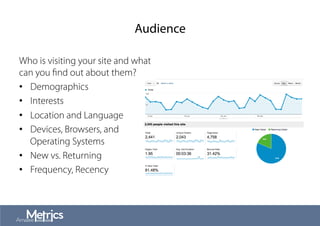
Who is visiting your site and what
can you find out about them?
•  Demographics
•  Interests
•  Location and Language
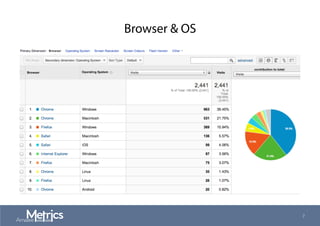
•  Devices, Browsers, and
Operating Systems
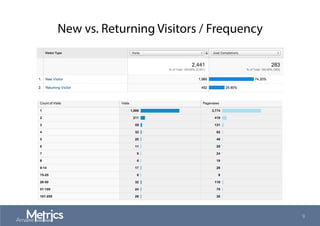
•  New vs. Returning
•  Frequency, Recency
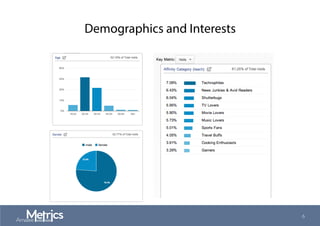
Demographics and Interests
6
Browser & OS
7
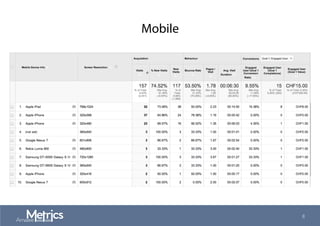
Mobile
8
New vs. Returning Visitors / Frequency
9
Audience: Implications
•  Do the actual visitors to my site correspond to my target market?
•  Is my site ready for (or backwards compatible with) the devices and
browsers they are using?
•  How can insights about my audience inform future development of
the site?
•  What actions can I take to either better attract my target audience or
better serve this audience?
•  How else might these insights require me to revise my strategies and
plans?
10
Acquisition
Acquisition
How did your visitors find you? Which channels are bringing the most
traffic?
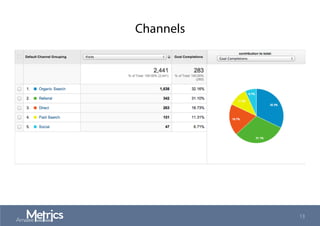
•  Channels: Direct, Search Engines, Referrals, Social, etc.
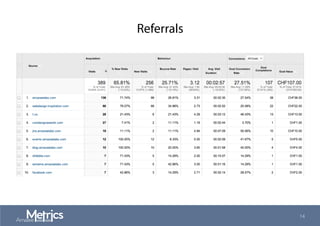
•  Referrals
•  Campaigns: Advertising, Newsletters, QR codes
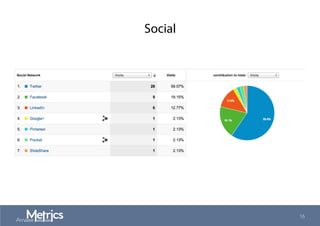
•  Social
Channels
13
Referrals
14
Campaigns
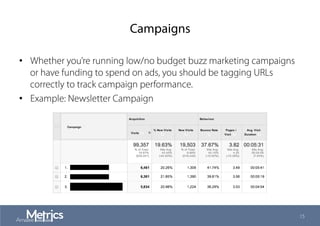
•  Whether you’re running low/no budget buzz marketing campaigns
or have funding to spend on ads, you should be tagging URLs
correctly to track campaign performance.
•  Example: Newsletter Campaign
15
Social
16
Acquisition: Implications
•  Which channels are working for me? Where might I try to improve?
•  Is all that time I spend guest blogging, answering questions on Q&A
sites, posting on social networks, etc. producing any results?
•  Are my marketing campaigns meeting my expectations?
17
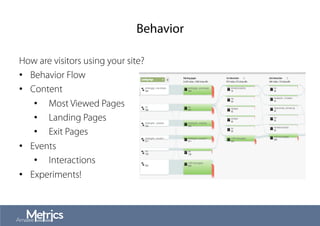
Behavior
Behavior
How are visitors using your site?
•  Behavior Flow
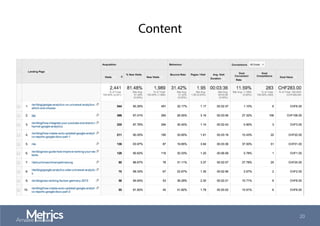
•  Content
•  Most Viewed Pages
•  Landing Pages
•  Exit Pages
•  Events
•  Interactions
•  Experiments!
Content
20
Events
•  Event tracking can be as simple as recording how often users click a
button or as detailed as registering how far down a page they scroll.
•  Form errors
•  Video engagement
•  Interaction with maps, custom widgets, popups
21
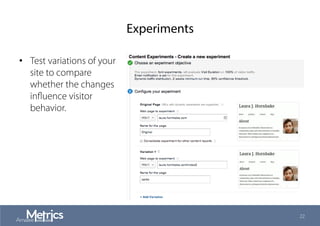
Experiments
•  Test variations of your
site to compare
whether the changes
influence visitor
behavior.
22
Behavior: Implications
•  Are visitors doing what you want or expect them to do (register,
subscribe to a newsletter, download a product brochure, etc.) on
your site?
•  Which pages are really attracting visitors and getting them to further
engage with the site?
•  Where are you losing visitors? Is there something you can clarify or
make simpler?
•  Are you tracking the key events that are important to you?
•  How can you use experiments to find the best performing version of
your content?
23
Conversions
Conversions
How can you measure success at meeting the specific goals you define
for your site?
•  Goals
•  E-commerce
•  Multi-Channel Funnels
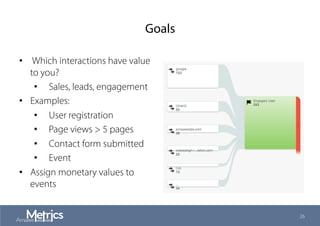
Goals
•  Which interactions have value
to you?
•  Sales, leads, engagement
•  Examples:
•  User registration
•  Page views > 5 pages
•  Contact form submitted
•  Event
•  Assign monetary values to
events
26
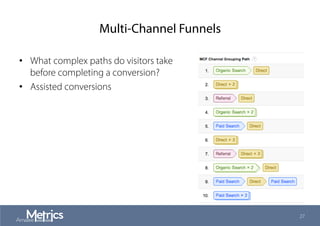
Multi-Channel Funnels
•  What complex paths do visitors take
before completing a conversion?
•  Assisted conversions
27
Conversion: Implications
•  Are you meeting the targets you’ve set for your goals? Do you need
to revise them?
•  What can you learn about how visitors finally arrive at the
interactions you’ve defined as goals?
•  Is the effect of certain channels more subtle than the Channels
reports suggest?
•  How might this influence your strategies?
28
Conclusions
Final Suggestions
•  Experiment with slicing and dicing data in different ways:
•  Timeframes
•  Segmentation
•  Make web analytics a regular part of your processes
•  Be curious; be flexible.
30
Take Away
•  Get beyond the first overview page of your analytics tool and dig
into the data.
•  Web analytics can provide you with a lot of good data for your
strategic decision-making.
•  Am I wasting time/effort/money or are the things I’m doing paying
off in concrete, measurable results?
Search Engine Optimization
(SEO)
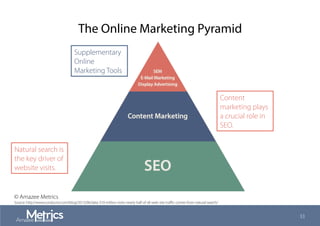
The Online Marketing Pyramid
33
Natural search is
the key driver of
website visits.
© Amazee Metrics
Source: http://www.conductor.com/blog/2013/06/data-310-million-visits-nearly-half-of-all-web-site-traffic-comes-from-natural-search/
Content
marketing plays
a crucial role in
SEO.
Supplementary
Online
Marketing Tools
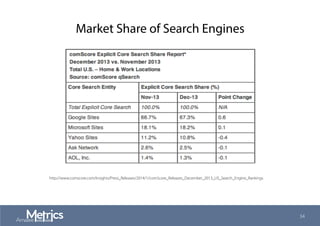
Market Share of Search Engines
http://www.comscore.com/Insights/Press_Releases/2014/1/comScore_Releases_December_2013_US_Search_Engine_Rankings
34
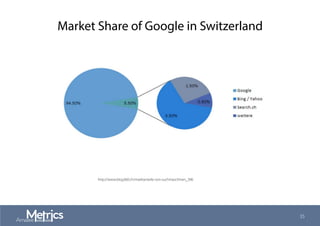
Market Share of Google in Switzerland
http://www.blog360.ch/marktanteile-von-suchmaschinen_396
35
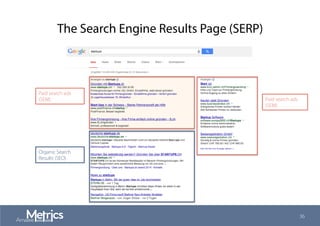
The Search Engine Results Page (SERP)
Paid search ads
(SEM)
Paid search ads
(SEM)
Organic Search
Results (SEO)
36
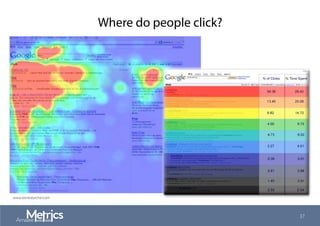
Where do people click?
www.seoresearcher.com
37
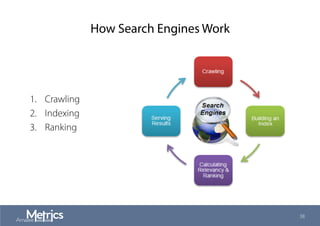
How Search Engines Work
1.  Crawling
2.  Indexing
3.  Ranking
38
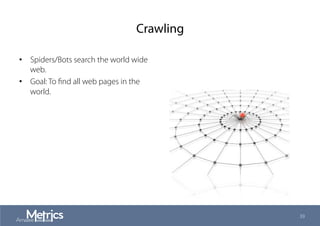
Crawling
•  Spiders/Bots search the world wide
web.
•  Goal: To find all web pages in the
world.
39
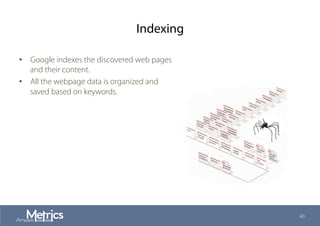
Indexing
•  Google indexes the discovered web pages
and their content.
•  All the webpage data is organized and
saved based on keywords.
40
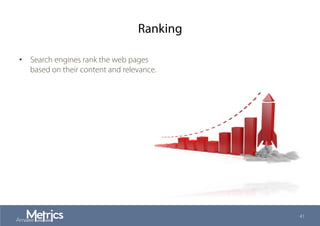
Ranking
•  Search engines rank the web pages
based on their content and relevance.
41
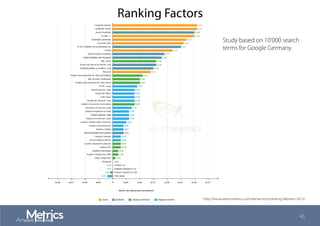
Ranking Factors
Ranking factors are criteria used by search engines to evaluate the content and
relevance of a web page.
The web pages are ranked based on these ranking factors.
42
Ranking Factors
Study based on 10’000 search
terms for Google Germany.
http://www.searchmetrics.com/de/services/ranking-faktoren-2013/
43
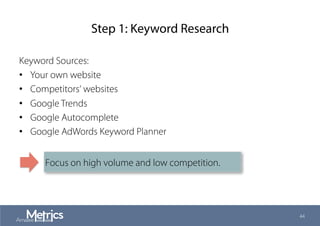
Step 1: Keyword Research
Keyword Sources:
•  Your own website
•  Competitors‘ websites
•  Google Trends
•  Google Autocomplete
•  Google AdWords Keyword Planner
44
Focus on high volume and low competition.
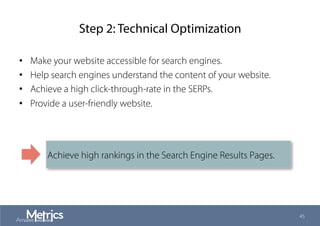
Step 2: Technical Optimization
•  Make your website accessible for search engines.
•  Help search engines understand the content of your website.
•  Achieve a high click-through-rate in the SERPs.
•  Provide a user-friendly website.
45
Achieve high rankings in the Search Engine Results Pages.
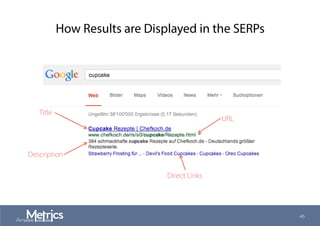
How Results are Displayed in the SERPs
46
Title
Description
URL
Direct Links
URL Structure
•  Use important keywords in the URL:
•  Search engines understand the content of your website.
•  Higher click-through-rate higher ranking
•  SEO Best Practice:
•  Separate words with dashes, no underscores
•  Keep your URLs as short as possible (not more than 200
charachters)
•  Do not use any spaces or special characters
47
Geographic and Language Targeting
There are 4 ways to include geographic and language targeting in URLs:
•  Top Level Domain: www.google.ch, www.google.de
•  Subdomain: de.reuters.com, uk.reuters.com
•  Subdirectory: www.zara.com/ch/de, www.zara.com/de
•  URL Parameter: example.com?loc=de, example.com?loc=fr
•  SEO Best Practice: Subdomain or Subfolder
•  Subdomain: Allows different server locations.
•  Subfolder: Low cost (1 host)
•  If you have different Top Level Domains link building must be done
separately for each domain.
•  There is no good reason to use URL parameters.
48
Title Tags
•  HTML Tag (HTML-Head): <title>
•  Use important keywords in the title tag:
•  Search engines understand the content of your website.
•  Higher click-through-rate higher ranking
•  SEO Best Practice:
•  Not more than 70 characters long
•  Place keywords at the beginning of the tag, the brand name at
the end.
49
Meta Description Tags
•  HTML Tag (HTML-Head):
<meta name="Description" content="Eine Beschreibung Ihrer Seite"/>
•  The meta description tag is a marketing text for your result in the
SERPs:
•  Does not affect search engine rankings.
•  But: Higher click-through-rate higher ranking
•  SEO Best Practice:
•  Not more than 160 characters long
50
Heading Tags
•  HML Tag (HTML-Body): <h1>, <h2>, <h3> etc.
•  H1 is the most important heading tag for search engines and should
include relevant keywords:
•  Search engines understand the content of your website.
•  SEO Best Practice:
•  Use exactly one H1 Tag on every page
(you can use more than one H2 tag).
51
Internal Linking
•  Search engines crawl a website by moving from link to link.
•  Internal linking is crucial for search engines:
•  To recognize the structure of the website.
•  To find all existing pages.
•  Search engines understand the content of a link based on its
anchor text.
•  SEO Best Practice:
•  Use 2-3 internal links on every page, but no more than 100 links
on one page.
•  Use relevant keywords in the anchor text.
52
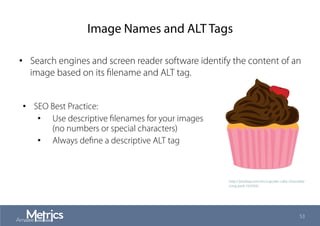
Image Names and ALT Tags
•  Search engines and screen reader software identify the content of an
image based on its filename and ALT tag.
53
•  SEO Best Practice:
•  Use descriptive filenames for your images
(no numbers or special characters)
•  Always define a descriptive ALT tag
http://pixabay.com/en/cupcake-cake-chocolate-
icing-pink-163593/
Source Code Validation
•  Search engines use the W3C standard to evaluate the quality of a
website.
•  Definition of W3C according to Wikipedia:
„The World Wide Web Consortium (W3C) is the main international
standards organization for the World Wide Web“.
•  Check your homepage regularly with the W3C validator and correct
all errors and warnings: http://validator.w3.org/
54
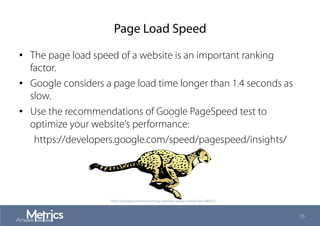
Page Load Speed
•  The page load speed of a website is an important ranking
factor.
•  Google considers a page load time longer than 1.4 seconds as
slow.
•  Use the recommendations of Google PageSpeed test to
optimize your website‘s performance:
https://developers.google.com/speed/pagespeed/insights/
55
http://pixabay.com/en/running-cheetah-speed-animal-fast-48433/
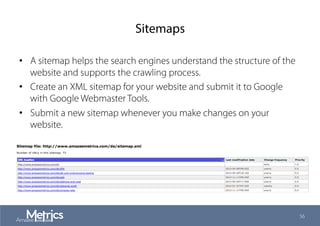
Sitemaps
•  A sitemap helps the search engines understand the structure of the
website and supports the crawling process.
•  Create an XML sitemap for your website and submit it to Google
with Google Webmaster Tools.
•  Submit a new sitemap whenever you make changes on your
website.
56
Duplicate Content
•  Duplicate content is caused by identical or similar content on
different URLs.
•  Duplicate content can harm search engine rankings:
•  Search engines do not know which of the pages is the most
relevant for a search query.
•  Search engines prefer to offer the user a variety of different
pages in the SERPs.
•  If there is a lot of duplicate content search engines might think
that you want to trick them.
57
Common Causes of Duplicate Content
•  URLs in www and non-www versions.
•  URLs with uppercase and lowercase characters.
58
Keep 1 version and implement a 301 Redirect from the other
versions to this one.
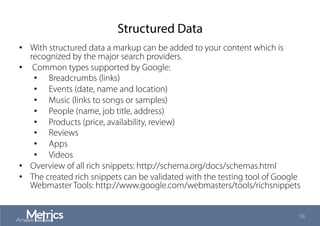
Structured Data
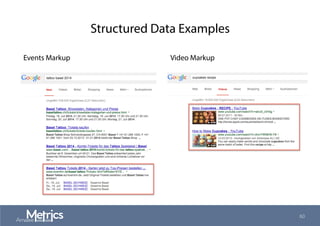
•  With structured data a markup can be added to your content which is
recognized by the major search providers.
•  Common types supported by Google:
•  Breadcrumbs (links)
•  Events (date, name and location)
•  Music (links to songs or samples)
•  People (name, job title, address)
•  Products (price, availability, review)
•  Reviews
•  Apps
•  Videos
•  Overview of all rich snippets: http://schema.org/docs/schemas.html
•  The created rich snippets can be validated with the testing tool of Google
Webmaster Tools: http://www.google.com/webmasters/tools/richsnippets
59
Structured Data Examples
60
Events Markup Video Markup
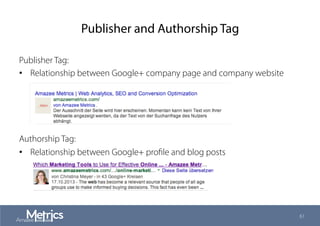
Publisher and Authorship Tag
Publisher Tag:
•  Relationship between Google+ company page and company website
Authorship Tag:
•  Relationship between Google+ profile and blog posts
61
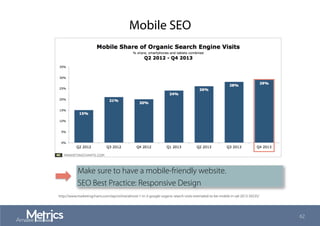
Mobile SEO
62
http://www.marketingcharts.com/wp/online/almost-1-in-3-google-organic-search-visits-estimated-to-be-mobile-in-q4-2013-39235/
Make sure to have a mobile-friendly website.
SEO Best Practice: Responsive Design
Step 3: Usability
•  Overall Appeal: Provide a readable, well-structured website
•  Navigation: Make it easy for users to navigate even if they access the
website from the search engines, as opposed to from the
homepage.
•  Information architecture: Provide consistency.
•  Content quality: Provide well-written, useful and fresh content.
63
Step 4: Link Building
The relevance of a website is defined based on the quantity and quality
of external links.
Effective link building measures:
•  Submit your website to company and industry directories.
•  Contribute with comments to relevant blogs and forums.
•  Submit your content to social bookmarking sites.
•  Search for unlinked brand mentions.
•  Identify broken links on websites.
64
Content Marketing is the most important driver of links.
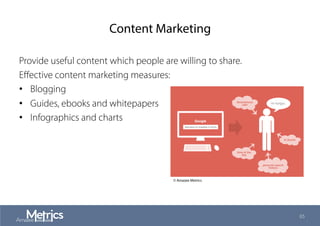
Content Marketing
Provide useful content which people are willing to share.
Effective content marketing measures:
•  Blogging
•  Guides, ebooks and whitepapers
•  Infographics and charts
65
© Amazee Metrics
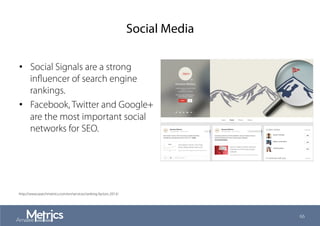
Social Media
•  Social Signals are a strong
influencer of search engine
rankings.
•  Facebook, Twitter and Google+
are the most important social
networks for SEO.
66
http://www.searchmetrics.com/en/services/ranking-factors-2013/
Take Away
•  Make sure that your website is visible in the Search Engine Results
Pages.
•  Take SEO into account when building your website.
•  Regularly monitor the technical performance of your website with
Google Webmaster Tools.
•  A continuous effort for link building and content marketing is
important.
•  SEO is an ongoing process – you will see results after a few months,
not after a few days.
67

Web Analytics and SEO for Startups

  • 1.
    Amazee Metrics AG/ Förrlibuckstr. 30 / 8005 Zürich / info@amazeemetrics.com Dr. Laura J. Hornbake, Consultant Web Analytics Christina Meyer, SEO/SEM Consultant 8.2.2014 Analytics and SEO for Startups
  • 2.
  • 3.
    Goals •  To communicatewhat web analytics can tell you and why you should care. •  To help you avoid data overload by focusing on the insights you need and allow you to forget about the vanity metrics. •  To provide you with some tools that can help you to learn more about your startup’s performance and to make data-driven decisions.
  • 4.
  • 5.
    Audience Who is visitingyour site and what can you find out about them? •  Demographics •  Interests •  Location and Language •  Devices, Browsers, and Operating Systems •  New vs. Returning •  Frequency, Recency
  • 6.
  • 7.
  • 8.
  • 9.
    New vs. ReturningVisitors / Frequency 9
  • 10.
    Audience: Implications •  Dothe actual visitors to my site correspond to my target market? •  Is my site ready for (or backwards compatible with) the devices and browsers they are using? •  How can insights about my audience inform future development of the site? •  What actions can I take to either better attract my target audience or better serve this audience? •  How else might these insights require me to revise my strategies and plans? 10
  • 11.
  • 12.
    Acquisition How did yourvisitors find you? Which channels are bringing the most traffic? •  Channels: Direct, Search Engines, Referrals, Social, etc. •  Referrals •  Campaigns: Advertising, Newsletters, QR codes •  Social
  • 13.
  • 14.
  • 15.
    Campaigns •  Whether you’rerunning low/no budget buzz marketing campaigns or have funding to spend on ads, you should be tagging URLs correctly to track campaign performance. •  Example: Newsletter Campaign 15
  • 16.
  • 17.
    Acquisition: Implications •  Whichchannels are working for me? Where might I try to improve? •  Is all that time I spend guest blogging, answering questions on Q&A sites, posting on social networks, etc. producing any results? •  Are my marketing campaigns meeting my expectations? 17
  • 18.
  • 19.
    Behavior How are visitorsusing your site? •  Behavior Flow •  Content •  Most Viewed Pages •  Landing Pages •  Exit Pages •  Events •  Interactions •  Experiments!
  • 20.
  • 21.
    Events •  Event trackingcan be as simple as recording how often users click a button or as detailed as registering how far down a page they scroll. •  Form errors •  Video engagement •  Interaction with maps, custom widgets, popups 21
  • 22.
    Experiments •  Test variationsof your site to compare whether the changes influence visitor behavior. 22
  • 23.
    Behavior: Implications •  Arevisitors doing what you want or expect them to do (register, subscribe to a newsletter, download a product brochure, etc.) on your site? •  Which pages are really attracting visitors and getting them to further engage with the site? •  Where are you losing visitors? Is there something you can clarify or make simpler? •  Are you tracking the key events that are important to you? •  How can you use experiments to find the best performing version of your content? 23
  • 24.
  • 25.
    Conversions How can youmeasure success at meeting the specific goals you define for your site? •  Goals •  E-commerce •  Multi-Channel Funnels
  • 26.
    Goals •  Which interactionshave value to you? •  Sales, leads, engagement •  Examples: •  User registration •  Page views > 5 pages •  Contact form submitted •  Event •  Assign monetary values to events 26
  • 27.
    Multi-Channel Funnels •  Whatcomplex paths do visitors take before completing a conversion? •  Assisted conversions 27
  • 28.
    Conversion: Implications •  Areyou meeting the targets you’ve set for your goals? Do you need to revise them? •  What can you learn about how visitors finally arrive at the interactions you’ve defined as goals? •  Is the effect of certain channels more subtle than the Channels reports suggest? •  How might this influence your strategies? 28
  • 29.
  • 30.
    Final Suggestions •  Experimentwith slicing and dicing data in different ways: •  Timeframes •  Segmentation •  Make web analytics a regular part of your processes •  Be curious; be flexible. 30
  • 31.
    Take Away •  Getbeyond the first overview page of your analytics tool and dig into the data. •  Web analytics can provide you with a lot of good data for your strategic decision-making. •  Am I wasting time/effort/money or are the things I’m doing paying off in concrete, measurable results?
  • 32.
  • 33.
    The Online MarketingPyramid 33 Natural search is the key driver of website visits. © Amazee Metrics Source: http://www.conductor.com/blog/2013/06/data-310-million-visits-nearly-half-of-all-web-site-traffic-comes-from-natural-search/ Content marketing plays a crucial role in SEO. Supplementary Online Marketing Tools
  • 34.
    Market Share ofSearch Engines http://www.comscore.com/Insights/Press_Releases/2014/1/comScore_Releases_December_2013_US_Search_Engine_Rankings 34
  • 35.
    Market Share ofGoogle in Switzerland http://www.blog360.ch/marktanteile-von-suchmaschinen_396 35
  • 36.
    The Search EngineResults Page (SERP) Paid search ads (SEM) Paid search ads (SEM) Organic Search Results (SEO) 36
  • 37.
    Where do peopleclick? www.seoresearcher.com 37
  • 38.
    How Search EnginesWork 1.  Crawling 2.  Indexing 3.  Ranking 38
  • 39.
    Crawling •  Spiders/Bots searchthe world wide web. •  Goal: To find all web pages in the world. 39
  • 40.
    Indexing •  Google indexesthe discovered web pages and their content. •  All the webpage data is organized and saved based on keywords. 40
  • 41.
    Ranking •  Search enginesrank the web pages based on their content and relevance. 41
  • 42.
    Ranking Factors Ranking factorsare criteria used by search engines to evaluate the content and relevance of a web page. The web pages are ranked based on these ranking factors. 42
  • 43.
    Ranking Factors Study basedon 10’000 search terms for Google Germany. http://www.searchmetrics.com/de/services/ranking-faktoren-2013/ 43
  • 44.
    Step 1: KeywordResearch Keyword Sources: •  Your own website •  Competitors‘ websites •  Google Trends •  Google Autocomplete •  Google AdWords Keyword Planner 44 Focus on high volume and low competition.
  • 45.
    Step 2: TechnicalOptimization •  Make your website accessible for search engines. •  Help search engines understand the content of your website. •  Achieve a high click-through-rate in the SERPs. •  Provide a user-friendly website. 45 Achieve high rankings in the Search Engine Results Pages.
  • 46.
    How Results areDisplayed in the SERPs 46 Title Description URL Direct Links
  • 47.
    URL Structure •  Useimportant keywords in the URL: •  Search engines understand the content of your website. •  Higher click-through-rate higher ranking •  SEO Best Practice: •  Separate words with dashes, no underscores •  Keep your URLs as short as possible (not more than 200 charachters) •  Do not use any spaces or special characters 47
  • 48.
    Geographic and LanguageTargeting There are 4 ways to include geographic and language targeting in URLs: •  Top Level Domain: www.google.ch, www.google.de •  Subdomain: de.reuters.com, uk.reuters.com •  Subdirectory: www.zara.com/ch/de, www.zara.com/de •  URL Parameter: example.com?loc=de, example.com?loc=fr •  SEO Best Practice: Subdomain or Subfolder •  Subdomain: Allows different server locations. •  Subfolder: Low cost (1 host) •  If you have different Top Level Domains link building must be done separately for each domain. •  There is no good reason to use URL parameters. 48
  • 49.
    Title Tags •  HTMLTag (HTML-Head): <title> •  Use important keywords in the title tag: •  Search engines understand the content of your website. •  Higher click-through-rate higher ranking •  SEO Best Practice: •  Not more than 70 characters long •  Place keywords at the beginning of the tag, the brand name at the end. 49
  • 50.
    Meta Description Tags • HTML Tag (HTML-Head): <meta name="Description" content="Eine Beschreibung Ihrer Seite"/> •  The meta description tag is a marketing text for your result in the SERPs: •  Does not affect search engine rankings. •  But: Higher click-through-rate higher ranking •  SEO Best Practice: •  Not more than 160 characters long 50
  • 51.
    Heading Tags •  HMLTag (HTML-Body): <h1>, <h2>, <h3> etc. •  H1 is the most important heading tag for search engines and should include relevant keywords: •  Search engines understand the content of your website. •  SEO Best Practice: •  Use exactly one H1 Tag on every page (you can use more than one H2 tag). 51
  • 52.
    Internal Linking •  Searchengines crawl a website by moving from link to link. •  Internal linking is crucial for search engines: •  To recognize the structure of the website. •  To find all existing pages. •  Search engines understand the content of a link based on its anchor text. •  SEO Best Practice: •  Use 2-3 internal links on every page, but no more than 100 links on one page. •  Use relevant keywords in the anchor text. 52
  • 53.
    Image Names andALT Tags •  Search engines and screen reader software identify the content of an image based on its filename and ALT tag. 53 •  SEO Best Practice: •  Use descriptive filenames for your images (no numbers or special characters) •  Always define a descriptive ALT tag http://pixabay.com/en/cupcake-cake-chocolate- icing-pink-163593/
  • 54.
    Source Code Validation • Search engines use the W3C standard to evaluate the quality of a website. •  Definition of W3C according to Wikipedia: „The World Wide Web Consortium (W3C) is the main international standards organization for the World Wide Web“. •  Check your homepage regularly with the W3C validator and correct all errors and warnings: http://validator.w3.org/ 54
  • 55.
    Page Load Speed • The page load speed of a website is an important ranking factor. •  Google considers a page load time longer than 1.4 seconds as slow. •  Use the recommendations of Google PageSpeed test to optimize your website‘s performance: https://developers.google.com/speed/pagespeed/insights/ 55 http://pixabay.com/en/running-cheetah-speed-animal-fast-48433/
  • 56.
    Sitemaps •  A sitemaphelps the search engines understand the structure of the website and supports the crawling process. •  Create an XML sitemap for your website and submit it to Google with Google Webmaster Tools. •  Submit a new sitemap whenever you make changes on your website. 56
  • 57.
    Duplicate Content •  Duplicatecontent is caused by identical or similar content on different URLs. •  Duplicate content can harm search engine rankings: •  Search engines do not know which of the pages is the most relevant for a search query. •  Search engines prefer to offer the user a variety of different pages in the SERPs. •  If there is a lot of duplicate content search engines might think that you want to trick them. 57
  • 58.
    Common Causes ofDuplicate Content •  URLs in www and non-www versions. •  URLs with uppercase and lowercase characters. 58 Keep 1 version and implement a 301 Redirect from the other versions to this one.
  • 59.
    Structured Data •  Withstructured data a markup can be added to your content which is recognized by the major search providers. •  Common types supported by Google: •  Breadcrumbs (links) •  Events (date, name and location) •  Music (links to songs or samples) •  People (name, job title, address) •  Products (price, availability, review) •  Reviews •  Apps •  Videos •  Overview of all rich snippets: http://schema.org/docs/schemas.html •  The created rich snippets can be validated with the testing tool of Google Webmaster Tools: http://www.google.com/webmasters/tools/richsnippets 59
  • 60.
  • 61.
    Publisher and AuthorshipTag Publisher Tag: •  Relationship between Google+ company page and company website Authorship Tag: •  Relationship between Google+ profile and blog posts 61
  • 62.
  • 63.
    Step 3: Usability • Overall Appeal: Provide a readable, well-structured website •  Navigation: Make it easy for users to navigate even if they access the website from the search engines, as opposed to from the homepage. •  Information architecture: Provide consistency. •  Content quality: Provide well-written, useful and fresh content. 63
  • 64.
    Step 4: LinkBuilding The relevance of a website is defined based on the quantity and quality of external links. Effective link building measures: •  Submit your website to company and industry directories. •  Contribute with comments to relevant blogs and forums. •  Submit your content to social bookmarking sites. •  Search for unlinked brand mentions. •  Identify broken links on websites. 64 Content Marketing is the most important driver of links.
  • 65.
    Content Marketing Provide usefulcontent which people are willing to share. Effective content marketing measures: •  Blogging •  Guides, ebooks and whitepapers •  Infographics and charts 65 © Amazee Metrics
  • 66.
    Social Media •  SocialSignals are a strong influencer of search engine rankings. •  Facebook, Twitter and Google+ are the most important social networks for SEO. 66 http://www.searchmetrics.com/en/services/ranking-factors-2013/
  • 67.
    Take Away •  Makesure that your website is visible in the Search Engine Results Pages. •  Take SEO into account when building your website. •  Regularly monitor the technical performance of your website with Google Webmaster Tools. •  A continuous effort for link building and content marketing is important. •  SEO is an ongoing process – you will see results after a few months, not after a few days. 67