
Prepared by
Neeraj Devarajan
WHAT IS DIGITAL MARKETING…?
• Digital marketing is the marketing through
….electronic devices such as computers, tablets,
….cell phones, smart phones, digital billboards
….etc to engage with the stakeholders of the
….business.
BENEFITS OF DIGITAL MARKETING
• Increases customer traffic
• Brand Awareness
• Customer Oriented
• Develops Brand image
• Cost Effective
• Measurable results
• Targeted Results
• Reduced Marketing Costs
COMPONENTS OF DIGITAL MARKETING
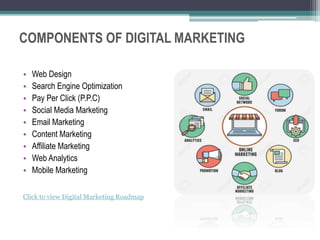
• Web Design
• Search Engine Optimization
• Pay Per Click (P.P.C)
• Social Media Marketing
• Email Marketing
• Content Marketing
• Affiliate Marketing
• Web Analytics
• Mobile Marketing
Click to view Digital Marketing Roadmap
WEB DESIGN ( User Experience )
• Online existence is becoming inevitable for companies.
• Design should take into account the business goals and objectives of the group
managing the project.
• User experience (UX) focuses on having a deep understanding of users, what they
need, what they value, their abilities, and also their limitations.
• A well designed website is likely to get more customers than others.
• Parallax designs are now being widely used and studies show that they have better
rate of conversion.
• Care should be taken to avoid cognitive dissonance (too much options or choices
may also lead the visitor to disconnect or bounce.
• Design features may influence the search results/page
ranking.
Guidelines while designing a web page..
• You should have more text content than HTML elements.
• No frames. They are the enemies of search engines, and search engines are enemies of frames.
• No ads if possible. Because most of the ads use Java-Script which is not advised to be used.
• No JavaScript. If you need JavaScript, call it from an external file rather than dumping the code in
the HTML file. JavaScript drop-down menus prevent spiders from crawling beyond your
homepage. If you use them, be sure to include text links at the bottom of the page.
• Do not put anything in the page topic that does not fit perfectly.
• No unnecessary directories. Keep your files as close to the root as possible.
• No fancy stuff (Flash, Splash, Animated Gifs, Rollovers, etc.) unless absolutely necessary.
SEARCH ENGINE OPTIMIZATION (S.E.O)
Search Engine Optimization (SEO) is the activity of optimizing web pages or whole
sites in order to make them search engine friendly, thus getting higher positions in
search results. SEO is the process of designing and developing a website to attain
a high rank in search engine results.
What is Search Engine Rank?
When you search any keyword using a search engine, it displays thousands of
results found in its database. Page ranking is measured by the position of web
pages displayed in the search engine results.
SEO is a technique for:
• designing and developing a website to rank well in search engine results.
• improving the volume and quality of traffic to a website from search engines.
• marketing by understanding how search algorithms work, and what human visitors
might search.
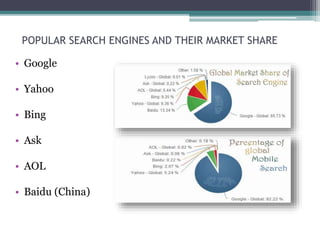
POPULAR SEARCH ENGINES AND THEIR MARKET SHARE
• Google
• Yahoo
• Bing
• Ask
• AOL
• Baidu (China)
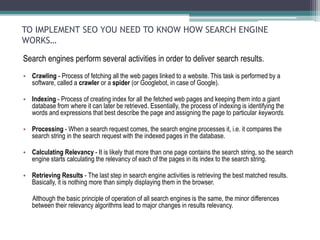
TO IMPLEMENT SEO YOU NEED TO KNOW HOW SEARCH ENGINE
WORKS…
Search engines perform several activities in order to deliver search results.
• Crawling - Process of fetching all the web pages linked to a website. This task is performed by a
software, called a crawler or a spider (or Googlebot, in case of Google).
• Indexing - Process of creating index for all the fetched web pages and keeping them into a giant
database from where it can later be retrieved. Essentially, the process of indexing is identifying the
words and expressions that best describe the page and assigning the page to particular keywords.
• Processing - When a search request comes, the search engine processes it, i.e. it compares the
search string in the search request with the indexed pages in the database.
• Calculating Relevancy - It is likely that more than one page contains the search string, so the search
engine starts calculating the relevancy of each of the pages in its index to the search string.
• Retrieving Results - The last step in search engine activities is retrieving the best matched results.
Basically, it is nothing more than simply displaying them in the browser.
Although the basic principle of operation of all search engines is the same, the minor differences
between their relevancy algorithms lead to major changes in results relevancy.
Types of Optimizations…
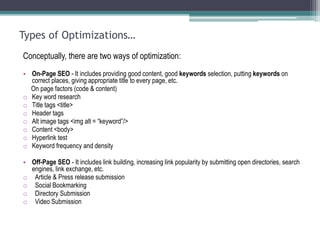
Conceptually, there are two ways of optimization:
• On-Page SEO - It includes providing good content, good keywords selection, putting keywords on
correct places, giving appropriate title to every page, etc.
On page factors (code & content)
o Key word research
o Title tags <title>
o Header tags
o Alt image tags <img alt = “keyword”/>
o Content <body>
o Hyperlink test
o Keyword frequency and density
• Off-Page SEO - It includes link building, increasing link popularity by submitting open directories, search
engines, link exchange, etc.
o Article & Press release submission
o Social Bookmarking
o Directory Submission
o Video Submission
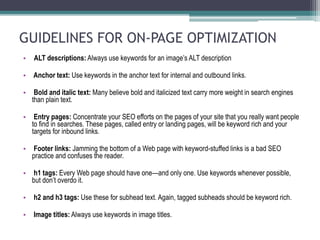
GUIDELINES FOR ON-PAGE OPTIMIZATION
• ALT descriptions: Always use keywords for an image’s ALT description
• Anchor text: Use keywords in the anchor text for internal and outbound links.
• Bold and italic text: Many believe bold and italicized text carry more weight in search engines
than plain text.
• Entry pages: Concentrate your SEO efforts on the pages of your site that you really want people
to find in searches. These pages, called entry or landing pages, will be keyword rich and your
targets for inbound links.
• Footer links: Jamming the bottom of a Web page with keyword-stuffed links is a bad SEO
practice and confuses the reader.
• h1 tags: Every Web page should have one—and only one. Use keywords whenever possible,
but don’t overdo it.
• h2 and h3 tags: Use these for subhead text. Again, tagged subheads should be keyword rich.
• Image titles: Always use keywords in image titles.
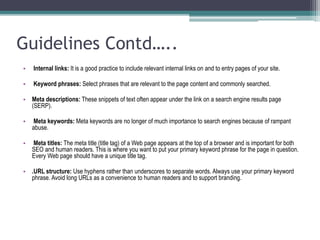
Guidelines Contd…..
• Internal links: It is a good practice to include relevant internal links on and to entry pages of your site.
• Keyword phrases: Select phrases that are relevant to the page content and commonly searched.
• Meta descriptions: These snippets of text often appear under the link on a search engine results page
(SERP).
• Meta keywords: Meta keywords are no longer of much importance to search engines because of rampant
abuse.
• Meta titles: The meta title (title tag) of a Web page appears at the top of a browser and is important for both
SEO and human readers. This is where you want to put your primary keyword phrase for the page in question.
Every Web page should have a unique title tag.
• .URL structure: Use hyphens rather than underscores to separate words. Always use your primary keyword
phrase. Avoid long URLs as a convenience to human readers and to support branding.
PAY PER CLICK (PPC)
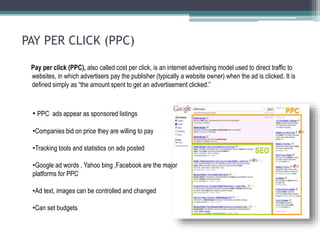
Pay per click (PPC), also called cost per click, is an internet advertising model used to direct traffic to
websites, in which advertisers pay the publisher (typically a website owner) when the ad is clicked. It is
defined simply as “the amount spent to get an advertisement clicked.”
• PPC ads appear as sponsored listings
•Companies bid on price they are willing to pay
•Tracking tools and statistics on ads posted
•Google ad words , Yahoo bing ,Facebook are the major
platforms for PPC
•Ad text, images can be controlled and changed
•Can set budgets
SOCIAL MEDIA MARKETING
• Social media marketing is the process of gaining website traffic or attention
through social media sites. Social media marketing programs usually center on
efforts to create content that attracts attention and encourages readers to share it
across their social networks.
Major social media platforms -
• Face book
• Twitter
• LinkedIn
• Google +
• Pinterest
• Vine
Here are a few suggested sources of inspiration:
• Content marketing: Unbounce, Virgin
https://econsultancy.com/blog/65619-18-reasons-to-love-virgin-s-blah-airlines-content-marketing-
campaign/
• Social media customer service: Tangerine, Warby Parker
• Social media advertising: AirBnB, the American Red Cross
http://contently.com/strategist/2014/12/05/how-airbnb-is-using-content-marketing-to-stay-on-top/
• Facebook strategy: Coca-Cola, Walmart
https://www.facebook.com/business/success/cocacola
• Google+ strategy: Cadbury, National Geographic
• Twitter strategy: Charmin, Oreo
https://econsultancy.com/blog/63908-how-oreo-owns-social-media-through-twitter-instagram-vine-and-
pinterest/
• Instagram strategy: Herschel Supply Co., General Electric
http://beta21.circussocial.com/case-studies/general-electrics-instagram-content-strategy-analyzed/
Email Marketing
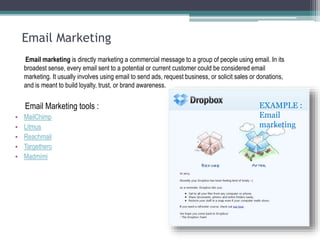
Email marketing is directly marketing a commercial message to a group of people using email. In its
broadest sense, every email sent to a potential or current customer could be considered email
marketing. It usually involves using email to send ads, request business, or solicit sales or donations,
and is meant to build loyalty, trust, or brand awareness.
Email Marketing tools :
• MailChimp
• Litmus
• Reachmail
• Targethero
• Madmimi
EXAMPLE :
Email
marketing
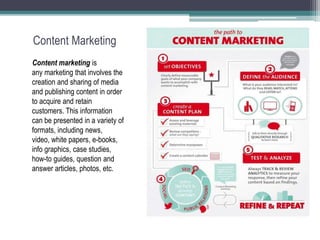
Content Marketing
Content marketing is
any marketing that involves the
creation and sharing of media
and publishing content in order
to acquire and retain
customers. This information
can be presented in a variety of
formats, including news,
video, white papers, e-books,
info graphics, case studies,
how-to guides, question and
answer articles, photos, etc.
Affiliate Marketing
Affiliate marketing is a type of performance-based marketing in which a business rewards one or
more affiliates for each visitor or customer brought by the affiliate's own marketing efforts. The industry
has four core players: the merchant (also known as 'retailer' or 'brand'), the network (that contains offers
for the affiliate to choose from and also takes care of the payments), the publisher (also known as 'the
affiliate'), and the customer.
To simplify it, here's the 4 step process for how it works:
• You find a product you want to promote.
• You sign up for their affiliate program.
• You get a special link that allows the merchant to track the people who clicked your link.
• If they buy the product, you get a commission.
Web Analysis
Web analytics is the measurement, collection, analysis and reporting of web data for purposes of
understanding and optimizing web usage. Web analytics is not just a tool for measuring web traffic but
can be used as a tool for business and market research, and to assess and improve the effectiveness of
a website.
WEB ANALYSIS PROCESS :
• Defining your website goals.
• Measuring your website with goals
• Analyzing and explaining data why there are areas that don’t perform well
• Optimize your website based on the findings
WEB ANALYSIS TOOLS
• Google Analytics
• Clicky
• Mint
• KISSMETRICS
Mobile Marketing
Mobile marketing is marketing on or with a mobile device, such as a smart phone. Mobile
marketing can provide customers with time and location sensitive, personalized information that
promotes goods, services and ideas.
Types of Mobile marketing
• SMS marketing
• MMS marketing
• Mobile Applications
• QR codes
• Mobile Games
• Mobile Banner Ads
• Mobile Internet Marketing
Digital Marketing Basics

Digital Marketing Basics

  • 1.
  • 2.
    WHAT IS DIGITALMARKETING…? • Digital marketing is the marketing through ….electronic devices such as computers, tablets, ….cell phones, smart phones, digital billboards ….etc to engage with the stakeholders of the ….business.
  • 3.
    BENEFITS OF DIGITALMARKETING • Increases customer traffic • Brand Awareness • Customer Oriented • Develops Brand image • Cost Effective • Measurable results • Targeted Results • Reduced Marketing Costs
  • 4.
    COMPONENTS OF DIGITALMARKETING • Web Design • Search Engine Optimization • Pay Per Click (P.P.C) • Social Media Marketing • Email Marketing • Content Marketing • Affiliate Marketing • Web Analytics • Mobile Marketing Click to view Digital Marketing Roadmap
  • 5.
    WEB DESIGN (User Experience ) • Online existence is becoming inevitable for companies. • Design should take into account the business goals and objectives of the group managing the project. • User experience (UX) focuses on having a deep understanding of users, what they need, what they value, their abilities, and also their limitations. • A well designed website is likely to get more customers than others. • Parallax designs are now being widely used and studies show that they have better rate of conversion. • Care should be taken to avoid cognitive dissonance (too much options or choices may also lead the visitor to disconnect or bounce. • Design features may influence the search results/page ranking.
  • 6.
    Guidelines while designinga web page.. • You should have more text content than HTML elements. • No frames. They are the enemies of search engines, and search engines are enemies of frames. • No ads if possible. Because most of the ads use Java-Script which is not advised to be used. • No JavaScript. If you need JavaScript, call it from an external file rather than dumping the code in the HTML file. JavaScript drop-down menus prevent spiders from crawling beyond your homepage. If you use them, be sure to include text links at the bottom of the page. • Do not put anything in the page topic that does not fit perfectly. • No unnecessary directories. Keep your files as close to the root as possible. • No fancy stuff (Flash, Splash, Animated Gifs, Rollovers, etc.) unless absolutely necessary.
  • 7.
    SEARCH ENGINE OPTIMIZATION(S.E.O) Search Engine Optimization (SEO) is the activity of optimizing web pages or whole sites in order to make them search engine friendly, thus getting higher positions in search results. SEO is the process of designing and developing a website to attain a high rank in search engine results. What is Search Engine Rank? When you search any keyword using a search engine, it displays thousands of results found in its database. Page ranking is measured by the position of web pages displayed in the search engine results. SEO is a technique for: • designing and developing a website to rank well in search engine results. • improving the volume and quality of traffic to a website from search engines. • marketing by understanding how search algorithms work, and what human visitors might search.
  • 8.
    POPULAR SEARCH ENGINESAND THEIR MARKET SHARE • Google • Yahoo • Bing • Ask • AOL • Baidu (China)
  • 9.
    TO IMPLEMENT SEOYOU NEED TO KNOW HOW SEARCH ENGINE WORKS… Search engines perform several activities in order to deliver search results. • Crawling - Process of fetching all the web pages linked to a website. This task is performed by a software, called a crawler or a spider (or Googlebot, in case of Google). • Indexing - Process of creating index for all the fetched web pages and keeping them into a giant database from where it can later be retrieved. Essentially, the process of indexing is identifying the words and expressions that best describe the page and assigning the page to particular keywords. • Processing - When a search request comes, the search engine processes it, i.e. it compares the search string in the search request with the indexed pages in the database. • Calculating Relevancy - It is likely that more than one page contains the search string, so the search engine starts calculating the relevancy of each of the pages in its index to the search string. • Retrieving Results - The last step in search engine activities is retrieving the best matched results. Basically, it is nothing more than simply displaying them in the browser. Although the basic principle of operation of all search engines is the same, the minor differences between their relevancy algorithms lead to major changes in results relevancy.
  • 10.
    Types of Optimizations… Conceptually,there are two ways of optimization: • On-Page SEO - It includes providing good content, good keywords selection, putting keywords on correct places, giving appropriate title to every page, etc. On page factors (code & content) o Key word research o Title tags <title> o Header tags o Alt image tags <img alt = “keyword”/> o Content <body> o Hyperlink test o Keyword frequency and density • Off-Page SEO - It includes link building, increasing link popularity by submitting open directories, search engines, link exchange, etc. o Article & Press release submission o Social Bookmarking o Directory Submission o Video Submission
  • 11.
    GUIDELINES FOR ON-PAGEOPTIMIZATION • ALT descriptions: Always use keywords for an image’s ALT description • Anchor text: Use keywords in the anchor text for internal and outbound links. • Bold and italic text: Many believe bold and italicized text carry more weight in search engines than plain text. • Entry pages: Concentrate your SEO efforts on the pages of your site that you really want people to find in searches. These pages, called entry or landing pages, will be keyword rich and your targets for inbound links. • Footer links: Jamming the bottom of a Web page with keyword-stuffed links is a bad SEO practice and confuses the reader. • h1 tags: Every Web page should have one—and only one. Use keywords whenever possible, but don’t overdo it. • h2 and h3 tags: Use these for subhead text. Again, tagged subheads should be keyword rich. • Image titles: Always use keywords in image titles.
  • 12.
    Guidelines Contd….. • Internallinks: It is a good practice to include relevant internal links on and to entry pages of your site. • Keyword phrases: Select phrases that are relevant to the page content and commonly searched. • Meta descriptions: These snippets of text often appear under the link on a search engine results page (SERP). • Meta keywords: Meta keywords are no longer of much importance to search engines because of rampant abuse. • Meta titles: The meta title (title tag) of a Web page appears at the top of a browser and is important for both SEO and human readers. This is where you want to put your primary keyword phrase for the page in question. Every Web page should have a unique title tag. • .URL structure: Use hyphens rather than underscores to separate words. Always use your primary keyword phrase. Avoid long URLs as a convenience to human readers and to support branding.
  • 13.
    PAY PER CLICK(PPC) Pay per click (PPC), also called cost per click, is an internet advertising model used to direct traffic to websites, in which advertisers pay the publisher (typically a website owner) when the ad is clicked. It is defined simply as “the amount spent to get an advertisement clicked.” • PPC ads appear as sponsored listings •Companies bid on price they are willing to pay •Tracking tools and statistics on ads posted •Google ad words , Yahoo bing ,Facebook are the major platforms for PPC •Ad text, images can be controlled and changed •Can set budgets
  • 14.
    SOCIAL MEDIA MARKETING •Social media marketing is the process of gaining website traffic or attention through social media sites. Social media marketing programs usually center on efforts to create content that attracts attention and encourages readers to share it across their social networks. Major social media platforms - • Face book • Twitter • LinkedIn • Google + • Pinterest • Vine
  • 15.
    Here are afew suggested sources of inspiration: • Content marketing: Unbounce, Virgin https://econsultancy.com/blog/65619-18-reasons-to-love-virgin-s-blah-airlines-content-marketing- campaign/ • Social media customer service: Tangerine, Warby Parker • Social media advertising: AirBnB, the American Red Cross http://contently.com/strategist/2014/12/05/how-airbnb-is-using-content-marketing-to-stay-on-top/ • Facebook strategy: Coca-Cola, Walmart https://www.facebook.com/business/success/cocacola • Google+ strategy: Cadbury, National Geographic • Twitter strategy: Charmin, Oreo https://econsultancy.com/blog/63908-how-oreo-owns-social-media-through-twitter-instagram-vine-and- pinterest/ • Instagram strategy: Herschel Supply Co., General Electric http://beta21.circussocial.com/case-studies/general-electrics-instagram-content-strategy-analyzed/
  • 16.
    Email Marketing Email marketingis directly marketing a commercial message to a group of people using email. In its broadest sense, every email sent to a potential or current customer could be considered email marketing. It usually involves using email to send ads, request business, or solicit sales or donations, and is meant to build loyalty, trust, or brand awareness. Email Marketing tools : • MailChimp • Litmus • Reachmail • Targethero • Madmimi EXAMPLE : Email marketing
  • 17.
    Content Marketing Content marketingis any marketing that involves the creation and sharing of media and publishing content in order to acquire and retain customers. This information can be presented in a variety of formats, including news, video, white papers, e-books, info graphics, case studies, how-to guides, question and answer articles, photos, etc.
  • 18.
    Affiliate Marketing Affiliate marketingis a type of performance-based marketing in which a business rewards one or more affiliates for each visitor or customer brought by the affiliate's own marketing efforts. The industry has four core players: the merchant (also known as 'retailer' or 'brand'), the network (that contains offers for the affiliate to choose from and also takes care of the payments), the publisher (also known as 'the affiliate'), and the customer. To simplify it, here's the 4 step process for how it works: • You find a product you want to promote. • You sign up for their affiliate program. • You get a special link that allows the merchant to track the people who clicked your link. • If they buy the product, you get a commission.
  • 19.
    Web Analysis Web analyticsis the measurement, collection, analysis and reporting of web data for purposes of understanding and optimizing web usage. Web analytics is not just a tool for measuring web traffic but can be used as a tool for business and market research, and to assess and improve the effectiveness of a website. WEB ANALYSIS PROCESS : • Defining your website goals. • Measuring your website with goals • Analyzing and explaining data why there are areas that don’t perform well • Optimize your website based on the findings WEB ANALYSIS TOOLS • Google Analytics • Clicky • Mint • KISSMETRICS
  • 20.
    Mobile Marketing Mobile marketingis marketing on or with a mobile device, such as a smart phone. Mobile marketing can provide customers with time and location sensitive, personalized information that promotes goods, services and ideas. Types of Mobile marketing • SMS marketing • MMS marketing • Mobile Applications • QR codes • Mobile Games • Mobile Banner Ads • Mobile Internet Marketing