Content Marketing
Measurement
Evelyn Thar, 12.11. 2013
Agenda
1.  What is Content Marketing?
2.  Content Marketing Measurement Frameworks
3.  Content Marketing – Metrics and KPIs
4.  Content Marketing and SEO
www.amazeemetrics.com
What is Content
Marketing?
Content Marketing
Wikipedia
Content Marketing is any marketing format that involves the creation and
sharing of media and publishing content in order to acquire customers. This
information can be presented in a variety of formats, including news video,
white papers, e-books, infographics, case studies, how-to guides, question and
answer articles, photos, etc.
http://en.wikipedia.org/wiki/Content_marketing
Content Marketing Institute
Content marketing is a marketing technique of creating and distributing
relevant and valuable content to attract, acquire, and engage a clearly defined
and understood target audience – with the objective of driving profitable
customer action.
http://contentmarketinginstitute.com/what-is-content-marketing/
www.amazeemetrics.com
Content Marketing
"Pragmatic Definition"
Content Marketing is about delivering the content your audience is seeking in
all the places they are searching for it. It is the effective combination of created,
curated and syndicated content.
https://twitter.com/BrennerMichael
Content Marketing Elevator Pitch
Traditional marketing and advertising it telling the world you're a rock star.
Content Marketing is showing the world that you are one.
https://twitter.com/Robert_Rose
www.amazeemetrics.com
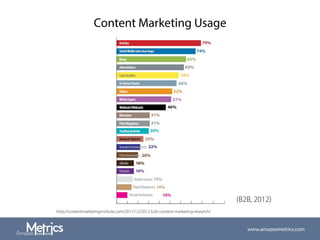
Content Marketing Usage
www.amazeemetrics.com
http://contentmarketinginstitute.com/2011/12/2012-b2b-content-marketing-research/
(B2B, 2012)
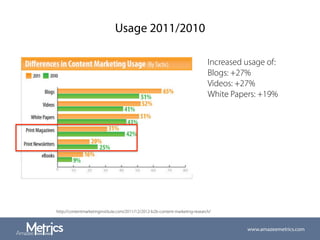
Usage 2011/2010
www.amazeemetrics.com
http://contentmarketinginstitute.com/2011/12/2012-b2b-content-marketing-research/
Increased usage of:
Blogs: +27%
Videos: +27%
White Papers: +19%
Content Marketing
Measurement
Frameworks
What are the Goals of Content Marketing?
Wikipedia
Content Marketing is any marketing format that involves the creation and
sharing of media and publishing content in order to acquire customers. This
information can be presented in a variety of formats, including news video,
white papers, e-books, info-graphics, case studies, how-to guides, question and
answer articles, photos, etc.
http://en.wikipedia.org/wiki/Content_marketing
Content Marketing Institute
Content marketing is a marketing technique of creating and distributing
relevant and valuable content to attract, acquire, and engage a clearly defined
and understood target audience – with the objective of driving profitable
customer action.
http://contentmarketinginstitute.com/what-is-content-marketing/
www.amazeemetrics.com
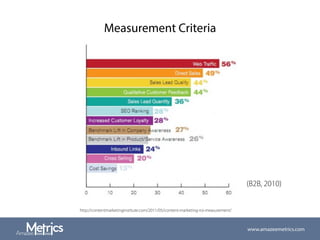
Measurement Criteria
www.amazeemetrics.com
http://contentmarketinginstitute.com/2011/05/content-marketing-roi-measurement/
(B2B, 2010)
Measurement Framework 1:
Content Marketing ROI and Page Value
Page Value (Google Analytics):
•  The average value for a page that a user visited before landing on
the goal page or completing an Ecommerce transaction (or both).
•  This value is intended to give you an idea of which page in your site
contributed more to your site’s revenue.
(http://www.branded3.com/blogs/using-page-value-in-google-analytics-to-measure-the-roi-of-content-marketing/)
Important:
Create segments and compare pages with pages of the same
part of the website.
(Blog posts with blog posts and not with contact or information
pages.)
www.amazeemetrics.com
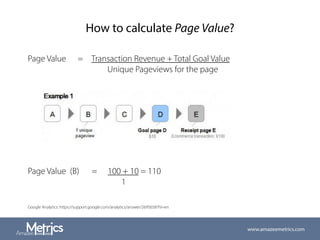
How to calculate Page Value?
www.amazeemetrics.com
Page Value = Transaction Revenue + Total Goal Value
Unique Pageviews for the page
Page Value (B) = 100 + 10 = 110
1
Google Analytics: https://support.google.com/analytics/answer/2695658?hl=en
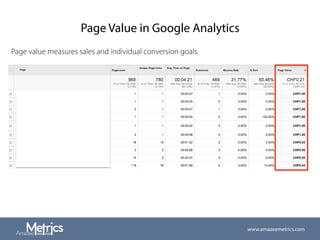
Page Value in Google Analytics
www.amazeemetrics.com
Page value measures sales and individual conversion goals.
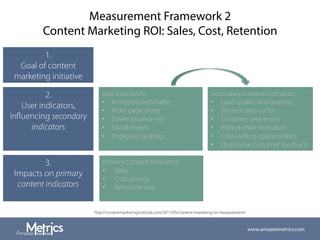
Measurement Framework 2
Content Marketing ROI: Sales, Cost, Retention
Primary Content Indicators:
•  Sales
•  Cost savings
•  Retention rate
www.amazeemetrics.com
http://contentmarketinginstitute.com/2011/05/content-marketing-roi-measurement/
Secondary content indicators:
•  Lead quality and quantity
•  Shorter sales cycles
•  Customer awareness
•  Market share indicators
•  Cross-selling opportunities
•  Qualitative customer feedback
1.
Goal of content
marketing initiative
2.
User indicators,
influencing secondary
indicators
3.
Impacts on primary
content indicators
User indicators:
•  Increased web traffic
•  More page views
•  Lower bounce rate
•  Social shares
•  Improved rankings
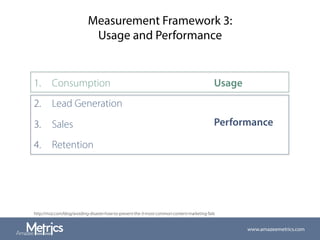
Measurement Framework 3:
Usage and Performance
1.  Consumption
2.  Lead Generation
3.  Sales
4.  Retention
http://moz.com/blog/avoiding-disaster-how-to-prevent-the-3-most-common-content-marketing-fails
www.amazeemetrics.com
Usage
Performance
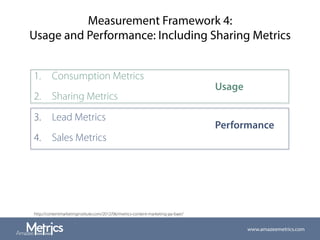
Measurement Framework 4:
Usage and Performance: Including Sharing Metrics
1.  Consumption Metrics
2.  Sharing Metrics
3.  Lead Metrics
4.  Sales Metrics
http://contentmarketinginstitute.com/2012/06/metrics-content-marketing-jay-baer/
www.amazeemetrics.com
Usage
Performance
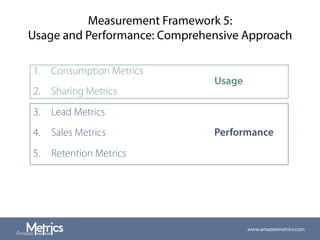
Measurement Framework 5:
Usage and Performance: Comprehensive Approach
1.  Consumption Metrics
2.  Sharing Metrics
3.  Lead Metrics
4.  Sales Metrics
5.  Retention Metrics
www.amazeemetrics.com
Usage
Performance
Content Marketing
Metrics and KPIs
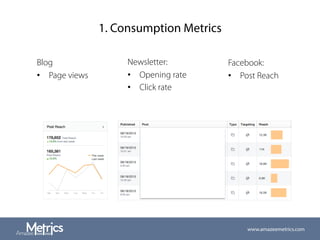
1. Consumption Metrics
Blog
•  Page views
www.amazeemetrics.com
Newsletter:
•  Opening rate
•  Click rate
Facebook:
•  Post Reach
2. Sharing Metrics
Blog Post:
•  Social Shares (social share buttons, URL mentioning)
•  External links to blog post
Twitter:
•  Retweets
•  Favorites
www.amazeemetrics.com
Google+ Page:
Dashboard including consumption and shares.
Facebook:
•  Likes
•  Shares
	
  
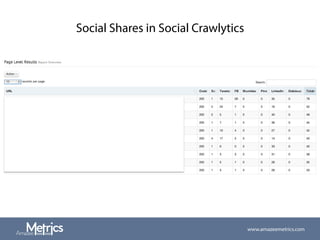
Social Shares in Social Crawlytics
www.amazeemetrics.com
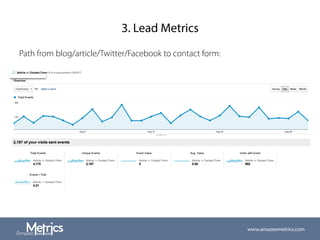
3. Lead Metrics
Path from blog/article/Twitter/Facebook to contact form:
www.amazeemetrics.com
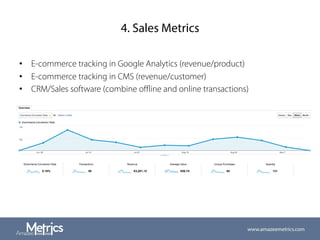
4. Sales Metrics
•  E-commerce tracking in Google Analytics (revenue/product)
•  E-commerce tracking in CMS (revenue/customer)
•  CRM/Sales software (combine offline and online transactions)
www.amazeemetrics.com
5. Retention Metrics
•  Returning Visitors
•  Customer Retention Rate (returning customers compared to customer total)
•  Repeated Sales (number of purchases per customer)
•  Average Customer Revenue
•  Net Promoter Score (recommendations)
www.amazeemetrics.com
Content Marketing and
SEO
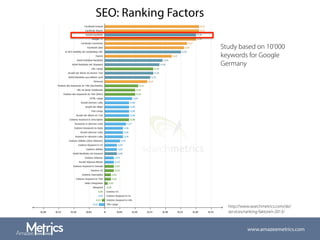
SEO: Ranking Factors
www.amazeemetrics.com
http://www.searchmetrics.com/de/
services/ranking-faktoren-2013/
Study based on 10'000
keywords for Google
Germany
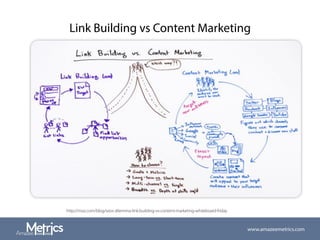
Link Building vs Content Marketing
http://moz.com/blog/seos-dilemma-link-building-vs-content-marketing-whiteboard-friday
www.amazeemetrics.com
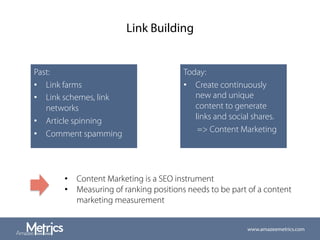
Link Building
Past:
•  Link farms
•  Link schemes, link
networks
•  Article spinning
•  Comment spamming
www.amazeemetrics.com
Today:
•  Create continuously
new and unique
content to generate
links and social shares.
=> Content Marketing
•  Content Marketing is a SEO instrument
•  Measuring of ranking positions needs to be part of a content
marketing measurement
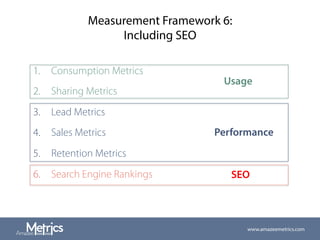
Measurement Framework 6:
Including SEO
1.  Consumption Metrics
2.  Sharing Metrics
3.  Lead Metrics
4.  Sales Metrics
5.  Retention Metrics
6.  Search Engine Rankings
www.amazeemetrics.com
Usage
Performance
SEO
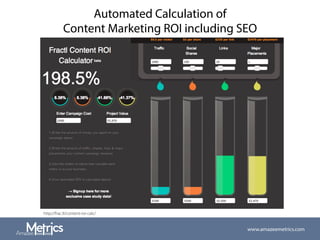
Automated Calculation of
Content Marketing ROI including SEO
http://frac.tl/content-roi-calc/
www.amazeemetrics.com
Take Home Message
•  Define the goal of the content marketing campaign
•  Choose a measurement framework and keep it
•  Compare changes and trends over time
www.amazeemetrics.com

Content Marketing Measurement - Analytics Roundtable Zurich 12.11.2013

  • 1.
  • 2.
    Agenda 1.  What isContent Marketing? 2.  Content Marketing Measurement Frameworks 3.  Content Marketing – Metrics and KPIs 4.  Content Marketing and SEO www.amazeemetrics.com
  • 3.
  • 4.
    Content Marketing Wikipedia Content Marketingis any marketing format that involves the creation and sharing of media and publishing content in order to acquire customers. This information can be presented in a variety of formats, including news video, white papers, e-books, infographics, case studies, how-to guides, question and answer articles, photos, etc. http://en.wikipedia.org/wiki/Content_marketing Content Marketing Institute Content marketing is a marketing technique of creating and distributing relevant and valuable content to attract, acquire, and engage a clearly defined and understood target audience – with the objective of driving profitable customer action. http://contentmarketinginstitute.com/what-is-content-marketing/ www.amazeemetrics.com
  • 5.
    Content Marketing "Pragmatic Definition" ContentMarketing is about delivering the content your audience is seeking in all the places they are searching for it. It is the effective combination of created, curated and syndicated content. https://twitter.com/BrennerMichael Content Marketing Elevator Pitch Traditional marketing and advertising it telling the world you're a rock star. Content Marketing is showing the world that you are one. https://twitter.com/Robert_Rose www.amazeemetrics.com
  • 6.
  • 7.
  • 8.
  • 9.
    What are theGoals of Content Marketing? Wikipedia Content Marketing is any marketing format that involves the creation and sharing of media and publishing content in order to acquire customers. This information can be presented in a variety of formats, including news video, white papers, e-books, info-graphics, case studies, how-to guides, question and answer articles, photos, etc. http://en.wikipedia.org/wiki/Content_marketing Content Marketing Institute Content marketing is a marketing technique of creating and distributing relevant and valuable content to attract, acquire, and engage a clearly defined and understood target audience – with the objective of driving profitable customer action. http://contentmarketinginstitute.com/what-is-content-marketing/ www.amazeemetrics.com
  • 10.
  • 11.
    Measurement Framework 1: ContentMarketing ROI and Page Value Page Value (Google Analytics): •  The average value for a page that a user visited before landing on the goal page or completing an Ecommerce transaction (or both). •  This value is intended to give you an idea of which page in your site contributed more to your site’s revenue. (http://www.branded3.com/blogs/using-page-value-in-google-analytics-to-measure-the-roi-of-content-marketing/) Important: Create segments and compare pages with pages of the same part of the website. (Blog posts with blog posts and not with contact or information pages.) www.amazeemetrics.com
  • 12.
    How to calculatePage Value? www.amazeemetrics.com Page Value = Transaction Revenue + Total Goal Value Unique Pageviews for the page Page Value (B) = 100 + 10 = 110 1 Google Analytics: https://support.google.com/analytics/answer/2695658?hl=en
  • 13.
    Page Value inGoogle Analytics www.amazeemetrics.com Page value measures sales and individual conversion goals.
  • 14.
    Measurement Framework 2 ContentMarketing ROI: Sales, Cost, Retention Primary Content Indicators: •  Sales •  Cost savings •  Retention rate www.amazeemetrics.com http://contentmarketinginstitute.com/2011/05/content-marketing-roi-measurement/ Secondary content indicators: •  Lead quality and quantity •  Shorter sales cycles •  Customer awareness •  Market share indicators •  Cross-selling opportunities •  Qualitative customer feedback 1. Goal of content marketing initiative 2. User indicators, influencing secondary indicators 3. Impacts on primary content indicators User indicators: •  Increased web traffic •  More page views •  Lower bounce rate •  Social shares •  Improved rankings
  • 15.
    Measurement Framework 3: Usageand Performance 1.  Consumption 2.  Lead Generation 3.  Sales 4.  Retention http://moz.com/blog/avoiding-disaster-how-to-prevent-the-3-most-common-content-marketing-fails www.amazeemetrics.com Usage Performance
  • 16.
    Measurement Framework 4: Usageand Performance: Including Sharing Metrics 1.  Consumption Metrics 2.  Sharing Metrics 3.  Lead Metrics 4.  Sales Metrics http://contentmarketinginstitute.com/2012/06/metrics-content-marketing-jay-baer/ www.amazeemetrics.com Usage Performance
  • 17.
    Measurement Framework 5: Usageand Performance: Comprehensive Approach 1.  Consumption Metrics 2.  Sharing Metrics 3.  Lead Metrics 4.  Sales Metrics 5.  Retention Metrics www.amazeemetrics.com Usage Performance
  • 18.
  • 19.
    1. Consumption Metrics Blog • Page views www.amazeemetrics.com Newsletter: •  Opening rate •  Click rate Facebook: •  Post Reach
  • 20.
    2. Sharing Metrics BlogPost: •  Social Shares (social share buttons, URL mentioning) •  External links to blog post Twitter: •  Retweets •  Favorites www.amazeemetrics.com Google+ Page: Dashboard including consumption and shares. Facebook: •  Likes •  Shares  
  • 21.
    Social Shares inSocial Crawlytics www.amazeemetrics.com
  • 22.
    3. Lead Metrics Pathfrom blog/article/Twitter/Facebook to contact form: www.amazeemetrics.com
  • 23.
    4. Sales Metrics • E-commerce tracking in Google Analytics (revenue/product) •  E-commerce tracking in CMS (revenue/customer) •  CRM/Sales software (combine offline and online transactions) www.amazeemetrics.com
  • 24.
    5. Retention Metrics • Returning Visitors •  Customer Retention Rate (returning customers compared to customer total) •  Repeated Sales (number of purchases per customer) •  Average Customer Revenue •  Net Promoter Score (recommendations) www.amazeemetrics.com
  • 25.
  • 26.
  • 27.
    Link Building vsContent Marketing http://moz.com/blog/seos-dilemma-link-building-vs-content-marketing-whiteboard-friday www.amazeemetrics.com
  • 28.
    Link Building Past: •  Linkfarms •  Link schemes, link networks •  Article spinning •  Comment spamming www.amazeemetrics.com Today: •  Create continuously new and unique content to generate links and social shares. => Content Marketing •  Content Marketing is a SEO instrument •  Measuring of ranking positions needs to be part of a content marketing measurement
  • 29.
    Measurement Framework 6: IncludingSEO 1.  Consumption Metrics 2.  Sharing Metrics 3.  Lead Metrics 4.  Sales Metrics 5.  Retention Metrics 6.  Search Engine Rankings www.amazeemetrics.com Usage Performance SEO
  • 30.
    Automated Calculation of ContentMarketing ROI including SEO http://frac.tl/content-roi-calc/ www.amazeemetrics.com
  • 31.
    Take Home Message • Define the goal of the content marketing campaign •  Choose a measurement framework and keep it •  Compare changes and trends over time www.amazeemetrics.com