Estimation and Costing
RATE ANALYSIS
Submitted By Submitted to
Vansheika (202601) Er. Akash Bhardwaj
RATE ANALYSIS
“ The determination of rate per unit of a particular item of work, from the
cost of quantities of materials, the cost of labourers and other miscellaneous
petty expenses required for its completion is known as the analysis of rates.”
In order to determine the rate of a particular item, the factors affecting
the rate of that item are studied carefully and then finally a rate is
decided for that item.
PURPOSE OF RATE ANALYSIS
•To work out the actual cost of per unit of the items.
•To work out the economical use of materials and processes in completing a
particular item.
•To work out the cost of extra items which are not provided in the contract bond,
but are to be done as per the directions of the department.
•To revise the schedule of rates due to increase in the cost of material and labour
or due to change in technique.
FACTORS AFFECTING RATE ANALYSIS
1. Specification of works and material, quality of materials, proportion of mortar
method of construction and operation.
2. Quantities of materials and their rates
3. Number of different types of labourer and their rates.
4. Location of site of work and its distance from the sources of materials and the
rates of transport, availability of water.
5. Profit and miscellaneous and overhead expenses of contractor.
How is a new unit rate defined?
The starting point to define the new unit rate, is to run a careful analysis of
the elements and resources that build up to form the new work item.
The elementary components, or resources, are generally the following:
• workforce
• materials
• hired equipment
• overheads
• company profits
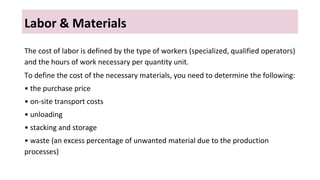
Labor & Materials
The cost of labor is defined by the type of workers (specialized, qualified operators)
and the hours of work necessary per quantity unit.
To define the cost of the necessary materials, you need to determine the following:
• the purchase price
• on-site transport costs
• unloading
• stacking and storage
• waste (an excess percentage of unwanted material due to the production
processes)
OVERHEAD COSTS
• It includes general office expense, rents, taxes, supervision and other costs which are indirect
expense and not productive expense of job.
• The miscellaneous expense on overheads may be under the following heads;
A.General overheads
1. Establishment (office staff)
2. Stationary, printing, postages etc.
3. Travelling expense
4. Telephone
5. Rent and Taxes
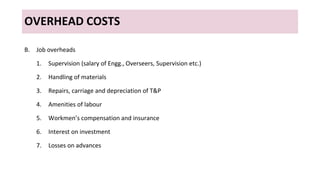
OVERHEAD COSTS
B. Job overheads
1. Supervision (salary of Engg., Overseers, Supervision etc.)
2. Handling of materials
3. Repairs, carriage and depreciation of T&P
4. Amenities of labour
5. Workmen’s compensation and insurance
6. Interest on investment
7. Losses on advances
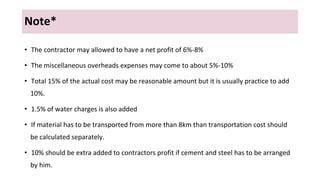
Note*
• The contractor may allowed to have a net profit of 6%-8%
• The miscellaneous overheads expenses may come to about 5%-10%
• Total 15% of the actual cost may be reasonable amount but it is usually practice to add
10%.
• 1.5% of water charges is also added
• If material has to be transported from more than 8km than transportation cost should
be calculated separately.
• 10% should be extra added to contractors profit if cement and steel has to be arranged
by him.
Lead statement
• The distance between the source of availability of material and construction site is
known as "Lead " and is expected in Km.
• The cost of conveyance of material depends on lead.
• This statement will give the total cost of materials per unit item. It includes first
cost, conveyance loading, unloading stacking, charges etc.
TASK OR TURN-OUT WORK
• Task : the capacity of doing work by an artisan or skilled labour in the form of quantity of work
per day.
• It varies to some extent according to the nature, size, height, situation, location etc.
example
For the excavation of foundation of a building. 4 labours worked out for 2 days and total quantity of
earthwork was 24cu.mt.
So total labours worked = 2 x 4 = 8 Nos
Task of one labour = 24/8 = 3 cu.mt.
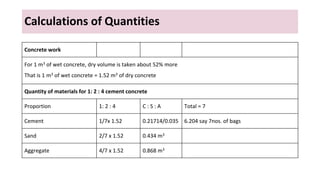
Calculations of Quantities
Concrete work
For 1 m3 of wet concrete, dry volume is taken about 52% more
That is 1 m3 of wet concrete = 1.52 m3 of dry concrete
Quantity of materials for 1: 2 : 4 cement concrete
Proportion 1: 2 : 4 C : S : A Total = 7
Cement 1/7x 1.52 0.21714/0.035 6.204 say 7nos. of bags
Sand 2/7 x 1.52 0.434 m3
Aggregate 4/7 x 1.52 0.868 m3
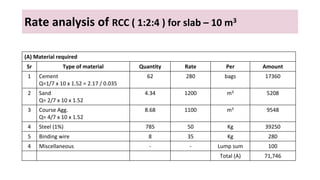
Rate analysis of RCC ( 1:2:4 ) for slab – 10 m3
(A) Material required
Sr Type of material Quantity Rate Per Amount
1 Cement
Q=1/7 x 10 x 1.52 = 2.17 / 0.035
62 280 bags 17360
2 Sand
Q= 2/7 x 10 x 1.52
4.34 1200 m3 5208
3 Course Agg.
Q= 4/7 x 10 x 1.52
8.68 1100 m3 9548
4 Steel (1%) 785 50 Kg 39250
5 Binding wire 8 35 Kg 280
4 Miscellaneous - - Lump sum 100
Total (A) 71,746
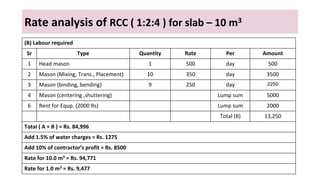
Rate analysis of RCC ( 1:2:4 ) for slab – 10 m3
(B) Labour required
Sr Type Quantity Rate Per Amount
1 Head mason 1 500 day 500
2 Mason (Mixing, Trans., Placement) 10 350 day 3500
3 Mason (binding, bending) 9 250 day 2250
4 Mason (centering ,shuttering) Lump sum 5000
6 Rent for Equp. (2000 Rs) Lump sum 2000
Total (B) 13,250
Total ( A + B ) = Rs. 84,996
Add 1.5% of water charges = Rs. 1275
Add 10% of contractor’s profit = Rs. 8500
Rate for 10.0 m3 = Rs. 94,771
Rate for 1.0 m3 = Rs. 9,477

Rate analysis vansheika

  • 1.
    Estimation and Costing RATEANALYSIS Submitted By Submitted to Vansheika (202601) Er. Akash Bhardwaj
  • 2.
    RATE ANALYSIS “ Thedetermination of rate per unit of a particular item of work, from the cost of quantities of materials, the cost of labourers and other miscellaneous petty expenses required for its completion is known as the analysis of rates.” In order to determine the rate of a particular item, the factors affecting the rate of that item are studied carefully and then finally a rate is decided for that item.
  • 3.
    PURPOSE OF RATEANALYSIS •To work out the actual cost of per unit of the items. •To work out the economical use of materials and processes in completing a particular item. •To work out the cost of extra items which are not provided in the contract bond, but are to be done as per the directions of the department. •To revise the schedule of rates due to increase in the cost of material and labour or due to change in technique.
  • 4.
    FACTORS AFFECTING RATEANALYSIS 1. Specification of works and material, quality of materials, proportion of mortar method of construction and operation. 2. Quantities of materials and their rates 3. Number of different types of labourer and their rates. 4. Location of site of work and its distance from the sources of materials and the rates of transport, availability of water. 5. Profit and miscellaneous and overhead expenses of contractor.
  • 5.
    How is anew unit rate defined? The starting point to define the new unit rate, is to run a careful analysis of the elements and resources that build up to form the new work item. The elementary components, or resources, are generally the following: • workforce • materials • hired equipment • overheads • company profits
  • 6.
    Labor & Materials Thecost of labor is defined by the type of workers (specialized, qualified operators) and the hours of work necessary per quantity unit. To define the cost of the necessary materials, you need to determine the following: • the purchase price • on-site transport costs • unloading • stacking and storage • waste (an excess percentage of unwanted material due to the production processes)
  • 7.
    OVERHEAD COSTS • Itincludes general office expense, rents, taxes, supervision and other costs which are indirect expense and not productive expense of job. • The miscellaneous expense on overheads may be under the following heads; A.General overheads 1. Establishment (office staff) 2. Stationary, printing, postages etc. 3. Travelling expense 4. Telephone 5. Rent and Taxes
  • 8.
    OVERHEAD COSTS B. Joboverheads 1. Supervision (salary of Engg., Overseers, Supervision etc.) 2. Handling of materials 3. Repairs, carriage and depreciation of T&P 4. Amenities of labour 5. Workmen’s compensation and insurance 6. Interest on investment 7. Losses on advances
  • 9.
    Note* • The contractormay allowed to have a net profit of 6%-8% • The miscellaneous overheads expenses may come to about 5%-10% • Total 15% of the actual cost may be reasonable amount but it is usually practice to add 10%. • 1.5% of water charges is also added • If material has to be transported from more than 8km than transportation cost should be calculated separately. • 10% should be extra added to contractors profit if cement and steel has to be arranged by him.
  • 10.
    Lead statement • Thedistance between the source of availability of material and construction site is known as "Lead " and is expected in Km. • The cost of conveyance of material depends on lead. • This statement will give the total cost of materials per unit item. It includes first cost, conveyance loading, unloading stacking, charges etc.
  • 11.
    TASK OR TURN-OUTWORK • Task : the capacity of doing work by an artisan or skilled labour in the form of quantity of work per day. • It varies to some extent according to the nature, size, height, situation, location etc. example For the excavation of foundation of a building. 4 labours worked out for 2 days and total quantity of earthwork was 24cu.mt. So total labours worked = 2 x 4 = 8 Nos Task of one labour = 24/8 = 3 cu.mt.
  • 12.
    Calculations of Quantities Concretework For 1 m3 of wet concrete, dry volume is taken about 52% more That is 1 m3 of wet concrete = 1.52 m3 of dry concrete Quantity of materials for 1: 2 : 4 cement concrete Proportion 1: 2 : 4 C : S : A Total = 7 Cement 1/7x 1.52 0.21714/0.035 6.204 say 7nos. of bags Sand 2/7 x 1.52 0.434 m3 Aggregate 4/7 x 1.52 0.868 m3
  • 13.
    Rate analysis ofRCC ( 1:2:4 ) for slab – 10 m3 (A) Material required Sr Type of material Quantity Rate Per Amount 1 Cement Q=1/7 x 10 x 1.52 = 2.17 / 0.035 62 280 bags 17360 2 Sand Q= 2/7 x 10 x 1.52 4.34 1200 m3 5208 3 Course Agg. Q= 4/7 x 10 x 1.52 8.68 1100 m3 9548 4 Steel (1%) 785 50 Kg 39250 5 Binding wire 8 35 Kg 280 4 Miscellaneous - - Lump sum 100 Total (A) 71,746
  • 14.
    Rate analysis ofRCC ( 1:2:4 ) for slab – 10 m3 (B) Labour required Sr Type Quantity Rate Per Amount 1 Head mason 1 500 day 500 2 Mason (Mixing, Trans., Placement) 10 350 day 3500 3 Mason (binding, bending) 9 250 day 2250 4 Mason (centering ,shuttering) Lump sum 5000 6 Rent for Equp. (2000 Rs) Lump sum 2000 Total (B) 13,250 Total ( A + B ) = Rs. 84,996 Add 1.5% of water charges = Rs. 1275 Add 10% of contractor’s profit = Rs. 8500 Rate for 10.0 m3 = Rs. 94,771 Rate for 1.0 m3 = Rs. 9,477