ESTIMATION AND COSTING OF SOIL AND WATER CONSERVATION MEASURES
ESTIMATE “ An estimate is calculation or computation of the quantities of materials needed for a particular work and expenses likely to be incurred in the execution  of the  work
Necessity   To assess the financial requirements  For obtaining the approval and sanction of competent authority To assess the economic feasibility of the project
Types of estimates   Preliminary estimate or rough cost estimate  Detailed estimate  Revised estimate  Supplementary estimate
Preliminary estimate To decide the financial involvement for AS by the authority  Cost of major components should be shown separately brief report  and site plan needed Prepared based on practical knowlwdge and similar works undertaken in the past
Detailed estimate Based on the plan and sectional drawings  Details of the works Quantities of diff items of works  Cost of each item Contingencies etc
Revised estimate   Is also a detailed estimate Prepared when original sanctioned estimate is likely to exceed during the execution of work. New components incorporated
Supplementary Estimate   Detailed estimate of the additional work  Is prepared when additional works are required to supplement the original work
Preparation of estimates   Rates of items are worked out based on detailed data providing  cost of materials, conveyance charges  and  labour  as per schedule
DATA   the data book deals  with the quantities of materials and labour required for different items of work will remain unchanged by fluctuation in market rates
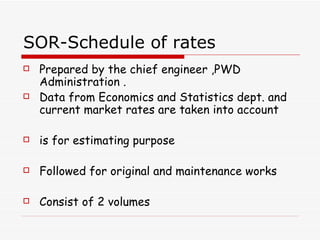
SOR-Schedule of rates  Prepared by the chief engineer ,PWD Administration . Data from Economics and Statistics dept. and current market rates are taken into account  is for estimating purpose  Followed for original and maintenance works  Consist of 2 volumes
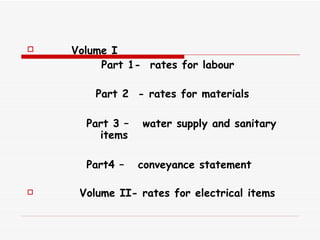
Volume I Part 1-  rates for labour Part 2  - rates for materials  Part 3 –  water supply and sanitary items  Part4 –  conveyance statement Volume II- rates for electrical items
Rates are exclusive of conveyance charges of materials to site of work Do not include contractor’s profit Present  schedule – REVISED SOR 2010
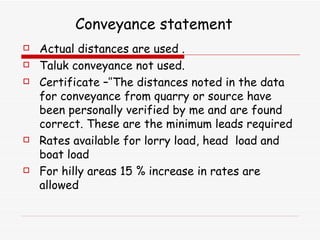
  Conveyance statement   Actual distances are used . Taluk conveyance not used.  Certificate –’’The distances noted in the data for conveyance from quarry or source have been personally verified by me and are found correct. These are the minimum leads required Rates available for lorry load, head  load and boat load For hilly areas 15 % increase in rates are allowed
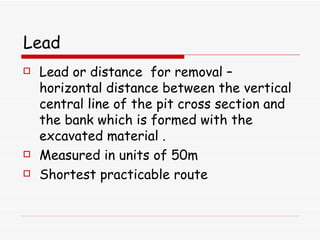
Lead Lead or distance  for removal – horizontal distance between the vertical central line of the pit cross section and the bank which is formed with the excavated material . Measured in units of 50m Shortest practicable route
Lift   Vertical distance  ½ depth of the pit excavated +1/2 the height of bank formed with excavated earth +difference in level between the top of the pit and bottom of the bank
A-DEPTH OF PIT EXCAVATED  B-HEIGHT OF BANK FORMED C-DIFF .BETWEEN TOP OF PIT & BOTTOM OF BANK  LIFT =1/2A+1/2B+C
Earthwork excavation   Excavation in different material to be estimated separately. Ordinary soil –Any material yields to the application of mammati ,spade or shovel  Hard soil – Any material which requires the application of picks or scarifiers to loosen
Data for earthwork excavation   Amount  Rate  unit Description of items  Qty  Sl no        Rs. 817.65/10 m³ Total 817.65     Sub Total   569.25 207.00 E 0.75 Man (boy) 2.75 248.40 276.00 E Man 0.9       Earth work excavation in ordinary soil and depositing it with leadupto 50 m and lift  upto 1.5 m including neat banking 10m 3 56
DR Masonry   Amount  Rate  unit Description of items  Qty  Sl no        Rs. 1,266.21/ m³ Total 193.20 276.00 E Man 0.7 299.00 373.75 E Mason  0.8 447.98 426.65 M 3 conveyance(13 km lorry load&200mheadload) 1.05 m³ 326.03 310.50 M 3 Cost of rubble 1.05 m³       Dry rubble masonry M 3 277

Basics of estimation

  • 1.
    ESTIMATION AND COSTINGOF SOIL AND WATER CONSERVATION MEASURES
  • 2.
    ESTIMATE “ Anestimate is calculation or computation of the quantities of materials needed for a particular work and expenses likely to be incurred in the execution of the work
  • 3.
    Necessity To assess the financial requirements For obtaining the approval and sanction of competent authority To assess the economic feasibility of the project
  • 4.
    Types of estimates Preliminary estimate or rough cost estimate Detailed estimate Revised estimate Supplementary estimate
  • 5.
    Preliminary estimate Todecide the financial involvement for AS by the authority Cost of major components should be shown separately brief report and site plan needed Prepared based on practical knowlwdge and similar works undertaken in the past
  • 6.
    Detailed estimate Basedon the plan and sectional drawings Details of the works Quantities of diff items of works Cost of each item Contingencies etc
  • 7.
    Revised estimate Is also a detailed estimate Prepared when original sanctioned estimate is likely to exceed during the execution of work. New components incorporated
  • 8.
    Supplementary Estimate Detailed estimate of the additional work Is prepared when additional works are required to supplement the original work
  • 9.
    Preparation of estimates Rates of items are worked out based on detailed data providing cost of materials, conveyance charges and labour as per schedule
  • 10.
    DATA the data book deals with the quantities of materials and labour required for different items of work will remain unchanged by fluctuation in market rates
  • 11.
    SOR-Schedule of rates Prepared by the chief engineer ,PWD Administration . Data from Economics and Statistics dept. and current market rates are taken into account is for estimating purpose Followed for original and maintenance works Consist of 2 volumes
  • 12.
    Volume I Part1- rates for labour Part 2 - rates for materials Part 3 – water supply and sanitary items Part4 – conveyance statement Volume II- rates for electrical items
  • 13.
    Rates are exclusiveof conveyance charges of materials to site of work Do not include contractor’s profit Present schedule – REVISED SOR 2010
  • 14.
    Conveyancestatement Actual distances are used . Taluk conveyance not used. Certificate –’’The distances noted in the data for conveyance from quarry or source have been personally verified by me and are found correct. These are the minimum leads required Rates available for lorry load, head load and boat load For hilly areas 15 % increase in rates are allowed
  • 15.
    Lead Lead ordistance for removal – horizontal distance between the vertical central line of the pit cross section and the bank which is formed with the excavated material . Measured in units of 50m Shortest practicable route
  • 16.
    Lift Vertical distance ½ depth of the pit excavated +1/2 the height of bank formed with excavated earth +difference in level between the top of the pit and bottom of the bank
  • 17.
    A-DEPTH OF PITEXCAVATED B-HEIGHT OF BANK FORMED C-DIFF .BETWEEN TOP OF PIT & BOTTOM OF BANK LIFT =1/2A+1/2B+C
  • 18.
    Earthwork excavation Excavation in different material to be estimated separately. Ordinary soil –Any material yields to the application of mammati ,spade or shovel Hard soil – Any material which requires the application of picks or scarifiers to loosen
  • 19.
    Data for earthworkexcavation Amount Rate unit Description of items Qty Sl no       Rs. 817.65/10 m³ Total 817.65     Sub Total   569.25 207.00 E 0.75 Man (boy) 2.75 248.40 276.00 E Man 0.9       Earth work excavation in ordinary soil and depositing it with leadupto 50 m and lift upto 1.5 m including neat banking 10m 3 56
  • 20.
    DR Masonry Amount Rate unit Description of items Qty Sl no       Rs. 1,266.21/ m³ Total 193.20 276.00 E Man 0.7 299.00 373.75 E Mason 0.8 447.98 426.65 M 3 conveyance(13 km lorry load&200mheadload) 1.05 m³ 326.03 310.50 M 3 Cost of rubble 1.05 m³       Dry rubble masonry M 3 277