Download to read offline
![International Research Journal of Engineering and Technology (IRJET) e-ISSN: 2395-0056
Volume: 05 Issue: 10 | Oct 2018 www.irjet.net p-ISSN: 2395-0072
© 2018, IRJET | Impact Factor value: 7.211 | ISO 9001:2008 Certified Journal | Page 1814
Optimal Placement and Size of DG and DER for Minimizing Power Loss
and AEL in 33-Bus Distribution System by various Optimization
Techniques
Priya Kashyap1 and Pushpendra Singh2
1M.Tech student, EE Dept., Govt. Women Engineering College, Ajmer, India
2Assistant Professor, EE Dept., Govt. Women Engineering College, Ajmer, India
---------------------------------------------------------------------***---------------------------------------------------------------------
Abstract - In the electrical power distribution system the
network feeds inductive loads for low voltage level, which
lead to higher currents and power losses. Therefore, it is
mandatory to improve the power system stability and
reliability, power factor and voltage profile, which is done
by placing active and reactive resources i.e., DG and
Capacitor bank in the system. This paper presents the new
optimization techniques for finding the optimal location and
size of DG and capacitor bank in the electrical network .The
proposed MFO optimization technique is first validated for
power loss minimization, performed in the MATLAB R2015a
software. Further, results are obtained for DG and DER
placement in 33 bus system for different load levels-peak,
normal and light load level. The study states that the best
location and size of DG and DER is obtained by using MFO
techniques for minimizing Power Loss and further
minimizing AEL in the distribution system.
Key Words: DG(Distributed generation),
DER(Distributed Energy Resources),Optimization
technique, MFO(Moth Flame Optimization),
GOA(Grasshopper Optimization Algorithm),
AEL(Annual Energy Loss).
1. INTRODUCTION
The power system contains three major blocks i.e. power
generation, power transmission, and power distribution.
Power is generated at power generation stations and
travels towards consumer area via transmission and
distribution system. The type of distribution system used
is of Radial Type because of its simplicity. In a radial
distribution system, there are main feeders and lateral
distributors. The main feeder originates from the
substation and passes through different consumer loads.
Laterals are connected to individual loads.[1]
The two major challenges that the modern power systems
are facing are voltage and angle stabilities, expansion in
electrical power network and increase in load demand
which leads to the stability issues, voltage level and power
losses issues. To obtain best from the existing network. i.e.,
to enhance voltage, minimize the losses compensation is
done by placing the capacitor bank at a particular node in
the system [2][3]. Nowadays Distributed generation is
used, which are small sized power generating units near to
the load center [4][5]. Which further increase its overall
efficiency in the distribution system at optimal locations.
DG is acronyms of Distributed generation and it is also
called as a decentralized generation, embedded generation
or dispersed generation.[6]The literal meaning of
Optimization is the act of making the best or most effective
use of a situation or resource. For starting any prototype
in engineering design, both analysis and optimization are
employed. An optimum solution for a problem is
determined by the use of optimization methods.It is
beneficial in reducing the losses effectively compared to
other methods of loss reduction.[7] In this paper, optimal
DG unit size and its placement using GOA and MFO
algorithm are discuss.
2. Problem Formulation
The study is done for the active power loss minimization
of the test power system. Consider the objective function
for active power minimization as:
Nb-1
Fploss= ∑ ki ri
i=1
(1)
ri resistance of line i
Vi voltage magnitude of bus i
Pi , Qi real and reactive power injected to bus i
The power flow equations are given by:
Nb-1
Pi+PDGi-PLi-Vi ∑Vj[Gij cos(𝞗ij) + Bij sin(𝞗ij)] = 0
i=1
(2)
Nb-1
Qi+QDGi-QLi-Vi ∑Vj[Gij sin(𝞗ij) + Bij cos(𝞗ij)] = 0
i=1
(3)
PDGi , QDGi DG power generation at bus i .
PLi , QLi Active, Reactive power load at bus i .
Gij Conductance of the line (between bus i and bus j) .
Bij Susceptance of the line (between bus i and bus j) .
𝞗ij Angle between bus i and bus j .
DG Capacity limit PDGi min ≤ PDGi ≤ PDGi max (4)
PDGi min Lower limit
𝑃𝑖
2
+ 𝑄𝑖𝑖
2
𝑉𝑖
2](https://image.slidesharecdn.com/irjet-v5i10349-181109104438/75/IRJET-Optimal-Placement-and-Size-of-DG-and-DER-for-Minimizing-Power-Loss-and-AEL-in-33-Bus-Distribution-System-by-various-Optimization-Techniques-1-2048.jpg)
![International Research Journal of Engineering and Technology (IRJET) e-ISSN: 2395-0056
Volume: 05 Issue: 10 | Oct 2018 www.irjet.net p-ISSN: 2395-0072
© 2018, IRJET | Impact Factor value: 7.211 | ISO 9001:2008 Certified Journal | Page 1815
PDGi max Upper limit
NL=NB -1 (5)
NL Number of lines. [8]
3. GOA (Grasshopper Optimization Algorithm)
The flow chart of GOA is show in Figure 1
Initialize swarm Xi (i=1,2,3….n)
Initialize cmax,cmin and maximum number if iteration
Calculate fitness of seach agent
And asign T as best search agent
Update c=cmax-l
Normalize the distance between grasshopper
Update the position of search agent and T
Criteria satisfied?
Fig -1: Algorithm for GOA.[8][9]
Grass hopper Optimization is a Meta heuristic algorithm
that works on the swarming behavior of grasshoppers. It
is an insect with long hind legs .These insects have special
social interaction which equip them with the predatory
strategy. The social interaction have the two type of forces
attractive forces that exploit local search and reputation
force to explore search space.[8]This algorithm is run for
150 iterations for finding the results for different load
level .
4. MFO (Moth Flame Optimization)
The navigation method of moths is the main inspiration of
this optimizer. Moths have a very effective mechanism of
flying at night and traveling in a straight line by
maintaining a fixed angle with respect to the moon. .
[9][10][14]. The below flow chart Figure 2, of MFO will
explain the mechanism of this algorithm.
Define the algorithm parameters
Randomly generate initial moth
Calculate fitness function
Tag best position by flame
Update flame number,r,t and calculate D
Update M (i,j)…eq(6)
NO
Termination
Criteria satisfied?
YES
Report best position among the moth
Fig -2: Algorithm for MFO. [9][10][13]
Moths are insects that belonged to the family of butterflies.
The special navigation method of these insects is
developed to fly at night using moon light. The moth flies
by maintaining a fixed angle with the moon, this
mechanism called transverse orientation for navigation.
But, When moths see an artificial light, the light is
extremely close compared to moon, so they try to
maintain a similar angle with the light to fly in straight
line. However, maintaining a similar angle to the light
source causes a useless or deadly spiral fly path for moths .
Equation 6 is the representation of moth in matrix form
M=[
2
2
] (6)
START
START
END
END](https://image.slidesharecdn.com/irjet-v5i10349-181109104438/75/IRJET-Optimal-Placement-and-Size-of-DG-and-DER-for-Minimizing-Power-Loss-and-AEL-in-33-Bus-Distribution-System-by-various-Optimization-Techniques-2-2048.jpg)
![International Research Journal of Engineering and Technology (IRJET) e-ISSN: 2395-0056
Volume: 05 Issue: 10 | Oct 2018 www.irjet.net p-ISSN: 2395-0072
© 2018, IRJET | Impact Factor value: 7.211 | ISO 9001:2008 Certified Journal | Page 1816
F=[
2
] (7)
Flame matrix similar to moth matrix.
S( )= . ebt . cos(2πt)+
(8)
- distance of the i-th moth for the j-th flame,
b- constant for defining the shape of the logarithmic spiral
t -random number in [-1,1].
| | (9)
n -number of moths
d - number of variables (dimension).
- i-th moth, - j-th flame, and - distance of the ith moth
for the j-th flame. [11][12].
4.1).Validation of MFO
The proposed technique is implemented on benchmark
33-bus test distribution system. This is a 12.66 kV radial
distribution system with total real demand of 3.715 MW
and reactive demand of 2.3MVAr. . The data is taken from
reference number [15].
Initially, the proposed MFO technique is validated for 33
bus system for power loss minimization. Figure 3 shows
the Convergence curve, that shows score obtained for 150
iterations. Table-1 shows the worst fitness value is 0.0840
and best fitness value is 0.0715. The mean fitness value is
0.0777.It take approx. 125 seconds by MFO technique to
minimize the result from 0.085 to 0.0715. These values
shows the power (MW) values analyzed at every iteration
by MFO technique. Further , analysis is done for : (i)3 DGs
placement in the system and (ii) 3 DGs with 3 shunt
capacitors for DER placement in the system which is
explained in the CASE STUDY below.
Fig -3: MFO best fitness.
Table -1: Value of MFO best fitness.
Method Worst
Fitness
Best
Fitness
Mean
Fitness
CPU
Time(sec)
MFO 0.0840 0.0715 0.0777 125 sec
Table -2: Different Load Levels with Load duration and
Cost.[17][18]
LOAD
LEVEL
mf LOAD
DURATION(h)
USD/MWh
Peak(P) 1.6 1500 120
Normal(N) 1.0 5256 72
Light(L) 0.5 2000 55
5. CASE STUDY:
Optimal locations of DG and DER are analyzed using GOA
and MFO techniques for different load levels. Parameters
for different load levels are taken from Table [17][18].
Both the algorithms are run for 150 iterations. Table no. 3
show the optimal locations and sizes of DGs and DERs,
losses in each techniques, minimum voltage value and DG
and DER Penetration percentage for both techniques.
The generated results are best when MFO is used and
hence different graphs are plotted using these results.
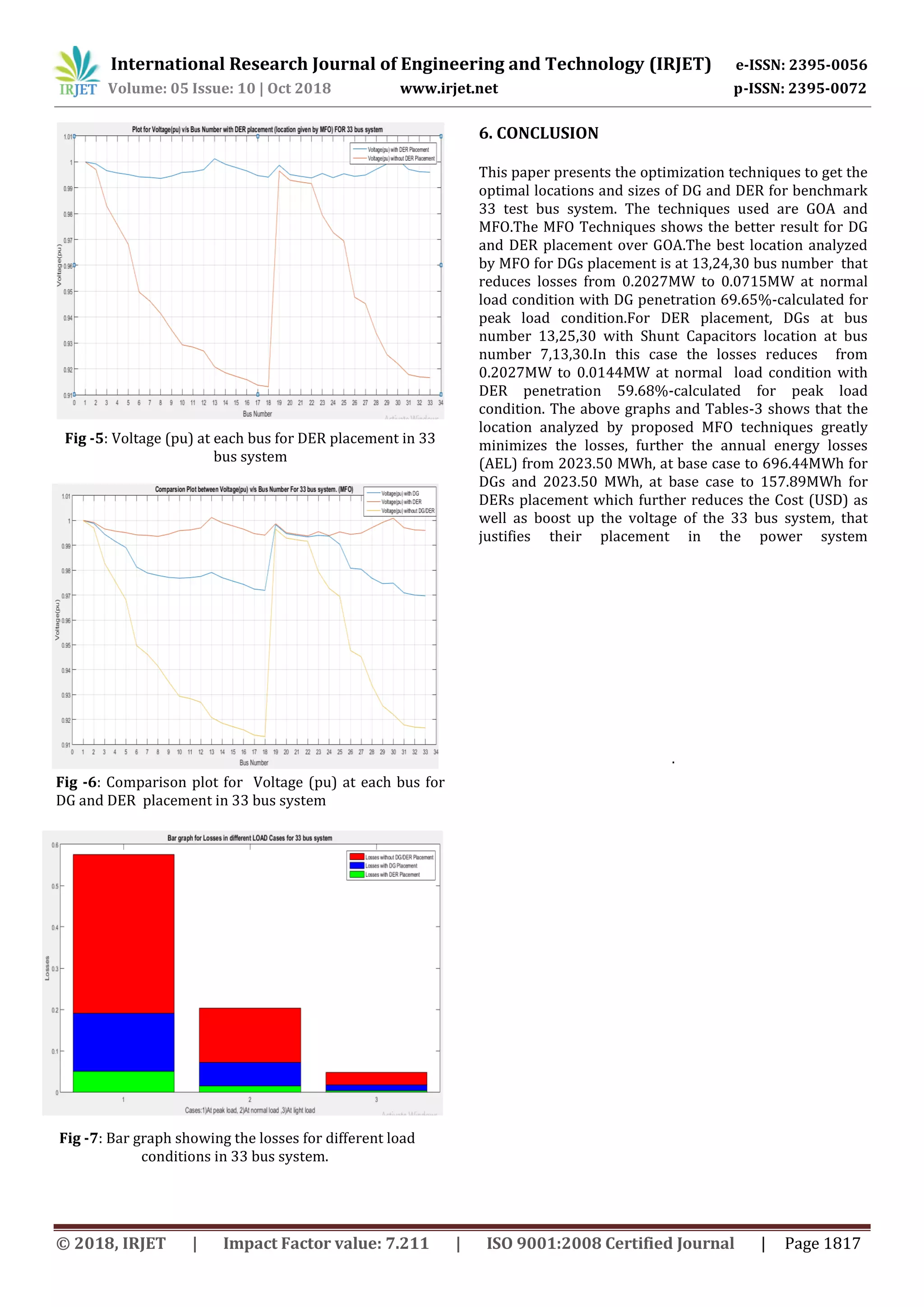
Figure 4 and Figure 5 shows plot for Voltage (pu) on each
bus for DG and DER placement respectively. A comparison
of Voltage values at each bus is shown in Figure 6, both for
DG and DER placement .And Figure 7 shows bar graph
showing the losses for different load conditions. This bar
graph shows that the losses are maximum at base case, i.e.,
when DG/DER(s) are not installed, and the losses in the
system are greatly reduces by placing DG/DER .Losses
minimization is more when DER is placed in the system.
Fig -4: Voltage (pu) at each bus for DG placement in 33
bus system.](https://image.slidesharecdn.com/irjet-v5i10349-181109104438/75/IRJET-Optimal-Placement-and-Size-of-DG-and-DER-for-Minimizing-Power-Loss-and-AEL-in-33-Bus-Distribution-System-by-various-Optimization-Techniques-3-2048.jpg)
![International Research Journal of Engineering and Technology (IRJET) e-ISSN: 2395-0056
Volume: 05 Issue: 10 | Oct 2018 www.irjet.net p-ISSN: 2395-0072
© 2018, IRJET | Impact Factor value: 7.211 | ISO 9001:2008 Certified Journal | Page 1818
Table -3: Optimal locations and Sizes of DG and DER for IEEE-33 bus system for different Load Levels.
Sno. METHOD
Used
OPTIMAL DG
Location
At
mf
OPTIMAL DG SIZE(MW) LOSSES(MW) Vmin DG penetration
(%)
Total
AEL(MWh)
COST(USD)
1 Base Case
---
P
---
0.5754 0.85
---
2023.502 185519.544
N 0.2027 0.91
L 0.0471 0.96
2 GOA 12 24 30
P 1.368 1.463 1.409 0.1966 0.94
60.65 709.146 64618.712
N 0.931 1.074 1.016 0.0721 0.97
L 0.451 0.531 0.501 0.0175 0.98
3 MFO 30 24 13
P 1.810 1.779 1.279 0.1905 0.95
69.65 696.440 63271.480
N 1.091 1.094 0.789 0.0715 0.97
L 0.530 0.540 0.390 0.0173 0.98
Sno. METHOD
Used
OPTIMAL
DER
Location
At mf OPTIMAL DER
SIZE(MW)
LOSSES(MW) Vmin DER
penetration
(%)
Total
AEL(MWh)
COST(USD)
1 Base Case
---
P
---
0.5754 0.85
--- 2023.502 185519.544N 0.2027 0.91
L 0.0471 0.96
2 GOA
24 12 31
{DG}
P {1.596 1.301 0.976} 0.0533 0.97
63.93 166.050 15670.800
[1.540 0.215 0.476]
N
{1.076 0.930 0.885}
0.0150 0.99
30 4 14
[SC]
[1.036 0.215 0.367]
L
{0.537 0.460 0.441}
0.0036 1.00[0.500 0.215 0.172]
3 MFO
13 30 25
{DG}
P
{1.175 1.420 1.085}
0.0501 0.97
59.68 157.894 14856.568
[1.225 0.549 0.193]
N
{0.794 1.058 0.859}
0.0144 0.99
30 13 7
[SC]
[1.000 0.352 0.193]
L
{0.394 0.526 0.429}
0.0035 1.00[0.466 0.152 0.193]](https://image.slidesharecdn.com/irjet-v5i10349-181109104438/75/IRJET-Optimal-Placement-and-Size-of-DG-and-DER-for-Minimizing-Power-Loss-and-AEL-in-33-Bus-Distribution-System-by-various-Optimization-Techniques-5-2048.jpg)
![International Research Journal of Engineering and Technology (IRJET) e-ISSN: 2395-0056
Volume: 05 Issue: 10 | Oct 2018 www.irjet.net p-ISSN: 2395-0072
© 2018, IRJET | Impact Factor value: 7.211 | ISO 9001:2008 Certified Journal | Page 1819
REFERENCES
[1]. PavlosS. Georgilakis, “Optimal Distributed Generation
Placement in Power Distribution Networks: Models,
Methods, and Future Research” IEEE TRANSACTIONS
ON POWER SYSTEMS, December 24, 2012. Paper no.
TPWRS-01051-2012.
[2]. A. Lakshmi Devi and B. Subramanyam ” OPTIMAL DG
UNIT PLACEMENT FOR LOSS REDUCTION IN RADIAL
DISTRIBUTION SYSTEM-A CASE STUDY” VOL. 2, NO.
6, DECEMBER 2007.
[3]. Pathomthat Chiradeja,” An Approach to Quantify the
Technical Benefits of Distributed Generation”, IEEE
TRANSACTIONS ON ENERGY CONVERSION, VOL. 19,
NO. 4, DECEMBER 2004.
[4]. Amin Khodabakhshian,Mohammad Hadi
Andishgar,”Simultaneous placement ans sizing of
DGs and Shunt capacitor in distribution system by
using IMDE algorithm”,ELSEVIER, Electrical power
and Energy System 82(2016)599-607.
[5]. P.ChiradejaandR.Ramakumar,“Areviewofdistributedg
enerationand storage,” in Proc. 1998 Frontiers of
Power Conf., pp. VIII 1–VIII 11.
[6]. “Benefits of distributed generation-a simple case
study,” in Proc. 1999 Frontiers of Power Conf., pp. X
1–X 9.
[7]. Shahrzad Saremi,Seyedali Mirijalili,Andrew Lewis,
“Grasshopper Optimization Algorithm:Theory and
application”.ELSEVIER ,Advance in Engineering
Software 105(2017) 30-47.
[8]. Mehran Sanjabi Asasi, Mojtaba Ahanch,”A
Grasshopper Optimization Algorithm to solve
Optimal Distrbution System Reconfiguration and
Distributed Generation Placement Problem”2017S
IEEE 4th International Conference on Knowledge-
Based Engineering and Innovation (KBEI) Dec. 22,
2017
[9]. Mahdi Bahrami, Omid Bozorg-Haddad, Xuefeng Chu,”
Advanced Optimization by Nature-Inspired
Algorithms: Moth-Flame Optimization (MFO)
Algorithm” pp 131-141.
[10]. Seyedali Mirjalili,” Moth-Flame Optimization
Algorithm: A Novel Nature-inspired Heuristic
Paradigm”( S. Mirjalili, Moth-Flame Optimization
Algorithm: A Novel Nature-inspired Heuristic
Paradigm, Knowledge-Based Systems (2015), doi:
http://dx.doi.org/10.1016/j.knosys.2015.07.006).
[11]. K. J. Gaston, J. Bennie, T. W. Davies, and J. Hopkins,
"The ecological impacts of nighttime light pollution: a
mechanistic appraisal," Biological reviews, vol. 88,
pp. 912-927, 2013.
[12]. K. D. Frank, C. Rich, and T. Longcore, "Effects of
artificial night lighting on moths," Ecological
consequences of artificial night lighting, pp. 305-344,
2006. [
[13]. Seyedali Mirjalili,” Moth-Flame Optimization
Algorithm: A Novel Nature-inspired Heuristic
Paradigm”( S. Mirjalili, Moth-Flame Optimization
Algorithm: A Novel Nature-inspired Heuristic
Paradigm, Knowledge-Based Systems (2015), doi:
http://dx.doi.org/10.1016/j.knosys.2015.07.006)
[14]. J. H. Holland, "Genetic algorithms," Scientific
American, vol. 267, pp. 66-72, 1992.
[15]. Mew E. Baran,Felix f. Wu,” NETWORK
RECONFIGURATION IN DISTRIBUTION SYSTEMS
FOR LOSS REDUCTION AND LOAD BALANCING”.
IEEE Transactions on Power Delivery, Vol. 4, No. 2,
April 1989.
[16]. N. Kanwar,N.Gupta ,K.Naizi and A.
swarnkar,”Simultaneous allocation of distributed
resources using improved teacher learning based
optimization”.Energy conservation and
management,vol.103,pp387-400,2015.
[17]. R.S.Rao, K.Ravindra,K.Satish and
S.Narasimham,”Power loss minimization in
distributed syste using network reconfiguration in
the presence of Distributed generation”.IEEE
transaction on power system,vol. 28 no.1,pp. 317-
325,2013.](https://image.slidesharecdn.com/irjet-v5i10349-181109104438/75/IRJET-Optimal-Placement-and-Size-of-DG-and-DER-for-Minimizing-Power-Loss-and-AEL-in-33-Bus-Distribution-System-by-various-Optimization-Techniques-6-2048.jpg)

This document summarizes research on optimizing the placement and sizing of distributed generation (DG) and distributed energy resources (DER) in a 33-bus distribution system to minimize power losses. Two optimization techniques are evaluated: Grasshopper Optimization Algorithm (GOA) and Moth Flame Optimization (MFO). MFO shows better results, identifying bus 13, 24 and 30 as optimal locations for DG, reducing losses from 0.2027 MW to 0.0715 MW at normal load. For DER, optimal locations are DG at buses 13, 25, 30 and capacitors at buses 7, 13, 30, further reducing losses to 0.0144 MW. Graphs and tables show MFO placement


