IJRET: International Journal of Research in Engineering and Technology eISSN: 2319-1163 | pISSN: 2321-7308
_______________________________________________________________________________________
Volume: 03 Issue: 06 | Jun-2014, Available @ http://www.ijret.org 630
PARALLEL UNIT-CONNECTED GENERATOR MODEL FOR THIRD
HARMONIC STATOR GROUND FAULT PROTECTION
G.A. Adepoju1
, S.O.A. Ogunjuyigbe2
, T.I. Brimmo3
1
Department of Electronic and Electrical Engineering, Ladoke Akintola University of Technology, Ogbomoso, Oyo
State, Nigeria
2
Department of Electronics and Electrical Engineering, University of Ibadan, Ibadan, Oyo State, Nigeria
3
Electrical Department, Mainstream Energy Solutions Limited-Kainji Hydro Power Plant, Kainji, Niger state, Nigeria
Abstract
Conventional ground fault protection schemes can be applied for any generator terminal connection but it covers at most 95% of
generator stator length. 100% protection for synchronous generator stator winding can be achieved by a combination of zero
sequence and third harmonic protection schemes. The implementation of the third harmonic scheme on any generator is
determined by magnitude of third harmonic voltage produced in the generator. The methods of connecting the generator terminal
also influence the range of third harmonic voltage at the stator terminal and neutral. An investigation into the compatibility of
particular generator configuration with the third harmonic scheme is important to prevent protection mal-operation since the
scheme is hampered in performance by certain factors which include grounding method employed and generator terminal
connection among others. In this paper, the modelling of parallel unit-connected generators of the second order is presented to
study the influence of parallel unit-connected generators on third harmonic stator ground fault protection. Application of mesh
analysis method to the circuit models produced ordinary non-linear algebraic equations. The equations were solved using
Cramer’s rule. Simulations of the circuit models were performed for no-load, light load and full load conditions using
MATLAB/SIMULINK to study the character of third harmonic voltage at stator neutral and terminal when a ground fault occurs
to validate the results of the models. Introduction of a ground fault at the neutral point of the single generator showed that the
third harmonic voltage decreased towards zero at the neutral but increased towards maximum at the terminal.
Keywords: Generator, MATLAB/SIMULINK, Harmonic
--------------------------------------------------------------------***----------------------------------------------------------------------
1. INTRODUCTION
Ground faults are a major cause of stator winding damage.
A ground fault in the stator winding of a synchronous
generator causes the flow of current whose magnitude is
dependent on the grounding method employed on the
generator and also limited by the fault impedance [1]. The
flow of the fault current if not interrupted often results in
insulation breakdown of the stator winding and burning of
lamination portions in severe cases.
Ordinary zero sequence voltage relays used for winding
protection against single phase ground faults on unit
connected generators cannot cover 100% of stator winding,
i.e. there is a dead zone at or near the generator neutral [2]
Zero sequence voltage relays can only detect faults over 90-
95% of the stator winding. Typically 5% - 10% of the
winding portion is unprotected. [3]. A combination of zero
sequence voltage relays and relays tuned to the third
harmonic voltage provide 100% protection for the generator
stator winding [4].
Third harmonic voltage is produced by all generators and is
present in the two ends of the stator winding in all
generators but in different magnitude. The magnitude varies
according to the machine design, the load level, the
measurement point and the fault location along the winding.
Its normal values are between 1% and 6% of the nominal
generator voltage, in the case of non-faulted windings [5].
A generator is suitable for third harmonic protection if
enough third harmonic voltage is produced in it during
normal operation. The third harmonic voltage can be used to
excite third harmonic relays to determine the presence of a
ground fault. The implementation of the third harmonic
protection depends on where the third harmonic voltage is
measured. It can be measured in the generator terminal,
neutral or both.
When a ground fault occurs near the neutral end of the stator
winding, the value of third harmonic voltage at that point of
the stator decreases towards zero but towards the terminal
point of the stator, it increases towards maximum.
Alternately for a fault close to the generator terminal, the
reverse is the case [5]
This character of third harmonic voltage at the neutral and
terminal of a generator form the basis of the third harmonic
protection. The three possible measurement positions form
the basis of the under voltage, overvoltage and ratio
approaches to implementing the protection [6] The
distribution of third harmonic voltage along the stator
winding terminal and neutral positions in normal and fault
conditions is shown in Figures 1 and 2 [7].
IJRET: International Journal of Research in Engineering and Technology eISSN: 2319-1163 | pISSN: 2321-7308
_______________________________________________________________________________________
Volume: 03 Issue: 06 | Jun-2014, Available @ http://www.ijret.org 631
Generator terminal connections are however a major
influence on a stator ground fault protection scheme excited
by the third harmonic voltage [8]. Investigation of the
influence of particular generator terminal connection on the
range and character of third harmonic voltage present in the
stator ends to excite protective relays is therefore important
to prevent mal-operation of the protection scheme.
Parallel unit-connected generator is one of such terminal
connections that can influence the character of third
harmonic voltage hence the performance of third harmonic
protection schemes.
Vt
Vn
neutral
0% 100%
% stator
winding
Full load
No load
Fig 1: Normal third harmonic voltage distribution.
Full load
No load
Vt
Vn
Neutral
0%
Terminal
100%
Fig 2a: Third harmonic voltage at terminal under fault.
Vt
Terminal
100%
Vn
Stator winding
Neutral
0%
Full load
No load
Fig 2b: Third harmonic voltage at neutral under fault.
2. METHODOLOGY
A typical parallel unit-connected generator of the second
order is shown in Figure 3. In order to study the
phenomenon of interest, the parallel unit-connected
generator is modelled to represent a condition of normal
operation and a condition when a ground fault has occurred
along the stator winding.
The two conditions are referred to as non-fault and fault
conditions of the unit. In modelling the unit, the stator
winding capacitance to ground and the capacitances of the
elements at the generator terminals are modelled as single
capacitors to ground [5]. The third harmonic voltage feeding
the measuring element of ground fault protection scheme is
influenced by generator active power [9] therefore the study
will be for no-load, light load and full load conditions of the
unit.
Third harmonic voltage in the stator winding varies in
magnitude according to the measurement point and the fault
location along the winding [5] therefore different values of
fault resistance in different portions of the winding were
applied to the fault model.
T
Step-up
transformer
RnB
CgBCgB CgB
N
GENERATOR B
GENERATOR A
CgA CgACgA
CXA CXA
CXA
CXB CXB
CXB
RnA
Ct
Isolator
isolator
Fig 3: Typical two generators in-parallel
For the parallel unit-connected generator shown in Figure 3,
CgA, CgB= stator winding capacitance to ground of
generators A & B
CxA,, CxB =Total capacitance to ground of all elements
connected to generator terminals.
RnA, RnB = Neutral resistance for generators A & B.
Ct = Step-up transformer capacitance to ground
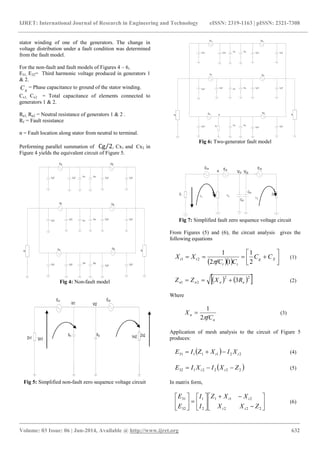
The non-fault circuit model of the unit is presented in
Figures 4 and 5. In order to study the ground fault
phenomenon, a resistance was connected to ground on a
phase of the generator as shown in Figure 6. The voltage
distribution across the terminal and neutral of the generators
under normal operating condition is determined from the
non-fault model.
The third harmonic voltage at the stator terminals vary in a
normal operation from when a ground fault occurs in the
IJRET: International Journal of Research in Engineering and Technology eISSN: 2319-1163 | pISSN: 2321-7308
_______________________________________________________________________________________
Volume: 03 Issue: 06 | Jun-2014, Available @ http://www.ijret.org 632
stator winding of one of the generators. The change in
voltage distribution under a fault condition was determined
from the fault model.
For the non-fault and fault models of Figures 4 – 6,
E31, E32= Third harmonic voltage produced in generators 1
& 2.
gC = Phase capacitance to ground of the stator winding.
Cx1, Cx2 = Total capacitance of elements connected to
generators 1 & 2.
Rn1, Rn2 = Neutral resistance of generators 1 & 2 .
Rf = Fault resistance
α = Fault location along stator from neutral to terminal.
Performing parallel summation of Cg 2, Cx1 and Cx2 in
Figure 4 yields the equivalent circuit of Figure 5.
Cg/2 Cg/2
Cx1 Cx2
Cg/2 Cg/2
Cg/2
Cg/2
Cx1
Cx2 Cg/2 Cg/2
Cg/2 Cg/2
Cx1 Cx2
Cg/2 Cg/2
Rn Rn
E32E31
E31
E32E31
E32
Fig 4: Non-fault model
E31 E32
Zn2
Vn1
Xt2
Zn1 Vn2Xt1
Vt1 Vt2
Fig 5: Simplified non-fault zero sequence voltage circuit
Cg/2 Cg/2
Cx1 Cx2
Cg/2 Cg/2
Cg/2
Cg/2
Cx1
Cx2 Cg/2 Cg/2
Cg/2
Cx1 Cx2
Cg/2 Cg/2
Rn Rn
E32E31
E31
E32E31
E32
Rf
α
Fig 6: Two-generator fault model
E3n E32
Z1
Ct2
Z2
E3t
Rf
I 1
I 2
I 3
Vt2Vt1
Ct2
α
Fig 7: Simplified fault zero sequence voltage circuit
From Figures (5) and (6), the circuit analysis gives the
following equations
   





 Xg
tt
tt CC
CfC
XX
2
1
12
1
21

(1)
    22
21 3 nnnn RXZZ  (2)
Where
n
n
fC
X
2
1
 (3)
Application of mesh analysis to the circuit of Figure 5
produces:
  2211131 tt XIXZIE  (4)
 2222132 ZXIXIE tt  (5)
In matrix form,




















222
211
2
1
32
31
ZXX
XXZ
I
I
E
E
tt
tt
(6)
IJRET: International Journal of Research in Engineering and Technology eISSN: 2319-1163 | pISSN: 2321-7308
_______________________________________________________________________________________
Volume: 03 Issue: 06 | Jun-2014, Available @ http://www.ijret.org 633
Or
E = IZ (7)
Substituting for voltages, generator parameters and
application of cramer’s rule to equation 6 gives




















5.2124.17184.1135
4.11359.24824.1718
5.92
5.92
2
1
jj
jj
I
I
(8)
 3231 EE 92.5
   
    4.11354.1135
5.2124.1718)9.24824.1718(0
jj
jj


46.66479260 
On light load condition, the terminal and neutral voltages
are obtained from 9 – 12.








5.2124.17185.92
4.11355.92
1
j
j
(9)
9.2020171 
0303.01 I A





 

5.924.1135
5.925.2124.1718
2
j
j
(10)
Note that  is the determinant of impedance matrix A. 1
and 2 are the determinant of matrix formed by replacing
the 1st
and 2nd
column of Z by E.
9.2020172 
0303.02 I A
1121 nnn ZIVV  (11)
3.6621  nn VV V
1121 ttt XIVV  (12)
5.3421  tt VV V
3. ANALYSIS OF THE FAULT MODEL
The value of voltage at terminal and neutral of both
generators when a fault occurs on one of the pair can also be
evaluated from the analysis of the fault model of Figure 7 as
follows.
  fnfn RIZRIE 2113  (13)
  131213 tftft XIRXIRIE  (14)
 2232232 ntt ZXIXIE  (15)
In matrix form


































222
11
1
3
2
1
32
3
3
0
0
ntt
tftf
fnf
t
n
ZXX
XRXR
RZR
I
I
I
E
E
E
(16)
Using cramer’s rule on the matrix of equation 16 yields:
0
1
1


I (17)
0
2
2


I (18)
0
3
3


I (19)
111 nn ZIV  (20)
232 nn ZIV  (21)
  1321 tt XIIV  (22)
  2232 tt XIIV  (23)
The voltage at terminal and neutral of the generators under
different fault conditions can be calculated from equations
17 23.
3.1 Parallel Generator Simulink Non-Fault Model
The non-fault model for a single generator is shown in
Figure 8. The parallel generator SIMULINK model consists
of a back to back connection of two of the single models of
Figure 8. The generator parallel connection can be operated
in a single generator mode or parallel operation mode.
When the generators are in parallel operation, capacitance at
the terminal of each generator is modelled as a parallel
summation of the capacitance at the terminals of individual
generator. For a condition of operation of one generator with
the other shutdown, the capacitance at the terminal of the
generator in operation is modelled as a parallel summation
of the capacitance at the terminal of the running generator
and the capacitance at the terminal of the shutdown
generator up to the open circuit breaker.
IJRET: International Journal of Research in Engineering and Technology eISSN: 2319-1163 | pISSN: 2321-7308
_______________________________________________________________________________________
Volume: 03 Issue: 06 | Jun-2014, Available @ http://www.ijret.org 634
Fig 8: Single generator SIMULINK model
4. RESULTS AND DISCUSSION
4.1 Validation of the Non-Fault Model
In order to verify that the circuit models presented to sudy
the phenomenon of interest are built correctly using
SIMULINK, validation of the non-fault model is done by a
comparison of results obtained from theoretical analysis and
computer simulation of the model.
Real generator parameters of generators located at Kainji
Hydo plant, Nigeria were used for the parallel unit
connection to validate the non-fault model are stated below.
Step-up Unit Parameter
Generator rated voltage: 16KV
Rated Power: 80MW
Frequency: 50Hz
Stator winding capacitance: 0.6µF
Grounding resistance: 16 / 3 , 10Amps, 925Ω
Circuit breaker capacitance: 0.1µF
Step-up transformer Capacitance: 0.1µF
Bus capacitance: 0.05µF
Step-up transformer power: 184MVA
Total third harmonic voltage produced in the generator
calculated as 1% of rated voltage [5] is shown in table 1 for
the load conditions under study.
Table 1: Total third harmonic voltage
Loading
Conditions
 VE3
% phase neutral
Voltage(V)
% 3E
No-load
voltage(V)
No-load 160.0 1.73 100
Light load 92.5 1.00 57
Full-load 320.0 3.46 200
The calculated and simulated voltage at the neutral and
terminal of the generators for other loading conditions using
the same formula above is shown in Table 2.
Table 2: Parallel generator calculated, simulated voltage
values and percentage error
Table 2A: Neutral Voltage
Loading
conditions
Calculated
Voltages(V)
1nV 2nV
Simulated
Voltages(V)
1nV 2nV
Percentage
Error (%)
No-load 114.7 114.7 115.8 115.8 0.95
Light-load 66.3 66.3 66.8 66.8 0.75
Full-load 229.5 229.5 231.6 231.6 0.92
Table 2B: Terminal Voltage
Loading
conditions
Calculated
Voltages(V)
1tV 2tV
Simulated
Voltages(V)
1tV 2tV
Percentage
Error (%)
No-load 59.6 59.6 60.0 60.0 0.67
Light-load 34.5 34.5 34.7 34.7 0.58
Full-load 119.4 119.4 120.1 120.1 0.59
Where FL = full load, LL = light load, NL= no-load.
Comparing the results, the error of simulated from
calculated values is less than 1% for all load conditions.
This shows that the circuit model was built correctly using
SIMULINK.
5. CONCLUSIONS
In this paper modelling parallel unit-connected generators
have been presented and implemented using
MATLAB/SIMULINK.
The circuit models can be used to study the influence of
parallel unit-connected generators on third harmonic stator
ground fault protection. When the parallel generator
arrangement is operated in a single generator mode, the total
capacitance at its terminal is modelled as a summation of its
terminal capacitance and the capacitances at the terminal of
the generator on standby up to the open circuit breaker.
When both generators are operated in parallel, the total
capacitance at the terminal of each generator is modeled as
the sum of the capacitances at the terminal of both
generators. Comparison of the calculated and simulated
values as presented in Table 2 with error of less than one
percent show that the model can be relied on for study.
The range and character of third harmonic voltage feeding
the protective relays for a parallel unit-connected generator
of the second order can therefore be evaluated using the
circuit models presented.
3
Connection
Port2
2
Connection
Port1
1
Connection
Port
v
+
-
Voltage6
v
+
-
Voltage5
v
+
-
Voltage4
v
+
-
Voltage3
v
+
-
Voltage2v
+
-
Voltage1
v
+
-
Voltage
Scope Vn
Scope Va5
Scope Va4
Scope Va3
Scope Va2
Scope Va1
Scope Va
Scope In
Rn_Cn
E3_b3
E3_b
E3_a
i
+
-
Current
C_3
C_2
C_1
IJRET: International Journal of Research in Engineering and Technology eISSN: 2319-1163 | pISSN: 2321-7308
_______________________________________________________________________________________
Volume: 03 Issue: 06 | Jun-2014, Available @ http://www.ijret.org 635
REFERENCES
[1]. Pillai .P, Pierce .A, Bailey. B, Douglas.B, Mozina.C,
Normand. C, Shipp. D, Stringer. T,Dalke.G, Jones.J,
Fisher.J, Bowen.J, Padden.L. Lowell. J, Nichols .N,
Young.R,(2003):“Grounding and ground fault protection of
multiple generator installations on medium-voltage
Industrial and commercial power system”, IEEE/IAS
working group report, part 2.
[2]. Pillai .P, Pierce .A, Bailey. B, Douglas.B, Mozina.C,
Normand. C, Shipp. D, Stringer. T,Dalke.G, Jones.J,
Fisher.J, Bowen.J, Padden.L. Lowell. J, Nichols .N,
Young.R, (2003):“Grounding and ground fault protection of
multiple generator installations on medium-voltage
Industrial and commercial power system”, IEEE/IAS
working group report, part 3.
[3]. Mozina.C (2009): “15 years experience with 100%
generator stator fault protection- what works, what doesn’t
and why” Industrial and commercial power systems
technical conference – conference record IEEE.
[4]. Pope .J.W (April 1984): “A comparison of 100% stator
ground fault protection schemes for generator stator
windings”Vol. PAS-103, pp 832-840.
[5]. Alcantara. R, Garcia. F, (2006): “100% stator ground
fault protection: a comparison of two protection methods,
Department of industrial Electrical Engineering and
automation, Lund Institute of technology.MSC Thesis,
pp20-46.
[6]. Weijian.W, Xiaoping.X, Xiling. Z, (2003): New
development of third harmonic ground fault protection
schemes for turbine generator stator winding’’ Tsinghua
University, Xuchang relay institute, pp. 250-253.
[7]. Ruiz-Mondragon, Mora-Florez, Perez-Londono,
(2010):“Improvement of the thirdharmonic based stator
ground fault protection for high resistance grounded
synchronous generators”, Rev. Fac. Ing. Univ.Antioquia, No
52, pp. 215-225.
[8]. Fulczyk .M, (2001): “Zero sequence voltages in unit-
connected generator for different Methods of grounding
generator neutral’’ developments in power system
protection, conference publication No.47, IEEE.
[9]. Fulczyk .M, (2003): “Voltages third harmonic in
generator stator winding at changes in generator load
conditions’’ IEEE ABB corporate research.
BIOGRAPHIES
Gafari A. Adepoju was born in Nigeria and
received the B.Tech. Hons Degree in
Electronic and Electrical Engineering from
the Ladoke Akintola University of
Technology (LAUTECH), Ogbomoso,
M.Sc. degree in Electrical and Electronics
Engineering from University of Lagos and Ph.D from
LAUTECH, Ogbomoso, Nigeria. He is a Senior Lecturer in
the Department of Electronic and Electrical Engineering,
LAUTECH, Ogbomoso, Nigeria. His research areas of
interest are power system Analysis and Electrical Machines
and Application of FACTS controllers in Power
Transmission systems
Ogunjuyigbe Ayodeji Samson received
B.Eng. degree in 1991 from the Bendel
state University, an M.Sc. with distinction
in 1995 from the University of Lagos,
Lagos, Nigeria, and a D.Tech. from the
Tshwane University of Technology,
Pretoria, South Africa. Since 1998,
Ayodeji has lectured in the Electrical/Electronic
Engineering department of the University of Ibadan,
Nigeria. His research interests are in the field of
performance improvement of Electric Machines, and
contingency planning in power systems.
Brimmo T. Isaac was born in Nigeria and
received the Technician Diploma and
Advanced Technician Diploma in
Electrical and Electronic Engineering
Technology from City and Guilds of
London Institute, Post-graduate Diploma in
Electronic and Electrical Engineering from
Ladoke Akintola University of Technology (LAUTECH)
Ogbomosho and is presently a Master student in the
Department of Electronic and Electrical Engineering,
LAUTECH, Ogbomoso, Nigeria. He is an Assistant
Manager in the Electrical Department of Mainstream Energy
Solutions Limited - Kainji Hydro Power Plant, Nigeria. His
research interest is in the area of Power System Protection
with particular interest in Generator Protection.

Parallel unit connected generator model for third

  • 1.
    IJRET: International Journalof Research in Engineering and Technology eISSN: 2319-1163 | pISSN: 2321-7308 _______________________________________________________________________________________ Volume: 03 Issue: 06 | Jun-2014, Available @ http://www.ijret.org 630 PARALLEL UNIT-CONNECTED GENERATOR MODEL FOR THIRD HARMONIC STATOR GROUND FAULT PROTECTION G.A. Adepoju1 , S.O.A. Ogunjuyigbe2 , T.I. Brimmo3 1 Department of Electronic and Electrical Engineering, Ladoke Akintola University of Technology, Ogbomoso, Oyo State, Nigeria 2 Department of Electronics and Electrical Engineering, University of Ibadan, Ibadan, Oyo State, Nigeria 3 Electrical Department, Mainstream Energy Solutions Limited-Kainji Hydro Power Plant, Kainji, Niger state, Nigeria Abstract Conventional ground fault protection schemes can be applied for any generator terminal connection but it covers at most 95% of generator stator length. 100% protection for synchronous generator stator winding can be achieved by a combination of zero sequence and third harmonic protection schemes. The implementation of the third harmonic scheme on any generator is determined by magnitude of third harmonic voltage produced in the generator. The methods of connecting the generator terminal also influence the range of third harmonic voltage at the stator terminal and neutral. An investigation into the compatibility of particular generator configuration with the third harmonic scheme is important to prevent protection mal-operation since the scheme is hampered in performance by certain factors which include grounding method employed and generator terminal connection among others. In this paper, the modelling of parallel unit-connected generators of the second order is presented to study the influence of parallel unit-connected generators on third harmonic stator ground fault protection. Application of mesh analysis method to the circuit models produced ordinary non-linear algebraic equations. The equations were solved using Cramer’s rule. Simulations of the circuit models were performed for no-load, light load and full load conditions using MATLAB/SIMULINK to study the character of third harmonic voltage at stator neutral and terminal when a ground fault occurs to validate the results of the models. Introduction of a ground fault at the neutral point of the single generator showed that the third harmonic voltage decreased towards zero at the neutral but increased towards maximum at the terminal. Keywords: Generator, MATLAB/SIMULINK, Harmonic --------------------------------------------------------------------***---------------------------------------------------------------------- 1. INTRODUCTION Ground faults are a major cause of stator winding damage. A ground fault in the stator winding of a synchronous generator causes the flow of current whose magnitude is dependent on the grounding method employed on the generator and also limited by the fault impedance [1]. The flow of the fault current if not interrupted often results in insulation breakdown of the stator winding and burning of lamination portions in severe cases. Ordinary zero sequence voltage relays used for winding protection against single phase ground faults on unit connected generators cannot cover 100% of stator winding, i.e. there is a dead zone at or near the generator neutral [2] Zero sequence voltage relays can only detect faults over 90- 95% of the stator winding. Typically 5% - 10% of the winding portion is unprotected. [3]. A combination of zero sequence voltage relays and relays tuned to the third harmonic voltage provide 100% protection for the generator stator winding [4]. Third harmonic voltage is produced by all generators and is present in the two ends of the stator winding in all generators but in different magnitude. The magnitude varies according to the machine design, the load level, the measurement point and the fault location along the winding. Its normal values are between 1% and 6% of the nominal generator voltage, in the case of non-faulted windings [5]. A generator is suitable for third harmonic protection if enough third harmonic voltage is produced in it during normal operation. The third harmonic voltage can be used to excite third harmonic relays to determine the presence of a ground fault. The implementation of the third harmonic protection depends on where the third harmonic voltage is measured. It can be measured in the generator terminal, neutral or both. When a ground fault occurs near the neutral end of the stator winding, the value of third harmonic voltage at that point of the stator decreases towards zero but towards the terminal point of the stator, it increases towards maximum. Alternately for a fault close to the generator terminal, the reverse is the case [5] This character of third harmonic voltage at the neutral and terminal of a generator form the basis of the third harmonic protection. The three possible measurement positions form the basis of the under voltage, overvoltage and ratio approaches to implementing the protection [6] The distribution of third harmonic voltage along the stator winding terminal and neutral positions in normal and fault conditions is shown in Figures 1 and 2 [7].
  • 2.
    IJRET: International Journalof Research in Engineering and Technology eISSN: 2319-1163 | pISSN: 2321-7308 _______________________________________________________________________________________ Volume: 03 Issue: 06 | Jun-2014, Available @ http://www.ijret.org 631 Generator terminal connections are however a major influence on a stator ground fault protection scheme excited by the third harmonic voltage [8]. Investigation of the influence of particular generator terminal connection on the range and character of third harmonic voltage present in the stator ends to excite protective relays is therefore important to prevent mal-operation of the protection scheme. Parallel unit-connected generator is one of such terminal connections that can influence the character of third harmonic voltage hence the performance of third harmonic protection schemes. Vt Vn neutral 0% 100% % stator winding Full load No load Fig 1: Normal third harmonic voltage distribution. Full load No load Vt Vn Neutral 0% Terminal 100% Fig 2a: Third harmonic voltage at terminal under fault. Vt Terminal 100% Vn Stator winding Neutral 0% Full load No load Fig 2b: Third harmonic voltage at neutral under fault. 2. METHODOLOGY A typical parallel unit-connected generator of the second order is shown in Figure 3. In order to study the phenomenon of interest, the parallel unit-connected generator is modelled to represent a condition of normal operation and a condition when a ground fault has occurred along the stator winding. The two conditions are referred to as non-fault and fault conditions of the unit. In modelling the unit, the stator winding capacitance to ground and the capacitances of the elements at the generator terminals are modelled as single capacitors to ground [5]. The third harmonic voltage feeding the measuring element of ground fault protection scheme is influenced by generator active power [9] therefore the study will be for no-load, light load and full load conditions of the unit. Third harmonic voltage in the stator winding varies in magnitude according to the measurement point and the fault location along the winding [5] therefore different values of fault resistance in different portions of the winding were applied to the fault model. T Step-up transformer RnB CgBCgB CgB N GENERATOR B GENERATOR A CgA CgACgA CXA CXA CXA CXB CXB CXB RnA Ct Isolator isolator Fig 3: Typical two generators in-parallel For the parallel unit-connected generator shown in Figure 3, CgA, CgB= stator winding capacitance to ground of generators A & B CxA,, CxB =Total capacitance to ground of all elements connected to generator terminals. RnA, RnB = Neutral resistance for generators A & B. Ct = Step-up transformer capacitance to ground The non-fault circuit model of the unit is presented in Figures 4 and 5. In order to study the ground fault phenomenon, a resistance was connected to ground on a phase of the generator as shown in Figure 6. The voltage distribution across the terminal and neutral of the generators under normal operating condition is determined from the non-fault model. The third harmonic voltage at the stator terminals vary in a normal operation from when a ground fault occurs in the
  • 3.
    IJRET: International Journalof Research in Engineering and Technology eISSN: 2319-1163 | pISSN: 2321-7308 _______________________________________________________________________________________ Volume: 03 Issue: 06 | Jun-2014, Available @ http://www.ijret.org 632 stator winding of one of the generators. The change in voltage distribution under a fault condition was determined from the fault model. For the non-fault and fault models of Figures 4 – 6, E31, E32= Third harmonic voltage produced in generators 1 & 2. gC = Phase capacitance to ground of the stator winding. Cx1, Cx2 = Total capacitance of elements connected to generators 1 & 2. Rn1, Rn2 = Neutral resistance of generators 1 & 2 . Rf = Fault resistance α = Fault location along stator from neutral to terminal. Performing parallel summation of Cg 2, Cx1 and Cx2 in Figure 4 yields the equivalent circuit of Figure 5. Cg/2 Cg/2 Cx1 Cx2 Cg/2 Cg/2 Cg/2 Cg/2 Cx1 Cx2 Cg/2 Cg/2 Cg/2 Cg/2 Cx1 Cx2 Cg/2 Cg/2 Rn Rn E32E31 E31 E32E31 E32 Fig 4: Non-fault model E31 E32 Zn2 Vn1 Xt2 Zn1 Vn2Xt1 Vt1 Vt2 Fig 5: Simplified non-fault zero sequence voltage circuit Cg/2 Cg/2 Cx1 Cx2 Cg/2 Cg/2 Cg/2 Cg/2 Cx1 Cx2 Cg/2 Cg/2 Cg/2 Cx1 Cx2 Cg/2 Cg/2 Rn Rn E32E31 E31 E32E31 E32 Rf α Fig 6: Two-generator fault model E3n E32 Z1 Ct2 Z2 E3t Rf I 1 I 2 I 3 Vt2Vt1 Ct2 α Fig 7: Simplified fault zero sequence voltage circuit From Figures (5) and (6), the circuit analysis gives the following equations           Xg tt tt CC CfC XX 2 1 12 1 21  (1)     22 21 3 nnnn RXZZ  (2) Where n n fC X 2 1  (3) Application of mesh analysis to the circuit of Figure 5 produces:   2211131 tt XIXZIE  (4)  2222132 ZXIXIE tt  (5) In matrix form,                     222 211 2 1 32 31 ZXX XXZ I I E E tt tt (6)
  • 4.
    IJRET: International Journalof Research in Engineering and Technology eISSN: 2319-1163 | pISSN: 2321-7308 _______________________________________________________________________________________ Volume: 03 Issue: 06 | Jun-2014, Available @ http://www.ijret.org 633 Or E = IZ (7) Substituting for voltages, generator parameters and application of cramer’s rule to equation 6 gives                     5.2124.17184.1135 4.11359.24824.1718 5.92 5.92 2 1 jj jj I I (8)  3231 EE 92.5         4.11354.1135 5.2124.1718)9.24824.1718(0 jj jj   46.66479260  On light load condition, the terminal and neutral voltages are obtained from 9 – 12.         5.2124.17185.92 4.11355.92 1 j j (9) 9.2020171  0303.01 I A         5.924.1135 5.925.2124.1718 2 j j (10) Note that  is the determinant of impedance matrix A. 1 and 2 are the determinant of matrix formed by replacing the 1st and 2nd column of Z by E. 9.2020172  0303.02 I A 1121 nnn ZIVV  (11) 3.6621  nn VV V 1121 ttt XIVV  (12) 5.3421  tt VV V 3. ANALYSIS OF THE FAULT MODEL The value of voltage at terminal and neutral of both generators when a fault occurs on one of the pair can also be evaluated from the analysis of the fault model of Figure 7 as follows.   fnfn RIZRIE 2113  (13)   131213 tftft XIRXIRIE  (14)  2232232 ntt ZXIXIE  (15) In matrix form                                   222 11 1 3 2 1 32 3 3 0 0 ntt tftf fnf t n ZXX XRXR RZR I I I E E E (16) Using cramer’s rule on the matrix of equation 16 yields: 0 1 1   I (17) 0 2 2   I (18) 0 3 3   I (19) 111 nn ZIV  (20) 232 nn ZIV  (21)   1321 tt XIIV  (22)   2232 tt XIIV  (23) The voltage at terminal and neutral of the generators under different fault conditions can be calculated from equations 17 23. 3.1 Parallel Generator Simulink Non-Fault Model The non-fault model for a single generator is shown in Figure 8. The parallel generator SIMULINK model consists of a back to back connection of two of the single models of Figure 8. The generator parallel connection can be operated in a single generator mode or parallel operation mode. When the generators are in parallel operation, capacitance at the terminal of each generator is modelled as a parallel summation of the capacitance at the terminals of individual generator. For a condition of operation of one generator with the other shutdown, the capacitance at the terminal of the generator in operation is modelled as a parallel summation of the capacitance at the terminal of the running generator and the capacitance at the terminal of the shutdown generator up to the open circuit breaker.
  • 5.
    IJRET: International Journalof Research in Engineering and Technology eISSN: 2319-1163 | pISSN: 2321-7308 _______________________________________________________________________________________ Volume: 03 Issue: 06 | Jun-2014, Available @ http://www.ijret.org 634 Fig 8: Single generator SIMULINK model 4. RESULTS AND DISCUSSION 4.1 Validation of the Non-Fault Model In order to verify that the circuit models presented to sudy the phenomenon of interest are built correctly using SIMULINK, validation of the non-fault model is done by a comparison of results obtained from theoretical analysis and computer simulation of the model. Real generator parameters of generators located at Kainji Hydo plant, Nigeria were used for the parallel unit connection to validate the non-fault model are stated below. Step-up Unit Parameter Generator rated voltage: 16KV Rated Power: 80MW Frequency: 50Hz Stator winding capacitance: 0.6µF Grounding resistance: 16 / 3 , 10Amps, 925Ω Circuit breaker capacitance: 0.1µF Step-up transformer Capacitance: 0.1µF Bus capacitance: 0.05µF Step-up transformer power: 184MVA Total third harmonic voltage produced in the generator calculated as 1% of rated voltage [5] is shown in table 1 for the load conditions under study. Table 1: Total third harmonic voltage Loading Conditions  VE3 % phase neutral Voltage(V) % 3E No-load voltage(V) No-load 160.0 1.73 100 Light load 92.5 1.00 57 Full-load 320.0 3.46 200 The calculated and simulated voltage at the neutral and terminal of the generators for other loading conditions using the same formula above is shown in Table 2. Table 2: Parallel generator calculated, simulated voltage values and percentage error Table 2A: Neutral Voltage Loading conditions Calculated Voltages(V) 1nV 2nV Simulated Voltages(V) 1nV 2nV Percentage Error (%) No-load 114.7 114.7 115.8 115.8 0.95 Light-load 66.3 66.3 66.8 66.8 0.75 Full-load 229.5 229.5 231.6 231.6 0.92 Table 2B: Terminal Voltage Loading conditions Calculated Voltages(V) 1tV 2tV Simulated Voltages(V) 1tV 2tV Percentage Error (%) No-load 59.6 59.6 60.0 60.0 0.67 Light-load 34.5 34.5 34.7 34.7 0.58 Full-load 119.4 119.4 120.1 120.1 0.59 Where FL = full load, LL = light load, NL= no-load. Comparing the results, the error of simulated from calculated values is less than 1% for all load conditions. This shows that the circuit model was built correctly using SIMULINK. 5. CONCLUSIONS In this paper modelling parallel unit-connected generators have been presented and implemented using MATLAB/SIMULINK. The circuit models can be used to study the influence of parallel unit-connected generators on third harmonic stator ground fault protection. When the parallel generator arrangement is operated in a single generator mode, the total capacitance at its terminal is modelled as a summation of its terminal capacitance and the capacitances at the terminal of the generator on standby up to the open circuit breaker. When both generators are operated in parallel, the total capacitance at the terminal of each generator is modeled as the sum of the capacitances at the terminal of both generators. Comparison of the calculated and simulated values as presented in Table 2 with error of less than one percent show that the model can be relied on for study. The range and character of third harmonic voltage feeding the protective relays for a parallel unit-connected generator of the second order can therefore be evaluated using the circuit models presented. 3 Connection Port2 2 Connection Port1 1 Connection Port v + - Voltage6 v + - Voltage5 v + - Voltage4 v + - Voltage3 v + - Voltage2v + - Voltage1 v + - Voltage Scope Vn Scope Va5 Scope Va4 Scope Va3 Scope Va2 Scope Va1 Scope Va Scope In Rn_Cn E3_b3 E3_b E3_a i + - Current C_3 C_2 C_1
  • 6.
    IJRET: International Journalof Research in Engineering and Technology eISSN: 2319-1163 | pISSN: 2321-7308 _______________________________________________________________________________________ Volume: 03 Issue: 06 | Jun-2014, Available @ http://www.ijret.org 635 REFERENCES [1]. Pillai .P, Pierce .A, Bailey. B, Douglas.B, Mozina.C, Normand. C, Shipp. D, Stringer. T,Dalke.G, Jones.J, Fisher.J, Bowen.J, Padden.L. Lowell. J, Nichols .N, Young.R,(2003):“Grounding and ground fault protection of multiple generator installations on medium-voltage Industrial and commercial power system”, IEEE/IAS working group report, part 2. [2]. Pillai .P, Pierce .A, Bailey. B, Douglas.B, Mozina.C, Normand. C, Shipp. D, Stringer. T,Dalke.G, Jones.J, Fisher.J, Bowen.J, Padden.L. Lowell. J, Nichols .N, Young.R, (2003):“Grounding and ground fault protection of multiple generator installations on medium-voltage Industrial and commercial power system”, IEEE/IAS working group report, part 3. [3]. Mozina.C (2009): “15 years experience with 100% generator stator fault protection- what works, what doesn’t and why” Industrial and commercial power systems technical conference – conference record IEEE. [4]. Pope .J.W (April 1984): “A comparison of 100% stator ground fault protection schemes for generator stator windings”Vol. PAS-103, pp 832-840. [5]. Alcantara. R, Garcia. F, (2006): “100% stator ground fault protection: a comparison of two protection methods, Department of industrial Electrical Engineering and automation, Lund Institute of technology.MSC Thesis, pp20-46. [6]. Weijian.W, Xiaoping.X, Xiling. Z, (2003): New development of third harmonic ground fault protection schemes for turbine generator stator winding’’ Tsinghua University, Xuchang relay institute, pp. 250-253. [7]. Ruiz-Mondragon, Mora-Florez, Perez-Londono, (2010):“Improvement of the thirdharmonic based stator ground fault protection for high resistance grounded synchronous generators”, Rev. Fac. Ing. Univ.Antioquia, No 52, pp. 215-225. [8]. Fulczyk .M, (2001): “Zero sequence voltages in unit- connected generator for different Methods of grounding generator neutral’’ developments in power system protection, conference publication No.47, IEEE. [9]. Fulczyk .M, (2003): “Voltages third harmonic in generator stator winding at changes in generator load conditions’’ IEEE ABB corporate research. BIOGRAPHIES Gafari A. Adepoju was born in Nigeria and received the B.Tech. Hons Degree in Electronic and Electrical Engineering from the Ladoke Akintola University of Technology (LAUTECH), Ogbomoso, M.Sc. degree in Electrical and Electronics Engineering from University of Lagos and Ph.D from LAUTECH, Ogbomoso, Nigeria. He is a Senior Lecturer in the Department of Electronic and Electrical Engineering, LAUTECH, Ogbomoso, Nigeria. His research areas of interest are power system Analysis and Electrical Machines and Application of FACTS controllers in Power Transmission systems Ogunjuyigbe Ayodeji Samson received B.Eng. degree in 1991 from the Bendel state University, an M.Sc. with distinction in 1995 from the University of Lagos, Lagos, Nigeria, and a D.Tech. from the Tshwane University of Technology, Pretoria, South Africa. Since 1998, Ayodeji has lectured in the Electrical/Electronic Engineering department of the University of Ibadan, Nigeria. His research interests are in the field of performance improvement of Electric Machines, and contingency planning in power systems. Brimmo T. Isaac was born in Nigeria and received the Technician Diploma and Advanced Technician Diploma in Electrical and Electronic Engineering Technology from City and Guilds of London Institute, Post-graduate Diploma in Electronic and Electrical Engineering from Ladoke Akintola University of Technology (LAUTECH) Ogbomosho and is presently a Master student in the Department of Electronic and Electrical Engineering, LAUTECH, Ogbomoso, Nigeria. He is an Assistant Manager in the Electrical Department of Mainstream Energy Solutions Limited - Kainji Hydro Power Plant, Nigeria. His research interest is in the area of Power System Protection with particular interest in Generator Protection.