International Journal of Trend in Scientific Research and Development (IJTSRD)
Volume 4 Issue 1, December 2019 Available Online: www.ijtsrd.com e-ISSN: 2456 – 6470
@ IJTSRD | Unique Paper ID – IJTSRD29704 | Volume – 4 | Issue – 1 | November-December 2019 Page 887
Analysis of Different Controllers used for Boiler
Drum Level Control by using LabVIEW Simulation
Sumit Patel, Vinit Sharma
Assistant Professor, SRMS College of Engineering and Technology, Bareilly, Uttar Pradesh, India
ABSTRACT
An intelligent model is developed to control the water level in boiler drum.
There are three different types of boiler control such as (i) Single element
boiler drum level control, (ii) Two element boiler drum level control and (iii)
Three element boiler drum level control. This paper provides the knowledge
about the Fuzzy PID Controller and the various PID controllerdesignmethods
such as Zeigler-Nichols method, Tyreus-Luyben method, Internal Model
Control (IMC). Comparative study is made on the performance of the PID and
Fuzzy PID controller for better control system design.
KEYWORDS: Boiler drum level control, Zeigler-Nichols method, Tyreus-Luyben
method, Internal Model Control, Fuzzy PID controller
How to cite this paper: Sumit Patel | Vinit
Sharma "Analysis of Different Controllers
used for Boiler Drum Level Control by
using LabVIEW Simulation" Published in
International Journal
of Trend in Scientific
Research and
Development(ijtsrd),
ISSN: 2456-6470,
Volume-4 | Issue-1,
December 2019,
pp.887-891, URL:
www.ijtsrd.com/papers/ijtsrd29704.pdf
Copyright © 2019 by author(s) and
International Journal ofTrendinScientific
Research and Development Journal. This
is an Open Access article distributed
under the terms of
the Creative
CommonsAttribution
License (CC BY 4.0)
(http://creativecommons.org/licenses/by
/4.0)
I. INRODUCTION
Boiler is defined as a closed vessel in which steam is
produced from water by the combustion of fuel. Generally,
in boilers steam is produced by the interaction of hot flue
gases with water pipes which is coming out from the fuel
mainly coal or coke. In boilers, chemical energy of stored
fuel is converted into the heat energy and this heat energy
is absorbed by the water which converts them into a
steam. Drum Level Control Systems are used extensively
throughout the process industries. It is used to control the
level of boiling water contained in boiler drums and
provide a constant supply of steam. There are three
different types of boiler drum level control:
A. single element boiler drum level control
B. two element boiler drum level control
C. three element boiler drum level control
The most basic and pervasive control algorithm used in the
feedback control is the Proportional Integral and Derivative
(PID) control algorithm. A proportional-integral-derivative
(PID) controller is a generic control loop feedback
mechanism (controller) widely used in industrial control
systems. A PID controller calculates an "error" value as the
difference between a measured process variable and a
desired setpoint. The controller attempts to minimize the
error by adjusting the process control inputs. In this paper,
two input and three output fuzzy PID controller is
designed. The inputs are the error and the error rate
(change in error) and outputs are the values of Kp, Ki and
Kd. The objective is to find the fuzzy relations among Kp, Ki,
Kd, error and error rate. With continuous testing, the three
output parameters are adjusted so as to achieve good
stability.
The proposed work illustrates how to design Fuzzy PID
Controller and the various PID controller design methods
such as Zeigler-Nichols method, Tyreus-Luyben method,
Internal Model Control (IMC) using LabVIEW.
The followings of the paper includes, Section II describing
the boiler drum level control and control strategies. In
Section III development of various controllers using
LabVIEW. In Section IV result and comparison between the
boiler performances is discussed. The paper concludes in
Section V.
II. BOILER DRUM LEVEL CONTROL STRATEGIES
Drum Level Control Systems are used extensively
throughout the process industries and theutilitiestocontrol
the level of boiling water contained in boiler drums on
process plant and help provide a constant supply of steam
The purpose of the drum level controlleristobringthedrum
up to level at boiler start-up and maintain the level at
constant steam load. A dramatic decrease in this level may
uncover boiler tubes, allowing them to become overheated
and damaged. An increase in thislevel mayinterferewiththe
process of separating moisture from steam within thedrum,
thus reducing boiler efficiency and carrying moisture into
the process or turbine. Boiler drum water level control is
critical to secure operation of the boiler and the steam
turbine.
IJTSRD29704
International Journal of Trend in Scientific Research and Development (IJTSRD) @ www.ijtsrd.com eISSN: 2456-6470
@ IJTSRD | Unique Paper ID – IJTSRD29704 | Volume – 4 | Issue – 1 | November-December 2019 Page 888
Fig.1 Control Instrumentation Diagram for Boiler
Control strategies are necessary for any system to perform
accurately. Some of these are given below.
A. Ziegler-Nichols Method
The Ziegler-Nichols closed-loop tuning technique was
perhaps the first rigorous method to tune PID controllers.
The technique is not widely used today because the closed-
loop behavior tends to be oscillatory and sensitive to
uncertainty.
Table .1 Ziegler-Nichols Parameter
Control Type Kp Ki Kd
P 0.50 Ku - -
PI 0.45 Ku 1.2 Kp/ Pu -
PID 0.60 Ku 2 Kp/ Pu KpPu/ 8
B. Tyreus-Luyben Method
This method is introduced by Tyreus-Luyen. In this
method, the Ki and Kd gains are first set to zero. The P gain
is increased until it reaches the ultimate gain Ku, at which
the output of the loop starts to oscillate.
Table.2 Tyreus-Luyben Parameter
Control Kp Ki Kd
PI 0.3125 Ku Kp/ 2.2 Pu -
PID 0.4545 Ku Kp/ 2.2 Pu KpPu/ 6.3
C. Internal Model Control
The Internal Model Control (IMC) based PID structure uses
the process model as in IMC design. In the IMC procedure,
the controller Gc(s) is directly based on the invertible part of
the process transfer function. The IMC results in only one
tuning parameter which is filter tuning factor but the IMC
based PID tuning parameters are the functions of thistuning
factor.
Fig.2 IMC Structure
When a disturbance affects a processunderfeedbackcontrol
it is necessary for a measured process output to change
before corrective action is taken to change the manipulated
input. It would be preferable to have a sensor that measures
the disturbance and adjusts the manipulated input before
the process output changes. This type of control strategy is
known as feed forward IMC control.
Fig.3 IMC FeedForward Structure
Cascade control involves the use of multiple measurements
and a single manipulated input.
Fig.4 IMC Cascade Structure
D. Fuzzy PID Control
Fuzzycontroller is a special fuzzysystem thatcan beused as
a controller component in a closed- loop system. It includes
the fuzzifier, fuzzy rule base, process knowledge and FL
rules, fuzzy interference engine and de-fuzzifier. The
fuzzifier is the plant to fuzzy logic system interface and
performs a mapping from real-valued variables into fuzzy
variables. The fuzzy rule base consists of a collection of
fuzzy rules. The knowledge base contains the experienced
knowledge of the flow process station. Data base contains
the membership function of every linguistic variable.
III. DEVELOPMENT OF VARIOUS CONTROLLERS
USING LabVIEW
The author has developed VI in LabVIEW for the assessment
of performance of various controllers in boiler drum level
control. Three different controller i.e. feedback controller,
feed forward controller and cascade controller has been
applied in the system.
A. Ziegler-Nichols Method
This is the simplest method to calculate the parameters of
PID. By applying this method, the PID parameters obtained
are [6]
Kp= 2.1, Ki= 0.43 , Kd= 2.57
Fig.5 Transfer Function Model of Ziegler Nichols
Method
International Journal of Trend in Scientific Research and Development (IJTSRD) @ www.ijtsrd.com eISSN: 2456-6470
@ IJTSRD | Unique Paper ID – IJTSRD29704 | Volume – 4 | Issue – 1 | November-December 2019 Page 889
Fig.6 Response of Ziegler-Nichols Method
B. Tyreus-Luyben Method
This is another method to set the tuning values. By applying
this method, PID parameters obtained are [6] as follows
Kp= 1.59, Ki= 0.073, Kd= 2.47
Fig.7 Transfer Function Model of Tyreus-Luyben
Method
Fig.8 Response of Tyreus-Luyben Method
C. Internal Model Control (IMC)
In this process, following process model is considered and
correspondingly the controller output is calculated.
Fig.9 Transfer Function Model of IMC
Fig.10 Response of IMC
When steam disturbance is added in the system, than single
feedback controller is not enough to control the whole
process. So, a feed forward controller is added which
removes this disturbances before it enter into the boiler
plant. Feed-forward control avoids the slownessoffeedback
control system. To calculate the parameter of controller for
steam disturbances, following calculation have been taken.
Fig.11 Transfer Function Model of FeedForward IMC
1
2
3
4
5
6
International Journal of Trend in Scientific Research and Development (IJTSRD) @ www.ijtsrd.com eISSN: 2456-6470
@ IJTSRD | Unique Paper ID – IJTSRD29704 | Volume – 4 | Issue – 1 | November-December 2019 Page 890
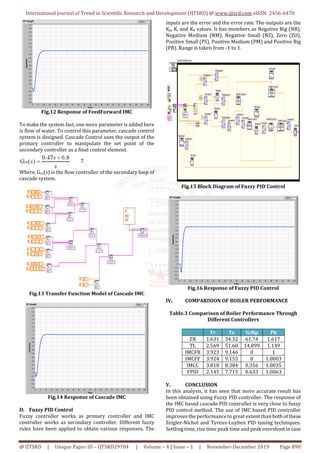
Fig.12 Response of FeedForward IMC
To make the system fast, one more parameter is added here
is flow of water. To control this parameter, cascade control
system is designed. Cascade Control uses the output of the
primary controller to manipulate the set point of the
secondary controller as a final control element.
Where, Gcv(s) is the flow controller of the secondary loop of
cascade system.
Fig.13 Transfer Function Model of Cascade IMC
Fig.14 Response of Cascade IMC
D. Fuzzy PID Control
Fuzzy controller works as primary controller and IMC
controller works as secondary controller. Different fuzzy
rules have been applied to obtain various responses. The
inputs are the error and the error rate. The outputs are the
Kp, Ki and Kd values. It has members as Negative Big (NB),
Negative Medium (NM), Negative Small (NS), Zero (ZO),
Positive Small (PS), Positive Medium (PM) and Positive Big
(PB). Range is taken from -1 to 1.
Fig.15 Block Diagram of Fuzzy PID Control
Fig.16 Response of Fuzzy PID Control
IV. COMPARISION OF BOILER PERFORMANCE
Table.3 Comparison of Boiler Performance Through
Different Controllers
Tr Ts %Mp Pk
ZN 1.631 34.32 61.74 1.617
TL 2.569 51.60 14.899 1.149
IMCFB 3.923 9.146 0 1
IMCFF 3.924 9.155 0 1.0003
IMCC 3.818 8.384 0.356 1.0035
FPID 2.145 7.715 0.633 1.0063
V. CONCLUSION
In this analysis, it has seen that more accurate result has
been obtained using Fuzzy PID controller. The response of
the IMC based cascade PID controller is very close to fuzzy
PID control method. The use of IMC based PID controller
improves the performance to great extent than bothofthese
Zeigler-Nichol and Tyreus-Luyben PID tuning techniques.
Settling time, rise time peak time and peak overshootincase
7
International Journal of Trend in Scientific Research and Development (IJTSRD) @ www.ijtsrd.com eISSN: 2456-6470
@ IJTSRD | Unique Paper ID – IJTSRD29704 | Volume – 4 | Issue – 1 | November-December 2019 Page 891
of Fuzzy PID controller is less than other methods.When the
plant response is changing with time, or thereisuncertainty,
the IMC method is preferable. IMC based PID controller can
adjust the control action before a change in the output set
point actually occurs. Hence, from the above data, the
investigator concludes that the Fuzzy PID method is better
than other PID controller techniques.
REFERENCES
[1] Min Xu, Shaoyuan Li, Wenjian Cai, “Cascade
Generalized Predictive Control Strategy For Boiler
Drum Level”, Proceedings of the International Journal
on Instrumentation System and Automation Society,
Vol. 44, Issue 3, pp. 399-404, July 2005.
[2] Yonghong Huang, Nianping Li, Yangchun Shil, Yixun
Yil,“Genetic Adaptive Control for Drum Level of a
Power Plant Boiler”, Proceedings of the International
Conference on Computational Engineering System.
Applications (IMACS), Beijing, China, Vol.2,pp. 1965-
1968, Oct 2006.
[3] Yuanhui Yang, Wailing Yang, Mingchun Wu, Qiwen
Yang, and Yuncan Xue, “A New Type of Adaptive Fuzzy
PID Controller”, Proceedings ofthe8th WorldCongress
on Intelligent Control and Automation,Jinan,pp.5306-
5310, July 2010.
[4] Xiang Fei, Zou Li Hua,”Optimization Design Of PID
Controller And Its Application”, Proceedings of the
International Conference on Measuring Technology
and Mechatronics Automation, Shangshai, Vol.2, pp.
803-806, Jan 2011.
[5] C. C. Hang, K. J. Astrom and W. K. Ho, “Refinements of
The Ziegler-Nichols Tuning Formula”, Proceedings of
International Conference on Control Theory and
Applications, Vol. 138, No. 2, August ,2002.
[6] B. Wayne Bequette, “Process Control Modeling Design
& Simulation”, Pearson Education, 2002.

Analysis of Different Controllers used for Boiler Drum Level Control by using LabVIEW Simulation

  • 1.
    International Journal ofTrend in Scientific Research and Development (IJTSRD) Volume 4 Issue 1, December 2019 Available Online: www.ijtsrd.com e-ISSN: 2456 – 6470 @ IJTSRD | Unique Paper ID – IJTSRD29704 | Volume – 4 | Issue – 1 | November-December 2019 Page 887 Analysis of Different Controllers used for Boiler Drum Level Control by using LabVIEW Simulation Sumit Patel, Vinit Sharma Assistant Professor, SRMS College of Engineering and Technology, Bareilly, Uttar Pradesh, India ABSTRACT An intelligent model is developed to control the water level in boiler drum. There are three different types of boiler control such as (i) Single element boiler drum level control, (ii) Two element boiler drum level control and (iii) Three element boiler drum level control. This paper provides the knowledge about the Fuzzy PID Controller and the various PID controllerdesignmethods such as Zeigler-Nichols method, Tyreus-Luyben method, Internal Model Control (IMC). Comparative study is made on the performance of the PID and Fuzzy PID controller for better control system design. KEYWORDS: Boiler drum level control, Zeigler-Nichols method, Tyreus-Luyben method, Internal Model Control, Fuzzy PID controller How to cite this paper: Sumit Patel | Vinit Sharma "Analysis of Different Controllers used for Boiler Drum Level Control by using LabVIEW Simulation" Published in International Journal of Trend in Scientific Research and Development(ijtsrd), ISSN: 2456-6470, Volume-4 | Issue-1, December 2019, pp.887-891, URL: www.ijtsrd.com/papers/ijtsrd29704.pdf Copyright © 2019 by author(s) and International Journal ofTrendinScientific Research and Development Journal. This is an Open Access article distributed under the terms of the Creative CommonsAttribution License (CC BY 4.0) (http://creativecommons.org/licenses/by /4.0) I. INRODUCTION Boiler is defined as a closed vessel in which steam is produced from water by the combustion of fuel. Generally, in boilers steam is produced by the interaction of hot flue gases with water pipes which is coming out from the fuel mainly coal or coke. In boilers, chemical energy of stored fuel is converted into the heat energy and this heat energy is absorbed by the water which converts them into a steam. Drum Level Control Systems are used extensively throughout the process industries. It is used to control the level of boiling water contained in boiler drums and provide a constant supply of steam. There are three different types of boiler drum level control: A. single element boiler drum level control B. two element boiler drum level control C. three element boiler drum level control The most basic and pervasive control algorithm used in the feedback control is the Proportional Integral and Derivative (PID) control algorithm. A proportional-integral-derivative (PID) controller is a generic control loop feedback mechanism (controller) widely used in industrial control systems. A PID controller calculates an "error" value as the difference between a measured process variable and a desired setpoint. The controller attempts to minimize the error by adjusting the process control inputs. In this paper, two input and three output fuzzy PID controller is designed. The inputs are the error and the error rate (change in error) and outputs are the values of Kp, Ki and Kd. The objective is to find the fuzzy relations among Kp, Ki, Kd, error and error rate. With continuous testing, the three output parameters are adjusted so as to achieve good stability. The proposed work illustrates how to design Fuzzy PID Controller and the various PID controller design methods such as Zeigler-Nichols method, Tyreus-Luyben method, Internal Model Control (IMC) using LabVIEW. The followings of the paper includes, Section II describing the boiler drum level control and control strategies. In Section III development of various controllers using LabVIEW. In Section IV result and comparison between the boiler performances is discussed. The paper concludes in Section V. II. BOILER DRUM LEVEL CONTROL STRATEGIES Drum Level Control Systems are used extensively throughout the process industries and theutilitiestocontrol the level of boiling water contained in boiler drums on process plant and help provide a constant supply of steam The purpose of the drum level controlleristobringthedrum up to level at boiler start-up and maintain the level at constant steam load. A dramatic decrease in this level may uncover boiler tubes, allowing them to become overheated and damaged. An increase in thislevel mayinterferewiththe process of separating moisture from steam within thedrum, thus reducing boiler efficiency and carrying moisture into the process or turbine. Boiler drum water level control is critical to secure operation of the boiler and the steam turbine. IJTSRD29704
  • 2.
    International Journal ofTrend in Scientific Research and Development (IJTSRD) @ www.ijtsrd.com eISSN: 2456-6470 @ IJTSRD | Unique Paper ID – IJTSRD29704 | Volume – 4 | Issue – 1 | November-December 2019 Page 888 Fig.1 Control Instrumentation Diagram for Boiler Control strategies are necessary for any system to perform accurately. Some of these are given below. A. Ziegler-Nichols Method The Ziegler-Nichols closed-loop tuning technique was perhaps the first rigorous method to tune PID controllers. The technique is not widely used today because the closed- loop behavior tends to be oscillatory and sensitive to uncertainty. Table .1 Ziegler-Nichols Parameter Control Type Kp Ki Kd P 0.50 Ku - - PI 0.45 Ku 1.2 Kp/ Pu - PID 0.60 Ku 2 Kp/ Pu KpPu/ 8 B. Tyreus-Luyben Method This method is introduced by Tyreus-Luyen. In this method, the Ki and Kd gains are first set to zero. The P gain is increased until it reaches the ultimate gain Ku, at which the output of the loop starts to oscillate. Table.2 Tyreus-Luyben Parameter Control Kp Ki Kd PI 0.3125 Ku Kp/ 2.2 Pu - PID 0.4545 Ku Kp/ 2.2 Pu KpPu/ 6.3 C. Internal Model Control The Internal Model Control (IMC) based PID structure uses the process model as in IMC design. In the IMC procedure, the controller Gc(s) is directly based on the invertible part of the process transfer function. The IMC results in only one tuning parameter which is filter tuning factor but the IMC based PID tuning parameters are the functions of thistuning factor. Fig.2 IMC Structure When a disturbance affects a processunderfeedbackcontrol it is necessary for a measured process output to change before corrective action is taken to change the manipulated input. It would be preferable to have a sensor that measures the disturbance and adjusts the manipulated input before the process output changes. This type of control strategy is known as feed forward IMC control. Fig.3 IMC FeedForward Structure Cascade control involves the use of multiple measurements and a single manipulated input. Fig.4 IMC Cascade Structure D. Fuzzy PID Control Fuzzycontroller is a special fuzzysystem thatcan beused as a controller component in a closed- loop system. It includes the fuzzifier, fuzzy rule base, process knowledge and FL rules, fuzzy interference engine and de-fuzzifier. The fuzzifier is the plant to fuzzy logic system interface and performs a mapping from real-valued variables into fuzzy variables. The fuzzy rule base consists of a collection of fuzzy rules. The knowledge base contains the experienced knowledge of the flow process station. Data base contains the membership function of every linguistic variable. III. DEVELOPMENT OF VARIOUS CONTROLLERS USING LabVIEW The author has developed VI in LabVIEW for the assessment of performance of various controllers in boiler drum level control. Three different controller i.e. feedback controller, feed forward controller and cascade controller has been applied in the system. A. Ziegler-Nichols Method This is the simplest method to calculate the parameters of PID. By applying this method, the PID parameters obtained are [6] Kp= 2.1, Ki= 0.43 , Kd= 2.57 Fig.5 Transfer Function Model of Ziegler Nichols Method
  • 3.
    International Journal ofTrend in Scientific Research and Development (IJTSRD) @ www.ijtsrd.com eISSN: 2456-6470 @ IJTSRD | Unique Paper ID – IJTSRD29704 | Volume – 4 | Issue – 1 | November-December 2019 Page 889 Fig.6 Response of Ziegler-Nichols Method B. Tyreus-Luyben Method This is another method to set the tuning values. By applying this method, PID parameters obtained are [6] as follows Kp= 1.59, Ki= 0.073, Kd= 2.47 Fig.7 Transfer Function Model of Tyreus-Luyben Method Fig.8 Response of Tyreus-Luyben Method C. Internal Model Control (IMC) In this process, following process model is considered and correspondingly the controller output is calculated. Fig.9 Transfer Function Model of IMC Fig.10 Response of IMC When steam disturbance is added in the system, than single feedback controller is not enough to control the whole process. So, a feed forward controller is added which removes this disturbances before it enter into the boiler plant. Feed-forward control avoids the slownessoffeedback control system. To calculate the parameter of controller for steam disturbances, following calculation have been taken. Fig.11 Transfer Function Model of FeedForward IMC 1 2 3 4 5 6
  • 4.
    International Journal ofTrend in Scientific Research and Development (IJTSRD) @ www.ijtsrd.com eISSN: 2456-6470 @ IJTSRD | Unique Paper ID – IJTSRD29704 | Volume – 4 | Issue – 1 | November-December 2019 Page 890 Fig.12 Response of FeedForward IMC To make the system fast, one more parameter is added here is flow of water. To control this parameter, cascade control system is designed. Cascade Control uses the output of the primary controller to manipulate the set point of the secondary controller as a final control element. Where, Gcv(s) is the flow controller of the secondary loop of cascade system. Fig.13 Transfer Function Model of Cascade IMC Fig.14 Response of Cascade IMC D. Fuzzy PID Control Fuzzy controller works as primary controller and IMC controller works as secondary controller. Different fuzzy rules have been applied to obtain various responses. The inputs are the error and the error rate. The outputs are the Kp, Ki and Kd values. It has members as Negative Big (NB), Negative Medium (NM), Negative Small (NS), Zero (ZO), Positive Small (PS), Positive Medium (PM) and Positive Big (PB). Range is taken from -1 to 1. Fig.15 Block Diagram of Fuzzy PID Control Fig.16 Response of Fuzzy PID Control IV. COMPARISION OF BOILER PERFORMANCE Table.3 Comparison of Boiler Performance Through Different Controllers Tr Ts %Mp Pk ZN 1.631 34.32 61.74 1.617 TL 2.569 51.60 14.899 1.149 IMCFB 3.923 9.146 0 1 IMCFF 3.924 9.155 0 1.0003 IMCC 3.818 8.384 0.356 1.0035 FPID 2.145 7.715 0.633 1.0063 V. CONCLUSION In this analysis, it has seen that more accurate result has been obtained using Fuzzy PID controller. The response of the IMC based cascade PID controller is very close to fuzzy PID control method. The use of IMC based PID controller improves the performance to great extent than bothofthese Zeigler-Nichol and Tyreus-Luyben PID tuning techniques. Settling time, rise time peak time and peak overshootincase 7
  • 5.
    International Journal ofTrend in Scientific Research and Development (IJTSRD) @ www.ijtsrd.com eISSN: 2456-6470 @ IJTSRD | Unique Paper ID – IJTSRD29704 | Volume – 4 | Issue – 1 | November-December 2019 Page 891 of Fuzzy PID controller is less than other methods.When the plant response is changing with time, or thereisuncertainty, the IMC method is preferable. IMC based PID controller can adjust the control action before a change in the output set point actually occurs. Hence, from the above data, the investigator concludes that the Fuzzy PID method is better than other PID controller techniques. REFERENCES [1] Min Xu, Shaoyuan Li, Wenjian Cai, “Cascade Generalized Predictive Control Strategy For Boiler Drum Level”, Proceedings of the International Journal on Instrumentation System and Automation Society, Vol. 44, Issue 3, pp. 399-404, July 2005. [2] Yonghong Huang, Nianping Li, Yangchun Shil, Yixun Yil,“Genetic Adaptive Control for Drum Level of a Power Plant Boiler”, Proceedings of the International Conference on Computational Engineering System. Applications (IMACS), Beijing, China, Vol.2,pp. 1965- 1968, Oct 2006. [3] Yuanhui Yang, Wailing Yang, Mingchun Wu, Qiwen Yang, and Yuncan Xue, “A New Type of Adaptive Fuzzy PID Controller”, Proceedings ofthe8th WorldCongress on Intelligent Control and Automation,Jinan,pp.5306- 5310, July 2010. [4] Xiang Fei, Zou Li Hua,”Optimization Design Of PID Controller And Its Application”, Proceedings of the International Conference on Measuring Technology and Mechatronics Automation, Shangshai, Vol.2, pp. 803-806, Jan 2011. [5] C. C. Hang, K. J. Astrom and W. K. Ho, “Refinements of The Ziegler-Nichols Tuning Formula”, Proceedings of International Conference on Control Theory and Applications, Vol. 138, No. 2, August ,2002. [6] B. Wayne Bequette, “Process Control Modeling Design & Simulation”, Pearson Education, 2002.