












DESIGN AND ANALYSIS OF
MULTISTOREY BUILDING
KIRANDEEP SINGH
140070/1410664
B.TECH(CIVIL ENGG.)
GURU NANAK DEV ENGINEERING COLLEGE, LUDHIANA
CONTENTS
• INTRODUCTION
• CODES
• SOFTWARES’S
• STATEMENT OF PROJECT
• LOADS ON THE STRUCTURE
• OBJECTIVES OF STRUCTURAL DESIGN
• DESIGN AND ANALYSIS
• REFERENCES
INTRODUCTION
• Our project is based on the design and analysis of the multi- storied building.
• Analysis is done through using the STAAD- PRO
• Notation adopted through out the project is same in IS- 456 2000
CODES
• IS- 456 2000: DESIGN CODE FOR RCC STRUCTURES
• SP-16: DESIGN CODE FOR COLUMNS
• IS-875(PART 1): CODE FOR DEAD LOADS
• IS-875(PART 2): CODE FOR IMPOSED LOADS
• IS- 875(PART 3): CODE FOR WIND LOADS
SOFTWARES
• This project is mainly based on software and it is essential to know the details about these softwares.
• STAAD Pro V8i
• ETABS
• AutoCAD
STAAD PRO V8I
• It stands for Structural Analysis and Design
• It is powerful design software licensed by Bentley,
• It is to calculate S.F.D and B.M.D of complex loading beam
• It comes up to building with several members it will taken a week
• Now a days most of the high rise buildings are designed by staad which makes a compulsion for a civil
engineer to know about this software.
AUTOCAD
• AutoCAD is a powerful software licensed by AutoDesk Company and CAD stands for Computer Aided
Design
• It is used for drawing different layouts, elevations, details, sections, can be shown in AutoCAD.
• We used for drawing the plan of Multi storey building
STATEMENT OF THE PROJECT
• Utility of building: Residential Building
• Number of Storeys: G+4
• Number of staircases: 5
• Shape of Building: Rectangular
• Type of Construciton: R.C.C framed structure
• Type of walls: Brick Wall
GEOMETRIC DETAILS
• Ground floor: 3.0 m
• Floor height: 3.0 m
• Height of plinth: 1.5 m from below foundation
• Depth of foundation: 500 mm
MATERIAL DETAILS
• Concrete Grade: M25
• All Steel Grade: Fe500 Grade
• Type of steel bars: HYSD
• Bearing Capacity of Soil: >180 kN/m^2
LOADS ON STRUCTURE
• Dead Load
• Imposed Load’
• Wind Load
• Earthquake Load
LOAD COMBINATIONS
• The structure should be analysed for combination of loads as in practice we have number of loads in
various directions act
• Some of the combinations to be checked are given as
• 1.5(DL+LL)
• 1.5(DL+WL)
• 1.5(DL+LL+WL)
OBJECTIVES OF STRUCTURAL DESIGN
• Designed structure should satisfy the criteria of ultimate strength
• Structure should satisfy the serviceability requirement
• It should satisfy the stability against overturning, sliding, and buckling
MAIN MEMBERS TO BE DESIGNED
• Foundation
• Exterior and Interior Columns
• Beam Design
• Slab Design
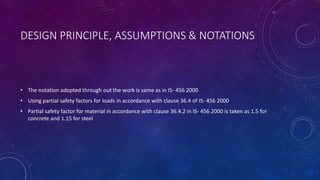
DESIGN PRINCIPLE, ASSUMPTIONS & NOTATIONS
• The notation adopted through out the work is same as in IS- 456 2000
• Using partial safety factors for loads in accordance with clause 36.4 of IS- 456 2000
• Partial safety factor for material in accordance with clause 36.4.2 in IS- 456 2000 is taken as 1.5 for
concrete and 1.15 for steel
LOADS AND DENSITY OF MATERIALS
• Material and their Density
• Plain concrete: 24.0 kN/m3
• Reinforced Concrete: 25.0 kN/m3
• Flooring Material: 20.0 kN/m3
• Brick Masonary: 19.0 kn/m3
• Flyash: 5.0 kn/m3
• Live Loads in accordance with IS- 875
• Live load on slab: 3.0 kN/m2
• Live load on stair: 3.0 kN/m2
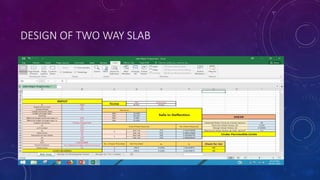
DESIGN OF TWO WAY SLAB
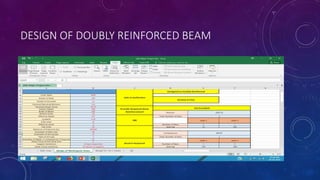
DESIGN OF DOUBLY REINFORCED BEAM
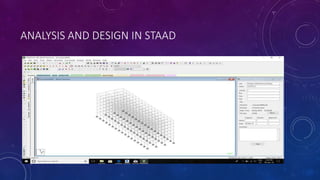
ANALYSIS AND DESIGN IN STAAD
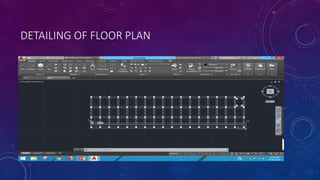
DETAILING OF FLOOR PLAN
THANKS
Any Query

Structure analysis and design

  • 1.
    DESIGN AND ANALYSISOF MULTISTOREY BUILDING KIRANDEEP SINGH 140070/1410664 B.TECH(CIVIL ENGG.) GURU NANAK DEV ENGINEERING COLLEGE, LUDHIANA
  • 2.
    CONTENTS • INTRODUCTION • CODES •SOFTWARES’S • STATEMENT OF PROJECT • LOADS ON THE STRUCTURE • OBJECTIVES OF STRUCTURAL DESIGN • DESIGN AND ANALYSIS • REFERENCES
  • 3.
    INTRODUCTION • Our projectis based on the design and analysis of the multi- storied building. • Analysis is done through using the STAAD- PRO • Notation adopted through out the project is same in IS- 456 2000
  • 4.
    CODES • IS- 4562000: DESIGN CODE FOR RCC STRUCTURES • SP-16: DESIGN CODE FOR COLUMNS • IS-875(PART 1): CODE FOR DEAD LOADS • IS-875(PART 2): CODE FOR IMPOSED LOADS • IS- 875(PART 3): CODE FOR WIND LOADS
  • 5.
    SOFTWARES • This projectis mainly based on software and it is essential to know the details about these softwares. • STAAD Pro V8i • ETABS • AutoCAD
  • 6.
    STAAD PRO V8I •It stands for Structural Analysis and Design • It is powerful design software licensed by Bentley, • It is to calculate S.F.D and B.M.D of complex loading beam • It comes up to building with several members it will taken a week • Now a days most of the high rise buildings are designed by staad which makes a compulsion for a civil engineer to know about this software.
  • 7.
    AUTOCAD • AutoCAD isa powerful software licensed by AutoDesk Company and CAD stands for Computer Aided Design • It is used for drawing different layouts, elevations, details, sections, can be shown in AutoCAD. • We used for drawing the plan of Multi storey building
  • 8.
    STATEMENT OF THEPROJECT • Utility of building: Residential Building • Number of Storeys: G+4 • Number of staircases: 5 • Shape of Building: Rectangular • Type of Construciton: R.C.C framed structure • Type of walls: Brick Wall
  • 9.
    GEOMETRIC DETAILS • Groundfloor: 3.0 m • Floor height: 3.0 m • Height of plinth: 1.5 m from below foundation • Depth of foundation: 500 mm
  • 10.
    MATERIAL DETAILS • ConcreteGrade: M25 • All Steel Grade: Fe500 Grade • Type of steel bars: HYSD • Bearing Capacity of Soil: >180 kN/m^2
  • 11.
    LOADS ON STRUCTURE •Dead Load • Imposed Load’ • Wind Load • Earthquake Load
  • 12.
    LOAD COMBINATIONS • Thestructure should be analysed for combination of loads as in practice we have number of loads in various directions act • Some of the combinations to be checked are given as • 1.5(DL+LL) • 1.5(DL+WL) • 1.5(DL+LL+WL)
  • 13.
    OBJECTIVES OF STRUCTURALDESIGN • Designed structure should satisfy the criteria of ultimate strength • Structure should satisfy the serviceability requirement • It should satisfy the stability against overturning, sliding, and buckling
  • 14.
    MAIN MEMBERS TOBE DESIGNED • Foundation • Exterior and Interior Columns • Beam Design • Slab Design
  • 15.
    DESIGN PRINCIPLE, ASSUMPTIONS& NOTATIONS • The notation adopted through out the work is same as in IS- 456 2000 • Using partial safety factors for loads in accordance with clause 36.4 of IS- 456 2000 • Partial safety factor for material in accordance with clause 36.4.2 in IS- 456 2000 is taken as 1.5 for concrete and 1.15 for steel
  • 16.
    LOADS AND DENSITYOF MATERIALS • Material and their Density • Plain concrete: 24.0 kN/m3 • Reinforced Concrete: 25.0 kN/m3 • Flooring Material: 20.0 kN/m3 • Brick Masonary: 19.0 kn/m3 • Flyash: 5.0 kn/m3 • Live Loads in accordance with IS- 875 • Live load on slab: 3.0 kN/m2 • Live load on stair: 3.0 kN/m2
  • 17.
    DESIGN OF TWOWAY SLAB
  • 18.
    DESIGN OF DOUBLYREINFORCED BEAM
  • 19.
  • 20.
  • 21.