
Traditional Media Fight to Remain
             Relevant
      Sponsored by PRSA Technology Section

  Presented by:


  November 2009
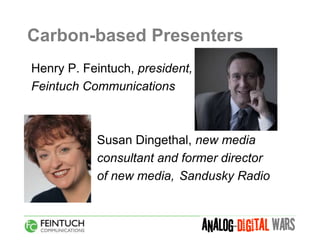
Carbon-based Presenters
Henry P. Feintuch, president,
Feintuch Communications


           Susan Dingethal, new media
           consultant and former director
           of new media, Sandusky Radio
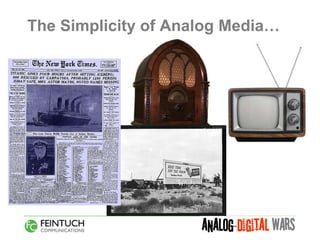
The Simplicity of Analog Media…
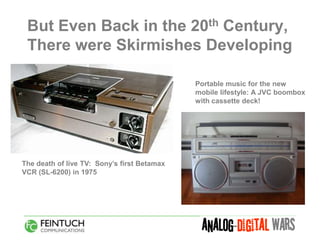
But Even Back in the 20th Century,
 There were Skirmishes Developing

                                             Portable music for the new
                                             mobile lifestyle: A JVC boombox
                                             with cassette deck!


The death of live TV: Sony’s first Betamax
VCR (SL-6200) in 1975
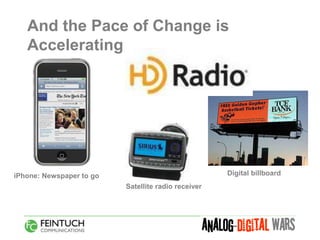
And the Pace of Change is
   Accelerating


iPhone: Newspaper to go                              Digital billboard
                          Satellite radio receiver
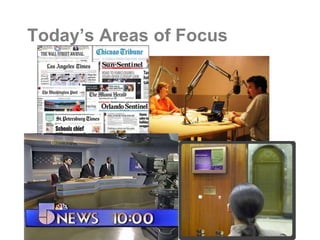
Today’s Areas of Focus
Newspapers
• The seeds for upheaval planted long time ago
  – Newspapers are dominant news source for two
    centuries
  – Radio offers competition in news and
    entertainment in 1920s
  – AP tries to deny radio stations use of info
  – Radio shines during World War II with reports on
    Pearl Harbor and Battle of Britain
  – TV’s ascent in second half of 1900s competes for
    consumer’s attention
Newspapers
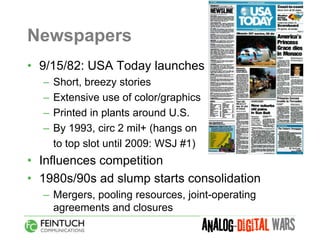
• 9/15/82: USA Today launches
  –   Short, breezy stories
  –   Extensive use of color/graphics
  –   Printed in plants around U.S.
  –   By 1993, circ 2 mil+ (hangs on
      to top slot until 2009: WSJ #1)
• Influences competition
• 1980s/90s ad slump starts consolidation
  – Mergers, pooling resources, joint-operating
    agreements and closures
Newspapers
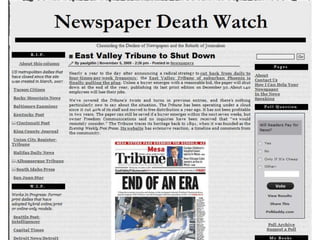
• By 1990, U.S. has 267 fewer newspapers
  than 1940
• By 1992, only 37 cities had separately
  owned, competing daily newspapers
• The Internet comes on strong and siphons
  even more readers away
• Oct. 26, 2009 stats/Audit Bureau of Control:
  – Total circ. lower than 41.1m papers sold in 1940
  – % of population reading daily = <13% (1940: 31%)
Newspapers
Newspapers
Newspapers
Newspapers
Newspapers
Newspapers
Newspapers
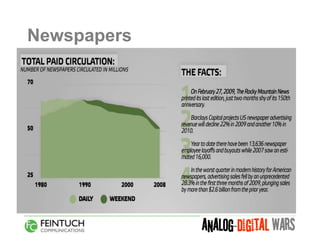
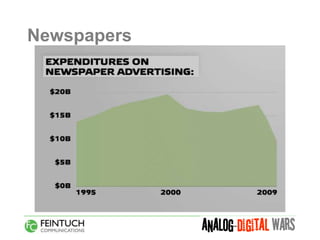
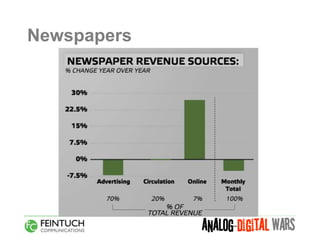
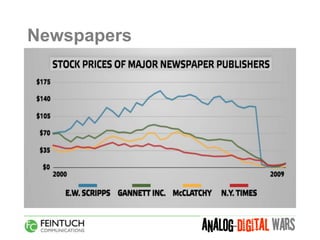
• Newspaper ad revenue down 16.6% last year
  and about 28% so far this year (NAA)
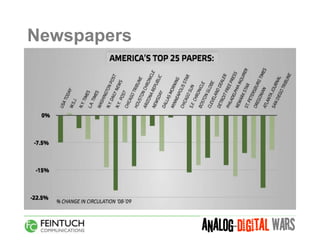
• Top 25 papers in the U.S. all posted circ.
  Declines except for WSJ (which now counts
  online subscriptions)
• NYT, now at $2 per daily copy, saw weekday
  circ. drop 7.3% to 928,000 (1st under 1m
  since 80s)
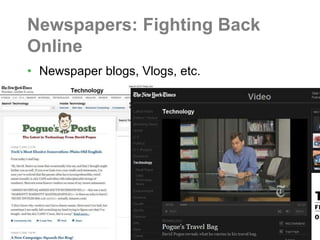
Newspapers: Fighting Back
Online…
Newspapers: Fighting Back
Online
• Newspaper blogs, Vlogs, etc.
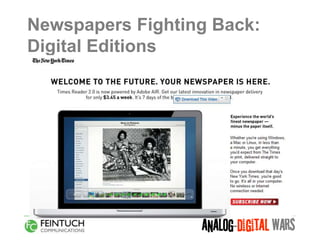
Newspapers Fighting Back:
Digital Editions
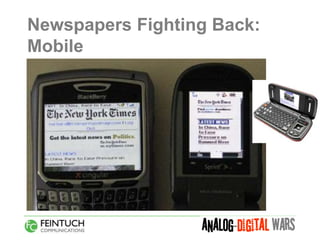
Newspapers Fighting Back:
Mobile
Newspapers: What it All Means
• Implications to PR Practitioners
  – Fewer papers & shrinking news hole
     • Harder to get print placements
• Fewer reporters doing more work and feeding
  more brand extensions/media
• Deadlines change (24/7 now; no longer tied
  to printing deadline)
• Journalist blogs present new opportunities to
  interact
• Citizen journalism allows consumer access
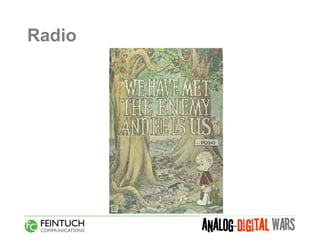
Radio
Radio
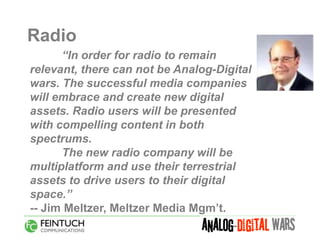
      “In order for radio to remain
relevant, there can not be Analog-Digital
wars. The successful media companies
will embrace and create new digital
assets. Radio users will be presented
with compelling content in both
spectrums.
      The new radio company will be
multiplatform and use their terrestrial
assets to drive users to their digital
space.”
-- Jim Meltzer, Meltzer Media Mgm’t.
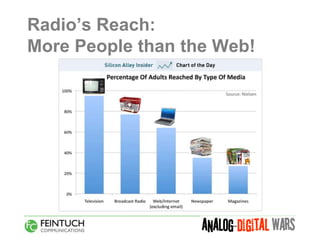
Radio’s Reach:
More People than the Web!
Challenges Facing Radio
• Personal casting
• Increased competition from new media
• Market compression due to latest ratings
  technology
• An identity problem: what business is radio
  in?
Emerging Technologies:
HD Radio
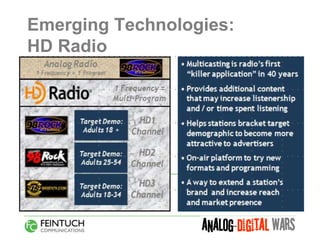
• HD Radio technology allows multicasting on
   several HD Radio channels
• HD side channels can carry complimentary or
   dissimilar programming
       “Multicasting is radio’s first killer
   application in 40 years.”
-- Rick Greenhut, Director, U.S. Sales
iBiquity Digital Corporation
Emerging Technologies:
HD Radio
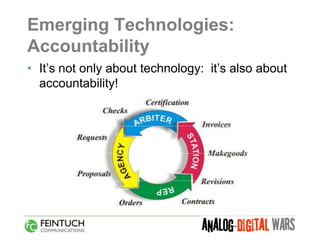
Emerging Technologies:
Accountability
• It’s not only about technology: it’s also about
  accountability!
Emerging Technologies:
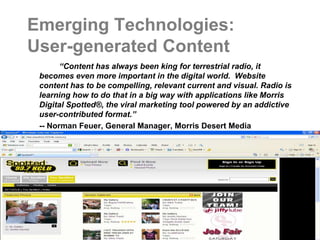
User-generated Content
       “Content has always been king for terrestrial radio, it
 becomes even more important in the digital world. Website
 content has to be compelling, relevant current and visual. Radio is
 learning how to do that in a big way with applications like Morris
 Digital Spotted®, the viral marketing tool powered by an addictive
 user-contributed format.”
 -- Norman Feuer, General Manager, Morris Desert Media
Emerging Technologies:
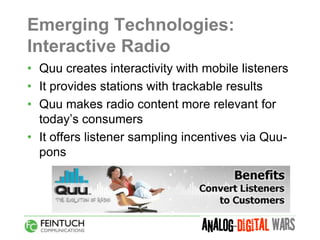
Interactive Radio
• Quu creates interactivity with mobile listeners
• It provides stations with trackable results
• Quu makes radio content more relevant for
  today’s consumers
• It offers listener sampling incentives via Quu-
  pons
Radio: What Does it All Mean?
• Implications to PR practitioners
  – Though ubiquitous, radio is a terribly underused
    medium
     • Highly personal: trusted on-air personalities loan
       credibility and strong endorsement to your message
  – New technologies are creating more
    stations/outlets = more PR opportunities
  – Multi-platform medium offering additional
    placement opportunities to clever publicists
  – Immediate medium and highly accountable
Radio
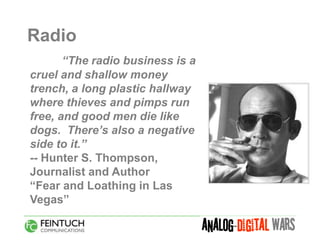
       “The radio business is a
cruel and shallow money
trench, a long plastic hallway
where thieves and pimps run
free, and good men die like
dogs. There’s also a negative
side to it.”
-- Hunter S. Thompson,
Journalist and Author
“Fear and Loathing in Las
Vegas”
TV News
• Previously a very simple model
  – Early evening and late evening local newscast
     • 30- and 60-minutes
  – Network newscast
     • 30 minutes and bulletins
• TV was one way: the anchor read the news
• In 1980s, film gives way to ENG (electronic
  news gathering)
  – Live cutaways to breaking news
  – Less talking heads
TV News
• Satellite technology allows for interviews; live
  broadcasting of news from around the world
• June 1, 1980: CNN becomes first network to
  broadcast news 24/7
• Competitive pressure begins between
  traditional networks and cable
• Local news relatively inexpensive to produce
   – Expanding program holes (early morning, local
     noon, 4-6:30PM, 7PM, 10 or 11PM)
TV News
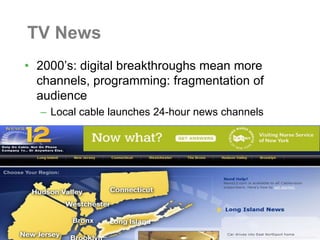
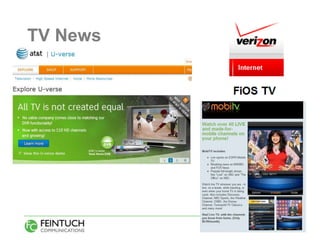
• 2000’s: digital breakthroughs mean more
  channels, programming: fragmentation of
  audience
  – Local cable launches 24-hour news channels
TV News
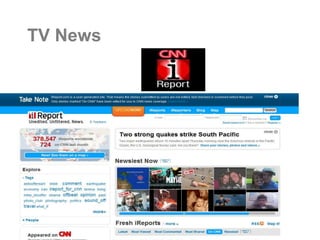
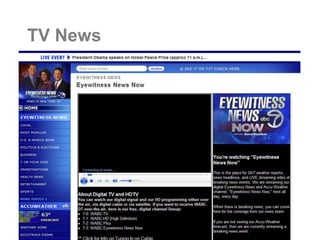
TV News
TV News
• 2000’s:
TV News
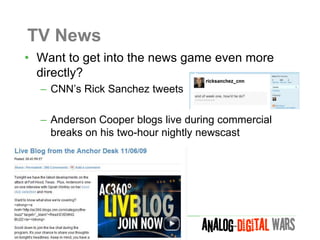
• Want to get into the news game even more
  directly?
  – CNN’s Rick Sanchez tweets

  – Anderson Cooper blogs live during commercial
    breaks on his two-hour nightly newscast
TV News: What it All Means?
• Implications to PR practitioners
  – As TV ad revenue drops, newsrooms do more
    with less
     • More programming but less time/budget to produce
       original packages
     • Reporters and anchors pull more air-time, cable, mobile,
       digital, blog, tweet
     • Prepping easy to cover stories with guests packaged
       more likely to get covered than investigative, long-form
       news
  – Diversity in media outlets and forms means more
    chances to impact local news (though smaller
    audiences)
TV News: What it All Means?
• Implications to PR practitioners
  – In many cases, easier for clients and brands to
    join the conversation directly with anchor/news
    team (bypassing assignment editor/producer)
  – Digital video can go viral: picked up directly off
    YouTube and web onto news casts and vice-versa
  – Consumers/PR people can upload/email video
    footage to newsrooms
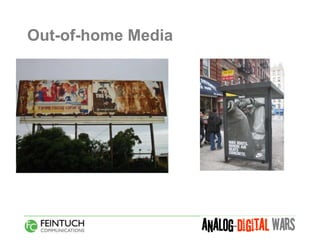
Out-of-home Media


                    Digital billboards
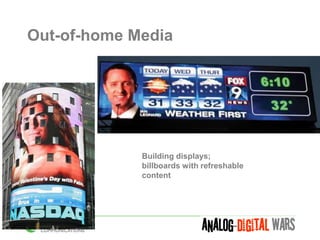
Out-of-home Media


             Building displays;
             billboards with refreshable
             content
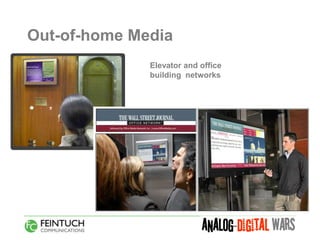
Out-of-home Media
              Elevator and office
              building networks
Out-of-home Media


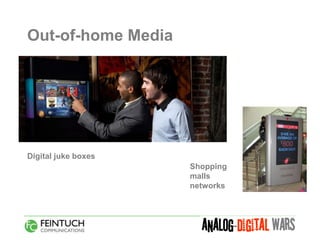
Digital juke boxes
                     Shopping
                     malls
                     networks
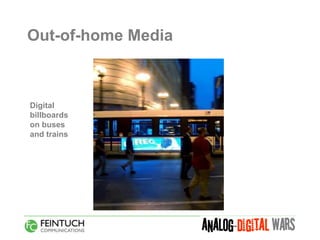
Out-of-home Media


Digital
billboards
on buses
and trains
Out-of-home: What Does it All
Mean?
• Implications to PR practitioners
  – Pitch the new and emerging digital networks for
    community news/news-you-can use for your
    company/client’s messages; calendar listings
  – Try pitching the new networks on PSA or
    discounted rates for non-profits
  – Paid placement can supplement a PR campaign
    given the speed of ad deployment and precise
    targeting options
  – Look for new forms and deployments; be creative
    in approaching network owners who are looking to
    differentiate themselves
What Does It All Mean to the
PR Industry?
• What has the analog-digital war meant to
  your company or agency?
• Have you embraced the new technologies
  and media realities to your company/client’s
  advantage?
• What’s coming next and is the PR industry in
  a position to leverage it?

• Questions? Comments?
Analog-Digital Wars
For more information, contact:
Henry Feintuch
henry@feintuchpr.com
212-808-4901
Susan Dingethal
dingethal@aol.com
206-619-0593
Download the presentation at
 www.feintuchpr.com; and visit the media
 room

Analog-Digital Wars

  • 1.
    Traditional Media Fightto Remain Relevant Sponsored by PRSA Technology Section Presented by: November 2009
  • 2.
    Carbon-based Presenters Henry P.Feintuch, president, Feintuch Communications Susan Dingethal, new media consultant and former director of new media, Sandusky Radio
  • 3.
    The Simplicity ofAnalog Media…
  • 4.
    But Even Backin the 20th Century, There were Skirmishes Developing Portable music for the new mobile lifestyle: A JVC boombox with cassette deck! The death of live TV: Sony’s first Betamax VCR (SL-6200) in 1975
  • 5.
    And the Paceof Change is Accelerating iPhone: Newspaper to go Digital billboard Satellite radio receiver
  • 6.
  • 7.
    Newspapers • The seedsfor upheaval planted long time ago – Newspapers are dominant news source for two centuries – Radio offers competition in news and entertainment in 1920s – AP tries to deny radio stations use of info – Radio shines during World War II with reports on Pearl Harbor and Battle of Britain – TV’s ascent in second half of 1900s competes for consumer’s attention
  • 8.
    Newspapers • 9/15/82: USAToday launches – Short, breezy stories – Extensive use of color/graphics – Printed in plants around U.S. – By 1993, circ 2 mil+ (hangs on to top slot until 2009: WSJ #1) • Influences competition • 1980s/90s ad slump starts consolidation – Mergers, pooling resources, joint-operating agreements and closures
  • 9.
    Newspapers • By 1990,U.S. has 267 fewer newspapers than 1940 • By 1992, only 37 cities had separately owned, competing daily newspapers • The Internet comes on strong and siphons even more readers away • Oct. 26, 2009 stats/Audit Bureau of Control: – Total circ. lower than 41.1m papers sold in 1940 – % of population reading daily = <13% (1940: 31%)
  • 10.
  • 11.
  • 12.
  • 13.
  • 14.
  • 15.
  • 16.
    Newspapers • Newspaper adrevenue down 16.6% last year and about 28% so far this year (NAA) • Top 25 papers in the U.S. all posted circ. Declines except for WSJ (which now counts online subscriptions) • NYT, now at $2 per daily copy, saw weekday circ. drop 7.3% to 928,000 (1st under 1m since 80s)
  • 17.
  • 18.
    Newspapers: Fighting Back Online •Newspaper blogs, Vlogs, etc.
  • 19.
  • 20.
  • 21.
    Newspapers: What itAll Means • Implications to PR Practitioners – Fewer papers & shrinking news hole • Harder to get print placements • Fewer reporters doing more work and feeding more brand extensions/media • Deadlines change (24/7 now; no longer tied to printing deadline) • Journalist blogs present new opportunities to interact • Citizen journalism allows consumer access
  • 22.
  • 23.
    Radio “In order for radio to remain relevant, there can not be Analog-Digital wars. The successful media companies will embrace and create new digital assets. Radio users will be presented with compelling content in both spectrums. The new radio company will be multiplatform and use their terrestrial assets to drive users to their digital space.” -- Jim Meltzer, Meltzer Media Mgm’t.
  • 24.
  • 25.
    Challenges Facing Radio •Personal casting • Increased competition from new media • Market compression due to latest ratings technology • An identity problem: what business is radio in?
  • 26.
    Emerging Technologies: HD Radio •HD Radio technology allows multicasting on several HD Radio channels • HD side channels can carry complimentary or dissimilar programming “Multicasting is radio’s first killer application in 40 years.” -- Rick Greenhut, Director, U.S. Sales iBiquity Digital Corporation
  • 27.
  • 28.
    Emerging Technologies: Accountability • It’snot only about technology: it’s also about accountability!
  • 29.
    Emerging Technologies: User-generated Content “Content has always been king for terrestrial radio, it becomes even more important in the digital world. Website content has to be compelling, relevant current and visual. Radio is learning how to do that in a big way with applications like Morris Digital Spotted®, the viral marketing tool powered by an addictive user-contributed format.” -- Norman Feuer, General Manager, Morris Desert Media
  • 30.
    Emerging Technologies: Interactive Radio •Quu creates interactivity with mobile listeners • It provides stations with trackable results • Quu makes radio content more relevant for today’s consumers • It offers listener sampling incentives via Quu- pons
  • 31.
    Radio: What Doesit All Mean? • Implications to PR practitioners – Though ubiquitous, radio is a terribly underused medium • Highly personal: trusted on-air personalities loan credibility and strong endorsement to your message – New technologies are creating more stations/outlets = more PR opportunities – Multi-platform medium offering additional placement opportunities to clever publicists – Immediate medium and highly accountable
  • 32.
    Radio “The radio business is a cruel and shallow money trench, a long plastic hallway where thieves and pimps run free, and good men die like dogs. There’s also a negative side to it.” -- Hunter S. Thompson, Journalist and Author “Fear and Loathing in Las Vegas”
  • 33.
    TV News • Previouslya very simple model – Early evening and late evening local newscast • 30- and 60-minutes – Network newscast • 30 minutes and bulletins • TV was one way: the anchor read the news • In 1980s, film gives way to ENG (electronic news gathering) – Live cutaways to breaking news – Less talking heads
  • 34.
    TV News • Satellitetechnology allows for interviews; live broadcasting of news from around the world • June 1, 1980: CNN becomes first network to broadcast news 24/7 • Competitive pressure begins between traditional networks and cable • Local news relatively inexpensive to produce – Expanding program holes (early morning, local noon, 4-6:30PM, 7PM, 10 or 11PM)
  • 35.
    TV News • 2000’s:digital breakthroughs mean more channels, programming: fragmentation of audience – Local cable launches 24-hour news channels
  • 36.
  • 37.
  • 38.
  • 39.
    TV News • Wantto get into the news game even more directly? – CNN’s Rick Sanchez tweets – Anderson Cooper blogs live during commercial breaks on his two-hour nightly newscast
  • 40.
    TV News: Whatit All Means? • Implications to PR practitioners – As TV ad revenue drops, newsrooms do more with less • More programming but less time/budget to produce original packages • Reporters and anchors pull more air-time, cable, mobile, digital, blog, tweet • Prepping easy to cover stories with guests packaged more likely to get covered than investigative, long-form news – Diversity in media outlets and forms means more chances to impact local news (though smaller audiences)
  • 41.
    TV News: Whatit All Means? • Implications to PR practitioners – In many cases, easier for clients and brands to join the conversation directly with anchor/news team (bypassing assignment editor/producer) – Digital video can go viral: picked up directly off YouTube and web onto news casts and vice-versa – Consumers/PR people can upload/email video footage to newsrooms
  • 42.
    Out-of-home Media Digital billboards
  • 43.
    Out-of-home Media Building displays; billboards with refreshable content
  • 44.
    Out-of-home Media Elevator and office building networks
  • 45.
    Out-of-home Media Digital jukeboxes Shopping malls networks
  • 46.
  • 47.
    Out-of-home: What Doesit All Mean? • Implications to PR practitioners – Pitch the new and emerging digital networks for community news/news-you-can use for your company/client’s messages; calendar listings – Try pitching the new networks on PSA or discounted rates for non-profits – Paid placement can supplement a PR campaign given the speed of ad deployment and precise targeting options – Look for new forms and deployments; be creative in approaching network owners who are looking to differentiate themselves
  • 48.
    What Does ItAll Mean to the PR Industry? • What has the analog-digital war meant to your company or agency? • Have you embraced the new technologies and media realities to your company/client’s advantage? • What’s coming next and is the PR industry in a position to leverage it? • Questions? Comments?
  • 49.
    Analog-Digital Wars For moreinformation, contact: Henry Feintuch henry@feintuchpr.com 212-808-4901 Susan Dingethal dingethal@aol.com 206-619-0593 Download the presentation at www.feintuchpr.com; and visit the media room