ANEMIA
ANJALI SHUKLA
ANEMIA
ANEMIA should be taken seriously. It is
more than just tiredness as it affects
adversely the entire body, especially in
growing children.
- Dr Lloyd Van Winkle
WHAT IS ANEMIA
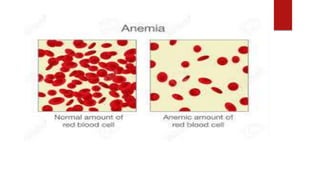
 Anemia is a medical condition in which the blood doesn’t have enough healthy
RBCs.
 Anemia is the one of the most underdiagnosed conditions and if left untreated,
can have numerous serious implications such as Pregnancy complications such as
LBW Baby, In children’s – delayed growth and CVD also.
INTRODUCTION
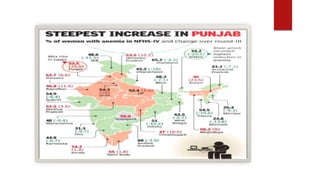
 Anemia is the most common nutritional deficiency disorder across world. Alone in
India 50 % of population is affected and statistics reveals that every second
women are anemic & one in every five maternal death is directly due to anemia.
 It is estimated that one- third of all women of reproductive age group are Anemic.
Out of this 40% of pregnant women are Anemic worldwide.
 Over 40% of children under 5 years of age are anemic.
DEFINITION
 Anemia is a Greek word meaning “Lack of Blood”.
 Anemia may be defined as the condition that results from the availability of the
Erythropoietic tissue to maintain a normal haemoglobin concentration on account
of inadequate supply of one or more nutrients leading to reduction in total
circulating hemoglobin.
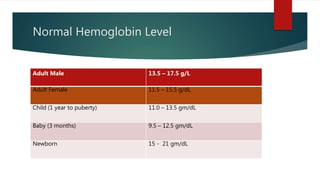
Normal Hemoglobin Level
Adult Male 13.5 – 17.5 g/L
Adult Female 11.5 – 15.5 g/dL
Child (1 year to puberty) 11.0 – 13.5 gm/dL
Baby (3 months) 9.5 – 12.5 gm/dL
Newborn 15 - 21 gm/dL
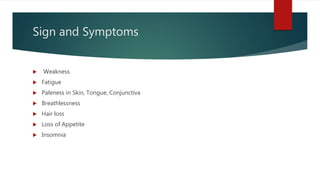
Sign and Symptoms
 Weakness
 Fatigue
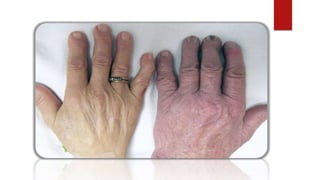
 Paleness in Skin, Tongue, Conjunctiva
 Breathlessness
 Hair loss
 Loss of Appetite
 Insomnia
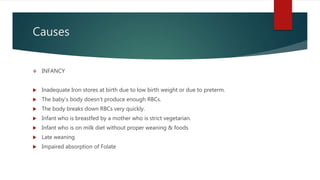
Causes
 INFANCY
 Inadequate Iron stores at birth due to low birth weight or due to preterm.
 The baby’s body doesn’t produce enough RBCs.
 The body breaks down RBCs very quickly.
 Infant who is breastfed by a mother who is strict vegetarian.
 Infant who is on milk diet without proper weaning & foods
 Late weaning
 Impaired absorption of Folate
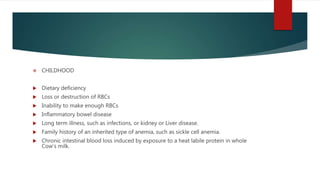
 CHILDHOOD
 Dietary deficiency
 Loss or destruction of RBCs
 Inability to make enough RBCs
 Inflammatory bowel disease
 Long term illness, such as infections, or kidney or Liver disease.
 Family history of an inherited type of anemia, such as sickle cell anemia.
 Chronic intestinal blood loss induced by exposure to a heat labile protein in whole
Cow’s milk.
 ADOLESCENCE
 At the time of Menarche
 Growth spurt with a sub-optimal hematopoietic content
 Gender Discrimination
 Iron depletion occurs in girls who take part in intensive exercise.
 Early marriage with Pregnancy.
 Excess blood loss during Mensuration
 PREGNANCY
 Increased requirements
 Hemodilution
 Low maternal age
 Cultural beliefs, Taboos and inappropriate food practices.
 Infection which may interfere with intake, absorption and assimilation of nutrients.
 Pregnancy related complications
 OLD AGE
 Dietary deficiency (Folic acid)
 Atrophic gastritis and bacterial overgrowth (B 12)
 Gastrointestinal blood loss from malignant disease, peptic ulcer disease.
 Use of non-steroidal anti-inflammatory drugs.
 Psychology problems
 Loneliness
 Poor absorption
 Chronic inflammatory disease
Types of Anemia
 Iron-Deficiency Anemia
 Body needs iron to make hemoglobin, the protein in RBCs that carries oxygen. Iron is
essential for the various activities of the human body especially in the haemoglobin
synthesis. The main way to get iron is from food. At certain times—such as during
pregnancy, growth spurts, or blood loss— body need to make more RBCs than usual.
Thus, body needs more iron than usual.
 The causes of iron-deficiency anemia are pregnancy or childhood growth spurts, Heavy
menstrual periods, Poor absorption of iron, Bleeding from the intestines, dietary factors
(iron poor or restricted diet), medication (aspirin ibuprofen and diclofenac), Lack of
certain vitamins (folic acid and vitamin B12), Bleeding from the kidney, Hookworm
infection, Bone marrow problems, leads to anemia.
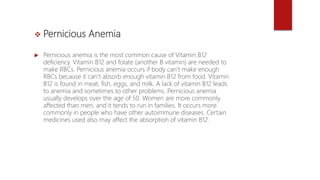
 Pernicious Anemia
 Pernicious anemia is the most common cause of Vitamin B12
deficiency. Vitamin B12 and folate (another B vitamin) are needed to
make RBCs. Pernicious anemia occurs if body can’t make enough
RBCs because it can’t absorb enough vitamin B12 from food. Vitamin
B12 is found in meat, fish, eggs, and milk. A lack of vitamin B12 leads
to anemia and sometimes to other problems. Pernicious anemia
usually develops over the age of 50. Women are more commonly
affected than men, and it tends to run in families. It occurs more
commonly in people who have other autoimmune diseases. Certain
medicines used also may affect the absorption of vitamin B12.
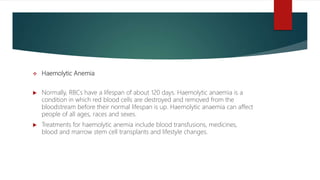
 Haemolytic Anemia
 Normally, RBCs have a lifespan of about 120 days. Haemolytic anaemia is a
condition in which red blood cells are destroyed and removed from the
bloodstream before their normal lifespan is up. Haemolytic anaemia can affect
people of all ages, races and sexes.
 Treatments for haemolytic anemia include blood transfusions, medicines,
blood and marrow stem cell transplants and lifestyle changes.
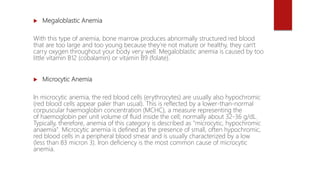
 Megaloblastic Anemia
With this type of anemia, bone marrow produces abnormally structured red blood
that are too large and too young because they’re not mature or healthy, they can't
carry oxygen throughout your body very well. Megaloblastic anemia is caused by too
little vitamin B12 (cobalamin) or vitamin B9 (folate).
 Microcytic Anemia
In microcytic anemia, the red blood cells (erythrocytes) are usually also hypochromic
(red blood cells appear paler than usual). This is reflected by a lower-than-normal
corpuscular haemoglobin concentration (MCHC), a measure representing the
of haemoglobin per unit volume of fluid inside the cell; normally about 32-36 g/dL.
Typically, therefore, anemia of this category is described as "microcytic, hypochromic
anaemia". Microcytic anemia is defined as the presence of small, often hypochromic,
red blood cells in a peripheral blood smear and is usually characterized by a low
(less than 83 micron 3). Iron deficiency is the most common cause of microcytic
anemia.
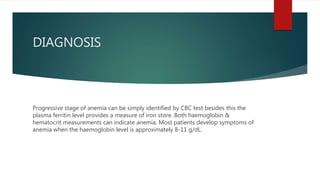
DIAGNOSIS
Progressive stage of anemia can be simply identified by CBC test besides this the
plasma ferritin level provides a measure of iron store. Both haemoglobin &
hematocrit measurements can indicate anemia. Most patients develop symptoms of
anemia when the haemoglobin level is approximately 8-11 g/dL.
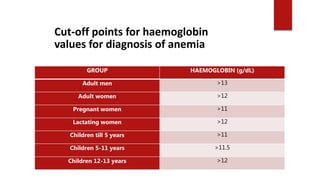
Cut-off points for haemoglobin
values for diagnosis of anemia
GROUP HAEMOGLOBIN (g/dL)
Adult men >13
Adult women >12
Pregnant women >11
Lactating women >12
Children till 5 years >11
Children 5-11 years >11.5
Children 12-13 years >12
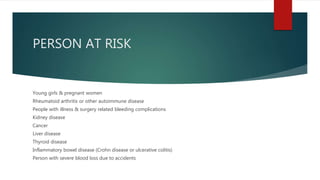
PERSON AT RISK
Young girls & pregnant women
Rheumatoid arthritis or other autoimmune disease
People with illness & surgery related bleeding complications
Kidney disease
Cancer
Liver disease
Thyroid disease
Inflammatory bowel disease (Crohn disease or ulcerative colitis)
Person with severe blood loss due to accidents
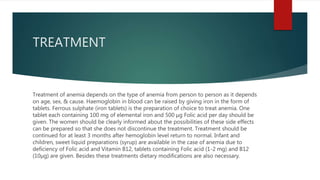
TREATMENT
Treatment of anemia depends on the type of anemia from person to person as it depends
on age, sex, & cause. Haemoglobin in blood can be raised by giving iron in the form of
tablets. Ferrous sulphate (iron tablets) is the preparation of choice to treat anemia. One
tablet each containing 100 mg of elemental iron and 500 µg Folic acid per day should be
given. The women should be clearly informed about the possibilities of these side effects
can be prepared so that she does not discontinue the treatment. Treatment should be
continued for at least 3 months after hemoglobin level return to normal. Infant and
children, sweet liquid preparations (syrup) are available in the case of anemia due to
deficiency of Folic acid and Vitamin B12, tablets containing Folic acid (1-2 mg) and B12
(10µg) are given. Besides these treatments dietary modifications are also necessary.
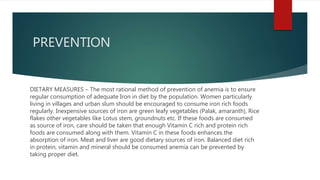
PREVENTION
DIETARY MEASURES – The most rational method of prevention of anemia is to ensure
regular consumption of adequate Iron in diet by the population. Women particularly
living in villages and urban slum should be encouraged to consume iron rich foods
regularly. Inexpensive sources of iron are green leafy vegetables (Palak, amaranth), Rice
flakes other vegetables like Lotus stem, groundnuts etc. If these foods are consumed
as source of iron, care should be taken that enough Vitamin C rich and protein rich
foods are consumed along with them. Vitamin C in these foods enhances the
absorption of iron. Meat and liver are good dietary sources of iron. Balanced diet rich
in protein, vitamin and mineral should be consumed anemia can be prevented by
taking proper diet.
 SUPPLEMENTATION – To prevent anemia under National Nutritional Anemia
Prophylaxis Programme distributes Iron and Folic tablets to pregnant women
during last trimester and for preschool children. Expectant and nursing mothers
are given 60 mg of elemental iron and 0.5 mg of Folic acid. Children in the age
group 1 to 5 years are given 20 mg of elemental iron and 0.1 mg of Folic acid.
 EDUCATION – Emphasis should be laid on educating both the health
functionaries as well as the general population about anemia. All Medical Health
and social workers, Horticulture department and voluntary organization have role
to play in promoting the consumption of iron rich foods.
 FORTIFICATION – The nutritive value of diet can be improved by the addition of
nutrients to a food item. This method of providing nutrients by addition of one or
more nutrients to the food item is known as Food Fortification. This, one of the
methods of ensuring adequate consumption of iron through diet is to add iron to a
food item that is consumed by one and all daily. Common salt, as it is consumed by
the rich and poor daily in our country has been identified as the vehicle for
fortification with iron. Studies have shown the consumption of common salt to which
iron has been added leads to an increase in hemoglobin level does reducing the
prevalence of anemia. Several iron fortified foods like wheat Atta, Breakfast cereals are
available in the market already. Fortified infant food with iron to protect infant fed for
long period on artificial milk formulas from anemia are also available.
 DISTRIBUTION OF IRON AND FOLIC ACID TABLETS - By giving iron tablets the
hemoglobin level in the blood can be raised. The distribution of tablet contains 100
mg of elemental iron and 500 mcg of Folic acid to the vulnerable section of a
community like pregnant and lactating women, family planning acceptors and
children (1-5 years)
BIBILOGRAPHY
 Book of Dietetics by B. Shri Laxmi
 www.webmd.com

Anemia

  • 1.
  • 2.
  • 3.
    ANEMIA should betaken seriously. It is more than just tiredness as it affects adversely the entire body, especially in growing children. - Dr Lloyd Van Winkle
  • 4.
    WHAT IS ANEMIA Anemia is a medical condition in which the blood doesn’t have enough healthy RBCs.  Anemia is the one of the most underdiagnosed conditions and if left untreated, can have numerous serious implications such as Pregnancy complications such as LBW Baby, In children’s – delayed growth and CVD also.
  • 6.
    INTRODUCTION  Anemia isthe most common nutritional deficiency disorder across world. Alone in India 50 % of population is affected and statistics reveals that every second women are anemic & one in every five maternal death is directly due to anemia.  It is estimated that one- third of all women of reproductive age group are Anemic. Out of this 40% of pregnant women are Anemic worldwide.  Over 40% of children under 5 years of age are anemic.
  • 7.
    DEFINITION  Anemia isa Greek word meaning “Lack of Blood”.  Anemia may be defined as the condition that results from the availability of the Erythropoietic tissue to maintain a normal haemoglobin concentration on account of inadequate supply of one or more nutrients leading to reduction in total circulating hemoglobin.
  • 10.
    Normal Hemoglobin Level AdultMale 13.5 – 17.5 g/L Adult Female 11.5 – 15.5 g/dL Child (1 year to puberty) 11.0 – 13.5 gm/dL Baby (3 months) 9.5 – 12.5 gm/dL Newborn 15 - 21 gm/dL
  • 11.
    Sign and Symptoms Weakness  Fatigue  Paleness in Skin, Tongue, Conjunctiva  Breathlessness  Hair loss  Loss of Appetite  Insomnia
  • 12.
    Causes  INFANCY  InadequateIron stores at birth due to low birth weight or due to preterm.  The baby’s body doesn’t produce enough RBCs.  The body breaks down RBCs very quickly.  Infant who is breastfed by a mother who is strict vegetarian.  Infant who is on milk diet without proper weaning & foods  Late weaning  Impaired absorption of Folate
  • 13.
     CHILDHOOD  Dietarydeficiency  Loss or destruction of RBCs  Inability to make enough RBCs  Inflammatory bowel disease  Long term illness, such as infections, or kidney or Liver disease.  Family history of an inherited type of anemia, such as sickle cell anemia.  Chronic intestinal blood loss induced by exposure to a heat labile protein in whole Cow’s milk.
  • 14.
     ADOLESCENCE  Atthe time of Menarche  Growth spurt with a sub-optimal hematopoietic content  Gender Discrimination  Iron depletion occurs in girls who take part in intensive exercise.  Early marriage with Pregnancy.  Excess blood loss during Mensuration
  • 15.
     PREGNANCY  Increasedrequirements  Hemodilution  Low maternal age  Cultural beliefs, Taboos and inappropriate food practices.  Infection which may interfere with intake, absorption and assimilation of nutrients.  Pregnancy related complications
  • 16.
     OLD AGE Dietary deficiency (Folic acid)  Atrophic gastritis and bacterial overgrowth (B 12)  Gastrointestinal blood loss from malignant disease, peptic ulcer disease.  Use of non-steroidal anti-inflammatory drugs.  Psychology problems  Loneliness  Poor absorption  Chronic inflammatory disease
  • 17.
    Types of Anemia Iron-Deficiency Anemia  Body needs iron to make hemoglobin, the protein in RBCs that carries oxygen. Iron is essential for the various activities of the human body especially in the haemoglobin synthesis. The main way to get iron is from food. At certain times—such as during pregnancy, growth spurts, or blood loss— body need to make more RBCs than usual. Thus, body needs more iron than usual.  The causes of iron-deficiency anemia are pregnancy or childhood growth spurts, Heavy menstrual periods, Poor absorption of iron, Bleeding from the intestines, dietary factors (iron poor or restricted diet), medication (aspirin ibuprofen and diclofenac), Lack of certain vitamins (folic acid and vitamin B12), Bleeding from the kidney, Hookworm infection, Bone marrow problems, leads to anemia.
  • 18.
     Pernicious Anemia Pernicious anemia is the most common cause of Vitamin B12 deficiency. Vitamin B12 and folate (another B vitamin) are needed to make RBCs. Pernicious anemia occurs if body can’t make enough RBCs because it can’t absorb enough vitamin B12 from food. Vitamin B12 is found in meat, fish, eggs, and milk. A lack of vitamin B12 leads to anemia and sometimes to other problems. Pernicious anemia usually develops over the age of 50. Women are more commonly affected than men, and it tends to run in families. It occurs more commonly in people who have other autoimmune diseases. Certain medicines used also may affect the absorption of vitamin B12.
  • 19.
     Haemolytic Anemia Normally, RBCs have a lifespan of about 120 days. Haemolytic anaemia is a condition in which red blood cells are destroyed and removed from the bloodstream before their normal lifespan is up. Haemolytic anaemia can affect people of all ages, races and sexes.  Treatments for haemolytic anemia include blood transfusions, medicines, blood and marrow stem cell transplants and lifestyle changes.
  • 20.
     Megaloblastic Anemia Withthis type of anemia, bone marrow produces abnormally structured red blood that are too large and too young because they’re not mature or healthy, they can't carry oxygen throughout your body very well. Megaloblastic anemia is caused by too little vitamin B12 (cobalamin) or vitamin B9 (folate).  Microcytic Anemia In microcytic anemia, the red blood cells (erythrocytes) are usually also hypochromic (red blood cells appear paler than usual). This is reflected by a lower-than-normal corpuscular haemoglobin concentration (MCHC), a measure representing the of haemoglobin per unit volume of fluid inside the cell; normally about 32-36 g/dL. Typically, therefore, anemia of this category is described as "microcytic, hypochromic anaemia". Microcytic anemia is defined as the presence of small, often hypochromic, red blood cells in a peripheral blood smear and is usually characterized by a low (less than 83 micron 3). Iron deficiency is the most common cause of microcytic anemia.
  • 21.
    DIAGNOSIS Progressive stage ofanemia can be simply identified by CBC test besides this the plasma ferritin level provides a measure of iron store. Both haemoglobin & hematocrit measurements can indicate anemia. Most patients develop symptoms of anemia when the haemoglobin level is approximately 8-11 g/dL.
  • 22.
    Cut-off points forhaemoglobin values for diagnosis of anemia GROUP HAEMOGLOBIN (g/dL) Adult men >13 Adult women >12 Pregnant women >11 Lactating women >12 Children till 5 years >11 Children 5-11 years >11.5 Children 12-13 years >12
  • 23.
    PERSON AT RISK Younggirls & pregnant women Rheumatoid arthritis or other autoimmune disease People with illness & surgery related bleeding complications Kidney disease Cancer Liver disease Thyroid disease Inflammatory bowel disease (Crohn disease or ulcerative colitis) Person with severe blood loss due to accidents
  • 24.
    TREATMENT Treatment of anemiadepends on the type of anemia from person to person as it depends on age, sex, & cause. Haemoglobin in blood can be raised by giving iron in the form of tablets. Ferrous sulphate (iron tablets) is the preparation of choice to treat anemia. One tablet each containing 100 mg of elemental iron and 500 µg Folic acid per day should be given. The women should be clearly informed about the possibilities of these side effects can be prepared so that she does not discontinue the treatment. Treatment should be continued for at least 3 months after hemoglobin level return to normal. Infant and children, sweet liquid preparations (syrup) are available in the case of anemia due to deficiency of Folic acid and Vitamin B12, tablets containing Folic acid (1-2 mg) and B12 (10µg) are given. Besides these treatments dietary modifications are also necessary.
  • 25.
    PREVENTION DIETARY MEASURES –The most rational method of prevention of anemia is to ensure regular consumption of adequate Iron in diet by the population. Women particularly living in villages and urban slum should be encouraged to consume iron rich foods regularly. Inexpensive sources of iron are green leafy vegetables (Palak, amaranth), Rice flakes other vegetables like Lotus stem, groundnuts etc. If these foods are consumed as source of iron, care should be taken that enough Vitamin C rich and protein rich foods are consumed along with them. Vitamin C in these foods enhances the absorption of iron. Meat and liver are good dietary sources of iron. Balanced diet rich in protein, vitamin and mineral should be consumed anemia can be prevented by taking proper diet.
  • 26.
     SUPPLEMENTATION –To prevent anemia under National Nutritional Anemia Prophylaxis Programme distributes Iron and Folic tablets to pregnant women during last trimester and for preschool children. Expectant and nursing mothers are given 60 mg of elemental iron and 0.5 mg of Folic acid. Children in the age group 1 to 5 years are given 20 mg of elemental iron and 0.1 mg of Folic acid.  EDUCATION – Emphasis should be laid on educating both the health functionaries as well as the general population about anemia. All Medical Health and social workers, Horticulture department and voluntary organization have role to play in promoting the consumption of iron rich foods.
  • 27.
     FORTIFICATION –The nutritive value of diet can be improved by the addition of nutrients to a food item. This method of providing nutrients by addition of one or more nutrients to the food item is known as Food Fortification. This, one of the methods of ensuring adequate consumption of iron through diet is to add iron to a food item that is consumed by one and all daily. Common salt, as it is consumed by the rich and poor daily in our country has been identified as the vehicle for fortification with iron. Studies have shown the consumption of common salt to which iron has been added leads to an increase in hemoglobin level does reducing the prevalence of anemia. Several iron fortified foods like wheat Atta, Breakfast cereals are available in the market already. Fortified infant food with iron to protect infant fed for long period on artificial milk formulas from anemia are also available.  DISTRIBUTION OF IRON AND FOLIC ACID TABLETS - By giving iron tablets the hemoglobin level in the blood can be raised. The distribution of tablet contains 100 mg of elemental iron and 500 mcg of Folic acid to the vulnerable section of a community like pregnant and lactating women, family planning acceptors and children (1-5 years)
  • 28.
    BIBILOGRAPHY  Book ofDietetics by B. Shri Laxmi  www.webmd.com