PREPARED BY:
ANJALI
(BSC. HONS NURSING 2nd YAER)
INTRODUCTION
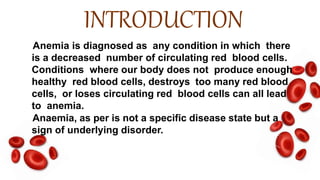
Anemia is diagnosed as any condition in which there
is a decreased number of circulating red blood cells.
Conditions where our body does not produce enough
healthy red blood cells, destroys too many red blood
cells, or loses circulating red blood cells can all lead
to anemia.
Anaemia, as per is not a specific disease state but a
sign of underlying disorder.
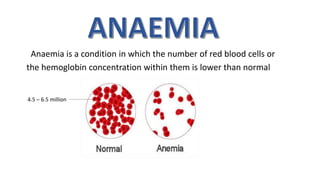
Anaemia is a condition in which the number of red blood cells or
the hemoglobin concentration within them is lower than normal
4.5 – 6.5 million
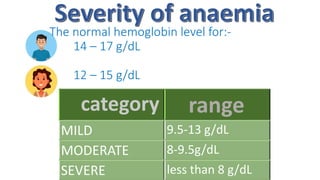
The normal hemoglobin level for:-
14 – 17 g/dL
12 – 15 g/dL
category range
MILD 9.5-13 g/dL
MODERATE 8-9.5g/dL
SEVERE less than 8 g/dL
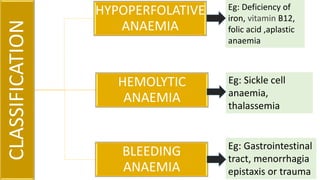
CLASSIFICATION HYPOPERFOLATIVE
ANAEMIA
HEMOLYTIC
ANAEMIA
BLEEDING
ANAEMIA
Eg: Deficiency of
iron, vitamin B12,
folic acid ,aplastic
anaemia
Eg: Sickle cell
anaemia,
thalassemia
Eg: Gastrointestinal
tract, menorrhagia
epistaxis or trauma
4
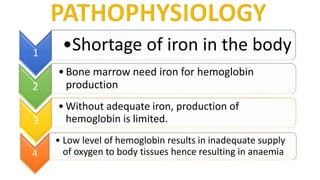
• Low level of hemoglobin results in inadequate supply
of oxygen to body tissues hence resulting in anaemia
1
•Shortage of iron in the body
2
•Bone marrow need iron for hemoglobin
production
3
• Without adequate iron, production of
hemoglobin is limited.
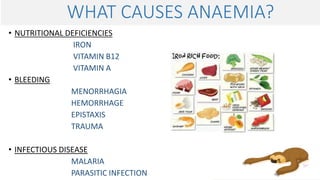
WHAT CAUSES ANAEMIA?
• NUTRITIONAL DEFICIENCIES
IRON
VITAMIN B12
VITAMIN A
• BLEEDING
MENORRHAGIA
HEMORRHAGE
EPISTAXIS
TRAUMA
• INFECTIOUS DISEASE
MALARIA
PARASITIC INFECTION
•Diet lacking in certain elements such as iron and
vitamins
•Intestinal disorders
•Menstruation
•Pregnancy
•Age
•Chronic conditions
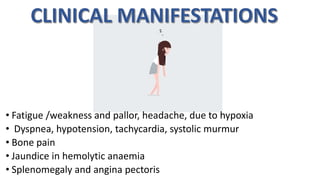
• Fatigue /weakness and pallor, headache, due to hypoxia
• Dyspnea, hypotension, tachycardia, systolic murmur
• Bone pain
• Jaundice in hemolytic anaemia
• Splenomegaly and angina pectoris
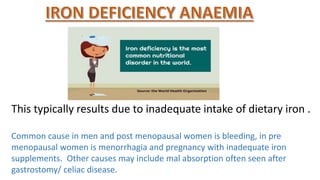
This typically results due to inadequate intake of dietary iron .
Common cause in men and post menopausal women is bleeding, in pre
menopausal women is menorrhagia and pregnancy with inadequate iron
supplements. Other causes may include mal absorption often seen after
gastrostomy/ celiac disease.
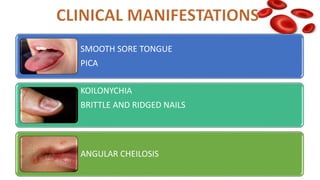
SMOOTH SORE TONGUE
PICA
KOILONYCHIA
BRITTLE AND RIDGED NAILS
ANGULAR CHEILOSIS
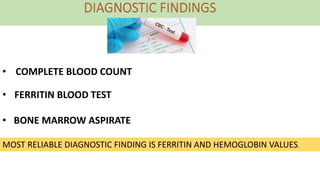
• COMPLETE BLOOD COUNT
MOST RELIABLE DIAGNOSTIC FINDING IS FERRITIN AND HEMOGLOBIN VALUES.
• FERRITIN BLOOD TEST
• BONE MARROW ASPIRATE
• ORAL REPLACEMENT
- Ferrous sulphate
- Ferrous gluconate
- Ferrous fumarate
• PARENTAL REPLACEMENT
- Iron dextran
- Iron sodium gluconate
- Iron sucrose complex
NURSING INTERVENTIONS
• Monitor vital signs for tachycardia/ tachypnea
• Monitor for reaction to parental therapy
• Promote iron intake
• Educate patient for
-sources of dietary iron and vitamin C intake
-restrictions and way of taking dose
-side effects
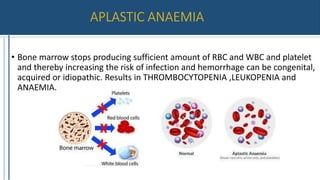
• Bone marrow stops producing sufficient amount of RBC and WBC and platelet
and thereby increasing the risk of infection and hemorrhage can be congenital,
acquired or idiopathic. Results in THROMBOCYTOPENIA ,LEUKOPENIA and
ANAEMIA.
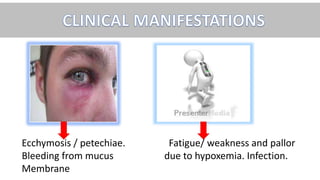
Ecchymosis / petechiae. Fatigue/ weakness and pallor
Bleeding from mucus due to hypoxemia. Infection.
Membrane
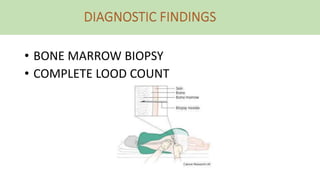
• BONE MARROW BIOPSY
• COMPLETE LOOD COUNT
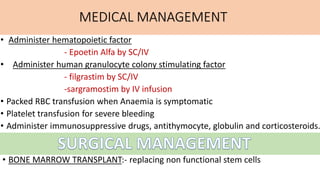
MEDICAL MANAGEMENT
• Administer hematopoietic factor
- Epoetin Alfa by SC/IV
• Administer human granulocyte colony stimulating factor
- filgrastim by SC/IV
-sargramostim by IV infusion
• Packed RBC transfusion when Anaemia is symptomatic
• Platelet transfusion for severe bleeding
• Administer immunosuppressive drugs, antithymocyte, globulin and corticosteroids.
• BONE MARROW TRANSPLANT:- replacing non functional stem cells
NURSING INTERVENSTIONS
• Monitor vitals for changes
• Report intake and output of fluids
• Protect patient from falls
• Avoid IM injections due to altered clotting ability
• Explain the patient
-No aspirin due to platelet aggregation
-Plan to take rest periods during activities
-Only use electric razor to decrease risk of bleeding
-Call physician/nurse for signs of bleeding
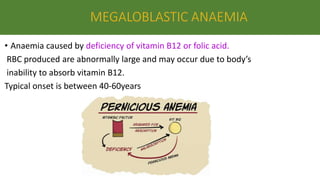
• Anaemia caused by deficiency of vitamin B12 or folic acid.
RBC produced are abnormally large and may occur due to body’s
inability to absorb vitamin B12.
Typical onset is between 40-60years
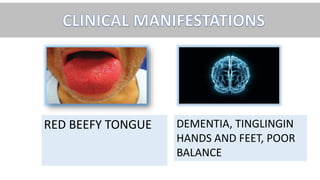
RED BEEFY TONGUE DEMENTIA, TINGLINGIN
HANDS AND FEET, POOR
BALANCE
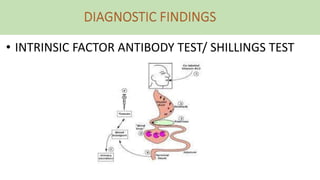
• INTRINSIC FACTOR ANTIBODY TEST/ SHILLINGS TEST
• Administration of vitamin B12
• Transfusion of paced RBC
• Oral folic acid on daily basis
NURSING INTERVENSTIONS
• Prevent injuries
• Improve folic acid intake
• Explain
- Use soft brush
- inspect feet each day (paresthesia)
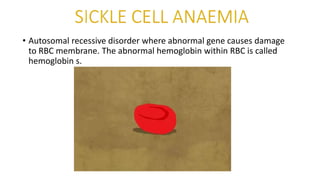
• Autosomal recessive disorder where abnormal gene causes damage
to RBC membrane. The abnormal hemoglobin within RBC is called
hemoglobin s.
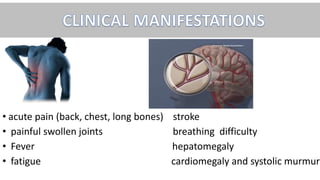
• acute pain (back, chest, long bones) stroke
• painful swollen joints breathing difficulty
• Fever hepatomegaly
• fatigue cardiomegaly and systolic murmur
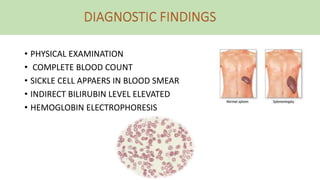
• PHYSICAL EXAMINATION
• COMPLETE BLOOD COUNT
• SICKLE CELL APPAERS IN BLOOD SMEAR
• INDIRECT BILIRUBIN LEVEL ELEVATED
• HEMOGLOBIN ELECTROPHORESIS
• Hydration and oxygenation
• Analgesics
• Warm compression
• Blood transfusion
• Treat infection
• Bone marrow transplant
• Splenectomy
• Hydroxyurea
NURSING INTERVENTIONS
• Increase fluid intake
• Administer supplemental oxygen
• Explain patient
-Avoid cold
- plan rest
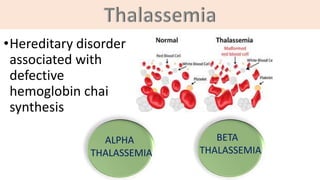
•Hereditary disorder
associated with
defective
hemoglobin chai
synthesis
ALPHA
THALASSEMIA
BETA
THALASSEMIA
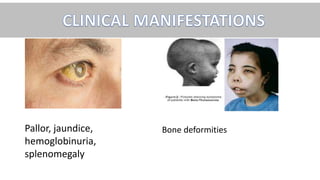
Pallor, jaundice,
hemoglobinuria,
splenomegaly
Bone deformities
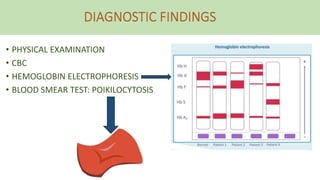
• PHYSICAL EXAMINATION
• CBC
• HEMOGLOBIN ELECTROPHORESIS
• BLOOD SMEAR TEST: POIKILOCYTOSIS
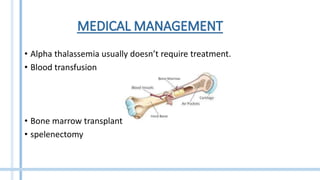
• Alpha thalassemia usually doesn’t require treatment.
• Blood transfusion
• Bone marrow transplant
• spelenectomy
NURSING INTERVENSTIONS
• Monitor vitals
• Manage fluid overload
• Monitor regular blood transfusion
• Urine color orange
• During blood transfusion iron
supplements should be restricted.
NURSING DIAGNOSIS
• Activity intolerance related to fatigue
• Imbalanced nutrition less than body
requirements related to inadequate intake of
essential nutrients
• Insufficient tissue perfusion related to
inadequate blood volume
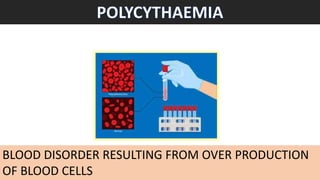
BLOOD DISORDER RESULTING FROM OVER PRODUCTION
OF BLOOD CELLS
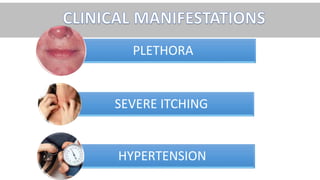
PLETHORA
SEVERE ITCHING
HYPERTENSION
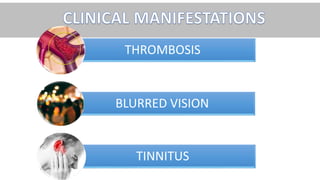
THROMBOSIS
BLURRED VISION
TINNITUS
• COMPLETE BLOOD COUNT
• BONE MARROW BIOPSY
• ELEVATED URIC ACID AND POTASSIUM LEVELS
• INCREASED VITAMIN B12 LEVELS
• PERIODIC SCHEDULED PLEBOTOMY
• ANTICOAGULANTS
• MYELOSUPRESSIVE MEDICATIONS
- hydroxyurea
- anagrelide
- radioactive phosphorous 32
• MEDICATIONS TO LOWER URIC ACID LEVEL
- allopurinol
• ALKYLATING AGENTS
- melphalan
- busulfan
• ANTIHISTAMINES
NURSING INTERVENSTIONS
• Monitor vital signs
• Monitor for bleeding and signs of infection
• Increase fluid intake
• Explain patient:
- maintain mobility
- avoid chances of bleeding
NURSING DIAGNOSIS
• INEFFECTIVE TISSUE PERFUSION RELATED TO
HYPERVOLEMIA
• ALTERED GAS EXCHANGE RELATED TO
HYPERVISCOSITY
Condition of reduced RBC is known as Anaemia.
•3 classifications : hemolytic, hypo-proliferative, bleeding
• Risk factors : age, pregnancy, menstruation, intestinal
disorders etc.
• Clinical manifestations : fatigue, pallor,
dyspnea, splenomegaly, jaundice, tachycardia, etc.
•Diagnosis : History, physical examination, CBC,
bone marrow aspirate, shillings test,
hemoglobin electrophoresis.
Polycythaemia is over production of blood cells.
• Clinical manifestations: plethora, hypertension, severe
itching, headache, blurred vision, tinnitus, thrombosis
leading to tissue hypoxia.
• Diagnostic findings: CBC, bone marrow biopsy
• Management: phlebotomy, antihistamines,
anticoagulants, allopurinol etc.
PLETHORA IS A CLINICAL MANIFESTATION OF
1. SICKLE CELL ANAEMIA
2. POLYCYTHAEMIA
3. THALASSEMIA
4. MEGALOBLASTIC ANAEMIA
MEGALOBLASTIC ANAEMIA IS DEFICIENCY OF
1. IRON
2. VITAMIN C
3. VITAMIN B12 AND FOLIC ACID
4. VITAMIN A
ANOTHER TERM FOR MEGALOBLASTIC ANAEMIA
1. APLASTIC ANAEMIA
2. PERNICIOUS ANAEMIA
3. THALASSEMIA
4. SICKLE CELL ANAEMIA
TRUE / FALSE
1. ANTACIDS AND DAIRY PRODUCTS SHOULD BE TAKEN WITH IRON
SUPPLEMENTS IN IRON DEFICIENCY ANAEMIA.
2. INSUFFICIENT INTAKE OF VITAMIN C CAN CAUSE MALABSORPTION
OF IRON IN BODY.
3. PHLEBOTOMY IS INDICATED IN POLYCYTHAEMIA.
4. THALASSEMIA FALLS UNDER THE CLASSIFICATION OF
HYPOPERFOLATIVE ANAEMIA.
5. ALPHA THALASSEMIA IS THE SEVERE FORM OF
THALASSEMIA.
6. ALLOPURINOL LOWERS URIC ACID LEVELS
NOT A DIAGNOSTIC TEST FOR POLYCYTHAEMIA
1. CBC
2. BONE MARROW BIOPSY
3. HEMOGLOBIN ELECTROPHORESIS
4. LEVELS OF VITAMIN B12
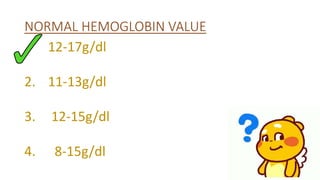
NORMAL HEMOGLOBIN VALUE
1. 12-17g/dl
2. 11-13g/dl
3. 12-15g/dl
4. 8-15g/dl

Anaemia and Polycythaemia

  • 1.
  • 2.
    INTRODUCTION Anemia is diagnosedas any condition in which there is a decreased number of circulating red blood cells. Conditions where our body does not produce enough healthy red blood cells, destroys too many red blood cells, or loses circulating red blood cells can all lead to anemia. Anaemia, as per is not a specific disease state but a sign of underlying disorder.
  • 3.
    Anaemia is acondition in which the number of red blood cells or the hemoglobin concentration within them is lower than normal 4.5 – 6.5 million
  • 4.
    The normal hemoglobinlevel for:- 14 – 17 g/dL 12 – 15 g/dL category range MILD 9.5-13 g/dL MODERATE 8-9.5g/dL SEVERE less than 8 g/dL
  • 5.
    CLASSIFICATION HYPOPERFOLATIVE ANAEMIA HEMOLYTIC ANAEMIA BLEEDING ANAEMIA Eg: Deficiencyof iron, vitamin B12, folic acid ,aplastic anaemia Eg: Sickle cell anaemia, thalassemia Eg: Gastrointestinal tract, menorrhagia epistaxis or trauma
  • 6.
    4 • Low levelof hemoglobin results in inadequate supply of oxygen to body tissues hence resulting in anaemia 1 •Shortage of iron in the body 2 •Bone marrow need iron for hemoglobin production 3 • Without adequate iron, production of hemoglobin is limited.
  • 7.
    WHAT CAUSES ANAEMIA? •NUTRITIONAL DEFICIENCIES IRON VITAMIN B12 VITAMIN A • BLEEDING MENORRHAGIA HEMORRHAGE EPISTAXIS TRAUMA • INFECTIOUS DISEASE MALARIA PARASITIC INFECTION
  • 8.
    •Diet lacking incertain elements such as iron and vitamins •Intestinal disorders •Menstruation •Pregnancy •Age •Chronic conditions
  • 9.
    • Fatigue /weaknessand pallor, headache, due to hypoxia • Dyspnea, hypotension, tachycardia, systolic murmur • Bone pain • Jaundice in hemolytic anaemia • Splenomegaly and angina pectoris
  • 10.
    This typically resultsdue to inadequate intake of dietary iron . Common cause in men and post menopausal women is bleeding, in pre menopausal women is menorrhagia and pregnancy with inadequate iron supplements. Other causes may include mal absorption often seen after gastrostomy/ celiac disease.
  • 11.
    SMOOTH SORE TONGUE PICA KOILONYCHIA BRITTLEAND RIDGED NAILS ANGULAR CHEILOSIS
  • 12.
    • COMPLETE BLOODCOUNT MOST RELIABLE DIAGNOSTIC FINDING IS FERRITIN AND HEMOGLOBIN VALUES. • FERRITIN BLOOD TEST • BONE MARROW ASPIRATE
  • 13.
    • ORAL REPLACEMENT -Ferrous sulphate - Ferrous gluconate - Ferrous fumarate • PARENTAL REPLACEMENT - Iron dextran - Iron sodium gluconate - Iron sucrose complex
  • 14.
    NURSING INTERVENTIONS • Monitorvital signs for tachycardia/ tachypnea • Monitor for reaction to parental therapy • Promote iron intake • Educate patient for -sources of dietary iron and vitamin C intake -restrictions and way of taking dose -side effects
  • 15.
    • Bone marrowstops producing sufficient amount of RBC and WBC and platelet and thereby increasing the risk of infection and hemorrhage can be congenital, acquired or idiopathic. Results in THROMBOCYTOPENIA ,LEUKOPENIA and ANAEMIA.
  • 16.
    Ecchymosis / petechiae.Fatigue/ weakness and pallor Bleeding from mucus due to hypoxemia. Infection. Membrane
  • 17.
    • BONE MARROWBIOPSY • COMPLETE LOOD COUNT
  • 18.
    MEDICAL MANAGEMENT • Administerhematopoietic factor - Epoetin Alfa by SC/IV • Administer human granulocyte colony stimulating factor - filgrastim by SC/IV -sargramostim by IV infusion • Packed RBC transfusion when Anaemia is symptomatic • Platelet transfusion for severe bleeding • Administer immunosuppressive drugs, antithymocyte, globulin and corticosteroids. • BONE MARROW TRANSPLANT:- replacing non functional stem cells
  • 19.
    NURSING INTERVENSTIONS • Monitorvitals for changes • Report intake and output of fluids • Protect patient from falls • Avoid IM injections due to altered clotting ability • Explain the patient -No aspirin due to platelet aggregation -Plan to take rest periods during activities -Only use electric razor to decrease risk of bleeding -Call physician/nurse for signs of bleeding
  • 20.
    • Anaemia causedby deficiency of vitamin B12 or folic acid. RBC produced are abnormally large and may occur due to body’s inability to absorb vitamin B12. Typical onset is between 40-60years
  • 21.
    RED BEEFY TONGUEDEMENTIA, TINGLINGIN HANDS AND FEET, POOR BALANCE
  • 22.
    • INTRINSIC FACTORANTIBODY TEST/ SHILLINGS TEST
  • 23.
    • Administration ofvitamin B12 • Transfusion of paced RBC • Oral folic acid on daily basis
  • 24.
    NURSING INTERVENSTIONS • Preventinjuries • Improve folic acid intake • Explain - Use soft brush - inspect feet each day (paresthesia)
  • 25.
    • Autosomal recessivedisorder where abnormal gene causes damage to RBC membrane. The abnormal hemoglobin within RBC is called hemoglobin s.
  • 26.
    • acute pain(back, chest, long bones) stroke • painful swollen joints breathing difficulty • Fever hepatomegaly • fatigue cardiomegaly and systolic murmur
  • 27.
    • PHYSICAL EXAMINATION •COMPLETE BLOOD COUNT • SICKLE CELL APPAERS IN BLOOD SMEAR • INDIRECT BILIRUBIN LEVEL ELEVATED • HEMOGLOBIN ELECTROPHORESIS
  • 28.
    • Hydration andoxygenation • Analgesics • Warm compression • Blood transfusion • Treat infection • Bone marrow transplant • Splenectomy • Hydroxyurea
  • 29.
    NURSING INTERVENTIONS • Increasefluid intake • Administer supplemental oxygen • Explain patient -Avoid cold - plan rest
  • 30.
    •Hereditary disorder associated with defective hemoglobinchai synthesis ALPHA THALASSEMIA BETA THALASSEMIA
  • 31.
  • 32.
    • PHYSICAL EXAMINATION •CBC • HEMOGLOBIN ELECTROPHORESIS • BLOOD SMEAR TEST: POIKILOCYTOSIS
  • 33.
    • Alpha thalassemiausually doesn’t require treatment. • Blood transfusion • Bone marrow transplant • spelenectomy
  • 34.
    NURSING INTERVENSTIONS • Monitorvitals • Manage fluid overload • Monitor regular blood transfusion • Urine color orange • During blood transfusion iron supplements should be restricted.
  • 35.
    NURSING DIAGNOSIS • Activityintolerance related to fatigue • Imbalanced nutrition less than body requirements related to inadequate intake of essential nutrients • Insufficient tissue perfusion related to inadequate blood volume
  • 36.
    BLOOD DISORDER RESULTINGFROM OVER PRODUCTION OF BLOOD CELLS
  • 37.
  • 38.
  • 39.
    • COMPLETE BLOODCOUNT • BONE MARROW BIOPSY • ELEVATED URIC ACID AND POTASSIUM LEVELS • INCREASED VITAMIN B12 LEVELS
  • 40.
    • PERIODIC SCHEDULEDPLEBOTOMY • ANTICOAGULANTS • MYELOSUPRESSIVE MEDICATIONS - hydroxyurea - anagrelide - radioactive phosphorous 32 • MEDICATIONS TO LOWER URIC ACID LEVEL - allopurinol • ALKYLATING AGENTS - melphalan - busulfan • ANTIHISTAMINES
  • 41.
    NURSING INTERVENSTIONS • Monitorvital signs • Monitor for bleeding and signs of infection • Increase fluid intake • Explain patient: - maintain mobility - avoid chances of bleeding
  • 42.
    NURSING DIAGNOSIS • INEFFECTIVETISSUE PERFUSION RELATED TO HYPERVOLEMIA • ALTERED GAS EXCHANGE RELATED TO HYPERVISCOSITY
  • 43.
    Condition of reducedRBC is known as Anaemia. •3 classifications : hemolytic, hypo-proliferative, bleeding • Risk factors : age, pregnancy, menstruation, intestinal disorders etc. • Clinical manifestations : fatigue, pallor, dyspnea, splenomegaly, jaundice, tachycardia, etc. •Diagnosis : History, physical examination, CBC, bone marrow aspirate, shillings test, hemoglobin electrophoresis.
  • 44.
    Polycythaemia is overproduction of blood cells. • Clinical manifestations: plethora, hypertension, severe itching, headache, blurred vision, tinnitus, thrombosis leading to tissue hypoxia. • Diagnostic findings: CBC, bone marrow biopsy • Management: phlebotomy, antihistamines, anticoagulants, allopurinol etc.
  • 45.
    PLETHORA IS ACLINICAL MANIFESTATION OF 1. SICKLE CELL ANAEMIA 2. POLYCYTHAEMIA 3. THALASSEMIA 4. MEGALOBLASTIC ANAEMIA
  • 46.
    MEGALOBLASTIC ANAEMIA ISDEFICIENCY OF 1. IRON 2. VITAMIN C 3. VITAMIN B12 AND FOLIC ACID 4. VITAMIN A
  • 47.
    ANOTHER TERM FORMEGALOBLASTIC ANAEMIA 1. APLASTIC ANAEMIA 2. PERNICIOUS ANAEMIA 3. THALASSEMIA 4. SICKLE CELL ANAEMIA
  • 48.
    TRUE / FALSE 1.ANTACIDS AND DAIRY PRODUCTS SHOULD BE TAKEN WITH IRON SUPPLEMENTS IN IRON DEFICIENCY ANAEMIA. 2. INSUFFICIENT INTAKE OF VITAMIN C CAN CAUSE MALABSORPTION OF IRON IN BODY. 3. PHLEBOTOMY IS INDICATED IN POLYCYTHAEMIA. 4. THALASSEMIA FALLS UNDER THE CLASSIFICATION OF HYPOPERFOLATIVE ANAEMIA. 5. ALPHA THALASSEMIA IS THE SEVERE FORM OF THALASSEMIA. 6. ALLOPURINOL LOWERS URIC ACID LEVELS
  • 49.
    NOT A DIAGNOSTICTEST FOR POLYCYTHAEMIA 1. CBC 2. BONE MARROW BIOPSY 3. HEMOGLOBIN ELECTROPHORESIS 4. LEVELS OF VITAMIN B12
  • 50.
    NORMAL HEMOGLOBIN VALUE 1.12-17g/dl 2. 11-13g/dl 3. 12-15g/dl 4. 8-15g/dl