©2017, Amazon Web Services, Inc. or its affiliates. All rights reserved
Deep Learning with Apache MXNet
Julien Simon, Principal Technical Evangelist
@julsimon
Selected customers running AI on AWS
Questions
• What’s the business problem my IT has failed to solve?
– That’s probably where Deep Learning can help
• Should I design and train my own Deep Learning model?
– Do I have the expertise?
– Do I have enough time, data & compute to train it?
• Should I use a pre-trained model?
– How well does it fit my use case?
– On what data was it trained? How close is this to my own data?
• Should I use a SaaS solution?
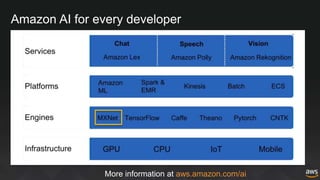
Amazon AI for every developer
More information at aws.amazon.com/ai
Neural Networks
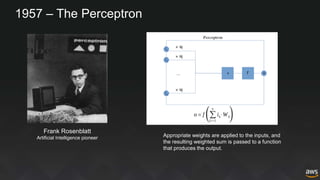
Frank Rosenblatt
Artificial Intelligence pioneer
1957 – The Perceptron
Appropriate weights are applied to the inputs, and
the resulting weighted sum is passed to a function
that produces the output.
The neuron
x = [x1, x2, …. xI ]
w = [w1, w2, …. wI ]
u = x.w
Activation function
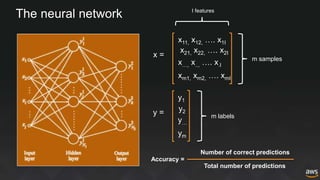
The neural network
x =
x11, x12, …. x1I
x21, x22, …. x2I
x…, x.., …. x.I
xm1, xm2, …. xmI
I features
m samples
y =
y1
y2
y…
ym
m labels
Total number of predictions
Accuracy =
Number of correct predictions
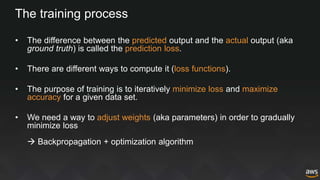
The training process
• The difference between the predicted output and the actual output (aka
ground truth) is called the prediction loss.
• There are different ways to compute it (loss functions).
• The purpose of training is to iteratively minimize loss and maximize
accuracy for a given data set.
• We need a way to adjust weights (aka parameters) in order to gradually
minimize loss
 Backpropagation + optimization algorithm
Paul Werbos
Artificial Intelligence pioneer
IEEE Neural Network Pioneer Award
1974 – Backpropagation
The back-propagation algorithm acts as an error
correcting mechanism at each neuron level,
thereby helping the network to learn effectively.
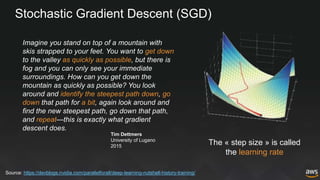
Stochastic Gradient Descent (SGD)
Imagine you stand on top of a mountain with
skis strapped to your feet. You want to get down
to the valley as quickly as possible, but there is
fog and you can only see your immediate
surroundings. How can you get down the
mountain as quickly as possible? You look
around and identify the steepest path down, go
down that path for a bit, again look around and
find the new steepest path, go down that path,
and repeat—this is exactly what gradient
descent does.
Tim Dettmers
University of Lugano
2015
Source: https://devblogs.nvidia.com/parallelforall/deep-learning-nutshell-history-training/
The « step size » is called
the learning rate
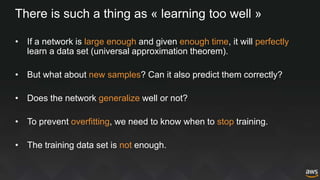
There is such a thing as « learning too well »
• If a network is large enough and given enough time, it will perfectly
learn a data set (universal approximation theorem).
• But what about new samples? Can it also predict them correctly?
• Does the network generalize well or not?
• To prevent overfitting, we need to know when to stop training.
• The training data set is not enough.
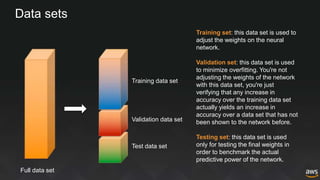
Data sets
Full data set
Training data set
Validation data set
Test data set
Training set: this data set is used to
adjust the weights on the neural
network.
Validation set: this data set is used
to minimize overfitting. You're not
adjusting the weights of the network
with this data set, you're just
verifying that any increase in
accuracy over the training data set
actually yields an increase in
accuracy over a data set that has not
been shown to the network before.
Testing set: this data set is used
only for testing the final weights in
order to benchmark the actual
predictive power of the network.
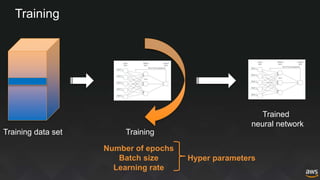
Training
Training data set Training
Trained
neural network
Number of epochs
Batch size
Learning rate
Hyper parameters
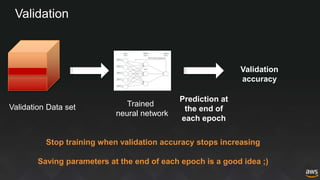
Validation
Validation Data set Trained
neural network
Validation
accuracy
Prediction at
the end of
each epoch
Stop training when validation accuracy stops increasing
Saving parameters at the end of each epoch is a good idea ;)
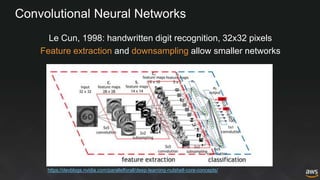
Convolutional Neural Networks
Le Cun, 1998: handwritten digit recognition, 32x32 pixels
Feature extraction and downsampling allow smaller networks
https://devblogs.nvidia.com/parallelforall/deep-learning-nutshell-core-concepts/
Apache MXNet
Apache MXNet
Programmable Portable High Performance
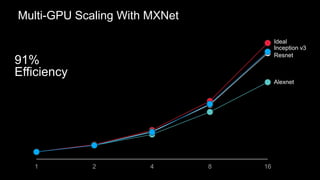
Near linear scaling
across hundreds of GPUs
Highly efficient
models for mobile
and IoT
Simple syntax,
multiple languages
Most Open Best On AWS
Optimized for
deep learning on
AWS
Accepted into the
Apache Incubator
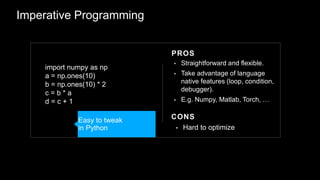
import numpy as np
a = np.ones(10)
b = np.ones(10) * 2
c = b * a
d = c + 1
• Straightforward and flexible.
• Take advantage of language
native features (loop, condition,
debugger).
• E.g. Numpy, Matlab, Torch, …
• Hard to optimize
PROS
CONSEasy to tweak
in Python
Imperative Programming
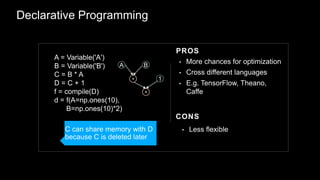
• More chances for optimization
• Cross different languages
• E.g. TensorFlow, Theano,
Caffe
• Less flexible
PROS
CONS
C can share memory with D
because C is deleted later
A = Variable('A')
B = Variable('B')
C = B * A
D = C + 1
f = compile(D)
d = f(A=np.ones(10),
B=np.ones(10)*2)
A B
1
+
x
Declarative Programming
0
4
8
12
16
1 2 4 8 16
Ideal
Inception v3
Resnet
Alexnet
91%
Efficiency
Multi-GPU Scaling With MXNet
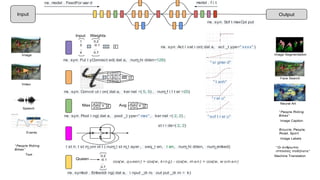
Input Output
1 1 1
1 0 1
0 0 0
3
mx. sym. Convol ut i on( dat a, ker nel =( 5, 5) , num_f i l t er =20)
mx. sym. Pool i ng( dat a, pool _t ype=" max" , ker nel =( 2, 2) ,
st r i de=( 2, 2)
l st m. l st m_unr ol l ( num_l st m_l ayer , seq_l en, l en, num_hi dden, num_embed)
4 2
2 0
4=Max
1
3
...
4
0.2
-0.1
...
0.7
mx. sym. Ful l yConnect ed( dat a, num_hi dden=128)
2
mx. symbol . Embeddi ng( dat a, i nput _di m, out put _di m = k)
0.2
-0.1
...
0.7
Queen
4 2
2 0
2=Avg
Input Weights
cos(w, queen ) = cos(w, k i n g) - cos(w, m an ) + cos(w, w om an )
mx. sym. Act i vat i on( dat a, act _t ype=" xxxx" )
" r el u"
" t anh"
" si gmoi d"
" sof t r el u"
Neural Art
Face Search
Image Segmentation
Image Caption
“ People Riding
Bikes”
Bicycle, People,
Road, Sport
Image Labels
Image
Video
Speech
Text
“ People Riding
Bikes”
Machine Translation
“ Οι άνθρωποι
ιππασίας ποδήλατα”
Events
mx. model . FeedFor war d model . f i t
mx. sym. Sof t maxOut put
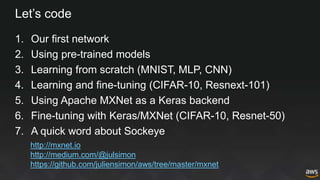
Let’s code
1. Our first network
2. Using pre-trained models
3. Learning from scratch (MNIST, MLP, CNN)
4. Learning and fine-tuning (CIFAR-10, Resnext-101)
5. Using Apache MXNet as a Keras backend
6. Fine-tuning with Keras/MXNet (CIFAR-10, Resnet-50)
7. A quick word about Sockeye
http://mxnet.io
http://medium.com/@julsimon
https://github.com/juliensimon/aws/tree/master/mxnet
Thank you!
http://aws.amazon.com/evangelists/julien-simon
@julsimon

Deep Learning with Apache MXNet (September 2017)

  • 1.
    ©2017, Amazon WebServices, Inc. or its affiliates. All rights reserved Deep Learning with Apache MXNet Julien Simon, Principal Technical Evangelist @julsimon
  • 2.
  • 3.
    Questions • What’s thebusiness problem my IT has failed to solve? – That’s probably where Deep Learning can help • Should I design and train my own Deep Learning model? – Do I have the expertise? – Do I have enough time, data & compute to train it? • Should I use a pre-trained model? – How well does it fit my use case? – On what data was it trained? How close is this to my own data? • Should I use a SaaS solution?
  • 4.
    Amazon AI forevery developer More information at aws.amazon.com/ai
  • 5.
  • 6.
    Frank Rosenblatt Artificial Intelligencepioneer 1957 – The Perceptron Appropriate weights are applied to the inputs, and the resulting weighted sum is passed to a function that produces the output.
  • 7.
    The neuron x =[x1, x2, …. xI ] w = [w1, w2, …. wI ] u = x.w Activation function
  • 8.
    The neural network x= x11, x12, …. x1I x21, x22, …. x2I x…, x.., …. x.I xm1, xm2, …. xmI I features m samples y = y1 y2 y… ym m labels Total number of predictions Accuracy = Number of correct predictions
  • 9.
    The training process •The difference between the predicted output and the actual output (aka ground truth) is called the prediction loss. • There are different ways to compute it (loss functions). • The purpose of training is to iteratively minimize loss and maximize accuracy for a given data set. • We need a way to adjust weights (aka parameters) in order to gradually minimize loss  Backpropagation + optimization algorithm
  • 10.
    Paul Werbos Artificial Intelligencepioneer IEEE Neural Network Pioneer Award 1974 – Backpropagation The back-propagation algorithm acts as an error correcting mechanism at each neuron level, thereby helping the network to learn effectively.
  • 11.
    Stochastic Gradient Descent(SGD) Imagine you stand on top of a mountain with skis strapped to your feet. You want to get down to the valley as quickly as possible, but there is fog and you can only see your immediate surroundings. How can you get down the mountain as quickly as possible? You look around and identify the steepest path down, go down that path for a bit, again look around and find the new steepest path, go down that path, and repeat—this is exactly what gradient descent does. Tim Dettmers University of Lugano 2015 Source: https://devblogs.nvidia.com/parallelforall/deep-learning-nutshell-history-training/ The « step size » is called the learning rate
  • 12.
    There is sucha thing as « learning too well » • If a network is large enough and given enough time, it will perfectly learn a data set (universal approximation theorem). • But what about new samples? Can it also predict them correctly? • Does the network generalize well or not? • To prevent overfitting, we need to know when to stop training. • The training data set is not enough.
  • 13.
    Data sets Full dataset Training data set Validation data set Test data set Training set: this data set is used to adjust the weights on the neural network. Validation set: this data set is used to minimize overfitting. You're not adjusting the weights of the network with this data set, you're just verifying that any increase in accuracy over the training data set actually yields an increase in accuracy over a data set that has not been shown to the network before. Testing set: this data set is used only for testing the final weights in order to benchmark the actual predictive power of the network.
  • 14.
    Training Training data setTraining Trained neural network Number of epochs Batch size Learning rate Hyper parameters
  • 15.
    Validation Validation Data setTrained neural network Validation accuracy Prediction at the end of each epoch Stop training when validation accuracy stops increasing Saving parameters at the end of each epoch is a good idea ;)
  • 16.
    Convolutional Neural Networks LeCun, 1998: handwritten digit recognition, 32x32 pixels Feature extraction and downsampling allow smaller networks https://devblogs.nvidia.com/parallelforall/deep-learning-nutshell-core-concepts/
  • 17.
  • 18.
    Apache MXNet Programmable PortableHigh Performance Near linear scaling across hundreds of GPUs Highly efficient models for mobile and IoT Simple syntax, multiple languages Most Open Best On AWS Optimized for deep learning on AWS Accepted into the Apache Incubator
  • 19.
    import numpy asnp a = np.ones(10) b = np.ones(10) * 2 c = b * a d = c + 1 • Straightforward and flexible. • Take advantage of language native features (loop, condition, debugger). • E.g. Numpy, Matlab, Torch, … • Hard to optimize PROS CONSEasy to tweak in Python Imperative Programming
  • 20.
    • More chancesfor optimization • Cross different languages • E.g. TensorFlow, Theano, Caffe • Less flexible PROS CONS C can share memory with D because C is deleted later A = Variable('A') B = Variable('B') C = B * A D = C + 1 f = compile(D) d = f(A=np.ones(10), B=np.ones(10)*2) A B 1 + x Declarative Programming
  • 21.
    0 4 8 12 16 1 2 48 16 Ideal Inception v3 Resnet Alexnet 91% Efficiency Multi-GPU Scaling With MXNet
  • 22.
    Input Output 1 11 1 0 1 0 0 0 3 mx. sym. Convol ut i on( dat a, ker nel =( 5, 5) , num_f i l t er =20) mx. sym. Pool i ng( dat a, pool _t ype=" max" , ker nel =( 2, 2) , st r i de=( 2, 2) l st m. l st m_unr ol l ( num_l st m_l ayer , seq_l en, l en, num_hi dden, num_embed) 4 2 2 0 4=Max 1 3 ... 4 0.2 -0.1 ... 0.7 mx. sym. Ful l yConnect ed( dat a, num_hi dden=128) 2 mx. symbol . Embeddi ng( dat a, i nput _di m, out put _di m = k) 0.2 -0.1 ... 0.7 Queen 4 2 2 0 2=Avg Input Weights cos(w, queen ) = cos(w, k i n g) - cos(w, m an ) + cos(w, w om an ) mx. sym. Act i vat i on( dat a, act _t ype=" xxxx" ) " r el u" " t anh" " si gmoi d" " sof t r el u" Neural Art Face Search Image Segmentation Image Caption “ People Riding Bikes” Bicycle, People, Road, Sport Image Labels Image Video Speech Text “ People Riding Bikes” Machine Translation “ Οι άνθρωποι ιππασίας ποδήλατα” Events mx. model . FeedFor war d model . f i t mx. sym. Sof t maxOut put
  • 23.
    Let’s code 1. Ourfirst network 2. Using pre-trained models 3. Learning from scratch (MNIST, MLP, CNN) 4. Learning and fine-tuning (CIFAR-10, Resnext-101) 5. Using Apache MXNet as a Keras backend 6. Fine-tuning with Keras/MXNet (CIFAR-10, Resnet-50) 7. A quick word about Sockeye http://mxnet.io http://medium.com/@julsimon https://github.com/juliensimon/aws/tree/master/mxnet
  • 24.

Editor's Notes

  • #20 Execute operations step by step. c = b ⨉ a invokes a kernel operation Numpy programs are imperative
  • #21 Declares the computation Compiles into a function C = B ⨉ A  only specifies the requirement SQL is declarative