14th Young Economists' Convention
8th International Conference
March 6-7, 2015
De La Salle University Henry Sy Sr. Building
1. Beyond Needs Gratification:
Nature of Economics
2. Foundations of Economic Thought
3. Happiness as Objective and
Subjective Well-Being
4. Economics towards human
flourishing
Outline
What is the nature of economics?
According to Mankiw (2011). Economics is the study
of how society manages its scarce resources.
What is the nature of economics?
According to Robbins (1952). It is the science which
studies human behavior as a relationship between
ends and scarce means that have alternative uses.
What is the nature of economics?
According to Samuelson (1967). It is the study of how
men and society choose, with or without the use of
money
The discoveries of economics
lead to the formulation of
economic policy.
A high level of theoretical conceptualization with
methodical rigor but a failure to operationalize the
maximization problem into the actual achievement of
happiness.
Why? Emphasis on the satisfaction of wants as the main
goal of economics. Sidestep wealth creation. “wealth is
a fundamental concept in economics indeed, perhaps
the conceptual starting, no consensus on what is
wealth.” (Heilbroner 1987)
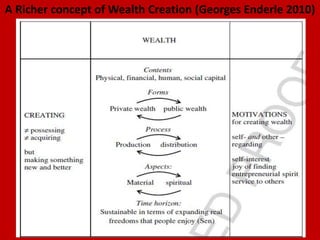
A Richer concept of Wealth Creation (Georges Enderle 2010)
“Making money” can be destroying
wealth while creating
wealth can be losing money.
A thorough understanding of
wealth creation enables us to
sharpen our economic critique of
fashionable and short-sighted
management recipes and to bring
the power of ethics to bear
where it matters most.
(Enderle 2010)
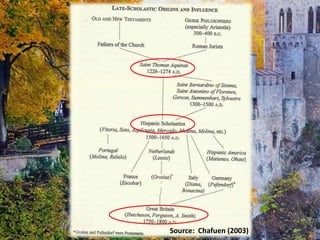
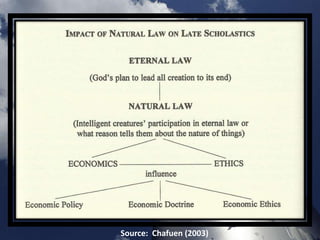
St. Thomas Treatise
on Justice influenced
more than 6
centuries of authors
on economics,
including
British economists
such as Hutcheson,
Adam Smith,
Austrian Economists
such as Menger and
Böhm-Bawerk.
Source: Chafuen (2003)
The personal desire
to achieve
happiness has
become an impetus
for economists,
sociologists and
psychologists to
determine the
attributes
explaining
happiness.
Happiness as
Objective and
Subjective
Well-Being
Necessary conditions
for human flourishing:
1st. Basic material
goods to thrive and
survive in existence
2nd. Participate as an
intelligent and free
agent in the market
economy
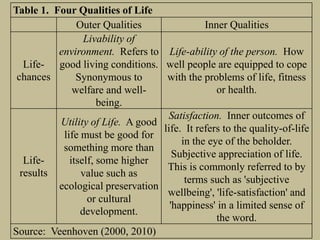
Table 1. Four Qualities of Life
Outer Qualities Inner Qualities
Life-
chances
Livability of
environment. Refers to
good living conditions.
Synonymous to
welfare and well-
being.
Life-ability of the person. How
well people are equipped to cope
with the problems of life, fitness
or health.
Life-
results
Utility of Life. A good
life must be good for
something more than
itself, some higher
value such as
ecological preservation
or cultural
development.
Satisfaction. Inner outcomes of
life. It refers to the quality-of-life
in the eye of the beholder.
Subjective appreciation of life.
This is commonly referred to by
terms such as 'subjective
wellbeing', 'life-satisfaction' and
'happiness' in a limited sense of
the word.
Source: Veenhoven (2000, 2010)
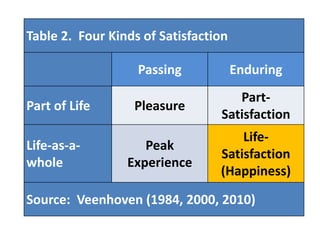
Table 2. Four Kinds of Satisfaction
Passing Enduring
Part of Life Pleasure
Part-
Satisfaction
Life-as-a-
whole
Peak
Experience
Life-
Satisfaction
(Happiness)
Source: Veenhoven (1984, 2000, 2010)
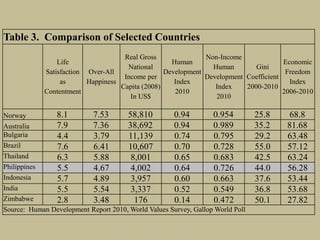
Table 3. Comparison of Selected Countries
Life
Satisfaction
as
Contentment
Over-All
Happiness
Real Gross
National
Income per
Capita (2008)
In US$
Human
Development
Index
2010
Non-Income
Human
Development
Index
2010
Gini
Coefficient
2000-2010
Economic
Freedom
Index
2006-2010
Norway 8.1 7.53 58,810 0.94 0.954 25.8 68.8
Australia 7.9 7.36 38,692 0.94 0.989 35.2 81.68
Bulgaria 4.4 3.79 11,139 0.74 0.795 29.2 63.48
Brazil 7.6 6.41 10,607 0.70 0.728 55.0 57.12
Thailand 6.3 5.88 8,001 0.65 0.683 42.5 63.24
Philippines 5.5 4.67 4,002 0.64 0.726 44.0 56.28
Indonesia 5.7 4.89 3,957 0.60 0.663 37.6 53.44
India 5.5 5.54 3,337 0.52 0.549 36.8 53.68
Zimbabwe 2.8 3.48 176 0.14 0.472 50.1 27.82
Source: Human Development Report 2010, World Values Survey, Gallop World Poll
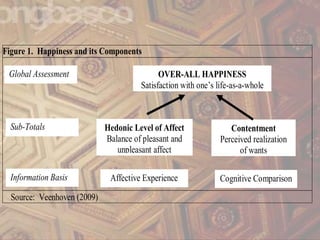
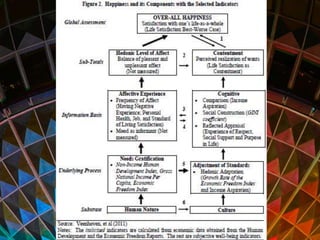
Figure 1. Happiness and its Components
Source: Veenhoven (2009)
Global Assessment
Sub-Totals
Information Basis
OVER-ALL HAPPINESS
Satisfaction with one’s life-as-a-whole
Hedonic Level of Affect
Balance of pleasant and
unpleasant affect
Contentment
Perceived realization
of wants
Affective Experience Cognitive Comparison
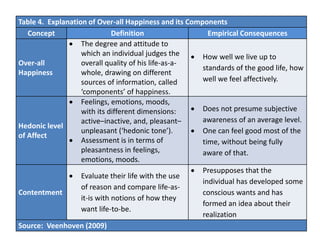
Table 4. Explanation of Over-all Happiness and its Components
Concept Definition Empirical Consequences
Over-all
Happiness
 The degree and attitude to
which an individual judges the
overall quality of his life-as-a-
whole, drawing on different
sources of information, called
‘components’ of happiness.
 How well we live up to
standards of the good life, how
well we feel affectively.
Hedonic level
of Affect
 Feelings, emotions, moods,
with its different dimensions:
active–inactive, and, pleasant–
unpleasant (‘hedonic tone’).
 Assessment is in terms of
pleasantness in feelings,
emotions, moods.
 Does not presume subjective
awareness of an average level.
 One can feel good most of the
time, without being fully
aware of that.
Contentment
 Evaluate their life with the use
of reason and compare life-as-
it-is with notions of how they
want life-to-be.
 Presupposes that the
individual has developed some
conscious wants and has
formed an idea about their
realization
Source: Veenhoven (2009)
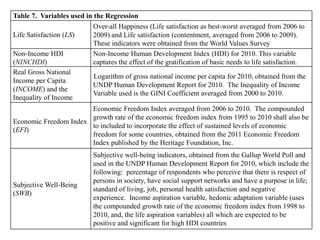
Table 7. Variables used in the Regression
Life Satisfaction (LS)
Over-all Happiness (Life satisfaction as best-worst averaged from 2006 to
2009) and Life satisfaction (contentment, averaged from 2006 to 2009).
These indicators were obtained from the World Values Survey
Non-Income HDI
(NINCHDI)
Non-Income Human Development Index (HDI) for 2010. This variable
captures the effect of the gratification of basic needs to life satisfaction.
Real Gross National
Income per Capita
(INCOME) and the
Inequality of Income
Logarithm of gross national income per capita for 2010, obtained from the
UNDP Human Development Report for 2010. The Inequality of Income
Variable used is the GINI Coefficient averaged from 2000 to 2010.
Economic Freedom Index
(EFI)
Economic Freedom Index averaged from 2006 to 2010. The compounded
growth rate of the economic freedom index from 1995 to 2010 shall also be
to included to incorporate the effect of sustained levels of economic
freedom for some countries, obtained from the 2011 Economic Freedom
Index published by the Heritage Foundation, Inc.
Subjective Well-Being
(SWB)
Subjective well-being indicators, obtained from the Gallup World Poll and
used in the UNDP Human Development Report for 2010, which include the
following: percentage of respondents who perceive that there is respect of
persons in society, have social support networks and have a purpose in life;
standard of living, job, personal health satisfaction and negative
experience. Income aspiration variable, hedonic adaptation variable (uses
the compounded growth rate of the economic freedom index from 1998 to
2010, and, the life aspiration variables) all which are expected to be
positive and significant for high HDI countries
Hypothesis 1. Life satisfaction
(contentment) and over-all
happiness can be explained by the
gratification of basic needs.
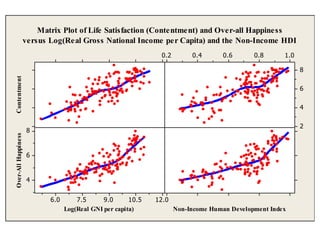
1.00.80.60.40.2
8
6
4
2
12.010.59.07.56.0
8
6
4
Contentment
Log(Real GNI per capita)
Over-AllHappiness
Non-Income Human Development Index
Matrix Plot of Life Satisfaction (Contentment) and Over-all Happiness
versus Log(Real Gross National Income per Capita) and the Non-Income HDI
Hypothesis 2. Life satisfaction (contentment) and
over-all happiness increase when other variables
which incorporate affective experience, adjustment
of standards, and, the inclusion of another basic
need such as economic freedom, all of which
characterize human flourishing, are included.
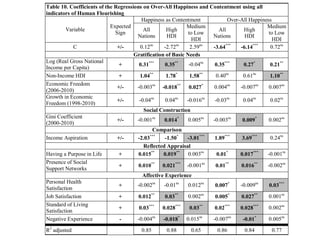
Table 10. Coefficients of the Regressions on Over-All Happiness and Contentment using all
indicators of Human Flourishing
Variable
Expected
Sign
Happiness as Contentment Over-All Happiness
All
Nations
High
HDI
Medium
to Low
HDI
All
Nations
High
HDI
Medium
to Low
HDI
C +/- 0.12ns
-2.72ns
2.59ns
-3.64***
-6.14***
0.72ns
Gratification of Basic Needs
Log (Real Gross National
Income per Capita)
+ 0.31***
0.35**
-0.04ns
0.35***
0.27*
0.21**
Non-Income HDI + 1.04**
1.78*
1.58**
0.40ns
0.61ns
1.10**
Economic Freedom
(2006-2010)
+/- -0.003ns
-0.018**
0.027*
0.004ns
-0.007ns
0.007ns
Growth in Economic
Freedom (1998-2010)
+/- -0.04ns
0.04ns
-0.016ns
-0.03ns
0.04ns
0.02ns
Social Construction
Gini Coefficient
(2000-2010)
+/- -0.001ns
0.014*
0.005ns
-0.003ns
0.009*
0.002ns
Comparison
Income Aspiration +/- -2.03***
-1.50*
-3.01***
1.89***
3.69***
0.24ns
Reflected Appraisal
Having a Purpose in Life + 0.015**
0.019**
0.003ns
0.01*
0.017***
-0.001ns
Presence of Social
Support Networks
+ 0.010**
0.021***
-0.001ns
0.01**
0.016**
-0.002ns
Affective Experience
Personal Health
Satisfaction
+ -0.002ns
-0.01ns
0.012ns
0.007*
-0.009ns
0.03***
Job Satisfaction + 0.012**
0.03**
0.002ns
0.005*
0.027**
0.001ns
Standard of Living
Satisfaction
+ 0.03***
0.028***
0.03**
0.02***
0.028***
0.002ns
Negative Experience - -0.004ns
-0.018*
0.015ns
-0.007ns
-0.01*
0.005ns
R2
adjusted 0.85 0.88 0.65 0.86 0.84 0.77
Standard Error of the
Summary of Results
The ability of chosen categories to explain happiness as contentment,
that is, more than mere pleasure shows that the desire for happiness
is consistent, follows a logical pattern, and is stable over time, when
analyzed from a cross-section of about 80 countries.
Enrichment of Economic Concepts by Going
Back to its Roots
• Qualitative variables such as
happiness can be explained
by economics, using its tools
for analysis
• Reason: it has stable
qualities because the agents
move about life with a life-
enduring goal.
• This is nothing more than a
need to return to the
influence of natural law, via
late scholastic thought on
the reality of the behavior of
the economic agents
Beyond Needs
Gratification:
Happiness
Economics as
Human Flourishing
Main References:
• Barrera, Albino (2001) Modern Catholic Social Documents and Political Economy, Washington DC:
Georgetown University Press
• Bruni, Luigino, Pier Luigi Porta, editors (2007) Handbook on the Economics of Happiness Edward Elgar:
Cheltenham, UK
• Chafuen, Alejandro (2003) Faith and Liberty: The Economic thought of the Late Scholastics, Lexington
Books, USA: Acton Institute
• Enderle, Georges (2010) “A Rich Concept of Wealth Creation Beyond Profit Maximization and Adding
Value, chapter 2, Fairness in International Trade, Geoff Moore, Editor, Durham, UK: Springer, pp. 9-26
• Gregg, Samuel (2001). Economic Thinking for the Theologically Minded. Maryland, USA: University
Press of America
• Hausman, Daniel M. and Michael S. McPherson (1993). “Taking Ethics Seriously: Economics and
Contemporary Moral Philosophy.” Journal of Economic Literature. Volume XXXI (June 1993). pp. 671-
731
• Heilbroner, R. L. (1987), ‘Wealth’, in J. Eatwell, M. Milgate and P. Newman (eds.) The New
Palgrave: A Dictionary of Economics, Vol. 4 (Macmillan, London), pp. 880–883.
• Minkler, Lanse (1999).“The Problem with Utility: Towards a Non-Consequentialist / Utility Theory
Synthesis.” Review of Social Economy. Vol. 57. pp. 4–24
• Peil, Jan and Irene van Staveren (2009) Handbook of Economics and Ethics, Cheltenhan, UK: Edward
Elgar
• Pontifical Council for Justice and Peace (2011) Social and Ethical Aspects of Economics. A Colloquium in
the Vatican. 2nd Edition. Vatican City
• Yeungert, Andrew (2003). Boundaries of Technique, Acton Institute, Grand Rapids, Michigan.
Happiness economics   with notes

Happiness economics with notes

  • 1.
    14th Young Economists'Convention 8th International Conference March 6-7, 2015 De La Salle University Henry Sy Sr. Building
  • 2.
    1. Beyond NeedsGratification: Nature of Economics 2. Foundations of Economic Thought 3. Happiness as Objective and Subjective Well-Being 4. Economics towards human flourishing Outline
  • 3.
    What is thenature of economics? According to Mankiw (2011). Economics is the study of how society manages its scarce resources.
  • 4.
    What is thenature of economics? According to Robbins (1952). It is the science which studies human behavior as a relationship between ends and scarce means that have alternative uses.
  • 5.
    What is thenature of economics? According to Samuelson (1967). It is the study of how men and society choose, with or without the use of money
  • 6.
    The discoveries ofeconomics lead to the formulation of economic policy.
  • 7.
    A high levelof theoretical conceptualization with methodical rigor but a failure to operationalize the maximization problem into the actual achievement of happiness.
  • 8.
    Why? Emphasis onthe satisfaction of wants as the main goal of economics. Sidestep wealth creation. “wealth is a fundamental concept in economics indeed, perhaps the conceptual starting, no consensus on what is wealth.” (Heilbroner 1987)
  • 9.
    A Richer conceptof Wealth Creation (Georges Enderle 2010)
  • 10.
    “Making money” canbe destroying wealth while creating wealth can be losing money. A thorough understanding of wealth creation enables us to sharpen our economic critique of fashionable and short-sighted management recipes and to bring the power of ethics to bear where it matters most. (Enderle 2010)
  • 11.
    St. Thomas Treatise onJustice influenced more than 6 centuries of authors on economics, including British economists such as Hutcheson, Adam Smith, Austrian Economists such as Menger and Böhm-Bawerk.
  • 12.
  • 13.
  • 14.
    The personal desire toachieve happiness has become an impetus for economists, sociologists and psychologists to determine the attributes explaining happiness.
  • 15.
    Happiness as Objective and Subjective Well-Being Necessaryconditions for human flourishing: 1st. Basic material goods to thrive and survive in existence 2nd. Participate as an intelligent and free agent in the market economy
  • 16.
    Table 1. FourQualities of Life Outer Qualities Inner Qualities Life- chances Livability of environment. Refers to good living conditions. Synonymous to welfare and well- being. Life-ability of the person. How well people are equipped to cope with the problems of life, fitness or health. Life- results Utility of Life. A good life must be good for something more than itself, some higher value such as ecological preservation or cultural development. Satisfaction. Inner outcomes of life. It refers to the quality-of-life in the eye of the beholder. Subjective appreciation of life. This is commonly referred to by terms such as 'subjective wellbeing', 'life-satisfaction' and 'happiness' in a limited sense of the word. Source: Veenhoven (2000, 2010)
  • 17.
    Table 2. FourKinds of Satisfaction Passing Enduring Part of Life Pleasure Part- Satisfaction Life-as-a- whole Peak Experience Life- Satisfaction (Happiness) Source: Veenhoven (1984, 2000, 2010)
  • 18.
    Table 3. Comparisonof Selected Countries Life Satisfaction as Contentment Over-All Happiness Real Gross National Income per Capita (2008) In US$ Human Development Index 2010 Non-Income Human Development Index 2010 Gini Coefficient 2000-2010 Economic Freedom Index 2006-2010 Norway 8.1 7.53 58,810 0.94 0.954 25.8 68.8 Australia 7.9 7.36 38,692 0.94 0.989 35.2 81.68 Bulgaria 4.4 3.79 11,139 0.74 0.795 29.2 63.48 Brazil 7.6 6.41 10,607 0.70 0.728 55.0 57.12 Thailand 6.3 5.88 8,001 0.65 0.683 42.5 63.24 Philippines 5.5 4.67 4,002 0.64 0.726 44.0 56.28 Indonesia 5.7 4.89 3,957 0.60 0.663 37.6 53.44 India 5.5 5.54 3,337 0.52 0.549 36.8 53.68 Zimbabwe 2.8 3.48 176 0.14 0.472 50.1 27.82 Source: Human Development Report 2010, World Values Survey, Gallop World Poll
  • 19.
    Figure 1. Happinessand its Components Source: Veenhoven (2009) Global Assessment Sub-Totals Information Basis OVER-ALL HAPPINESS Satisfaction with one’s life-as-a-whole Hedonic Level of Affect Balance of pleasant and unpleasant affect Contentment Perceived realization of wants Affective Experience Cognitive Comparison
  • 20.
    Table 4. Explanationof Over-all Happiness and its Components Concept Definition Empirical Consequences Over-all Happiness  The degree and attitude to which an individual judges the overall quality of his life-as-a- whole, drawing on different sources of information, called ‘components’ of happiness.  How well we live up to standards of the good life, how well we feel affectively. Hedonic level of Affect  Feelings, emotions, moods, with its different dimensions: active–inactive, and, pleasant– unpleasant (‘hedonic tone’).  Assessment is in terms of pleasantness in feelings, emotions, moods.  Does not presume subjective awareness of an average level.  One can feel good most of the time, without being fully aware of that. Contentment  Evaluate their life with the use of reason and compare life-as- it-is with notions of how they want life-to-be.  Presupposes that the individual has developed some conscious wants and has formed an idea about their realization Source: Veenhoven (2009)
  • 21.
    Table 7. Variablesused in the Regression Life Satisfaction (LS) Over-all Happiness (Life satisfaction as best-worst averaged from 2006 to 2009) and Life satisfaction (contentment, averaged from 2006 to 2009). These indicators were obtained from the World Values Survey Non-Income HDI (NINCHDI) Non-Income Human Development Index (HDI) for 2010. This variable captures the effect of the gratification of basic needs to life satisfaction. Real Gross National Income per Capita (INCOME) and the Inequality of Income Logarithm of gross national income per capita for 2010, obtained from the UNDP Human Development Report for 2010. The Inequality of Income Variable used is the GINI Coefficient averaged from 2000 to 2010. Economic Freedom Index (EFI) Economic Freedom Index averaged from 2006 to 2010. The compounded growth rate of the economic freedom index from 1995 to 2010 shall also be to included to incorporate the effect of sustained levels of economic freedom for some countries, obtained from the 2011 Economic Freedom Index published by the Heritage Foundation, Inc. Subjective Well-Being (SWB) Subjective well-being indicators, obtained from the Gallup World Poll and used in the UNDP Human Development Report for 2010, which include the following: percentage of respondents who perceive that there is respect of persons in society, have social support networks and have a purpose in life; standard of living, job, personal health satisfaction and negative experience. Income aspiration variable, hedonic adaptation variable (uses the compounded growth rate of the economic freedom index from 1998 to 2010, and, the life aspiration variables) all which are expected to be positive and significant for high HDI countries
  • 23.
    Hypothesis 1. Lifesatisfaction (contentment) and over-all happiness can be explained by the gratification of basic needs.
  • 24.
    1.00.80.60.40.2 8 6 4 2 12.010.59.07.56.0 8 6 4 Contentment Log(Real GNI percapita) Over-AllHappiness Non-Income Human Development Index Matrix Plot of Life Satisfaction (Contentment) and Over-all Happiness versus Log(Real Gross National Income per Capita) and the Non-Income HDI
  • 25.
    Hypothesis 2. Lifesatisfaction (contentment) and over-all happiness increase when other variables which incorporate affective experience, adjustment of standards, and, the inclusion of another basic need such as economic freedom, all of which characterize human flourishing, are included.
  • 26.
    Table 10. Coefficientsof the Regressions on Over-All Happiness and Contentment using all indicators of Human Flourishing Variable Expected Sign Happiness as Contentment Over-All Happiness All Nations High HDI Medium to Low HDI All Nations High HDI Medium to Low HDI C +/- 0.12ns -2.72ns 2.59ns -3.64*** -6.14*** 0.72ns Gratification of Basic Needs Log (Real Gross National Income per Capita) + 0.31*** 0.35** -0.04ns 0.35*** 0.27* 0.21** Non-Income HDI + 1.04** 1.78* 1.58** 0.40ns 0.61ns 1.10** Economic Freedom (2006-2010) +/- -0.003ns -0.018** 0.027* 0.004ns -0.007ns 0.007ns Growth in Economic Freedom (1998-2010) +/- -0.04ns 0.04ns -0.016ns -0.03ns 0.04ns 0.02ns Social Construction Gini Coefficient (2000-2010) +/- -0.001ns 0.014* 0.005ns -0.003ns 0.009* 0.002ns Comparison Income Aspiration +/- -2.03*** -1.50* -3.01*** 1.89*** 3.69*** 0.24ns Reflected Appraisal Having a Purpose in Life + 0.015** 0.019** 0.003ns 0.01* 0.017*** -0.001ns Presence of Social Support Networks + 0.010** 0.021*** -0.001ns 0.01** 0.016** -0.002ns Affective Experience Personal Health Satisfaction + -0.002ns -0.01ns 0.012ns 0.007* -0.009ns 0.03*** Job Satisfaction + 0.012** 0.03** 0.002ns 0.005* 0.027** 0.001ns Standard of Living Satisfaction + 0.03*** 0.028*** 0.03** 0.02*** 0.028*** 0.002ns Negative Experience - -0.004ns -0.018* 0.015ns -0.007ns -0.01* 0.005ns R2 adjusted 0.85 0.88 0.65 0.86 0.84 0.77 Standard Error of the
  • 27.
    Summary of Results Theability of chosen categories to explain happiness as contentment, that is, more than mere pleasure shows that the desire for happiness is consistent, follows a logical pattern, and is stable over time, when analyzed from a cross-section of about 80 countries.
  • 28.
    Enrichment of EconomicConcepts by Going Back to its Roots • Qualitative variables such as happiness can be explained by economics, using its tools for analysis • Reason: it has stable qualities because the agents move about life with a life- enduring goal. • This is nothing more than a need to return to the influence of natural law, via late scholastic thought on the reality of the behavior of the economic agents
  • 29.
    Beyond Needs Gratification: Happiness Economics as HumanFlourishing Main References: • Barrera, Albino (2001) Modern Catholic Social Documents and Political Economy, Washington DC: Georgetown University Press • Bruni, Luigino, Pier Luigi Porta, editors (2007) Handbook on the Economics of Happiness Edward Elgar: Cheltenham, UK • Chafuen, Alejandro (2003) Faith and Liberty: The Economic thought of the Late Scholastics, Lexington Books, USA: Acton Institute • Enderle, Georges (2010) “A Rich Concept of Wealth Creation Beyond Profit Maximization and Adding Value, chapter 2, Fairness in International Trade, Geoff Moore, Editor, Durham, UK: Springer, pp. 9-26 • Gregg, Samuel (2001). Economic Thinking for the Theologically Minded. Maryland, USA: University Press of America • Hausman, Daniel M. and Michael S. McPherson (1993). “Taking Ethics Seriously: Economics and Contemporary Moral Philosophy.” Journal of Economic Literature. Volume XXXI (June 1993). pp. 671- 731 • Heilbroner, R. L. (1987), ‘Wealth’, in J. Eatwell, M. Milgate and P. Newman (eds.) The New Palgrave: A Dictionary of Economics, Vol. 4 (Macmillan, London), pp. 880–883. • Minkler, Lanse (1999).“The Problem with Utility: Towards a Non-Consequentialist / Utility Theory Synthesis.” Review of Social Economy. Vol. 57. pp. 4–24 • Peil, Jan and Irene van Staveren (2009) Handbook of Economics and Ethics, Cheltenhan, UK: Edward Elgar • Pontifical Council for Justice and Peace (2011) Social and Ethical Aspects of Economics. A Colloquium in the Vatican. 2nd Edition. Vatican City • Yeungert, Andrew (2003). Boundaries of Technique, Acton Institute, Grand Rapids, Michigan.