Be Happy

By Andrea Groenewald
    May 13, 2011
     Revera Inc.
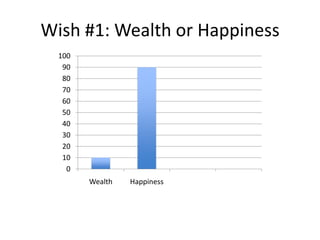
Wish #1: Wealth or Happiness
  100
   90
   80
   70
   60
   50
   40
   30
   20
   10
    0
        Wealth   Happiness
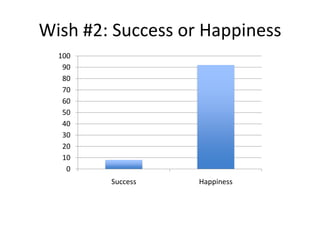
Wish #2: Success or Happiness
  100
   90
   80
   70
   60
   50
   40
   30
   20
   10
    0
        Success    Happiness
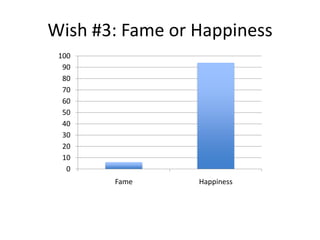
Wish #3: Fame or Happiness
 100
  90
  80
  70
  60
  50
  40
  30
  20
  10
   0
       Fame      Happiness
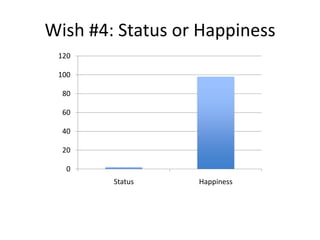
Wish #4: Status or Happiness
 120

 100

  80

  60

  40

  20

  0
        Status    Happiness
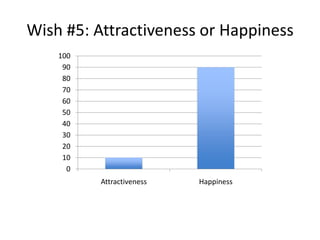
Wish #5: Attractiveness or Happiness
    100
     90
     80
     70
     60
     50
     40
     30
     20
     10
      0
          Attractiveness   Happiness
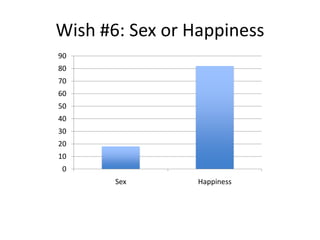
Wish #6: Sex or Happiness
90
80
70
60
50
40
30
20
10
 0
       Sex       Happiness
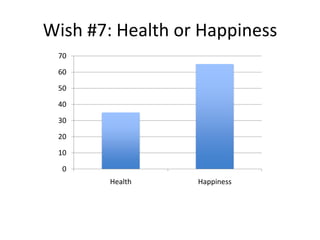
Wish #7: Health or Happiness
 70

 60

 50

 40

 30

 20

 10

  0
        Health    Happiness
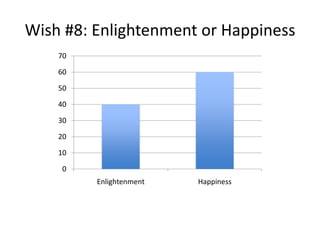
Wish #8: Enlightenment or Happiness
    70

    60

    50

    40

    30

    20

    10

     0
         Enlightenment   Happiness
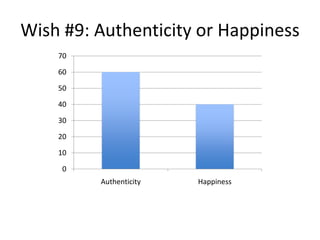
Wish #9: Authenticity or Happiness
    70

    60

    50

    40

    30

    20

    10

     0
         Authenticity   Happiness
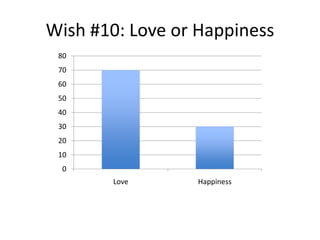
Wish #10: Love or Happiness
 80
 70
 60
 50
 40
 30
 20
 10
  0
       Love      Happiness
Study conducted in 2003
           (Diener&Oishi)

Researchers interviewed 9,000 people
    on the importance of happiness
against values such as health, wealth &
    attractiveness. Happiness came
first, even beating out heaven by 13%.
Happiness is a Universally accepted
               Goal!
In other research we learn that
        Happiness leads to:
Higher Income

Superior work outcomes including
 increased productivity & higher quality of
 work

More satisfying and longer marriages
Happiness also Leads To:
More friends, stronger social support &
 richer social interactions
More energy, increased activity and flow
Better physical health including a bolstered
 immune system, lowered stress levels &
 less pain
Longer life
Even inspires people to want to serve &
 benefit other
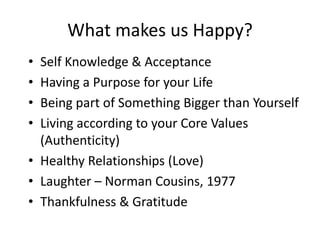
What makes us Happy?
• Self Knowledge & Acceptance
• Having a Purpose for your Life
• Being part of Something Bigger than Yourself
• Living according to your Core Values
  (Authenticity)
• Healthy Relationships (Love)
• Laughter – Norman Cousins, 1977
• Thankfulness & Gratitude
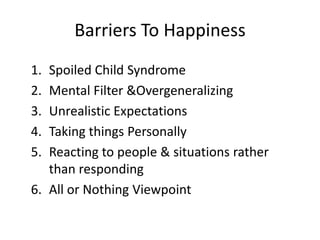
Barriers To Happiness
1. Spoiled Child Syndrome
2. Mental Filter &Overgeneralizing
3. Unrealistic Expectations
4. Taking things Personally
5. Reacting to people & situations rather
   than responding
6. All or Nothing Viewpoint
Happiness in the Workplace


Five Alarm Bulletin:
  The Workplace has Changed!
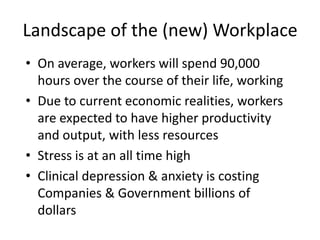
Landscape of the (new) Workplace
• On average, workers will spend 90,000
  hours over the course of their life, working
• Due to current economic realities, workers
  are expected to have higher productivity
  and output, with less resources
• Stress is at an all time high
• Clinical depression & anxiety is costing
  Companies & Government billions of
  dollars
Predictors of Happiness in the
            Workplace
How much you Enjoy your job
Feeling your work has a Purpose - Ms.
 Emily Groenewald
Confidence in your ability to do your job
Matching of Personal Values with
 Corporate Values
Trust in your Employer & Direct Reports
Recognition&Appreciation for your work
More Predictors of Happiness in the
           Workplace
 Your ability to Manage Stress – 80% of
  physical illnesses are caused by stress

 Your ability to Manage your Thoughts
  and Attitudes
Managing Stress
 Satisfiers

 Relaxation Techniques

 Coping with Uncertainty – WW II study

 Distinguishing between what you can
  change and what needs to be managed

 Stop Labelling – SrikumerRao
Great minds manage their Thoughts


     “A man is what he thinks
      about all day long.”
      ~Emerson~
“We become what we
  think about”

    ~Earl Nightengale~
“The greatest discovery of my
  generation is that a human
  being can alter his life by
  altering his attitude of
  mind”          ~William James~
Conclusion: We can change the
way we feel and experience life &
  work by changing the way we
             think!
What if we could create our own
          Happiness?
“I am the happiest man alive. I
have that in me that can convert
 poverty to riches, adversity to
    prosperity, and I am more
vulnerable than Achilles; fortune
 hath not one place to hit me.”
      ~Sir Thomas Brown~
We can Synthesize our own Happiness

 • Experience Simulator in Prefrontal Cortex
   (Ice Cream Flavours/Lottery)

 • The Impact Bias, “the tendency to
   overestimate the hedonic impact of
   future events.” (Purchases)
Synthesized Happiness
Harvard’s, Dan Gilbert’s Research using
  the “Free Choice Paradigm.”

• Monet Prints


• Monet Prints with amnesia patients

They change their hedonic
  reaction, not just perception or
  rationalization!
Examples of Synthesized Happiness

  “I don’t have one minute regret. It
    was a glorious experience.”

  Moreese Beckham – Upon release of 37
   years confined to a Louisiana Prison for
   a crime he was exonerated from based
   on DNA evidence
“I believe it turned out for the best.”

   Harry S. Langerman – turned down a
MacDonald’s Franchise because his brother
wouldn’t lend him the $3,000 stating, “You
   idiot, no one eats hamburgers.” Two
    months later, Ray Crock bought the
franchise and became the wealthiest man
                in America.
“I’m happier than I would have
      been with the Beatles.”

Pete Best, original drummer for the
 Beatles who was ‘abandoned’ by
     them without any notice.
“I’ve been able to enjoy love and
relationships at a deeper level than
           ever before.”

 Shania Twain – After the double
betrayal of her music producer &
husband having an affair with her
     best friend & confident
“I am the happiest man alive. I
have that in me that can convert
 poverty to riches, adversity to
    prosperity, and I am more
vulnerable than Achilles; fortune
 hath not one place to hit me.”

      ~Sir Thomas Brown~
“There is nothing good or bad, but
      thinking makes it so.”

     ~William Shakespeare~
I don’t wholeheartedly agree with
  Shakepeare’s quote but we can see
from the research that how and what
   we think about, especially as we
  rehearse or create scenarios in our
 minds, clearly affects our mood, our
  stress levels, our attitudes and will
    ultimately affect our behaviour.

Be happy presentation1

  • 1.
    Be Happy By AndreaGroenewald May 13, 2011 Revera Inc.
  • 2.
    Wish #1: Wealthor Happiness 100 90 80 70 60 50 40 30 20 10 0 Wealth Happiness
  • 3.
    Wish #2: Successor Happiness 100 90 80 70 60 50 40 30 20 10 0 Success Happiness
  • 4.
    Wish #3: Fameor Happiness 100 90 80 70 60 50 40 30 20 10 0 Fame Happiness
  • 5.
    Wish #4: Statusor Happiness 120 100 80 60 40 20 0 Status Happiness
  • 6.
    Wish #5: Attractivenessor Happiness 100 90 80 70 60 50 40 30 20 10 0 Attractiveness Happiness
  • 7.
    Wish #6: Sexor Happiness 90 80 70 60 50 40 30 20 10 0 Sex Happiness
  • 8.
    Wish #7: Healthor Happiness 70 60 50 40 30 20 10 0 Health Happiness
  • 9.
    Wish #8: Enlightenmentor Happiness 70 60 50 40 30 20 10 0 Enlightenment Happiness
  • 10.
    Wish #9: Authenticityor Happiness 70 60 50 40 30 20 10 0 Authenticity Happiness
  • 11.
    Wish #10: Loveor Happiness 80 70 60 50 40 30 20 10 0 Love Happiness
  • 12.
    Study conducted in2003 (Diener&Oishi) Researchers interviewed 9,000 people on the importance of happiness against values such as health, wealth & attractiveness. Happiness came first, even beating out heaven by 13%.
  • 13.
    Happiness is aUniversally accepted Goal!
  • 14.
    In other researchwe learn that Happiness leads to: Higher Income Superior work outcomes including increased productivity & higher quality of work More satisfying and longer marriages
  • 15.
    Happiness also LeadsTo: More friends, stronger social support & richer social interactions More energy, increased activity and flow Better physical health including a bolstered immune system, lowered stress levels & less pain Longer life Even inspires people to want to serve & benefit other
  • 16.
    What makes usHappy? • Self Knowledge & Acceptance • Having a Purpose for your Life • Being part of Something Bigger than Yourself • Living according to your Core Values (Authenticity) • Healthy Relationships (Love) • Laughter – Norman Cousins, 1977 • Thankfulness & Gratitude
  • 17.
    Barriers To Happiness 1.Spoiled Child Syndrome 2. Mental Filter &Overgeneralizing 3. Unrealistic Expectations 4. Taking things Personally 5. Reacting to people & situations rather than responding 6. All or Nothing Viewpoint
  • 18.
    Happiness in theWorkplace Five Alarm Bulletin: The Workplace has Changed!
  • 19.
    Landscape of the(new) Workplace • On average, workers will spend 90,000 hours over the course of their life, working • Due to current economic realities, workers are expected to have higher productivity and output, with less resources • Stress is at an all time high • Clinical depression & anxiety is costing Companies & Government billions of dollars
  • 20.
    Predictors of Happinessin the Workplace How much you Enjoy your job Feeling your work has a Purpose - Ms. Emily Groenewald Confidence in your ability to do your job Matching of Personal Values with Corporate Values Trust in your Employer & Direct Reports Recognition&Appreciation for your work
  • 21.
    More Predictors ofHappiness in the Workplace Your ability to Manage Stress – 80% of physical illnesses are caused by stress Your ability to Manage your Thoughts and Attitudes
  • 22.
    Managing Stress  Satisfiers Relaxation Techniques  Coping with Uncertainty – WW II study  Distinguishing between what you can change and what needs to be managed  Stop Labelling – SrikumerRao
  • 23.
    Great minds managetheir Thoughts “A man is what he thinks about all day long.” ~Emerson~
  • 24.
    “We become whatwe think about” ~Earl Nightengale~
  • 25.
    “The greatest discoveryof my generation is that a human being can alter his life by altering his attitude of mind” ~William James~
  • 26.
    Conclusion: We canchange the way we feel and experience life & work by changing the way we think!
  • 27.
    What if wecould create our own Happiness?
  • 28.
    “I am thehappiest man alive. I have that in me that can convert poverty to riches, adversity to prosperity, and I am more vulnerable than Achilles; fortune hath not one place to hit me.” ~Sir Thomas Brown~
  • 29.
    We can Synthesizeour own Happiness • Experience Simulator in Prefrontal Cortex (Ice Cream Flavours/Lottery) • The Impact Bias, “the tendency to overestimate the hedonic impact of future events.” (Purchases)
  • 30.
    Synthesized Happiness Harvard’s, DanGilbert’s Research using the “Free Choice Paradigm.” • Monet Prints • Monet Prints with amnesia patients They change their hedonic reaction, not just perception or rationalization!
  • 31.
    Examples of SynthesizedHappiness “I don’t have one minute regret. It was a glorious experience.” Moreese Beckham – Upon release of 37 years confined to a Louisiana Prison for a crime he was exonerated from based on DNA evidence
  • 32.
    “I believe itturned out for the best.” Harry S. Langerman – turned down a MacDonald’s Franchise because his brother wouldn’t lend him the $3,000 stating, “You idiot, no one eats hamburgers.” Two months later, Ray Crock bought the franchise and became the wealthiest man in America.
  • 33.
    “I’m happier thanI would have been with the Beatles.” Pete Best, original drummer for the Beatles who was ‘abandoned’ by them without any notice.
  • 34.
    “I’ve been ableto enjoy love and relationships at a deeper level than ever before.” Shania Twain – After the double betrayal of her music producer & husband having an affair with her best friend & confident
  • 35.
    “I am thehappiest man alive. I have that in me that can convert poverty to riches, adversity to prosperity, and I am more vulnerable than Achilles; fortune hath not one place to hit me.” ~Sir Thomas Brown~
  • 36.
    “There is nothinggood or bad, but thinking makes it so.” ~William Shakespeare~
  • 37.
    I don’t wholeheartedlyagree with Shakepeare’s quote but we can see from the research that how and what we think about, especially as we rehearse or create scenarios in our minds, clearly affects our mood, our stress levels, our attitudes and will ultimately affect our behaviour.