SME DEVELOPMENT STRATEGY IN LIBYA
PROJECT STEERING COMMITTEE &
SHORT TERM ACTION PLAN MEETING
TUNIS, 8 DECEMBER 2016
Session 4: SHORT TERM ACTION PLAN – CONSULTATION
PROCESS
Lois Stevenson, OECD Consultant
1
OBJECTIVE OF SESSION 4
 To gain agreement and commitment of the Project
Steering Committee and other Libyan stakeholders
on the consultation process to develop and validate
the Short-term Action Plan and its priority of
activities.
2
PURPOSE OF CONSULTATION SESSIONS
 Very important to consult broadly with
entrepreneurship and SME stakeholders during the
process of developing the Short-term Action Plan
 Need to:
 solicit input on and validate the priority SME problems,
 advise on the key policy targets, objectives and strategic
pillars,
 make suggestions on the lines of action to achieve
objectives and targets under each policy pillar and
 validate the first draft of the Action Plan.
 Engagement of stakeholders in the work of
developing the Action Plan better ensures local buy-in
for the elaboration and acceptance of the Action Plan
and its implementation 3
THESE CONSULTATIONS SHOULD BE HELD AT
VARIOUS STAGES OF THE PROCESS
 At the beginning of the process to gather input on the major
challenges facing entrepreneurship and SME development in
the country, the key issues to be addressed in the Action Plan
and improvements needed to the support system;
 During the process of developing and validating the major
objectives of the Action Plan and its overarching framework;
 During the process of gathering input on the specific activities
to be included in the Action Plan under each of the strategic
objectives/themes; and
 During the last stage of validating the final draft of the Action
Plan and seeking co-operation with the relevant stakeholders
on their roles and responsibilities in implementing the strategy
components.
 The consultation sessions could take the form of one-on-one
meetings, workshops, roundtables and focus groups, as
appropriate.
4
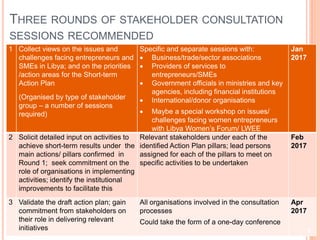
THREE ROUNDS OF STAKEHOLDER CONSULTATION
SESSIONS RECOMMENDED
1 Collect views on the issues and
challenges facing entrepreneurs and
SMEs in Libya; and on the priorities
/action areas for the Short-term
Action Plan
(Organised by type of stakeholder
group – a number of sessions
required)
Specific and separate sessions with:
 Business/trade/sector associations
 Providers of services to
entrepreneurs/SMEs
 Government officials in ministries and key
agencies, including financial institutions
 International/donor organisations
 Maybe a special workshop on issues/
challenges facing women entrepreneurs
with Libya Women’s Forum/ LWEE
Jan
2017
2 Solicit detailed input on activities to
achieve short-term results under the
main actions/ pillars confirmed in
Round 1; seek commitment on the
role of organisations in implementing
activities; identify the institutional
improvements to facilitate this
Relevant stakeholders under each of the
identified Action Plan pillars; lead persons
assigned for each of the pillars to meet on
specific activities to be undertaken
Feb
2017
3 Validate the draft action plan; gain
commitment from stakeholders on
their role in delivering relevant
initiatives
All organisations involved in the consultation
processes
Could take the form of a one-day conference
Apr
2017
5
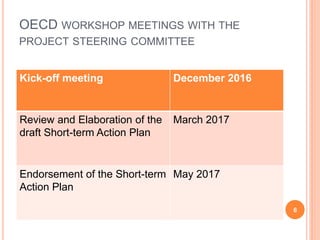
OECD WORKSHOP MEETINGS WITH THE
PROJECT STEERING COMMITTEE
Kick-off meeting December 2016
Review and Elaboration of the
draft Short-term Action Plan
March 2017
Endorsement of the Short-term
Action Plan
May 2017
6
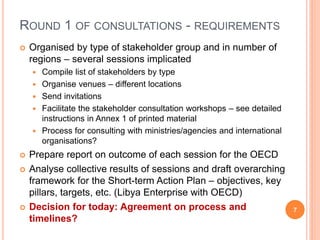
ROUND 1 OF CONSULTATIONS - REQUIREMENTS
 Organised by type of stakeholder group and in number of
regions – several sessions implicated
 Compile list of stakeholders by type
 Organise venues – different locations
 Send invitations
 Facilitate the stakeholder consultation workshops – see detailed
instructions in Annex 1 of printed material
 Process for consulting with ministries/agencies and international
organisations?
 Prepare report on outcome of each session for the OECD
 Analyse collective results of sessions and draft overarching
framework for the Short-term Action Plan – objectives, key
pillars, targets, etc. (Libya Enterprise with OECD)
 Decision for today: Agreement on process and
timelines?
7
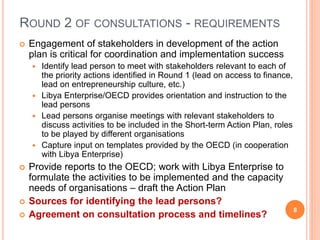
ROUND 2 OF CONSULTATIONS - REQUIREMENTS
 Engagement of stakeholders in development of the action
plan is critical for coordination and implementation success
 Identify lead person to meet with stakeholders relevant to each of
the priority actions identified in Round 1 (lead on access to finance,
lead on entrepreneurship culture, etc.)
 Libya Enterprise/OECD provides orientation and instruction to the
lead persons
 Lead persons organise meetings with relevant stakeholders to
discuss activities to be included in the Short-term Action Plan, roles
to be played by different organisations
 Capture input on templates provided by the OECD (in cooperation
with Libya Enterprise)
 Provide reports to the OECD; work with Libya Enterprise to
formulate the activities to be implemented and the capacity
needs of organisations – draft the Action Plan
 Sources for identifying the lead persons?
 Agreement on consultation process and timelines?
8
ROUND 3 OF CONSULTATIONS - REQUIREMENTS
 Important to validate the draft Action Plan; gain
commitment of organisations in the implementation of
activities
 Form of a one-day conference?
 Stakeholders review/comment on the draft Action Plan
 Draft Action Plan is refined
 Action Plan is approved by the Project Steering
Committee – OECD meeting organised for this
purpose
 Decision for today: Agreement on consultation
process and timelines
9
COMMENTS/ QUESTIONS?
10

SME DEVELOPMENT STRATEGY IN LIBYA PROJECT STEERING COMMITTEE

  • 1.
    SME DEVELOPMENT STRATEGYIN LIBYA PROJECT STEERING COMMITTEE & SHORT TERM ACTION PLAN MEETING TUNIS, 8 DECEMBER 2016 Session 4: SHORT TERM ACTION PLAN – CONSULTATION PROCESS Lois Stevenson, OECD Consultant 1
  • 2.
    OBJECTIVE OF SESSION4  To gain agreement and commitment of the Project Steering Committee and other Libyan stakeholders on the consultation process to develop and validate the Short-term Action Plan and its priority of activities. 2
  • 3.
    PURPOSE OF CONSULTATIONSESSIONS  Very important to consult broadly with entrepreneurship and SME stakeholders during the process of developing the Short-term Action Plan  Need to:  solicit input on and validate the priority SME problems,  advise on the key policy targets, objectives and strategic pillars,  make suggestions on the lines of action to achieve objectives and targets under each policy pillar and  validate the first draft of the Action Plan.  Engagement of stakeholders in the work of developing the Action Plan better ensures local buy-in for the elaboration and acceptance of the Action Plan and its implementation 3
  • 4.
    THESE CONSULTATIONS SHOULDBE HELD AT VARIOUS STAGES OF THE PROCESS  At the beginning of the process to gather input on the major challenges facing entrepreneurship and SME development in the country, the key issues to be addressed in the Action Plan and improvements needed to the support system;  During the process of developing and validating the major objectives of the Action Plan and its overarching framework;  During the process of gathering input on the specific activities to be included in the Action Plan under each of the strategic objectives/themes; and  During the last stage of validating the final draft of the Action Plan and seeking co-operation with the relevant stakeholders on their roles and responsibilities in implementing the strategy components.  The consultation sessions could take the form of one-on-one meetings, workshops, roundtables and focus groups, as appropriate. 4
  • 5.
    THREE ROUNDS OFSTAKEHOLDER CONSULTATION SESSIONS RECOMMENDED 1 Collect views on the issues and challenges facing entrepreneurs and SMEs in Libya; and on the priorities /action areas for the Short-term Action Plan (Organised by type of stakeholder group – a number of sessions required) Specific and separate sessions with:  Business/trade/sector associations  Providers of services to entrepreneurs/SMEs  Government officials in ministries and key agencies, including financial institutions  International/donor organisations  Maybe a special workshop on issues/ challenges facing women entrepreneurs with Libya Women’s Forum/ LWEE Jan 2017 2 Solicit detailed input on activities to achieve short-term results under the main actions/ pillars confirmed in Round 1; seek commitment on the role of organisations in implementing activities; identify the institutional improvements to facilitate this Relevant stakeholders under each of the identified Action Plan pillars; lead persons assigned for each of the pillars to meet on specific activities to be undertaken Feb 2017 3 Validate the draft action plan; gain commitment from stakeholders on their role in delivering relevant initiatives All organisations involved in the consultation processes Could take the form of a one-day conference Apr 2017 5
  • 6.
    OECD WORKSHOP MEETINGSWITH THE PROJECT STEERING COMMITTEE Kick-off meeting December 2016 Review and Elaboration of the draft Short-term Action Plan March 2017 Endorsement of the Short-term Action Plan May 2017 6
  • 7.
    ROUND 1 OFCONSULTATIONS - REQUIREMENTS  Organised by type of stakeholder group and in number of regions – several sessions implicated  Compile list of stakeholders by type  Organise venues – different locations  Send invitations  Facilitate the stakeholder consultation workshops – see detailed instructions in Annex 1 of printed material  Process for consulting with ministries/agencies and international organisations?  Prepare report on outcome of each session for the OECD  Analyse collective results of sessions and draft overarching framework for the Short-term Action Plan – objectives, key pillars, targets, etc. (Libya Enterprise with OECD)  Decision for today: Agreement on process and timelines? 7
  • 8.
    ROUND 2 OFCONSULTATIONS - REQUIREMENTS  Engagement of stakeholders in development of the action plan is critical for coordination and implementation success  Identify lead person to meet with stakeholders relevant to each of the priority actions identified in Round 1 (lead on access to finance, lead on entrepreneurship culture, etc.)  Libya Enterprise/OECD provides orientation and instruction to the lead persons  Lead persons organise meetings with relevant stakeholders to discuss activities to be included in the Short-term Action Plan, roles to be played by different organisations  Capture input on templates provided by the OECD (in cooperation with Libya Enterprise)  Provide reports to the OECD; work with Libya Enterprise to formulate the activities to be implemented and the capacity needs of organisations – draft the Action Plan  Sources for identifying the lead persons?  Agreement on consultation process and timelines? 8
  • 9.
    ROUND 3 OFCONSULTATIONS - REQUIREMENTS  Important to validate the draft Action Plan; gain commitment of organisations in the implementation of activities  Form of a one-day conference?  Stakeholders review/comment on the draft Action Plan  Draft Action Plan is refined  Action Plan is approved by the Project Steering Committee – OECD meeting organised for this purpose  Decision for today: Agreement on consultation process and timelines 9
  • 10.