An initial Framework
of a Competency-based project
         management
    Mikhail ROZHKOV, C.F. Cheung and Eric Tsui
       Knowledge Management Research Centre,
    Department of Industrial and Systems Engineering,
         The Hong Kong Polytechnic University


                              Mikhail Rozhkov
                              PhD Candidate, PolyU
                              mail: mnrozhkov@gmail.com
What I’m going to talk about?

1. The role of employee’s competencies in
   innovation projects
2. Framework of a Competency-based project
   management
3. Framework’s application
Current project management issues:
         literature review…

1) Requirements of being open-
  innovative, active in the web
  environment, flexible
2) Using virtual and remote workers
3) Organization network cooperation is required
4) High project complexity

    Human resources are the critical factor to handle these
                          issues
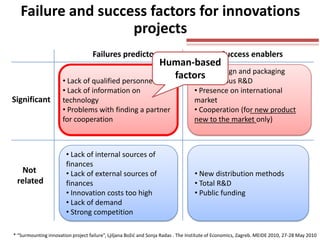
Success factors of innovation projects:
           research results…

• Croatian Community Innovation Survey (2004
  – 2009)
• The sample: 979
  – Potential innovators
  – Successful innovators


      * “Surmounting innovation project failure”, Ljiljana Božid and Sonja Radas The Institute of
                                             Economics, Zagreb. MEIDE 2010, 27‐28 May 2010
Failure and success factors for
                     innovations projects
                                Failures predictors                                         Success enablers
                                                                                  • New design and packaging
                      • Lack of qualified personnel                               • Continuous R&D
                      • Lack of information on                                    • Presence on international
Significant           technology                                                  market
                      • Problems with finding a partner                           • Cooperation (for new product
                      for cooperation                                             new to the market only)


                       • Lack of internal sources of
                       finances
  Not                  • Lack of external sources of                              • New distribution methods
 related               finances                                                   • Total R&D
                       • Innovation costs too high                                • Public funding
                       • Lack of demand
                       • Strong competition

 * “Surmounting innovation project failure”, Ljiljana Božid and Sonja Radas The Institute of Economics, Zagreb. MEIDE 2010, 27‐28 May 2010
Failure and success factors for
                     innovations projects
                                   Failures predictors                                        Success enablers
                                                                              • New design and packaging
                      • Lack of qualified personnel                           • Continuous R&D
                      • Lack of information on                                • Presence on international
Significant           technology                                              market
                      • Problems with finding a partner                       • Cooperation (for new product
                      for cooperation                                      Finance-based only)
                                                                              new to the market
                                                                                  factors
                       • Lack of internal sources of
                       finances
  Not                  • Lack of external sources of
                                                                                  • New distribution methods
 related               finances                                             Market-based
                                                                              • Total R&D
                       • Innovation costs too high
                                                                              •factors
                                                                                Public funding
                       • Lack of demand
                       • Strong competition

 * “Surmounting innovation project failure”, Ljiljana Božid and Sonja Radas The Institute of Economics, Zagreb. MEIDE 2010, 27‐28 May 2010
Failure and success factors for innovations
                    projects
                                    Failures predictors                                        Success enablers
                                                                  Human-based
                                                                        • New
                      • Lack of qualified personnel
                                                                    factors design R&Dpackaging
                                                                        • Continuous
                                                                                     and

                      • Lack of information on                                    • Presence on international
Significant           technology                                                  market
                      • Problems with finding a partner                           • Cooperation (for new product
                      for cooperation                                             new to the market only)


                        • Lack of internal sources of
                        finances
  Not                   • Lack of external sources of                              • New distribution methods
 related                finances                                                   • Total R&D
                        • Innovation costs too high                                • Public funding
                        • Lack of demand
                        • Strong competition

* “Surmounting innovation project failure”, Ljiljana Božid and Sonja Radas . The Institute of Economics, Zagreb. MEIDE 2010, 27‐28 May 2010
What is «competency»?

               Motivation
              and attitudes

Knowledge                                Personal
 and skills                               traits
                                                                     Competency

                The
              observed
              behavior


                              *adopted from presentation of Gregory Finkelshtein, ECOPSY Consulting
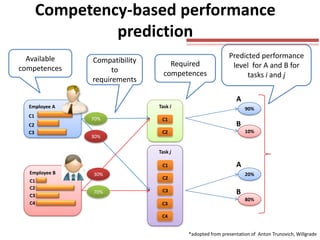
Competency-based performance
                prediction
  Available                                              Predicted performance
               Compatibility       Required
competences                                               level for A and B for
                     to          competences                   tasks i and j
               requirements

                                                            A
  Employee A                   Task i                           90%
  C1
               70%              C1
  C2                                                        B
  C3                            C2                              10%
               30%

                               Task j

                                C1                          A
  Employee B   30%                                              20%
                                C2
  C1
  C2                            C3
  C3
               70%                                          B
                                                                80%
  C4                            C3

                                C4


                                        *adopted from presentation of Anton Trunovich, Willgrade
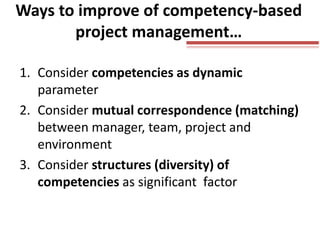
Ways to improve of competency-based
       project management…

1. Consider competencies as dynamic
   parameter
2. Consider mutual correspondence (matching)
   between manager, team, project and
   environment
3. Consider structures (diversity) of
   competencies as significant factor
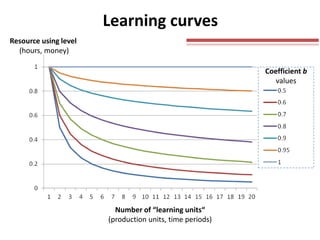
Learning curves
Resource using level
  (hours, money)

                                                          Coefficient b
                                                             values


                         Number of “learning units“
                       (production units, time periods)
Competency developing curves
Competency
   level

                                             Coefficient b
                                                values


                Number of “learning units”
                  (projects, time periods)
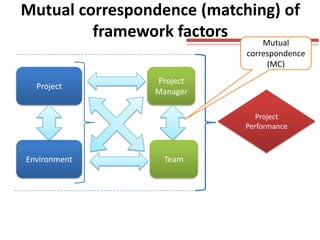
Mutual correspondence (matching) of
         framework factors
                                Mutual
                            correspondence
                                 (MC)
                Project
  Project
                Manager

                               Project
                            Performance


Environment      Team
• Competencies       • Competencies          Project
    Project        required (level)     (level)                 Manager

• Size/value                                                 • Personality
                                        • Management
• Cooperation      • Competencies                            • Learning style
                                        style
required           required                                  • Communication
                                        • Values
• Competencies     (level, structure)                        and management
                                        • Motivation
required                                                     style


• Strategy
                                                             •Personality
• Cooperation     • Management
                                        • Competencies       •Learning style
network           style
                                        (level, structure)   • Communication
• Project support • Culture (values)
                                                             and working style
•HR-management

                   • Culture (values)
                   • Motivation         • Values
 Environment       system               • Motivation
                                                                  Team
• Competencies       • Competencies
     Project                                                 Project Manager
                   required (level)     (level)


• Size/value                                                 • Personality
                                        • Management
• Cooperation      • Competencies                            • Learning style
                                        style
required           required                                  • Communication
                                        • Values
• Competencies     (level, structure)                        and management
                                        • Motivation
required                                                     style


• Strategy
                                                             •Personality
• Cooperation     • Management
                                        •Competencies        •Learning style
network           style
                                        (level, structure)   • Communication
• Project support • Culture (values)
                                                             and working style
•HR-management

                   • Culture (values)
                                        • Values
  Environment      • Motivation                                    Team
                                        • Motivation
                   system
• Competencies       • Competencies
     Project                                                 Project Manager
                   required (level      (level)


• Size/value                                                 • Personality
                                        • Management
• Cooperation      • Competencies                            • Learning style
                                        style
required           required                                  • Communication
                                        • Values
• Competencies     (level, structure)                        and management
                                        • Motivation
required                                                     style


• Strategy
                                                             •Personality
• Cooperation     • Management
                                        • Competencies       •Learning style
network           style
                                        (level, structure)   • Communication
• Project support • Culture (values)
                                                             and working style
•HR-management

                   • Culture (values)
                   • Motivation         • Values
  Environment                                                      Team
                   system               • Motivation
• Competencies       • Competencies
     Project                                               Project Manager
                   required (level)     (level)


• Size/value                                               • Personality
                                        • Management
• Cooperation      • Competencies                          • Learning style
                                        style
required           required                                • Communication
                                        • Values
• Competencies     (level, structure)                      and management
                                        • Motivation
required                                                   style


• Strategy
                                                           •Personality
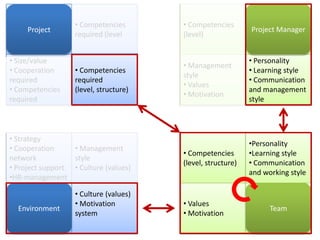
• Cooperation     • Management          • Competencies
                                                           •Learning style
network           style                 required (level,
                                                           • Communication
• Project support • Culture (values)    structure)
                                                           and working style
•HR-management

                   • Culture (values)
                   • Motivation         • Values
  Environment                                                    Team
                   system               • Motivation
Framework applications

Benefits
                                             Single innovation
  Applications               Corporations
                                            projects / start-ups

  Current projects’
   “bottlenecks”
 analysis/prediction     Less risk of failure
                         More flexible teams
 Project management
  practice improving


                           Cost efficiency
 Training and learning
  needs assessment

 Decision supporting

                    Hiring “right” people
 for hiring of project
     team and/or
           Better project portfolio and
       manager
 Completed projects
        analysis
   (failure/success
                    cooperation network
       analysis)
                        management
Target pr                   jects!

  Product
development
  projects

          Software
        development
          projects


                      Marketing
                       projects


                            Other Innovation
                                projects
Thank you!


             Mikhail ROZHKOV
          PhD Candidate, PolyU
   mail: mnrozhkov@gmail.com

An initial framework of competency-based knowledge management

  • 1.
    An initial Framework ofa Competency-based project management Mikhail ROZHKOV, C.F. Cheung and Eric Tsui Knowledge Management Research Centre, Department of Industrial and Systems Engineering, The Hong Kong Polytechnic University Mikhail Rozhkov PhD Candidate, PolyU mail: mnrozhkov@gmail.com
  • 2.
    What I’m goingto talk about? 1. The role of employee’s competencies in innovation projects 2. Framework of a Competency-based project management 3. Framework’s application
  • 3.
    Current project managementissues: literature review… 1) Requirements of being open- innovative, active in the web environment, flexible 2) Using virtual and remote workers 3) Organization network cooperation is required 4) High project complexity Human resources are the critical factor to handle these issues
  • 4.
    Success factors ofinnovation projects: research results… • Croatian Community Innovation Survey (2004 – 2009) • The sample: 979 – Potential innovators – Successful innovators * “Surmounting innovation project failure”, Ljiljana Božid and Sonja Radas The Institute of Economics, Zagreb. MEIDE 2010, 27‐28 May 2010
  • 5.
    Failure and successfactors for innovations projects Failures predictors Success enablers • New design and packaging • Lack of qualified personnel • Continuous R&D • Lack of information on • Presence on international Significant technology market • Problems with finding a partner • Cooperation (for new product for cooperation new to the market only) • Lack of internal sources of finances Not • Lack of external sources of • New distribution methods related finances • Total R&D • Innovation costs too high • Public funding • Lack of demand • Strong competition * “Surmounting innovation project failure”, Ljiljana Božid and Sonja Radas The Institute of Economics, Zagreb. MEIDE 2010, 27‐28 May 2010
  • 6.
    Failure and successfactors for innovations projects Failures predictors Success enablers • New design and packaging • Lack of qualified personnel • Continuous R&D • Lack of information on • Presence on international Significant technology market • Problems with finding a partner • Cooperation (for new product for cooperation Finance-based only) new to the market factors • Lack of internal sources of finances Not • Lack of external sources of • New distribution methods related finances Market-based • Total R&D • Innovation costs too high •factors Public funding • Lack of demand • Strong competition * “Surmounting innovation project failure”, Ljiljana Božid and Sonja Radas The Institute of Economics, Zagreb. MEIDE 2010, 27‐28 May 2010
  • 7.
    Failure and successfactors for innovations projects Failures predictors Success enablers Human-based • New • Lack of qualified personnel factors design R&Dpackaging • Continuous and • Lack of information on • Presence on international Significant technology market • Problems with finding a partner • Cooperation (for new product for cooperation new to the market only) • Lack of internal sources of finances Not • Lack of external sources of • New distribution methods related finances • Total R&D • Innovation costs too high • Public funding • Lack of demand • Strong competition * “Surmounting innovation project failure”, Ljiljana Božid and Sonja Radas . The Institute of Economics, Zagreb. MEIDE 2010, 27‐28 May 2010
  • 8.
    What is «competency»? Motivation and attitudes Knowledge Personal and skills traits Competency The observed behavior *adopted from presentation of Gregory Finkelshtein, ECOPSY Consulting
  • 9.
    Competency-based performance prediction Available Predicted performance Compatibility Required competences level for A and B for to competences tasks i and j requirements A Employee A Task i 90% C1 70% C1 C2 B C3 C2 10% 30% Task j C1 A Employee B 30% 20% C2 C1 C2 C3 C3 70% B 80% C4 C3 C4 *adopted from presentation of Anton Trunovich, Willgrade
  • 10.
    Ways to improveof competency-based project management… 1. Consider competencies as dynamic parameter 2. Consider mutual correspondence (matching) between manager, team, project and environment 3. Consider structures (diversity) of competencies as significant factor
  • 11.
    Learning curves Resource usinglevel (hours, money) Coefficient b values Number of “learning units“ (production units, time periods)
  • 12.
    Competency developing curves Competency level Coefficient b values Number of “learning units” (projects, time periods)
  • 13.
    Mutual correspondence (matching)of framework factors Mutual correspondence (MC) Project Project Manager Project Performance Environment Team
  • 14.
    • Competencies • Competencies Project Project required (level) (level) Manager • Size/value • Personality • Management • Cooperation • Competencies • Learning style style required required • Communication • Values • Competencies (level, structure) and management • Motivation required style • Strategy •Personality • Cooperation • Management • Competencies •Learning style network style (level, structure) • Communication • Project support • Culture (values) and working style •HR-management • Culture (values) • Motivation • Values Environment system • Motivation Team
  • 15.
    • Competencies • Competencies Project Project Manager required (level) (level) • Size/value • Personality • Management • Cooperation • Competencies • Learning style style required required • Communication • Values • Competencies (level, structure) and management • Motivation required style • Strategy •Personality • Cooperation • Management •Competencies •Learning style network style (level, structure) • Communication • Project support • Culture (values) and working style •HR-management • Culture (values) • Values Environment • Motivation Team • Motivation system
  • 16.
    • Competencies • Competencies Project Project Manager required (level (level) • Size/value • Personality • Management • Cooperation • Competencies • Learning style style required required • Communication • Values • Competencies (level, structure) and management • Motivation required style • Strategy •Personality • Cooperation • Management • Competencies •Learning style network style (level, structure) • Communication • Project support • Culture (values) and working style •HR-management • Culture (values) • Motivation • Values Environment Team system • Motivation
  • 17.
    • Competencies • Competencies Project Project Manager required (level) (level) • Size/value • Personality • Management • Cooperation • Competencies • Learning style style required required • Communication • Values • Competencies (level, structure) and management • Motivation required style • Strategy •Personality • Cooperation • Management • Competencies •Learning style network style required (level, • Communication • Project support • Culture (values) structure) and working style •HR-management • Culture (values) • Motivation • Values Environment Team system • Motivation
  • 18.
    Framework applications Benefits Single innovation Applications Corporations projects / start-ups Current projects’ “bottlenecks” analysis/prediction Less risk of failure More flexible teams Project management practice improving Cost efficiency Training and learning needs assessment Decision supporting Hiring “right” people for hiring of project team and/or Better project portfolio and manager Completed projects analysis (failure/success cooperation network analysis) management
  • 19.
    Target pr jects! Product development projects Software development projects Marketing projects Other Innovation projects
  • 20.
    Thank you! Mikhail ROZHKOV PhD Candidate, PolyU mail: mnrozhkov@gmail.com