By-
ANJAN CHATTERJEE
DEBANIK DEY
MONIKUNTALA BHATTACHARYA
PROTIBHU GHOSH
RAHUL MONDAL
RAJARSHI ROYCHOWDHURY
Guided by Prof. SANKHADEEP SAHA
 In this project we have made a 3-phase SVPWM
inverter, using 8051 microcontroller and MOSFETs as
switches.
 Three phase inverter has its application in various
frequency drive and high power applications.
 A basic three-phase inverter consists of three single-
phase inverter switches (6 in no) each connected to one
of the three load terminals.
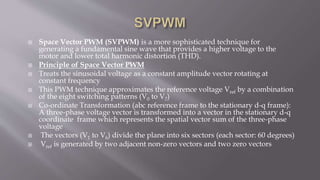
 Space Vector PWM (SVPWM) is a more sophisticated technique for
generating a fundamental sine wave that provides a higher voltage to the
motor and lower total harmonic distortion (THD).
 Principle of Space Vector PWM
 Treats the sinusoidal voltage as a constant amplitude vector rotating at
constant frequency
 This PWM technique approximates the reference voltage Vref by a combination
of the eight switching patterns (V0 to V7)
 Co-ordinate Transformation (abc reference frame to the stationary d-q frame):
A three-phase voltage vector is transformed into a vector in the stationary d-q
coordinate frame which represents the spatial vector sum of the three-phase
voltage
 The vectors (V1 to V6) divide the plane into six sectors (each sector: 60 degrees)
 Vref is generated by two adjacent non-zero vectors and two zero vectors
Open loop voltage control
VSI AC
motor
PWMvref
Closed loop current-control
VSI
AC
motorPWMiref
if/back
PWM – Voltage Source Inverter
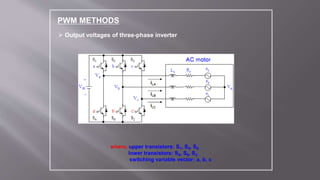
 Output voltages of three-phase inverter
PWM METHODS
where, upper transistors: S1, S3, S5
lower transistors: S4, S6, S2
switching variable vector: a, b, c
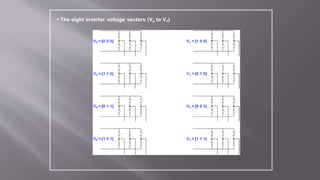
 The eight inverter voltage vectors (V0 to V7)
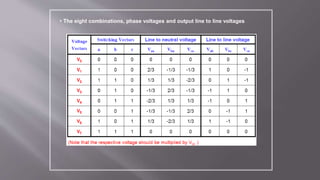
 The eight combinations, phase voltages and output line to line voltages
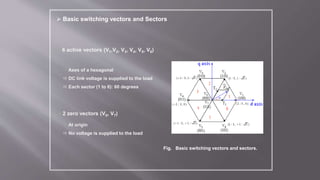
 Basic switching vectors and Sectors
Fig. Basic switching vectors and sectors.
 6 active vectors (V1,V2, V3, V4, V5, V6)
 Axes of a hexagonal
 DC link voltage is supplied to the load
 Each sector (1 to 6): 60 degrees
 2 zero vectors (V0, V7)
 At origin
 No voltage is supplied to the load
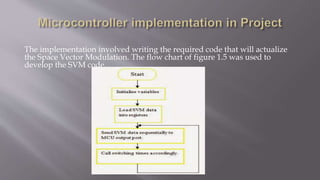
The implementation involved writing the required code that will actualize
the Space Vector Modulation. The flow chart of figure 1.5 was used to
develop the SVM code.
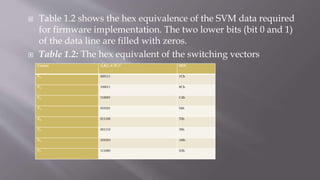
 Table 1.2 shows the hex equivalence of the SVM data required
for firmware implementation. The two lower bits (bit 0 and 1)
of the data line are filled with zeros.
 Table 1.2: The hex equivalent of the switching vectors
Vectors A,B,C,A’,B’,C’ HEX
V0 000111 1Ch
V1 100011 8Ch
V2 110001 C4h
V3 010101 54h
V4 011100 70h
V5 001110 38h
V6 101010 A8h
V7 111000 E0h
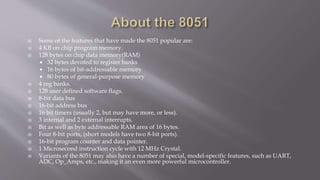
 Some of the features that have made the 8051 popular are:
 4 KB on chip program memory.
 128 bytes on chip data memory(RAM)
 32 bytes devoted to register banks
 16 bytes of bit-addressable memory
 80 bytes of general-purpose memory
 4 reg banks.
 128 user defined software flags.
 8-bit data bus
 16-bit address bus
 16 bit timers (usually 2, but may have more, or less).
 3 internal and 2 external interrupts.
 Bit as well as byte addressable RAM area of 16 bytes.
 Four 8-bit ports, (short models have two 8-bit ports).
 16-bit program counter and data pointer.
 1 Microsecond instruction cycle with 12 MHz Crystal.
 Variants of the 8051 may also have a number of special, model-specific features, such as UART,
ADC, Op_Amps, etc., making it an even more powerful microcontroller.
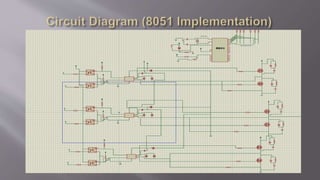
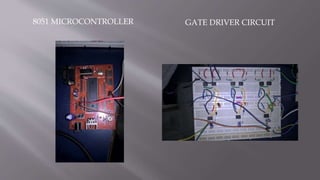
8051 MICROCONTROLLER GATE DRIVER CIRCUIT
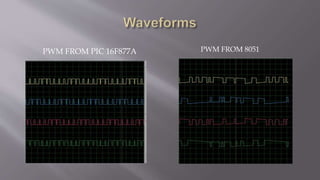
PWM FROM PIC 16F877A PWM FROM 8051
Thus we come to the end of our presentation on 3-phase
inverters. Throughout this project we have learned working on
various electrical simulation softwares like Proteus and
Multisim, and also hands-on work with the circuit components.
We are thankful to our Project guide Prof. Sankhadeep Saha who
guided and helped us throughout the duration of this project.
SVPWM Inverter

SVPWM Inverter

  • 1.
    By- ANJAN CHATTERJEE DEBANIK DEY MONIKUNTALABHATTACHARYA PROTIBHU GHOSH RAHUL MONDAL RAJARSHI ROYCHOWDHURY Guided by Prof. SANKHADEEP SAHA
  • 2.
     In thisproject we have made a 3-phase SVPWM inverter, using 8051 microcontroller and MOSFETs as switches.  Three phase inverter has its application in various frequency drive and high power applications.  A basic three-phase inverter consists of three single- phase inverter switches (6 in no) each connected to one of the three load terminals.
  • 3.
     Space VectorPWM (SVPWM) is a more sophisticated technique for generating a fundamental sine wave that provides a higher voltage to the motor and lower total harmonic distortion (THD).  Principle of Space Vector PWM  Treats the sinusoidal voltage as a constant amplitude vector rotating at constant frequency  This PWM technique approximates the reference voltage Vref by a combination of the eight switching patterns (V0 to V7)  Co-ordinate Transformation (abc reference frame to the stationary d-q frame): A three-phase voltage vector is transformed into a vector in the stationary d-q coordinate frame which represents the spatial vector sum of the three-phase voltage  The vectors (V1 to V6) divide the plane into six sectors (each sector: 60 degrees)  Vref is generated by two adjacent non-zero vectors and two zero vectors
  • 4.
    Open loop voltagecontrol VSI AC motor PWMvref Closed loop current-control VSI AC motorPWMiref if/back PWM – Voltage Source Inverter
  • 5.
     Output voltagesof three-phase inverter PWM METHODS where, upper transistors: S1, S3, S5 lower transistors: S4, S6, S2 switching variable vector: a, b, c
  • 6.
     The eightinverter voltage vectors (V0 to V7)
  • 7.
     The eightcombinations, phase voltages and output line to line voltages
  • 8.
     Basic switchingvectors and Sectors Fig. Basic switching vectors and sectors.  6 active vectors (V1,V2, V3, V4, V5, V6)  Axes of a hexagonal  DC link voltage is supplied to the load  Each sector (1 to 6): 60 degrees  2 zero vectors (V0, V7)  At origin  No voltage is supplied to the load
  • 11.
    The implementation involvedwriting the required code that will actualize the Space Vector Modulation. The flow chart of figure 1.5 was used to develop the SVM code.
  • 12.
     Table 1.2shows the hex equivalence of the SVM data required for firmware implementation. The two lower bits (bit 0 and 1) of the data line are filled with zeros.  Table 1.2: The hex equivalent of the switching vectors Vectors A,B,C,A’,B’,C’ HEX V0 000111 1Ch V1 100011 8Ch V2 110001 C4h V3 010101 54h V4 011100 70h V5 001110 38h V6 101010 A8h V7 111000 E0h
  • 13.
     Some ofthe features that have made the 8051 popular are:  4 KB on chip program memory.  128 bytes on chip data memory(RAM)  32 bytes devoted to register banks  16 bytes of bit-addressable memory  80 bytes of general-purpose memory  4 reg banks.  128 user defined software flags.  8-bit data bus  16-bit address bus  16 bit timers (usually 2, but may have more, or less).  3 internal and 2 external interrupts.  Bit as well as byte addressable RAM area of 16 bytes.  Four 8-bit ports, (short models have two 8-bit ports).  16-bit program counter and data pointer.  1 Microsecond instruction cycle with 12 MHz Crystal.  Variants of the 8051 may also have a number of special, model-specific features, such as UART, ADC, Op_Amps, etc., making it an even more powerful microcontroller.
  • 15.
  • 17.
    PWM FROM PIC16F877A PWM FROM 8051
  • 20.
    Thus we cometo the end of our presentation on 3-phase inverters. Throughout this project we have learned working on various electrical simulation softwares like Proteus and Multisim, and also hands-on work with the circuit components. We are thankful to our Project guide Prof. Sankhadeep Saha who guided and helped us throughout the duration of this project.