Chandu Veera Ramakrishna
16F91A05B0
Prakasam Engineering College,Kandukur.
ABSTRACT
 Cloud computing is a very useful solution to many individual users and
organizations.
 It can provide many services based on different needs and requirements.
 However, there are many issues related to the user data that need to be
addressed when using cloud computing.
 Among the most important issues are: data ownership, data privacy, and
storage.
 In other words, more important data will be encrypted with more secure
encryption algorithm and larger key sizes, while less important data might even
not be encrypted.
 The results of applying the proposed framework show improvement and
efficiency over other existing frameworks.
INTRODUCTION
 An Efficient and Secured Framework for Mobile Cloud Computing
Smartphones provide a wide range of applications, such as face detection,
augmented reality, image and video processing, and video gaming and
speech recognition.
 These applications are complex and there is an increasing demand for
computing resources.
 Despite advances in smartphones, however, the extent of battery life
remained one of the main challenges in improving computational
requirements through battery upgrading.
FEATURES
 The framework also adds a new security layer, which in the off-607
loading case uses an AES technique to protect the data methods before
transferring to the cloud.
Frame work architecture and content
 The framework design consists of six modules, namely, estimator, profile,
network and bandwidth monitor, decision maker, mobile manager, and cloud
manager.
 First, the framework works at the method level, wherever the developers have to
be compelled to add AN annotation (Remote) specifically intensive strategy at
the developing step.
 These strategies should need further computation and might be offloaded to the
cloud for remote execution. These strategies should not
 a) depend upon the user interface or
 b) use any I/O mobile device like GPS, camera, or measuring device.
FRAME WORK MODULES
 1. Estimator
 The estimator module is responsible for identifying these strategies for
native execution on the mobile device and remote execution on the cloud
with totally different input sizes at the installation step.
 Then, the module obtains the values of execution time, memory usage,
CPU utilization, and energy consumption for every annotated technique
for these totally different input sizes
 Finally, the values are communicated and sent to the profile module.
FRAME WORK MODULE
2. Profile
 The profile module obtains the values of execution time, memory usage,
CPU utilization, and energy consumption from figurer module for every
annotated technique.
 Then, the module creates a brand new file for every technique and stores
these values into the file.
 These files are updated when every running method and utilized by the
decision maker module as a history-based go into the offloading decision.
FRAME WORK MODULE
 3. Network and Bandwidth Monitor
 This module only monitors this standing of the network and gathers cell
connection state and its information measure, Wi-Fi association state and
its information measure, and signal strength of cell and Wi-Fi connection.
 Then, this data is shipped to {the call ,the choice} maker module to
support the determination the offloading decision.
FRAME WORK MODULE
 4. Decision Maker
 The choice build, that is, the core module of the planned framework,
contains associate whole number linear programming model and
decision-making rule that predicts at runtime wherever the annotated
strategies are executed.
 The goal of the model is to search out associate application partitioning
strategy that minimizes the energy consumption, transfer knowledge,
memory usage, and electronic equipment utilization, in smartphones,
subject to bound constraints.
FRAME WORK MODULES
 5. Mobile Manager
 The mobile manager module is responsible for causing a computer file
containing the method code and its needed libraries at the installation step.
 The mobile manager handles the execution of the method supported the model
decision.
 If the tactic is dead regionally on the mobile device, the files are updated with
new values through the profile module.
 AES technique and communicates with the cloud manager module to transfer
this knowledge with the method name.
 Finally, the mobile manager receives and delivers the results to the appliance.
FRAME WORK MODULE
 6. Cloud Manager
 The cloud manager module is that the solely module deployed on the cloud side.
 This module is written strictly in Java.
 Therefore, any application will take pleasure in the projected framework to offload its
computation to any resource that runs the Java Virtual Machine (JVM).
 Communication between the cloud manager and also the mobile manager modules is
managed by wading bird communication middleware within the 1st communication.
 Then, the cloud manager receives the ways data and decrypts them within the following
run.
 Then, the manager executes the tactic remotely and sends the result back to the mobile
manager module with the new values to be updated by the profile module.
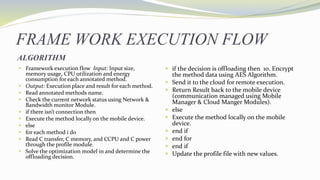
FRAME WORK EXECUTION FLOW
ALGORITHM
 Framework execution flow Input: Input size,
memory usage, CPU utilization and energy
consumption for each annotated method.
 Output: Execution place and result for each method.
 Read annotated methods name.
 Check the current network status using Network &
Bandwidth monitor Module.
 if there isn’t connection then
 Execute the method locally on the mobile device.
 else
 for each method i do
 Read C transfer, C memory, and CCPU and C power
through the profile module.
 Solve the optimization model in and determine the
offloading decision.
 if the decision is offloading then 10. Encrypt
the method data using AES Algorithm.
 Send it to the cloud for remote execution.
 Return Result back to the mobile device
(communication managed using Mobile
Manager & Cloud Manger Modules).
 else
 Execute the method locally on the mobile
device.
 end if
 end for
 end if
 Update the profile file with new values.
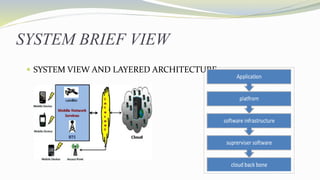
SYSTEM BRIEF VIEW
 SYSTEM VIEW AND LAYERED ARCHITECTURE
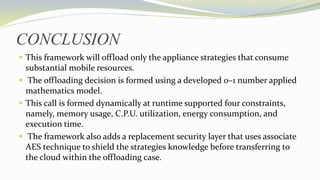
CONCLUSION
 This framework will offload only the appliance strategies that consume
substantial mobile resources.
 The offloading decision is formed using a developed 0–1 number applied
mathematics model.
 This call is formed dynamically at runtime supported four constraints,
namely, memory usage, C.P.U. utilization, energy consumption, and
execution time.
 The framework also adds a replacement security layer that uses associate
AES technique to shield the strategies knowledge before transferring to
the cloud within the offloading case.
Presented To:
Dr.S.Srinivasulu Rao Phd.,M.Tech

AN EFFICIENT AND SECURED FRAMEWORK FOR MOBILE CLOUD COMPUTING

  • 1.
    Chandu Veera Ramakrishna 16F91A05B0 PrakasamEngineering College,Kandukur.
  • 2.
    ABSTRACT  Cloud computingis a very useful solution to many individual users and organizations.  It can provide many services based on different needs and requirements.  However, there are many issues related to the user data that need to be addressed when using cloud computing.  Among the most important issues are: data ownership, data privacy, and storage.  In other words, more important data will be encrypted with more secure encryption algorithm and larger key sizes, while less important data might even not be encrypted.  The results of applying the proposed framework show improvement and efficiency over other existing frameworks.
  • 3.
    INTRODUCTION  An Efficientand Secured Framework for Mobile Cloud Computing Smartphones provide a wide range of applications, such as face detection, augmented reality, image and video processing, and video gaming and speech recognition.  These applications are complex and there is an increasing demand for computing resources.  Despite advances in smartphones, however, the extent of battery life remained one of the main challenges in improving computational requirements through battery upgrading.
  • 4.
    FEATURES  The frameworkalso adds a new security layer, which in the off-607 loading case uses an AES technique to protect the data methods before transferring to the cloud.
  • 5.
    Frame work architectureand content  The framework design consists of six modules, namely, estimator, profile, network and bandwidth monitor, decision maker, mobile manager, and cloud manager.  First, the framework works at the method level, wherever the developers have to be compelled to add AN annotation (Remote) specifically intensive strategy at the developing step.  These strategies should need further computation and might be offloaded to the cloud for remote execution. These strategies should not  a) depend upon the user interface or  b) use any I/O mobile device like GPS, camera, or measuring device.
  • 6.
    FRAME WORK MODULES 1. Estimator  The estimator module is responsible for identifying these strategies for native execution on the mobile device and remote execution on the cloud with totally different input sizes at the installation step.  Then, the module obtains the values of execution time, memory usage, CPU utilization, and energy consumption for every annotated technique for these totally different input sizes  Finally, the values are communicated and sent to the profile module.
  • 7.
    FRAME WORK MODULE 2.Profile  The profile module obtains the values of execution time, memory usage, CPU utilization, and energy consumption from figurer module for every annotated technique.  Then, the module creates a brand new file for every technique and stores these values into the file.  These files are updated when every running method and utilized by the decision maker module as a history-based go into the offloading decision.
  • 8.
    FRAME WORK MODULE 3. Network and Bandwidth Monitor  This module only monitors this standing of the network and gathers cell connection state and its information measure, Wi-Fi association state and its information measure, and signal strength of cell and Wi-Fi connection.  Then, this data is shipped to {the call ,the choice} maker module to support the determination the offloading decision.
  • 9.
    FRAME WORK MODULE 4. Decision Maker  The choice build, that is, the core module of the planned framework, contains associate whole number linear programming model and decision-making rule that predicts at runtime wherever the annotated strategies are executed.  The goal of the model is to search out associate application partitioning strategy that minimizes the energy consumption, transfer knowledge, memory usage, and electronic equipment utilization, in smartphones, subject to bound constraints.
  • 10.
    FRAME WORK MODULES 5. Mobile Manager  The mobile manager module is responsible for causing a computer file containing the method code and its needed libraries at the installation step.  The mobile manager handles the execution of the method supported the model decision.  If the tactic is dead regionally on the mobile device, the files are updated with new values through the profile module.  AES technique and communicates with the cloud manager module to transfer this knowledge with the method name.  Finally, the mobile manager receives and delivers the results to the appliance.
  • 11.
    FRAME WORK MODULE 6. Cloud Manager  The cloud manager module is that the solely module deployed on the cloud side.  This module is written strictly in Java.  Therefore, any application will take pleasure in the projected framework to offload its computation to any resource that runs the Java Virtual Machine (JVM).  Communication between the cloud manager and also the mobile manager modules is managed by wading bird communication middleware within the 1st communication.  Then, the cloud manager receives the ways data and decrypts them within the following run.  Then, the manager executes the tactic remotely and sends the result back to the mobile manager module with the new values to be updated by the profile module.
  • 12.
    FRAME WORK EXECUTIONFLOW ALGORITHM  Framework execution flow Input: Input size, memory usage, CPU utilization and energy consumption for each annotated method.  Output: Execution place and result for each method.  Read annotated methods name.  Check the current network status using Network & Bandwidth monitor Module.  if there isn’t connection then  Execute the method locally on the mobile device.  else  for each method i do  Read C transfer, C memory, and CCPU and C power through the profile module.  Solve the optimization model in and determine the offloading decision.  if the decision is offloading then 10. Encrypt the method data using AES Algorithm.  Send it to the cloud for remote execution.  Return Result back to the mobile device (communication managed using Mobile Manager & Cloud Manger Modules).  else  Execute the method locally on the mobile device.  end if  end for  end if  Update the profile file with new values.
  • 13.
    SYSTEM BRIEF VIEW SYSTEM VIEW AND LAYERED ARCHITECTURE
  • 14.
    CONCLUSION  This frameworkwill offload only the appliance strategies that consume substantial mobile resources.  The offloading decision is formed using a developed 0–1 number applied mathematics model.  This call is formed dynamically at runtime supported four constraints, namely, memory usage, C.P.U. utilization, energy consumption, and execution time.  The framework also adds a replacement security layer that uses associate AES technique to shield the strategies knowledge before transferring to the cloud within the offloading case.
  • 15.